Original publication
Original title: 潜能开发密训
Author: Chen Hongzhen (陈洪震)
Publication year: 2020
Original language: Chinese
Source file MD5:fac3775f9de25592ea15a5e9d8397bf8
This is an English translation of a Chinese training manual (潜能开发强化训练) by Chen Hongzhen, a high school teacher who researched eyeless sight methods since 2008. It covers ESP game training, blindfolded reading, wave speed reading, photographic memory, and “inspired learning” techniques. The book is aimed at potential development instructors and parents, discussing both practical training methods and the philosophy of turning these abilities into educational outcomes.
Author: Chen Hongzhen
Publisher: China United Culture Press CHINAUNITEDCULTUREPRESS
Address: FLATF,5/F.,BLK3,BOTANAVILLA,138FUKHANGTSUENROAD,TUENMUN,N.T.
Executive Editor: Song Yanli Layout Design: Xiao Yu
Format: 1/16
Print Sheets: 28
Word Count: 450 thousand words
Edition: 1st Edition, May 2020
Printing: 1st Printing, May 2020
Quantity: 1-1000 copies
Printer: Beijing Huaxi Printing Co., Ltd.
ISBN: 978-988-79628-6-1
Price: 796.00 Yuan
Preface
In the past decade, courses named after midbrain development, right brain development, and whole brain development, with training subjects such as extrasensory perception (ESP), wave speed reading, photographic memory, and inspired writing, have developed like a spark starting a prairie fire. Finally, around 2016, they began to blossom everywhere across the country with irresistible force. When parents of primary and middle school students see these incredible courses launched by many educational tutoring institutions, they fear their children will miss the opportunity to become successful, worry their children will be surpassed by others, but also hesitate at the high prices. Some parents treat these courses as first-class tickets for their children to go straight to the destination of their successful dreams, or as a life-saving straw to save their children’s studies. All of this is both ridiculous and deeply distressing.
I am an ordinary high school teacher, and like most people, I am curious about special functions such as blindfolded reading, remote viewing, clairvoyance, and precognition. Starting in 2008, I began researching methods to induce children’s extrasensory perception abilities in my spare time. Soon, I was able to help children achieve the ability to distinguish colors and read characters while blindfolded with a high success rate. However, I did not immerse myself in researching the authenticity of these phenomena. Instead, I have been thinking about what impact having this ability will have on a child’s growth and how it will help their education. I follow universal values and outlooks on life more closely, hoping that children can possess more scientific knowledge and skills, hoping that children can get into good universities, and hoping that more children can contribute greater strength to the construction of socialism with Chinese characteristics by improving their comprehensive literacy. I really do not want children, parents, and society to focus only on these so-called “miraculous powers” phenomena, because these “miraculous powers” will not change a child’s destiny. Therefore, I summarized my years of research experience and compiled the “Right Brain Development Training Manual” in 2016, publicly disclosing the training methods for ESP (Extrasensory Perception) such as blindfolded color discrimination and blindfolded reading. I hope that through my humble efforts, more people can understand right brain/whole brain development, and that bewildered instructors can have a training handle.
Technically speaking, enabling children to achieve functions such as so-called blindfolded reading and wave speed reading is not complicated. Because these abilities look too magical, many business people have packaged them and pushed them to the market as educational products. There is no lack of rapid dissemination of these extrasensory ability developments through technology transfer, franchising, and other forms. However, most institutions just blindly joined without obtaining the actual results they wanted, so many institutions, like many parents of children who have taken these courses, are like headless flies, unable to find direction and not knowing where to go. The development of extrasensory functions like blindfolded reading is indeed very easy for young children to achieve, and it can even be said to be an innate human instinct. The induction of these abilities only requires the instructor to have enough confidence and patience, the courage to practice, and the child’s absolute belief; almost all school-age children can be trained to achieve them. Not long after parents see their children possessing these incredible abilities, they often quickly sober up and hope to see changes in their children’s lives and studies. Instructors must clarify what the purpose of ESP training (potential development, right brain development, whole brain development) is, and this purpose must be rooted in the bottom of their hearts, reminding themselves at all times.
In medical physiology, the development of brain science may be the most difficult discipline to break through. Because much of the so-called “physiology” is actually studied on the basis of dissecting corpses. Fortunately, with the rapid development of information technology, functional magnetic resonance imaging (fMRI) can obtain images of brain activity, thereby gradually allowing people to judge which different behaviors are related to which areas of the cerebral cortex based on active areas. This technology has greatly promoted scientific and medical research, identifying the cerebral cortex functional areas related to diseases from children’s dyslexia to Alzheimer’s disease. Current brain science research still cannot explain human special ability phenomena such as ESP extrasensory perception and psychokinesis (PK). Due to the influence of traditional brain science cognition, some knowledge in this book is not rigorous; regarding incorrect expressions, please criticize and correct them. Before neuroscience, the so-called right brain theory and midbrain theory were quickly overturned. Neuro-education asserts that the neural activity of the brain is a whole. From this angle, the education of ESP and all ability developments should also be called whole brain education. To unify the terminology, this book refers to the development of all seemingly magical functions promoted under various names such as right brain development, midbrain development, and whole brain development as potential development (meaning latent functions). Arguing about the truth or falsity of special functions is of little significance; it can be treated as a performance show, otherwise, one should solidly conduct scientific research. Therefore, this book refers to people with special functions as “Vajra Experts”.
It is estimated that by the end of 2019, there were already tens of thousands of institutions nationwide doing potential development work, with over 100,000 participants. Potential development education presents a myriad of forms; educational training institutions and practitioners have their own different purposes and various confusions. Whether practitioners or parents, most do not know where the direction lies, and what the ultimate harvest will be.
Blindfolded reading, wave speed reading, photographic memory, and other trainings are just educational tools. It is hard to say whether they can improve academic performance. Improving academic performance is a series of complex psychological and behavioral activities, influenced by many factors, and individual psychological characteristics vary widely. It is impossible to use a single tool to easily change or achieve a certain result. A tool is a means to reach, complete, or promote something. Potential development is to enhance children’s self-confidence, imagination, concentration, and other abilities. Through training, the improvement of these abilities can definitely be achieved. However, in the eyes of most parents, ability is an invisible thing; they prefer to see changes in their children’s academic performance, which requires the transformation of ability. Many tutoring institutions and research institutions are not clear on how to complete the transformation of ability into academic performance.
The core of this book is to develop human potential, both in breadth and depth, allowing potential development practitioners to broaden their horizons and enlarge their pattern, to truly understand and recognize potential, and not just potential in terms of functions. It links developing potential with cultivating an excellent person, raising a child to become a successful person. This book explains in detail the techniques and related theories of various potential development technologies. It not only includes blindfolded reading, wave speed reading, photographic memory, etc., but also reveals one by one the methods for functions achieved by “Vajra Experts” such as psychokinetic object breaking, telepathic thought transmission, psychokinetic photography, fetching medicine from the air, shaking pills, and bean sprouting. The inspired learning method is a sublimation of potential development education. It is the development of “spirituality” based on the “Five Educations” (moral, intellectual, physical, aesthetic, and labor), allowing students not only to be smart but, more importantly, to possess “spiritual aura.” This is the first time the secret of the “Tao’s Inspired Learning Method” is being published to the public.
Education is not accomplished overnight; it is impossible to make a child a dragon or a phoenix with just a few methods. What is education? The past and present of potential development? What is the essence of potential development? What is the purpose of potential development? How to cultivate an excellent potential development instructor? Where is potential training going? These questions are issues I have frequently exchanged with tutoring institutions, parents, and potential development research enthusiasts in seminars, workshops, and instructor training courses over the past few years. I hope more people can understand these, take fewer detours, and uncover the mysteries of human potential as soon as possible. Therefore, I have compiled my lecture notes and thinking results from recent years into a book, hoping to give more people some inspiration and thinking, making potential development education more meaningful and efficient, and allowing more people to research potential development to bring more value to society.
To understand the content described in the text more intuitively and clearly, I selected a portion of suitable videos from thousands of videos and attached the links in the text. Readers can use their mobile phones to scan the QR codes to watch. Due to various reasons, some technologies are temporarily not suitable for public disclosure, and some sensitive content is not mentioned in the book. I have only selected technologies publicly published by predecessors in human science research to dedicate to potential development enthusiasts.
Table of Contents
- Chapter 1: YOUR Natural Potential
- 1.1 Excellent Qualities of Successful People
- 1.2 Who Possesses These Qualities and Potential 3
- 1.3 What Causes Human Potential to be Hidden 5
- 1.4 The Secret of the Midbrain… 10
- Chapter 2 ESP Game Training 13
- 2.1 The Magic Light· 13
- 2.2 What is the Pineal Gland? 15
- 2.3 Yellow Card Training… 22
- 2.4 Activating the Pineal Gland· 25
- 2.5 Blindfolded Color Identification. 29
- 2.6 Blindfolded Reading… 37
- 2.7 Follow-up Training for “Superpowered Children” 40
- 2.8 Where is it Seen? 44
- 2.9 Adults Also Want to be Supermen… 50
- 2.10 The Children are Peeking 56
- Chapter 3 Energy Supplementation 62
- 3.1 Energy Decides Everything 62
- 3.2 Light …71
- 3.3 Sound Gate Methods and Alpha Wave Music 75
- 3.4 Magnetic Fields, Qigong, and Meditation 79
- 3.5 Self-Confidence and Emotions 86
- 3.6 Meditation… 94
- 3.7 Mind Power and the Subconscious 101
- 3.8 Love 108
- 3.9 Energy Implantation 113
- 3.10 Will it Harm the Body? 118
- Chapter 4 The Origin and Development of Blindfolded Reading 125
- 4.1 “Supernatural Powers” in Buddhism, Taoism, and Qigong 125
- 4.2 The Beginning of Potential Development 130
- 4.3 The Development of Potential Development 134
- 4.4 From Right Brain Development to Whole Brain Development 138
- Chapter 5 The Essence of Potential Development 145
- 5.1 Samatha-Vipassana (Stopping and Seeing) Methods, “Light Balls”, and “Brain Screens” 145
- 5.2 The Essence of Potential Development 150
- 5.3 Advanced Development Techniques? 157
- 5.4 Everyone Possesses 3.6 Billion Years of Wisdom 163
- Chapter 6 The Purpose and Significance of ESP Games 170
- 6.1 Life Awakening 170
- 6.2 Self-Confidence 178
- 6.3 Concentration 182
- 6.4 Imagination 185
- Chapter 7 Qualities of Excellent Instructors 193
- 7.1 Basic Scientific Literacy — Psychology and Brain Science 193
- 7.1.1 Psychology is Also Magical 193
- 7.1.2 Multiple Intelligences to Understand in Whole Brain Education 197
- 7.1.3 Basics of Brain Science 202
- 7.1.4 Meditation Reshapes the Brain 212
- 7.1.5 Accepting All Phenomena in Potential Development Teaching 214
- 7.2 Seeing Through Surface Phenomena — “Peeling the Onion” 216
- 7.3 Overlapping Techniques — Hypnosis and Suggestion 220
- 7.3.1 Hypnosis and Suggestion 220
- 7.3.2 Automatic Writing 222
- 7.3.3 Borrowing Hypnotic Techniques 224
- 7.4 The Winning Weapon — Establishing a Channel for Open Relationships 226
- 7.5 A Life Essential Course — “Conscience” (Zhi Liangzhi) 232
- 7.1 Basic Scientific Literacy — Psychology and Brain Science 193
- Chapter 8 Potential Development Oriented Towards Improving Academic Performance 239
- 8.1 Principles and Stances for Improving Grades 239
- 8.2 The Mind Method for Improving Grades… 245
- 8.3 The Strongest Brain — Technical Whole Brain Development 252
- 8.3.1 Rapid Memory Method 253
- 8.3.2 Speed Reading 257
- 8.3.3 Mind Mapping 258
- 8.3.4 The Strongest Brain is Not Necessarily a Genius 260
- 8.4 A Mirror of Multi-Dimensional Space-Time — Photographic Memory 262
- 8.5 Can Also Be a “Transformer” 270
- 8.6 Information from the Sky: Wave Speed Reading 275
- 8.7 The Naked Eye Sees Wave Speed Reading… 283
- Chapter 9 Potential Development Oriented Towards Functional Research 285
- 9.1 Selected Examples of “Diamond Masters” 285
- 9.1.1 The “Superpower” CEO — Zheng Xiangling 285
- 9.1.2 The Xinjiang Wonder — Emil Imiti 288
- 9.1.3 The Pioneer of Potential Development — Liang Guangxiang 290
- 9.1.4 The “Diamond Master” Queen — Sun Chulin 293
- 9.2 How Did They Do It? 296
- 9.2.1 Telepathy 298
- 9.2.2 Sticking Coins 299
- 9.2.3 Acupoint Magnetic Effect Experiment 300
- 9.2.4 Thoughtography 301
- 9.2.5 Healing and Curing 302
- 9.2.6 Bending Metal with Mind Power 302
- 9.2.7 Unlocking with Mind Power 303
- 9.2.8 Punching Holes in Coins 304
- 9.2.9 Fetching Medicine from Thin Air 305
- 9.2.10 Teleportation (Breaking Spatial Barriers) 305
- 9.2.11 Penetrating Walls with Mind Power (Shaking Pills) 306
- 9.2.12 Earthquake Prediction 306
- 9.2.13 Bean Sprouting and Re-sprouting 308
- 9.2.14 Green Apples Turning Red 309
- 9.2.15 Prospecting for Minerals and Oil 310
- 9.2.16 Several Key Points 311
- 9.3 Starting with Finger Reading and “Brain Screen” Imaging 312
- 9.3.1 Finger Reading is Not Blindfolded Reading 312
- 9.3.2 Training from Finger Reading (ESP) to Psychokinesis (PK) 314
- 9.3.3 Character Recognition by “Diamond Masters” 322
- 9.3.4 “Brain Screen” Imaging is Key 325
- 9.4 How to View the “Diamond Master” Phenomenon 330
- 9.4.1 “Diamond Masters” Cannot Change the World 330
- 9.4.2 Possessing Powers Cannot Change Fate 333
- 9.4.3 From the Debate on Authenticity to Reappearance in the World 335
- 9.4.4 Believers Always Believe, Non-Believers Always Doubt 343
- 9.5 Related Foreign Research 348
- 9.1 Selected Examples of “Diamond Masters” 285
- Chapter 10 Potential Development Oriented Towards Spiritual High-Dimensional Wisdom 355
- 10.1 Spirituality and High-Dimensional Wisdom 355
- 10.2 Tao Yongdi and the Inspiration Learning Method 359
- 10.3 Success Stories of Tao’s Inspiration Learning Method 361
- 10.4 Basic Principles of the Inspiration Learning Method 365
- 10.5 Basic Training Process and Content of the Inspiration Learning Method 368
- 10.5.1 Opening Wisdom 368
- 10.5.2 Poetry Training and Writing 375
- 10.5.3 Brainstorming and Energy Enhancement 378
- 10.5.4 Tao’s Inspiration Learning Method Improvement Strategies 381
- 10.6 Reflections on Tao’s Inspiration Learning Method 385
- Chapter 11 How Should Potential Development Education… 392
- 11.1 What is Education 392
- 11.2 Industry Positioning of Potential Development Institutions 399
- 11.3 Seek the Way, Not Food 405
- 11.3.1 Business Like Flowing Water 405
- 11.3.2 Techniques That Can Be Copied in Minutes 406
- 11.3.3 Heart-Wrenching Media Reports 409
- 11.3.4 The Law of Attraction 411
- 11.4 Successful Operational Models for Potential Development Education 415
- 11.5 Making People Mature is an Important Task of Education 417
- Appendix A Brief Analysis of Healing Myopia in Adolescents and Children via Internal Vision and External Qi 421
Chapter 1: YOUR Natural Potential
Although everyone has different standards and definitions for the word “success,” almost everyone hopes that they or their children will become successful people. In the eyes of many, successful people are looked up to like high mountains, unreachable in the hearts of ordinary people. In reality, everyone is born with the same potential and qualities as successful people, and naturally possesses various kinds of magical abilities; it is just that these abilities and qualities have been hidden away as age increases.
1.1 Excellent Qualities of Successful People
Everyone can understand the saying “Dreams are the driving force and source of reality.” Dreams are something very important in life. Because dreams give us hope, dreams keep us full of imagination and creativity. Therefore, adults often ask children, what is your dream? Or what do you want to be when you grow up? I would like to ask everyone, what do you think a child should do when they grow up to make you feel satisfied? Perhaps everyone hasn’t really thought seriously about this question. Children might want to become doctors, teachers, judges, police officers, scientists, astronauts, etc., or some children might want to become excavator drivers, chefs, couriers, or even some children might just say they want to be workers. At this moment, parents mostly make a judgment in their hearts about which jobs are good and which are bad. Actually, I believe everyone is willing to let their child become a certain kind of person. No matter what the profession is, as long as their own child becomes this kind of person, every parent will be satisfied. This is what we often call “successful people.”
The halo of a “successful person” can mask people’s judgment of their profession, attention to their knowledge, and discussion of their abilities. It is simply because this person has “succeeded” and appears to have “become a dragon or phoenix” (achieved greatness), which is people’s expectation for their children. Everyone can think about it, what qualities does a successful person possess? Nowadays, inspirational stories of successful people are within easy reach, and they are overwhelming on mobile phones and the internet. People are almost surrounded by “successology” every day. Perhaps many people are paying attention to the anecdotes and past events of these people, focusing on the achievements they have made, and focusing on what they have said. But how many parents truly look beyond the specific imitation of “doing things” in these stories to think about the qualities, character, and habits these people truly possess, thereby influencing their children with these qualities? The figure below lists the keywords of the excellent qualities common to successful people that I have summarized from dozens of articles (see Figure: Excellent Qualities of Successful People) for your reference.
I think most parents, when raising their own children, focus more on questions like what the child is learning and how to improve their grades. Is it really true that the more knowledge one has, the more useful it is? From this list of excellent qualities common to successful people, I don’t see that having a lot of knowledge is a mandatory item. What I see more is that mindset, character, habits, and thinking determine whether a person can succeed.
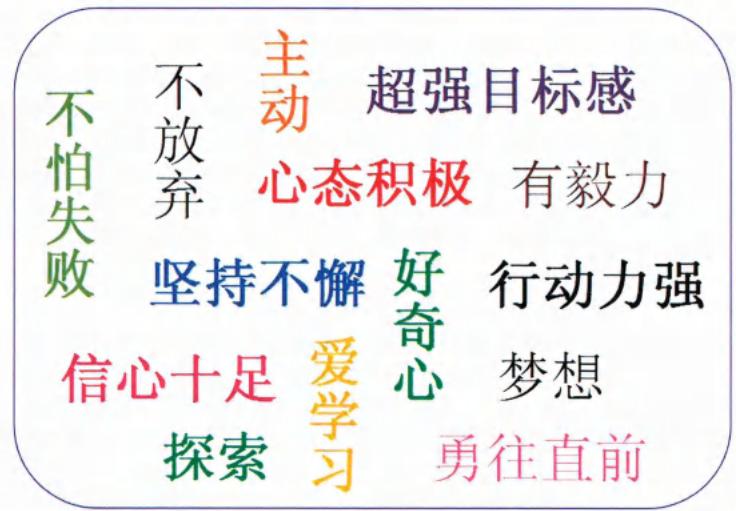
Excellent Qualities of Successful People
The first generation of leaders of New China were almost all military commanders. Before the founding of New China, they won one battle after another, proving that their military talents were very strong. They laid down their guns and immediately threw themselves into the construction of New China, managing the economy, diplomacy, and development. They used 30 years to lay a solid foundation for all aspects of China. They became politicians, economists, and diplomats, right?
Everyone must be very familiar with the famous CCTV host Sa Beining. Do you think he counts as a successful person? He is witty, agile, lively, and sunny, and many people like his hosting style. Everyone knows that he graduated from the Law School of Peking University and first hosted legal programs on CCTV. Now, our impression might be that there is no program he cannot host. Think about it, based on our feeling of him, does he possess all the excellent qualities common to successful people?
Jack Ma is a businessman admired by many people. He started as a foreign language teacher, didn’t understand computers, didn’t understand the internet, and hadn’t studied finance. But he founded Alibaba, Taobao, and Alipay, becoming one of the richest people in China. Read Jack Ma’s story and see which of the excellent qualities common to successful people he possesses?
Yuan Longping, who is now nearly 90 years old, is familiar to many children through the eighth-grade Chinese text “Father of Hybrid Rice.” He is often soaking in the rice fields, with dark skin and wearing a straw hat, looking just like a native old farmer. But he is one of the most accomplished modern scientists in China. Does this great scientist possess the excellent qualities common to successful people?
These three people have all achieved tremendous success in their current work. Suppose they suddenly decided to change their current careers and developed an interest in new things tomorrow: Sa Beining wants to be a doctor, Jack Ma wants to be a teacher, and Yuan Longping wants to be a government official. How do you think they would do in their new careers? Even though they might not know any of the knowledge or skills required for the new jobs yet, when they decide to do the new work, can they still do it very well? I think the answer is definitely yes. It is not the knowledge and technology they possess that determine their success, but their “success qualities.”
1.2 Who Possesses These Qualities and Potential
The answer is obvious. The magnitude of a person’s achievements and the degree of their happiness do not depend on superficial things like how much wealth, knowledge, and skills a person possesses, but are certainly determined by their inner mindset, character, habits, and way of thinking. However, when raising their children, our parents often focus on those external and superficial things, while neglecting their inner qualities. Are those who possess these qualities a minority in society? Exactly who possesses such qualities, and how do we cultivate these qualities in our children? Before answering this question, everyone can first watch the video “YOU Talent Potential”.
Below is an excerpt of the narration from the video. Please pay attention to the underlined text sections:
You have some very cute personalities from the infant to the toddler stage. In your eyes, everything is so interesting and so worth exploring. Almost nothing can discourage you; you are very curious and want to know why all day long. No matter how you look at it, the world is so beautiful to you, and most importantly, you are full of enthusiasm and enjoy everything you do. Nothing makes you feel bored, not even the simplest idea, or even a piece of paper. If you want something, you go forward bravely. You never thought about why you couldn’t do some things or why you couldn’t reach your goals; you are always so positive and enterprising. You don’t know what pessimism, boredom, or cynicism are. Of course, you occasionally fall, but you can get up again quickly. You understand that as long as you keep trying, you won’t fail. Hey, what’s that? Oh, it’s the big dog from the backyard walking in. There is no reason to suspect it has bad intentions, no reason to fear those unknown things; no one taught you these things. That’s just how it is; how can there be gains without taking risks? There must be some mystery to this. Yes, you were indeed a bit different when you were young; you were full of curiosity and wanted to learn everything. You say, “Of course, babies are like this. Babies have no responsibilities, no fantasies are bad, and nothing kills their love.” You are wrong to say this. In fact, these precious childlike hearts are still hidden in your heart, waiting for the right time. Unrestrained motivation, curiosity, the spirit of brave exploration and change, the ability to get up after falling—everything still exists. The problem only lies with yourself. Think about it yourself: do you want to rekindle the excellent qualities you once displayed when you were young?
YOU Talent Potential
Everyone can compare the keywords of the excellent qualities possessed by the successful people mentioned earlier and see what you find?
Yes, it turns out that babies possess all these excellent qualities that successful people have. This is what Buddhism calls “All sentient beings possess the wisdom and virtues of the Tathagata.” Some people may still not be convinced, feeling that despite this, why does their child not seem to be like this? They are not focused, have poor memory, their grades just won’t go up, and they have all kinds of problems. Is my child naturally incapable? I say, no. Every child was a genius at learning when they were young, possessing super strong memory and learning ability. If you don’t believe it, please carefully watch the CCTV1 2010 Issue 18 program “Zhuangyuan 360: We Have a Set — The Magical Nanny”.
I believe many people feel the same way I do after watching this video: Wow! So little children are actually so incredible, so amazing! I watched this video too late; my child is already older. Can it still be done?
The jaw-dropping flag recognition, dot cards, and word card training in the video all belong to flash card training, which is suitable for infants under 5 or 6 years old. This training method was first used by Glenn Doman from the United States, so it is called Doman Flash Cards. Later, Shichida Makoto’s kindergarten education also used similar flash cards as training tools. This method uses a flashing technique to quickly convey information to the baby to stimulate the relevant neural pathways in the infant’s brain, thereby laying a better foundation for the development of the child’s brain. So why is flash card training suitable for infants under 5 or 6 years old? According to right-brain theory, the human brain develops the right brain first, starting from the fetal stage and continuing until 3 years old. From 3 to 6 years old is the transition period from the right brain to the left brain. Starting from 6 years old, the child enters the left-brain era. At this time, the right brain functions that the toddler possessed gradually disappear.
What gives children the incredible abilities in the video is the five special abilities of the right brain proposed by right-brain experts.
First, Extra Sensory Perception (ESP), commonly known as intuition, the sixth sense, etc., belongs to this ability.
Second, Instant Imaging Ability, which is the ability to perform image memory instantly upon seeing or hearing something.
Third, Rapid Calculation Ability. This ability can make a person perform outstandingly in arithmetic calculations.
Fourth, Absolute Pitch. Absolute pitch ability refers to the ability to remember any sound as long as one has heard it. Once possessing this ability, the heard melody is saved in memory, which is also the reason why people are very sensitive to sounds heard frequently during the fetal period.
Fifth, Right Brain Language Learning Ability. Many people think language is learned with the left brain, but in infants under six years old, while using the left brain, they can also use the right brain to learn language. Compared with adults who mainly use left-brain language learning, the two are completely different.
Japanese child educator Shichida Makoto basically holds this right-brain theory. Perhaps it is not necessarily completely correct, but it is undeniable that the thinking patterns of toddlers and adults are completely different. The genius abilities displayed by the infants and toddlers in the “Magical Nanny” video are even more unattainable for adults.
There is another reason why older children cannot undergo flash card training: in psychology, there is the concept of sensitive periods in child growth. Once the sensitive period is missed, the development speed is relatively slow, and learning certain knowledge and skills may also be relatively difficult. The sensitive period is proposed relative to the critical period. It is generally believed that in the development of child psychology, some aspects cannot be made up for once the timing is missed, that is, there exists a critical period. However, in more aspects, it is not absolutely impossible to remedy; it just requires more effort to make up for it after the timing is missed. Knowledge regarding sensitive periods and critical periods in psychology is still very important for counselors and parents. It is suggested that friends learn more about the relevant content.
1.3 What Causes Human Potential to Be Hidden
Let us return to the previous topic. We watched the video “YOU: Talent and Potential,” and we know that every one of us possessed the excellent qualities of successful people when we were young. Of course, we also possessed the super learning abilities of toddlers in “The Super Nanny.” So, what caused those qualities and abilities to be lost or hidden? Is it simply inevitable that this happens as we age? There is another video I hope everyone will watch carefully, “The Scores Children Give Their Mothers.” This video is very short, only two and a half minutes; if necessary, you can watch it a few times. After watching this video, everyone needs to think about this question: What causes children to slowly hide their various excellent potentials?
After watching this video, many parents, especially mothers, will be deeply touched. In the video, the mothers give their children scores of 9, 8, 7, or 5, while the children give their mothers scores of 10, or even 10,000. In the children’s eyes, the world is so beautiful; Mom is naturally the best, too. They are full of enthusiasm in everything they do and enjoy it; nothing makes them feel bored. But what about the mothers? In the eyes of parents, the children have all kinds of faults and bad habits. These faults and bad habits give the mothers headaches, so they constantly judge and keep scoring the children. The few points missing from the score you give your child are exactly your focus. The child will always exhibit this or that problem similar to what you focus on. Therefore, as long as you constantly judge your child’s behavior, the child’s potential and the excellent qualities they had at birth will become fewer and fewer, buried deeper and deeper. Children’s super abilities and excellent qualities are lost bit by bit amidst the self-righteous judgments of adults. Put yourself in their shoes: if you watched the scores others gave you every day and they were never perfect, what kind of values would you form? Consequently, children will use their subconscious minds to hide the excellent qualities they possess by nature, bit by bit. When a child is judged for wiping their mouth with their sleeve, they confirm they are an unhygienic child; when a child refuses to eat or eat green vegetables and is judged, they believe they are a picky eater; when a child doesn’t listen to adults and the adults get angry, the child begins to believe they are an unwelcome person. From this moment on, perhaps it becomes difficult for the child to achieve great things, as the saying goes: “All sentient beings possess the wisdom and virtues of the Tathagata, but are unable to attain them due to delusional attachments and obsessions.” As we grow up, we also hide our potential, creating many rules and regulations that lock us up; potential is locked away by concepts.
The Scores Children Give Their Mothers
There is a story called “The Nine-Cow Person.” Let us take a look at this story.
In a certain village in ancient Greece, there were two brothers, Kaka and Gugu. They had reached marriageable age but had not yet found the girls of their dreams. Kaka and Gugu decided to sail their small boat to embark on a “Wife Hunting” journey. They rowed and rowed for eighty-one days, visiting forty-nine islands, but still did not find the wives they envisioned. Either the unmarried women didn’t fancy them, or the women they liked were already married. Just when they were about to despair, they arrived at a small island. As their small boat approached the shore, Kaka’s eyes suddenly lit up: Isn’t that woman picking seashells exactly the other half he was looking for?!
He pointed her out to Gugu, but Gugu shook his head. “Hey, her appearance and temperament are too ordinary.” But Kaka was adamant; she was the woman he was looking for!
So, Gugu accompanied Kaka to the island to ask about local marriage customs. The locals told him that for a man to propose to a woman, he must use cows as a betrothal gift. The number of cows represented the woman’s value in the man’s heart. An ordinary girl only required one or two cows; a virtuous and beautiful girl required more cows, that is, four or five. The maximum was nine cows. Such a girl was very excellent and extremely rare; no one here had ever given nine cows.
Kaka did a quick calculation and bought nine cows in one go. After making all the preparations, he chose an auspicious day and grandly drove the herd of cows to propose marriage.
“Bang, bang, bang…” He knocked for a long time without anyone answering. Kaka continued knocking. After a long while, finally, an old man came to open the door.
The old man was startled to see so many cows. Leaning on the doorframe, he asked in surprise, “Young man, what can I do for you?”
Kaka said, “Old man, I have taken a liking to your daughter. I have driven these cows here to propose marriage.”
The old man shook his head and said, “You don’t need to drive so many cows to propose. My daughter is just an ordinary girl; two cows at most are enough. If you send so many cows and I accept them, the neighbors will laugh at me and say I am greedy.”
Kaka said, “No, old man, I believe your daughter is the most beautiful and best girl in the world. I think she is worth nine cows. Please, you must accept them.”
The old man declined repeatedly but eventually had to accept the nine cows.
After drinking Kaka’s wedding wine, Gugu sailed away to continue his search for a wife…
Time passed quickly. In the blink of an eye, two years had passed. Gugu, having not yet found his ideal wife, returned to this small island after searching here and there. He wanted to see how Kaka’s newlywed life was going and whether he was living happily with his wife. Suddenly, Gugu thought, were his own standards too high? If he had married an ordinary girl like Kaka, perhaps he would have children now and be living a happy life. Just as he was sighing, the small boat reached the shore. Gugu docked the boat by the island and went ashore to ask about Kaka.
When he walked into the market, his eyes suddenly lit up. A beautiful, elegant woman was standing right in front of him. Gugu was stunned for a long time, unable to snap out of it. The woman he had painstakingly searched for for two years was actually on this island! Just as he was staring spellbound, the woman slowly walked towards him and nodded to him very politely. He tried to stay calm, cleared his throat, and asked politely, “Do you know where Kaka lives, the man who came here two years ago and married a local girl?” The woman said, “Follow me.”
Gugu followed her for a long way, arriving at the place where he had accompanied Kaka to propose two years ago, but there were big changes here. Next to the old man’s house, a very beautiful new house had been built, and a little girl about two years old was playing in front of the door…
“Mommy is back!” The little girl saw the beautiful woman, shouted, and ran over, hugging the woman’s leg. Gugu immediately felt a pang of sadness: No way, the ideal woman he searched for so long actually already had such a big daughter.
Before Gugu could react, a pair of hands pulled him over. Gugu looked up and saw it was Kaka, whom he hadn’t seen for two years. The two brothers were obviously very excited and chatted about their respective lives over the past two years.
After chatting for a while, Kaka asked, “How did you find me?” Gugu smiled and said, “A beautiful, elegant woman brought me here.” Before he could finish speaking, the woman brought the tea over and said, “Have some tea, brother-in-law.”
“This is your sister-in-law,” Kaka said, “the woman picking seashells by the sea that we saw two years ago.” Gugu’s eyes widened, full of doubt. He could not connect the woman from two years ago with the sister-in-law before him; the change was too great.
The woman seemed to see Gugu’s thoughts and said to him, “I always thought I was just an ordinary woman and always hoped that one day a gentleman would come to my house with two cows to propose. But Kaka married me with nine cows. Since then, I realized I am a ‘Nine-Cow Person,’ and I started to demand of myself the standards of a ‘Nine-Cow Person,’ requiring myself to truly become a ‘Nine-Cow Person’ in every aspect.”
Affirmation and praise can stimulate infinite potential in people. The key to whether you can cultivate your child into a “Nine-Cow Person” is whether you are willing to view your child with the eye of someone discovering a “Nine-Cow Person.” I hope all children believe that to their parents, they are unique in this world! Parents can have a heart-to-heart talk with their children, then give them a good hug to pass on energy to the child. You must let the child feel it, and then do the test below together.
Make Your Fingers Longer
First, put your palms together. Make sure the bottoms of both hands are aligned. Compare your hands and fingers to see how big both hands are and how long the fingers are. Most people have two identical hands, though some may differ; either way is normal. Throughout the entire process below, only make sounds when you are asked to speak; otherwise, please remain silent.
Then, put down the hand you use most often, leaving the other, less frequently used hand. Look at this hand seriously and think about it. Think about why you have never paid attention to it. Is it because it doesn’t look good enough? Do you assume it isn’t as flexible as the other hand by nature? Feel it carefully; feel its temperature, feel the blood flowing through the hand. Look at it closely with your eyes; look at its delicate skin, look at every single skin line. Have you ever looked at it and paid attention to it this seriously?
Now, please say to it silently in your heart:
I’m sorry, I haven’t paid attention to you, made full use of you, or truly loved you.
Please forgive me for ignoring you, for not treating you as a strong person but as a weak one.
Thank you for your eternal companionship, your eternal support, and for never leaving me.
I love you, I love you, I love you.
Now, please say to it loudly and with your heart:
I’m sorry, please forgive me, thank you, I love you.
I’m sorry, please forgive me, thank you, I love you.
I’m sorry, please forgive me, thank you, I love you.
Now feel this hand again. Is this hand a bit warm? Is it a bit comfortable? Okay, regardless of how this hand feels right now, please let this hand cooperate with the following movements: Please stand up, stand straight, stretch this hand out, stretch it out completely straight, stretch your arm out straight too, pointing at the sky, hold your hand up high, pointing at the sky! Excellent!
Okay, excellent. Now I want you to focus all your attention on your fingers. Yes, very good. Next, I want you to use your maximum imagination. There is a force coming from your abdomen, passing through your arm, making your fingers become longer and longer. Yes! Use your maximum imagination to make your fingers become longer and longer! This force will also become greater and greater! Yes! Excellent! Put effort into it, excellent! Okay, now, 1 centimeter! 2 centimeters! 3 centimeters! 5 centimeters! Becoming longer and longer, good! Very, very good, yes, very good! Use your maximum imagination to make your fingers longer, longer and longer! 10 centimeters! 20 centimeters!
Okay, excellent. Now let’s bring the hand back, place it in front of the chest, and put palms together again. Compare the two hands. Has this hand become longer?
Say to this hand sincerely: Thank you, I love you!
The above is the guided script for the game of making fingers longer. It can serve as a test for the degree to which a subject accepts suggestion, and it can also be used to give people an intuitive understanding of the energy of the subconscious mind. It is also frequently used during hypnosis tests. This game appears on page 38 of the Right Brain Development Training Manual, along with a similar game “Hand Stuck to the Head”; they were included in the book as relaxation games. Children may largely find it very fun that their fingers suddenly become longer, or that their hand is stuck to their head and cannot be pulled down no matter what. Children have relatively simple thinking; as long as they can focus on this game, they can generally succeed, and the effect is quite good. When guiding children, it is only necessary to guide the part following “I’m sorry, please forgive me, thank you, I love you.” During this part of the guidance, the voice should be loud, use a commanding tone, be very crisp and certain in what you say, and also pay attention to constantly give full affirmation and encouragement to the movements of the person playing the game. The cleansing guidance part of “I’m sorry, please forgive me, thank you, I love you” can be applied to adults; first, allow adults to have a sufficient game prelude to achieve the best results. Of course, in some spiritual classes, the instructor may have people say “I love you” to one hand a hundred times with their heart, which may also achieve similar effects. If you use this game often, you will find that often people can make their fingers 1–2 centimeters longer, which is quite amazing.
In our concept, what a person looks like, their height, their appearance, and how long their legs are do not change with a person’s subjective consciousness. You can move your fingers, bend your waist, turn your head, or puff out your chest, but you absolutely cannot use your will to control and regulate things like vascular tension, pupil size, and whether sweat glands sweat or not—things that the autonomic nervous system (also known as the involuntary nervous system or vegetative nervous system) can do. The number of human brain nerve cells is estimated to be about 90 billion. When stimulated externally, brain nerve cells will sprout and grow into branches, which are what people call neurons. They combine with other brain cells and communicate with each other, promoting the development of the communication network, thus opening up information circuits. Scientists now generally believe that consciousness is produced when brain neurons are excited enough for a sufficient amount of time. However, under normal circumstances, more than 95% of human neurons are in an unused state. Psychologists believe that these 95% of neurons control the non-conscious mind, that is, the subconscious mind, and possess enormous energy. The subconscious mind was first proposed by Austrian psychologist Sigmund Freud in his “Psychoanalysis” theory. It refers to a mysterious force hidden beneath our general consciousness, a type of thought relative to “consciousness.” Later, some research enthusiasts also called it “right brain consciousness” or “universal consciousness,” while Shigeyoshi Haruyama, author of The Brain Revolution, called it the “ancestor brain.” The subconscious mind is the ability humans originally possess but have forgotten how to use. Some people call this ability “potential,” which means ability that exists but has not been developed and utilized; actually, these statements may not necessarily be correct. Chuan Wen, the author of the book Brain Imaging: Decoding the Information Codes that Control Life, has conducted many cases where teenagers retrieve information affecting their height and then change it, thereby allowing these teenagers to grow taller quickly. Chuan Wen does not fully agree with some of the aforementioned theories of “universal consciousness” and “ancestor brain,” but rather endorses Freud’s theory of the subconscious mind, believing that humans can regulate conscious information that they usually cannot perceive, thereby adjusting various functions of the human body, including the activation of switches for various potentials.
Through the game, we suddenly discovered today that our own hands can actually follow the commands of ourselves and the instructor, which is truly incredible. So, we really want to know, what other magical things will happen next?
1.4 The Secret of the Interbrain
Around 2013, I came across an episode of the program “The Secret of the Interbrain” on Taiwan’s Formosa News online. Before seeing this video, I only understood potential through articles on human science exploration and research, attempted to grasp its mysteries through simple Qigong, and made attempts by educating the children around me. This video actually gave me a very pleasant surprise after years of following potential development exploration, greatly boosting both my confidence and interest. This video made me realize that in Malaysia, Taiwan, and other places, not only are university professors researching “finger reading,” but folk education and training institutions are also treating it as a large-scale enterprise; I learned for the first time that they do not use the Qigong guidance methods common in our mainland, but rather rely on special audio; they have a relatively complete teaching process, placing great importance on warm-up sessions during instruction to create a more relaxed, safe, comfortable, and happy environment; most importantly, it made me value knowledge related to neuroscience, leading me to focus on the phenomenon of potential development from an educational and scientific perspective.
The Secret of the Interbrain
When this video is shown to friends who have never been exposed to extrasensory development, they seem to be utterly shocked, almost having their worldviews overturned. Some friends will pester me to develop their children, and I generally tell them that if a child’s grades improve because of this, it is due to what the video states: “their school grades have improved due to enhanced attention and comprehension,” and nothing else. This video convinces many people that extrasensory perception (ESP) and potential development are scientific. However, many related news reports or special programs on potential development broadcast by local TV stations in various provinces and cities during the same period were almost all classified as “pseudoscience,” rather than truly and objectively allowing more people to verify and discuss these phenomena. Therefore, getting more people to truly accept ESP or potential development is not an easy task.
This video is called “The Secret of the Interbrain.” The institution in Taiwan emphasizes that the interbrain, the center located between the left and right brains, acts like a leader that can manage the brain. Once this leader wakes up, the usage efficiency of the left and right brains is greatly improved. The theory of the left brain, right brain, and interbrain originated in the United States. In 1970, Dr. Paul MacLean of the Laboratory of Brain Evolution and Behavior at the National Institute of Mental Health in Maryland, USA, summarized relevant literature and observational research on animal and human behavior, publishing the “Triune Brain Theory” hypothesis. As a product of different stages of human evolution, the brain follows the order of appearance: the Reptilian Brain (Instinctual Brain) — the Basic Brain; the Paleomammalian Brain (Emotional Brain) — the Interbrain; and the Neomammalian Brain (Rational Brain) — the Neocortex, forming a triune structure (see the “Triune Brain” schematic). From the fetus onwards, this developmental sequence of the triune brain is followed. Each brain possesses its own intelligence, subjectivity, sense of time and space, and memory. This hypothesis has become a quite influential paradigm in brain research, spurring a rethinking of the functional mechanisms of the human brain.①
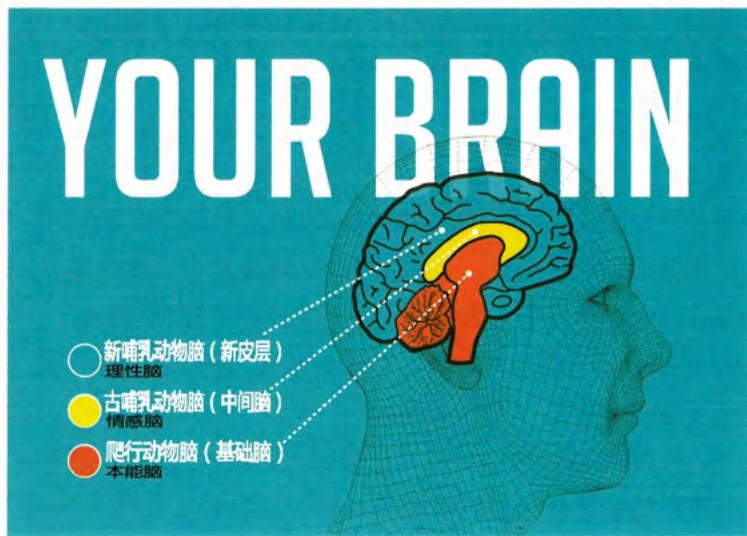
“Triune Brain” schematic
Canadian neurophysiologist Wilder Penfield said: “The cerebral cortex (referring to the left and right brain cortex) is not the place where the highest level of integration occurs; it merely serves the auxiliary tasks of the details for the completion of integration. The highest level of brain structure exists in the interbrain,” and “The interbrain possesses the highest brain function for knowing the mind and automatic sensory and motor functions.” The famous Japanese right-brain educator Shichida Makoto pointed out in his book The Right Brain Revolution: “The interbrain is the command tower of the entire brain, and human spirituality lies within the interbrain. The interbrain possesses the function of omniscience and omnipotence. Human interbrain consciousness activity depends on heredity (referring to the information genetic RNA) and the postnatal formed mental wave patterns. So-called fate is actually a person’s postnatal formed thinking habits and behavioral tendencies. It is guided by the mental wave patterns existing in the interbrain consciousness. Postnatal formed behavioral tendencies, etc., can be eliminated and changed through methods of controlling the interbrain. Interbrain consciousness guides human activity. The conviction that one’s character and abilities belong to a certain form is also produced by the interbrain. The interbrain is responsible for the integration of the left brain’s information system (language system) and the right brain’s information system (image circuit). In addition, the interbrain uses the brain as a center to dominate the nerves spread throughout the body and another hormone system through the spinal cord. Generally speaking, the interbrain is the central area of the brain. If one learns to control the interbrain, one can reach a realm of freedom.” “Through methods of controlling the interbrain, the brain can evolve. By concentrating consciousness on the interbrain and transmitting mental image waves to the interbrain, the function of the interbrain can be fully opened.” Therefore, in interbrain and right brain development training, it is very important to use interbrain and right brain mental image training and five-senses training to activate the right brain and interbrain; activating the interbrain activates the entire brain.①
There is a crucial structure within the interbrain—the pineal gland. Although it is an irregular oval gland weighing only about 0.1~0.2 grams with an anteroposterior diameter of about 8 millimeters, it is considered the central processing unit of the interbrain and even the brain, while the left and right brains are the terminal devices of the brain. The pineal gland is speculated to be the “third eye” inherited by humans from their primitive ancestors. It is precisely because of this theory that in interbrain, right brain, or whole brain development training, activating the pineal gland is particularly important; opening the third eye is the mark of activating the pineal gland, and activating the pineal gland means activating the brain’s command center.
So, how is this third eye activated? What exactly is the pineal gland? We will introduce these one by one in the next chapter.
Chapter 2 ESP Game Training
Blindfolded color identification, blindfolded reading, and other various ESP extrasensory games are something almost every child can do at a certain age. It is not yet known whether this is the result of the activation of the pineal gland. Now we have already explored methods very suitable for unlocking this potential ability in children, and ESP games are no longer limited to blindfolded reading, blindfolded sports, etc. At this time, it will trigger people’s curiosity: where was this seen? Can adults do it? During ESP game training, instructors and parents may also discover that some children will peek; how exactly should this be explained?
2.1 The Magic Lamp
After watching the videos recommended in Chapter 1 and playing the finger-lengthening game, most children will be brimming with confidence and high spirits regarding potential development, eager to try the next game. Of course, in a classroom setting without parents, it is not strictly necessary to play videos; if there are only children, using games for a warm-up might yield better results. There is no fixed pattern for warm-up activities; different counselors and parents should design them based on their own strengths, or they can refer to the relaxation games in Chapter 3 of the Right Brain Development Training Manual. The goal is to make children feel relaxed, safe, comfortable, happy, and trusting towards the counselor, classmates, and the environment, and to be confident in the subsequent learning.
Have the students sit together properly to create a sense of mystery. Let the children know that magical things can happen here at any time, and that they are like little fairies or “Jedi” here (the name of a finger-reading training camp held by Li Szu-tsen, former president of National Taiwan University, in the San Francisco Bay Area, derived from the movie Star Wars). Then tell the children to wait for the teacher to bring out a magic lamp to attract their attention and focus them on the counselor. The counselor must give clear instructions to the students:
Students, please sit up straight, with your feet naturally flat on the floor, feet shoulder-width apart, hands on your knees or thighs, back straight, and take three deep breaths.
Next, the teacher will bring out a very, very magic lamp. This lamp will only stay lit for a short while. When the lamp is on, students must stare intently without blinking and watch this lamp seriously. After the lamp goes out, students should gently close their eyes and then listen to the teacher’s guidance. If you hear clearly, please nod.
The counselor takes out the lamp and lets it shine for about 30 seconds before turning it off. Then, refer to “Visual Light Training” (pages 41-43) in Chapter 4 of the Light Gazing Training to guide the students; the latter part regarding the Yellow Card training can be postponed and treated as a separate training subject. The bulb used for visual light training is generally a 60W incandescent bulb because incandescent bulbs have good light color and light-gathering properties. 60W is an intensity generally acceptable to children and looking at it for a short time usually does not affect children’s eyes. Of course, this bulb is not the absolute light source; one can also look directly at candlelight, a desk lamp in daily use, or a living room lamp. Do not use mobile phone LED flashlights or anything too dazzling; be careful not to damage the eyes. For children, generally only need to look once, so counselors and parents must be clear about the purpose of visual light training.
The purpose of visual light training is to activate the pineal gland through visual light training, enabling children to become familiar with the sensation of a light sphere generated in the brain, and for the brain screen to generate clear, simple images. Here, activating the pineal gland is mentioned; the standard for pineal gland activation is that the brain screen can generate and change clear colored images. The so-called brain screen is just a feeling, a sensation of an image presenting itself on the forehead or before the eyes. In psychology, the image that surfaces in our mind when the object is not present is called a mental image. Some people also believe the standard for pineal gland activation is that the Yellow Card can present its original colors. Regarding these, I think there is no need to be too entangled. Research on the function of the pineal gland has always been highly controversial in the physiological and medical communities, and much of it is deduced by potential development enthusiasts. Since so many people are interested in this thing, we will also call it the pineal gland. For children’s learning and growth, self-confidence, concentration, and imagination are very valuable abilities, so we aim to activate the pineal gland to cultivate children’s mental imagery and blindfolded reading. Visual light training is not a necessary procedure for activating the pineal gland; methods such as Qigong or listening to music are also used. Regardless, the main purpose is to let the child quickly find the sensation of the light sphere. Most children can find this light sphere and change images without looking at a lamp. No matter what method is used, guiding the child to seriously feel and “see” is an essential step. The guidance scripts are basically similar, all requiring to “see the light sphere, let the light sphere change size, shape, and color.” In addition to being able to “see” images with eyes closed according to requirements, students can also open their eyes to look at a white wall (or white paper) at the end of this link. Most school-age children can also see images on the white wall (or white paper). Whether the visual light link is needed can be decided by the counselor based on their personal characteristics; in any case, forming and maintaining the sensation of the “light sphere” is very important.
What needs attention in visual light training is that when the counselor is guiding, it is best to guide simple geometric shapes first, then specific objects, proceeding from simple to complex. Specific objects should be familiar items with clear, bright colors, such as fruits and daily necessities. Counselors must have patience; some children will change images quickly, achieving it as soon as the teacher finishes speaking; some children will change slowly, even making you feel it is very slow, so patience is required. Some children may wait a long time and still not succeed; it is possible the child is not in the right state. That is fine; comfort him, let him watch other children practice, or let him leave the practice classroom and train him again after he adjusts his state.
When training multiple students simultaneously, have them change images or colors according to the teacher’s guidance. After completing the change, having the child nod or raise their hand is sufficient; do not let the child speak. Once they start speaking, they start using the left brain, which will affect the stability of the image. By not speaking, children will not influence each other, so visual light training can be conducted for multiple people at the same time. When the child successfully completes the change and nods to confirm, giving full affirmation and encouragement is very important, making the student feel happy and that it is very simple.
Before conducting visual light training for students or when not teaching, counselors or parents themselves should frequently undergo visual light experience training. Quietly, with eyes closed, a bright spot in the shape of the lamp will appear before the eyes; this sensation must be found. The light spot of the lamp is “seen,” seemingly right before the eyes. Breathing slowly, try to “look” at this bright spot with as calm a mind as possible. Can you make it bigger and brighter? Can you change its color and shape at will? Can you keep the “light sphere” presented before the eyes for more than 1 minute? As adults, achieving this is actually very difficult, and few people can do it, but children can do it easily. This is the difference between adults and children, but if adults frequently perform visual light training, even if it is just to keep the light spot before the eyes for a longer time, it will be beneficial to the body, mind, and work.
As children grow older and their abstract logical thinking strengthens, the results of visual light training also begin to develop in the direction of most adults. For teenagers over 12 years old, the difficulty of activating the pineal gland using the visual light method begins to increase. After 12, they start junior high school, the academic burden is very heavy, and accumulated knowledge might make students disbelieve in potential development phenomena. Students generally find it hard to relax and calm down to cooperate with the training. A small number of children may be similar to adults during visual light training, where the light sphere is relatively dim, and they cannot change size, shape, or color, unless their ability in this area is improved through certain methods such as Qigong. For such children and children over 12, I do not advocate unselective ESP (Extra Sensory Perception) development training, because this training may not help improve children’s self-confidence, concentration, or image thinking ability.
Visual Light Imagination Game
Of course, most school-age children will proceed very smoothly with visual light training. The video Visual Light Imagination Game shows 8-year-old Xiaomeng visiting my home with her dad. She combined visual light training with imagination training, completing the training just like playing a game. Everyone can use this video only as a reference; do not imitate it deliberately. You must find your own guiding language and mode, and find a way that children can like and accept. As long as the child is in a happy mood and willing to accept your instructions, everything is very simple.
Let the child try to change the color, size, and shape of the bright spot. When they can quickly transform it into any object and clearly “see” the image, it indicates that the pineal gland has been activated, and this “seen” image is the brain screen image. So what exactly is the pineal gland? Let’s chat about the pineal gland again.
2.2 What is the Pineal Gland?
What exactly is the pineal gland, widely “popularized” by spiritual science enthusiasts and potential development workers? In reality, very few people can explain it clearly. There are no detailed materials on this brain structure in general popular science books on brain science and neuroscience. From an evolutionary perspective, this structure exists in the brains of carp, showing its long history. In the previous chapter, we already learned that the human pineal gland is located in the diencephalon; it is an irregular oval gland weighing only about 0.1~0.2 grams with an anteroposterior diameter of about 8 millimeters. Although it is very small, it is the most frequently mentioned gland in Western esoteric circles, and it was mentioned very early on. The scientific community generally recognizes that the pineal gland secretes melatonin. Because the hormone secreted by the pineal gland of amphibians has the effect of fading skin color, this hormone was named melatonin. It has an effect on the body’s awakening, sleep, and biological cycles. The main ingredient of the famous gift “Naobaijin” is melatonin. The pineal gland has a certain connection with light sensing. People’s worship of the pineal gland contains their pursuit, yearning, and awe of light.
Regarding records of the pineal gland, as early as the 3rd century BC, Herophilus, a Greek physician during the time of Alexander the Great, depicted the appearance of the pineal gland in his anatomical manuscripts. By the 1st century AD, the ancient Roman physician and philosopher Galen named the pineal gland (pineal gland); its name comes precisely from its pinecone-like shape.
In the 8th century AD, Qusta ibn Luqa combined the views of his predecessors to understand the function of the pineal gland in this way: “The person who wants to recall looks upward, because looking upward raises the ‘worm’-like particles, opens the passage, and retrieves memory from the posterior ventricle. On the other hand, the person who wants to think looks downward, because this lowers the particles, closes the passage, and protects the spirit in the middle ventricle from interference by memories stored in the posterior ventricle” (i.e., the “worm” is the valve for memory and thinking). Due to mistranslations and other reasons, in some medieval texts, terms such as pineal gland, cerebellar vermis, and choroid plexus were confused; they were all worm-like obstacles. Predecessors took many detours in the process of seeking the truth, eventually forming the “common sense” that we now take for granted and use.
René Descartes’ status in the history of science is by no means ordinary. He lived in the 17th century and is known as the “father of modern science.” He is a world-famous French philosopher, mathematician, and physicist. It can be said that he made the pineal gland a research object of world attention. In The Passions of the Soul, Descartes focused on how the pineal gland, as the seat of the soul, interacts with the soul and the body. All our external senses are paired, but because we can have only one and simple thought about a certain thing at the same moment, there must be some place where the two images coming from our two eyes, and other double images of a single object coming from other paired senses, can be united into one thing before they reach the soul, so that they do not represent two objects to the soul but one (The Passions of the Soul). Considering that structures like the left and right frontal lobes and left and right temporal lobes in the brain appear in pairs, while the pineal gland is a single gland existing in the core position of the brain, this uniqueness also strengthened Descartes’ assertion of the pineal gland’s special status. In The Passions of the Soul, Descartes described it this way: “We can understand it this way: for example, if we see an animal walking towards us, our two eyes receive the image of the animal respectively, each point will correspond to the gland through the optic nerve to form corresponding points, and finally the images input by the two eyes reach the pineal gland to form a single image of this animal. This image will immediately affect the soul, making it see the figure of this animal.” (See the diagram drawn by Descartes of the pineal gland helping the soul receive and translate information). As a dualist, Descartes focused more on how the spirit and flesh are combined while discussing the soul and the body at length. It is this magical gland that serves as the communication hub between the soul and the body, and is the decoder of consciousness. Descartes said, “There is a small gland in the brain where the soul exercises its functions more particularly than in the other parts.” “If the eyes are the windows of the human soul, the pineal gland is the place where the soul resides.”
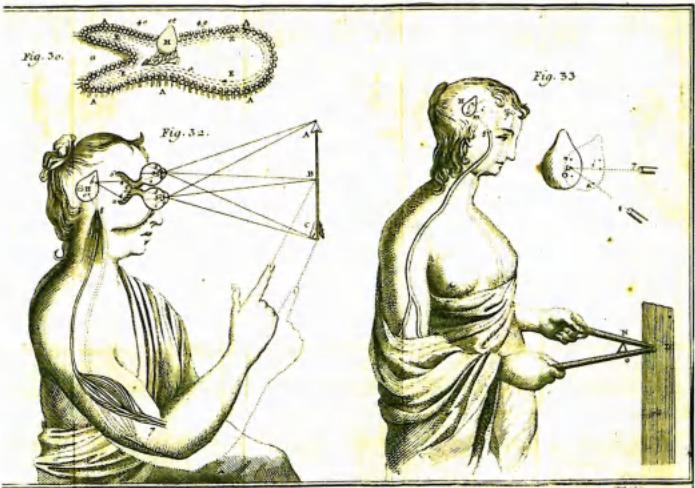
Diagram drawn by Descartes of the pineal gland helping the soul receive and translate information
In the blink of an eye, it was the 1970s. At that time, Dr. Rick Strassman, an American psychiatrist who was still a student, took many courses on sleep and dreams, hypnosis, consciousness psychology, physiological psychology, and Buddhist studies at Stanford University, so his research direction was the pineal gland, which very few people were involved in. The pineal gland is recognized by the physiological and medical communities as a gland that secretes melatonin. Strassman believed: “If being in this position is merely to help melatonin play its role in our lives, then there is no need for the pineal gland to stay in the center of the brain.” In DMT: The Spirit Molecule, he analyzed the decisive factors of the pineal gland’s location in the core area of the brain: the pineal gland can also secrete DMT (Dimethyltryptamine, a psychedelic drug, a tryptamine hallucinogen), which is extremely easily decomposed, to supply the surrounding core perceptual areas nearby. DMT exists in the human body in trace amounts (referring to extremely small amounts, so small that there is only a trace), and is extremely easily decomposed. Under the effects of meditation, near-death experiences, or other stresses, the human pineal gland will produce large amounts of DMT, at which time the person will enter a state of super-consciousness. Therefore, as a gland capable of releasing DMT under certain conditions, the position it occupies in the brain is called a “strategic position” by Strassman. Descartes said, “The part of the body that immediately exercises its functions is neither the heart nor the whole brain, but only the deepest part of the brain, a very small gland, which is suspended above the passage through which the animal spirits in its anterior cavities communicate with those in its posterior cavities.” This gland, “located in the very center of the brain substance,” matches the necessary conditions mentioned by Dr. Strassman. If DMT can directly enter the visual, auditory, and emotional centers that are extremely close to the pineal gland, this will profoundly affect our inner experience. Because DMT is decomposed within a few short minutes, and the tiny distance between the pineal gland and important brain structures is only millimeters wide, it can spread directly to these parts through cerebrospinal fluid without needing to enter the blood circulation first. If DMT enters the blood first, the oxidases in the body will destroy it before it returns to the brain to exert its profound spiritual influence.
This is probably one of the most scientific explanations currently available regarding the pineal gland and special perception. Simply put, the pineal gland produces substances that affect the human central nervous system, causing changes in sensation and emotion, and producing illusions of time and space and hallucinations. Magical experiences such as “psychic communication” and “supernatural powers” are the credit of the pineal gland. Moreover, the position of the pineal gland is very wonderful; if it were in a different position, this experience could not be produced. This position is also the throne of the soul mentioned by Descartes.
In Baidu Baike, the pineal gland is explained as follows: The human pineal gland is a gray-red oval small body, 5~8mm long and 3~5mm wide, weighing 120~200mg, and its development peaks at 7~8 years old. The pineal gland is located at the top of the diencephalon, between the habenular commissure and the posterior commissure, in the depression above the quadrigeminal bodies, and at the roof of the third ventricle, so it is also called the epiphysis. One end is connected to the roof of the third ventricle by a slender stalk, and the third ventricle protrudes into the stalk to form the pineal recess (see the figure of the pineal gland). The surface of the pineal gland is covered by a connective tissue capsule continuous from the pia mater. The capsule extends into the parenchyma with blood vessels, dividing the parenchyma into many irregular lobules. The lobules are mainly composed of pinealocytes, glial cells, and nerve fibers. The pineal gland has abundant blood vessels, and its blood flow is second only to that of the kidneys. Micro-arteries from the branches of the left and right posterior choroidal arteries penetrate the pineal gland capsule, travel between the connective tissues, and then form a capillary network, which converges through veins and penetrates the capsule to form the pineal vein, finally injecting into the great cerebral vein.
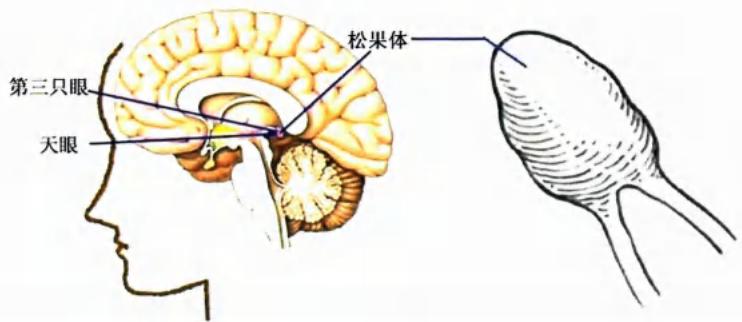
Pineal Gland
- 松果体 - Pineal Gland (also called Pineal Body)
- 第三只眼 - The Third Eye
- 大眼 - Physical Eyes (literally “big eyes”)
The theories about the pineal gland circulating on the internet are also well-founded, but it is difficult to distinguish their sources. They are cited here for reference only.
The pineal gland is also known as the “third eye” because it can see beyond the scenes visible to the ordinary human eye; it possesses internal vision, penetration, clairvoyance, and the ability to see things fundamentally invisible to the naked eye. Russian paleoanthropologist Belov’s research suggests that the images appearing in the brains of individuals with special abilities are precisely the result of the pineal gland’s function. They can align their bodies with the earth’s oscillations and enable their brains to gather natural energy, thus allowing the pineal gland to acquire extraordinary abilities from the universe. In 1918, a Swedish anatomist, while observing the pineal glands of frogs and goldfish under a microscope, discovered: their cell shapes bore a striking resemblance to the photoreceptor cells on the retina of the eye, and some nerve fibers even remained connected. Based on this discovery, some quickly boldly speculated: the pineal gland in the brains of most vertebrates is highly likely a vestigial remnant of a degenerated eye. Although the pineal gland belongs to a part of the brain, it lacks brain cells, possessing instead astrocytes found in no other gland, as well as proteins capable of distinguishing light and color. This indicates that the human pineal gland is likewise a product of eye degeneration. Scientists have also discovered through research: the pineal gland prefers darkness and fears light; under strong light, it becomes lighter in weight, decreases in cells, shrinks in volume, and declines in function.
Pineal gland cells are rich in serotonin, which is converted into melatonin under the action of special enzymes; this is a hormone secreted by the pineal gland. Researchers have found that the secretion of melatonin is constrained by light exposure. When strong light shines, melatonin secretion decreases; in dim light, melatonin secretion increases. When melatonin levels are high in the human body, one feels depressed; conversely, when melatonin levels are low, one feels “in high spirits when things go well.” From this, it is not surprising that human emotions are influenced by light. Since melatonin secretion is regulated by light and darkness, the periodic alternation of light and darkness in the circadian cycle causes a corresponding periodic circadian change in melatonin secretion levels. Experiments confirm that melatonin concentration in plasma decreases during the day and increases at night. Through this circadian secretion cycle of melatonin, the pineal gland sends “time signals” to the central nervous system, which in turn triggers several “biological clock” phenomena related to time or age. Examples include human sleep and wakefulness, ovulation in the menstrual cycle, and the onset of puberty.
The human pineal gland is located in the brain, surrounded on all sides by massive amounts of brain tissue and the barrier of the hard skull. So, how does it perceive external light and darkness? Scientists at the University of Maganza in West Germany discovered through experiments: the pineal gland contains certain magnetosensitive cells which possess a certain ability to perceive and receive magnetic lines.
Professor A. Robin Baker of the University of Manchester in the UK also discovered: there is a biomagnetic field at the junction of the human nasal bone and skull, located right in front of the pineal gland; it can gather radiation and acts to scan images. Biologists long ago discovered a hole in the skulls of ancient animals that became extinct long ago. Initially, biologists were puzzled by this, but later it was confirmed that this was precisely the eye socket of the third eye. Research shows that whether it be birds, beasts, frogs, fish, turtles, snakes, or even human ancestors, all have possessed a third eye. It is just that with biological evolution, this third eye gradually moved from the outside of the skull to the inside of the brain, becoming a “hidden” third eye. Although the pineal gland has moved into the dark cranial cavity and cannot directly observe the colorful world, because it once performed the function of the human third eye, relying on its original function, it can still sense light signals and react. For example, on sunny days people feel cheerful, energetic, and sleep less. Conversely, when encountering overcast weather with continuous drizzle, they feel low-spirited, depressed, and often desire sleep. This phenomenon is precisely the effect of the pineal gland’s function.
The human third eye, when the embryo develops to two months—when the nerves of the lens, photoreceptor, and diencephalon regions have just formed—will suddenly stop and begin to degenerate.
According to the famous Haeckel’s biogenetic law, we know: in a very short time during embryonic development, it undergoes the entire evolutionary history of its species. Therefore, it is said that our human ancestors indeed possessed a third eye at a certain period, but later, due to the needs of evolution, this eye degenerated.
Although the third eye was long ago degenerated during evolution, these dormant traces can be awakened or flash forth under appropriate environmental conditions; this is the biological “law of recapitulation” or “atavism.” Therefore, some people, through certain cultivation or other special means of stimulation, can still reopen this mysterious third eye.
Professor Li Szu-tsun, former president of National Taiwan University, presented a scientific report on the location of the brain’s “third eye” at the 2003 International Society of Magnetic Resonance (ISMAR) conference. Through magnetic resonance experiments, he confirmed that when the third eye is opened, the largest signal occurs in a region at the top of the spine and behind the thalamus; this intersects with the pineal gland but is not entirely the pineal gland. Looking in from the front of the face, it is behind the glabella (between the eyebrows); if looking down from the top of the head, it is below the Baihui acupoint. This is precisely the Niwan (Huan) Palace and Upper Dantian spoken of by Chinese Taoists. Seven Slips from the Cloudy Satchel, Volume 33, states: “One inch back from the center of the eyebrows is the Bright Hall (Mingtang), two inches is the Grotto (Dongfang), three inches is the Upper Dantian (Niwan Palace).” The “Unsurpassed Yoga” of the Esoteric Buddhism speaks of the brow chakra, located on the upper channel (sushumna) within the triangular bone between the eyebrows, and considers this wheel to be quite related to the cultivation of the “Heavenly Eye.”
Below the Baihui acupoint, between the eyebrows, and deep behind the Yintang, is what Taoists call the Heavenly Eye. Ancient clergy often inlaid large gems on their headgear corresponding to the position of the Heavenly Eye; during divination and other rituals, they would let light shine towards the Yintang or the brow and crown, all pointing to the Heavenly Eye. The center of the eyebrows has always been regarded as a place of concentrated spiritual power; when a person encounters bad luck, it is said their Yintang looks dark.
Taoists also call this place the Heavenly Eye (Tianmu), Heavenly Heart (Tianxin), Ancestral Orifice (Zuqiao), and Mysterious Pass (Xuanguan), believing this is the door to communicate with the universe and enter the mysterious. Once this opening is unlocked, one can achieve what Laozi stated in the Tao Te Ching: “Without going out of the door, one knows the world; without looking out of the window, one sees the Heavenly Way. The further one goes, the less one knows. Therefore the sage knows without traveling, names without seeing, and accomplishes without doing.” Taoism places great importance on the “Seven Orifices of Light” and regards the scene of True Yang and brilliance appearing at the Mysterious Pass as one of the main signs of the emergence of supernatural powers through cultivation, believing that once this opening is unlocked, all openings are connected. The Zhouyi Cantong Qi says: “The One is masked, and the people of the world do not know it; one opening connects ten thousand openings, the One runs through the whole body.” And because the Ancestral Orifice is the main gateway for the entry and exit of the Three Lights, it has historically been regarded by practitioners as a mysterious opening that must not be passed on to outsiders.
The location of the Heavenly Eye is called the Niwan Palace by Chinese Taoists and traditional Chinese medicine. Taoists have many names for the Niwan Palace, including Heavenly Brain (Tiannao), Yellow Court (Huangting), Kunlun, Heavenly Valley (Tiangu), and dozens of others. Another theory states: the Upper True Lord (Shangyuan Zhenjun) resides in the Niwan Palace. In ancient medical texts, the Upper True Lord is mostly called the Niwan Lord, but also called the Taiyi Imperial Lord (Taiyi Dijun) or Taiyi Prime Truth (Taiyi Yuanzhen). Nowadays, it is mostly called the Primordial Spirit (Yuanshen) and Brain Spirit. For example, Zhang Jingyue’s Leijing notes: “The human brain is the sea of marrow, which is called the Upper Dantian, where the Taiyi Imperial Lord resides.” The so-called “Taiyi” is the ancestral palace of the whole body, occupying the supreme position, being the meeting point of all yangs and the capital where all spirits gather. Ancient texts are not lacking in relevant records:
“The brain is the master of the body, the meeting of a hundred spirits; its way aligns with the Supreme Mystery, hence it is called Niwan.” (Xuzhen Shishu)
“The Nine Truths of Niwan all have chambers, a square inch in size located therein. The imperishable way lies in contemplating the Nine Truths of Niwan. The brain has nine divisions, the chamber is one inch.” (Huangting Neijing Jing)
“There are nine palaces in the head: one inch back from between the eyebrows is the Bright Hall Palace, two inches is the Grotto Palace, three inches is the Dantian Palace, four inches is the Flowing Pearl Palace, five inches is the Jade Emperor Palace; one inch above the Bright Hall is the Heavenly Court Palace, one inch above the Grotto is the Ultimate Truth Palace, one inch above the Dantian is the Mysterious Dantian Palace, one inch above the Flowing Pearl is the Grand Ultimate Palace.” (Dongzhen Taishang Daojun Yuandan Shangjing)
“The Heavenly Brain is the spirit of the body, the cave of a hundred spirits’ fate, the mountain source of fluids, the jade chamber of the soul’s essence. If one can make the brain round and empty to irrigate the truth, then ten thousand openings stand true, a thousand holes generate smoke, virtue equalling heaven and earth, penetrating the vastness, therefore it is called Niwan. Niwan is the upper god of form.” (Daoshu·Pingdu Pian)
“The Taiyi Imperial Lord is in the head, called the Niwan Lord, commanding all spirits. Zhao gives birth to the consciousness spirit, which is the human soul. Siming is in the heart, admitting life. Yuanying dwells on the left, controlling the three souls. Baiyuan dwells on the right, constructing the three po. Taohe dwells in the navel, the root of deep essence. Illuminating the hundred joints, giving birth to a hundred spirits. Therefore the whole body is not empty. Literary qi enters the nose, irrigating the Niwan. Therefore the spirit and form are solid and safe. Movement and stopping depend on the heart. Therefore life is said to be thus.” (Taishang Laojun Neiguan Jing)
The Zhixuan Pian: Xiuxian Bianhuo Lun claims that the Niwan Lord plays a crucial role in the body’s life activities, so the Yunji Qiqian: Yuanqi Lun links it to human health: “If the brain is solid, the spirit is whole; if the spirit is whole, the qi is whole; if the qi is whole, the form is whole; if the form is whole, the hundred passages are harmonized internally, and the eight evils are eliminated externally.” It links the Niwan Palace with life and death, stating: “The middle palace is called Niwan. It is the palace where the Primordial Spirit resides; its emptiness is like a valley, and the spirit dwells in it, hence it is called the Valley Spirit. If the spirit remains, one is healthy; if the spirit leaves, one dies. By day it connects with objects, by night it connects with dreams; the spirit cannot rest in its dwelling.” Precisely because the Niwan Palace is where the spirit dwells and true qi exists within, serving as the life center of the human, the Suwen: Cijin Lun Pian emphasizes: “If one needles the brain and hits the brain portal (Nao Hu), entering the brain causes immediate death.”
2.3 Yellow Card Training
After the visual training is completed, students generally feel particularly refreshed and happy. This is likely because it is the child’s first discovery that the world can be so wonderful and magical even with their eyes closed. They possess the ability, like Superman, to change the light spheres, graphics, and images seen by their eyes according to their own will. This lays the foundation for building confidence and interest in the next steps of training.
When this ability is present, it can be basically confirmed that the student will have no trouble completing blindfolded color discrimination, but there is no need to rush. After the visual training, let the child rest for a while and play some games to maintain a relaxed, happy, and confident state, and then prepare for the Yellow Card training. For children who have succeeded in visual training, Yellow Card training can help consolidate the imaging on the brain screen, making the child’s light sphere brighter, and the graphics in the brain screen change faster, more stably, and more clearly, laying a solid foundation for the subsequent blindfolded color discrimination.
The Yellow Card is a concept derived from Makoto Shichida’s modification of color cards; it is a tool to help present mental imagery. These include rectangular full-color cards in red, yellow, blue, green, etc., and cards with geometric figures of various colors in the middle. The most common type is the card with a circle of complementary colors (also known as contrasting colors) in the center of the following color cards. Finished Yellow Cards can be purchased; generally, there will be a few Yellow Cards in wave speed reading memory training sets. Yellow Cards can also be printed using a color printer, or students can simply look at Yellow Card images on a computer screen; these are all excellent choices. Viewing the Yellow Card on a computer screen provides higher brightness and the clarity of the afterimage will be higher.

When looking at the three types of Yellow Cards above (see Yellow Card image), most children, after looking and closing their eyes, are able to see the complementary color of the Yellow Card (see Figure 12 Color Wheel). This is a magical visual afterimage, simply referred to as an afterimage. When reminded to adjust the complementary color to the original color, children can gradually adjust it to the original color. A small number of children find it difficult to change it to the original color; similar to adults, such children can improve their brain imaging ability through repeated visual training and simple Yellow Card training.
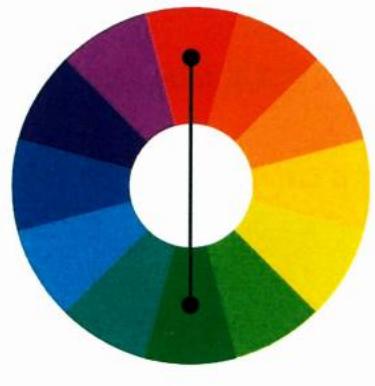
180° directly opposite are complementary colors
12 Color Wheel
Taking the first image as an example, we can guide as follows:
Teacher: Please look at the Yellow Card for 30 seconds, only looking at the blue circle in the middle. (After 30 seconds) Please close your eyes. Okay, now look clearly at the image in front of your eyes (feeling like it’s behind your eyelids), what does it look like?
Student: There is a yellow circle in the middle, and blue on the surroundings.
Teacher: Very good. Now change it to the same color you just saw, with blue in the middle and yellow on the surroundings. You can definitely do it! … (Wait a moment) Has it changed?
Student: Yes, it has changed.
Teacher: Great, that’s amazing. Now please try to keep this image in front of your eyes for as long as possible. (Pause for about a minute until the image disappears) Okay, everyone slowly open your eyes. Did you see a very clear Yellow Card just now, especially bright?
Generally speaking, the higher the brightness of the Yellow Card, the easier it is to restore it. This restored image is related to human imagination and concentration; the restored image is no longer the afterimage of visual persistence, but the processing of image information based on the afterimage. For most adults, after looking at the Yellow Card, merely maintaining the complementary color image for more than 30 seconds is a huge challenge, let alone being able to restore it to the original color. However, for most school-age children, this presents no difficulty. For children or adults who find this training difficult, if they insist on choosing to train, they can refer to “Right Brain Development Training Manual” Chapter 8 Visual Training: Yellow Card Training.
For most school-age children, Yellow Card training is still an extremely simple matter. However, the speed of transformation varies from fast to slow. When training in a group, simply have the children who have completed the transformation nod or raise their hands; once a child speaks, it will affect the other children who have not yet completed it. For most children who can complete the color restoration relatively quickly, you can immediately proceed to the practice with solid color cards:
Bring up a red card on the computer screen.
Teacher: Now let’s look at a red card together, don’t blink your eyes. Now only look at the red square… (After 30 seconds) Close your eyes, what do you see?
Student: A green square. (Generally, the complementary color is still seen; after frequent training, students may naturally use their imagination to restore it.)
Teacher: Awesome! Now change the green square to a red square yourself, just like the one you just saw. Have you changed it?
Student: Yes.
Teacher: Okay. Now everyone freely change it to yellow, blue, or any color you like.
Now that everyone can change colors at will, we will start changing shapes. You can change it into a red five-pointed star, a green triangle, a red apple, a yellow banana, a blue ocean, or a green big tree (do not speak too fast; control the pace according to the children’s situation).
At the end, have the object the child transformed bow and thank the teacher in its own unique way.
After the above exercises can be completed smoothly, generally practice with a few more cards and transform a few more figures. Finally, depending on the situation, students can also be asked to transform objects with more complex colors and shapes, such as a white cushion spread on the grass, with apples, bananas, oranges, etc. on the cushion. But overall, do not do too much; the standard is that the child does not feel tired or bored. The figures to be transformed should mainly be those familiar to and liked by children, with relatively simple shapes. At the end of the guidance, let the apples, bananas, trees, etc., transformed by the child, move freely to thank the teacher. This is mainly to cultivate the child’s heart of gratitude and habit; children with a grateful heart will find it easier to enter the state in subsequent training.
There are also some advanced Yellow Cards (see Advanced Yellow Card image), which can be interspersed in later exercises (when ESP training begins, it can serve as a warm-up game). This type of Yellow Card training lays the foundation for future Mandala Card training and is also aimed at improving the brain’s sensitivity to colors and shapes, thereby enhancing image memory ability.

Advanced Yellow Card
Yellow Card training can also be done by staring at the card and then not closing the eyes, but turning the eyes to other white planes (such as a white wall or white paper); generally, an afterimage can also be seen. This kind of training can have a better effect on cultivating imagination. The time for staring at the Yellow Card should be gradually shortened to improve the brain’s memory and reaction speed. You can start from 30 seconds, then go to 20 seconds, 10 seconds, and 5 seconds, provided the trainee can complete it. During training, always pay attention to improving the child’s self-confidence and encourage the child to bravely challenge themselves with higher difficulty training.
As the number of trainings increases, the time the afterimage can be maintained can be extended to 70 or 80 seconds, and some people may even maintain it for several minutes. Extending the time the afterimage is maintained in front of the eyes as much as possible can exercise a person’s concentration. In short, the ultimate goal of Yellow Card training is to be able to change its color and shape at will.
Yellow Card training looks very complex, but you absolutely cannot guide children based on the feelings of adult experience. If you have never guided a child before, as long as you have done a few training sessions with the child, you will feel that the child is really amazing, and adults are simply no match for them.
2.4 Activating the Pineal Gland
When a child can produce a sphere of light in the brain through vision training and yellow card training, and can make this sphere of light or afterimage change in size, shape, and color, and even transform it into a clear image of an object, this is the “brain screen,” and it can be said that the pineal gland has been activated. This method is safe, fast, and convenient. Activating the pineal gland through vision training actually originates from the Taoist vision arts of China. Chinese Taoists achieve the flow of Qi through the Eight Extraordinary Meridians by gazing at candlelight or the sun and utilizing Qigong exercises, thereby strengthening the constitution and opening up wisdom. This is a method of using the body’s internal energy to activate the pineal gland.
Western research on the activation of the pineal gland largely holds that as children age, data shows that approximately 75% of normal adults show calcification of the pineal gland on CT scans, thus losing its function. If adults wish to awaken and achieve certain special abilities, they must revitalize the pineal gland; hence, the concept of “pineal gland decalcification” circulates in society. According to this theory, there are still 25% of adults without pineal gland calcification, yet the pineal gland is also very difficult to activate, and the ability of the brain screen cannot be realized. Therefore, regarding the theory and practice of pineal gland decalcification, I believe educators need not divert their energy to explore it.
The brain screen and mental imagery are both connected and distinct; mental imagery encompasses the concepts of representation and imagination in psychology. The mental imagery generated during our ESP game training is a relatively subtle and vague sensation, including things that are “seen,” “heard,” and “felt,” and can involve an immersive feeling, but it may not necessarily be a clear “real image.” During training, students can also be asked to project the imagined scene onto white paper, a white wall, or into the air, and they can see it with their eyes open. This is not too difficult for children, but it is more difficult for adults. The term mental imagery is also widely used in right-brain theories such as those of Makoto Shichida, and the brain screen can be understood as one form of mental imagery. The brain screen is the “screen” for imaging within the brain. Whether the images presented on this screen are clear or not, according to right-brain theory, has nothing to do with the screen itself, but is related to the activation of the right brain. The 7 stages of mental imagery during the right-brain activation process mentioned at the beginning of Chapter 4 of the “Right Brain Development Training Manual” are entirely directed at image-based thinking, so in a greater sense, they refer to the image capability presented by the brain screen. Whether it is called mental imagery or brain screen, these are just names we have given to this phenomenon, and we do not need to care too much about them. It is just like when you are focused on watching TV; the images outside the screen seem undetectable, and the screen frame also seems to be outside the visual range.
These 7 stages, or 7 levels, of the appearance of mental imagery during the right-brain activation process are aimed at adults, because children under the age of 12 can hardly distinguish between these 7 stages. Starting from vision training, once the sensation of the sphere of light is found, the time it takes for each child’s sphere of light to change in size, shape, and color may vary from fast to slow. Most children become very clear in minutes, while a few may take several days to reach a state of stable change. This difference may be related to the different development of the child’s left brain; that is, the child’s left-brain thinking mode may affect the activation of the right brain. For most adults, each of these 7 stages may be very long regardless of the method used to activate the pineal gland, and most people practice for a while then shrink back and let it slide. So, no matter what, persistence is one of a person’s best qualities. However, it needs special explanation that many people may have right-brain activation only at the 1st stage, that is, closing their eyes to pitch darkness and not seeing any images, but this does not necessarily affect their ability to perceive external information such as colors or text through intuition or other unknown means.
For children, the vast majority of school-age children only need verbal guidance to open the brain screen, because this is an innate ability. According to the “Triune Brain Theory” mentioned earlier, the interbrain (diencephalon) where the pineal gland is located is a brain structure possessed by reptiles. The pineal gland is the “eye” through which animals in ancient times perceived the world and has the function of receiving cosmic information. What is cosmic information? It is the sensations generated by all existence in the universe that can be perceived; images, sounds, etc., are carriers of such sensations. The information received by the pineal gland is processed by the right brain (paleocortex) to form signals such as images, text (which is also an image), and sounds, which are then presented through the brain screen. Humans follow the developmental order of interbrain, right brain, and left brain starting from the fetal stage. Therefore, the pineal gland and its abilities are innate. With the development of the left brain, the neocortex becomes larger and larger during the evolutionary process and eventually becomes the main body of the brain. This squeezes the abilities of the right brain and the pineal gland, causing them to gradually fall into dormancy. Searching for “activating the pineal gland” on the internet brings up an astronomical amount of information, making people feel that the activation of the pineal gland is a very mysterious and difficult thing. Many potential development institutions take advantage of this and play it up, such as claiming the need for special foreign audio technologies, etc., leaving people dizzy and confused. Of course, some tools can serve as aids to open ESP (Extra Sensory Perception) abilities and can have the effect of increasing mystery and stimulating interest. The “Right Brain Development Training Manual” briefly introduces methods for pineal gland activation, which generally include vision training, vocal music listening and reading, tapping vibration, and other methods such as electrical current stimulation, Qigong, meditation, accidental injury, etc.
In addition to vision training, the flash stimulation method and the strong light stimulation method have also been used by potential development researchers. The flash stimulation method involves a flash stimulator flashing at a certain frequency. The light reaches the retina through the refractive system of the eyeball and undergoes a photochemical reaction with the photosensitive layer of visual cells, converting light energy into nerve impulses, which are then transmitted to the cerebral cortex via the optic nerve fibers and the central visual pathway, thereby generating visual information. It is a new science developed after conventional electroencephalography (EEG) and is often used in medical diagnosis. Using the flash stimulation method, some people have opened sensations of numbness and soreness in a certain meridian, similar to those during acupuncture; some have produced a Qi sensation like when practicing Qigong; and some have opened the brain screen. However, there are certain dangers, and improper operation may induce epilepsy. This method is used by only a very small number of researchers for research purposes and has not appeared in the broad potential development education industry.
The strong light stimulation method is a subject in foreign agent training. It uses a halogen lamp of more than 1000W to force people to keep their eyes open and look at the lamp for more than 60 seconds to stimulate the trainee’s sensory system to make it more acute, and to strengthen the image information processing and memory capabilities of the brain. However, strong light stimulation training is indeed not something ordinary people can endure, and the specific training details are also regarded as classified and cannot be known. It is said that the vision training method using a 60W incandescent lamp also originated from the strong light stimulation method used by agents.
Currently, there are methods in society to activate the pineal gland, open the brain screen, and achieve functions such as blindfolded color discrimination by listening to music through headphones. Through some high-frequency music stimulation, some children and adults may indeed experience the brain screen after a certain period of time, but the success rate is lower than that of vision training and instructor guidance. Moreover, it easily makes people cognitively rely on the assistance of instruments, ignoring the fact that humans are “innately sufficient.” However, music can indeed induce resonance in the human body. Li Sitsen of National Taiwan University introduced this in his book “Unbelievable: Scientists Explore the Mysterious Information Field”: “Since human ears cannot hear sounds of 10 Hertz, I asked students to use a computer to produce high-frequency music audible to the human ear, then cut it into 10 syllables per second and record it onto a tape. The classmate who helped with the cutting and recording listened to it repeatedly at the computer desk, and as a result, it triggered spontaneous movement (a type of Qigong), and his body shook involuntarily, almost making him unable to operate the keyboard. Later, when I gave a speech at Taipei Medical College, I played this sound. In less than 20 seconds, a lecturer named Huang in the audience began to shake in his seat, stomped his feet violently on the floor, and finally fell to the ground, shocking the whole audience. It turned out that he had been meditating for seven or eight years and easily resonated with external stimuli.” This text may seem incredible to friends who do not understand Qigong, but in Qigong, this kind of spontaneous movement is quite common. There is a technique specifically dedicated to the internal movement of fetal breathing. After starting fetal breathing during practice, the body will jump with the music, producing wonderful reactions (see the video “Fetal Breathing Internal Movement”). These movements are difficult to do if one tries to do them consciously and specifically, but this fetal breathing internal movement has good effects on physical fitness, health, beauty, and body shaping.
Of course, the practice of Qigong does not require the induction and assistance of music; it is just that listening to music can cause body resonance. Li Sitsen also invented a method of rapid thinking to let himself enter a Qigong state. He recites 1 to 10 every second, constantly repeating, using the regular discharge (thinking) of the left temporal lobe (located below the lateral sulcus, responsible for processing auditory information, and also related to memory and emotion) to interactively stimulate the thalamus①, thereby allowing himself to enter a Qigong state. Although traditional practices in China, India, etc., did not use the concept of the pineal gland, the supernatural powers involved in Qigong, Yoga, Esoteric Buddhism, and other Eastern mysteries are no different from the functions achievable by the pineal gland proposed in the West. Therefore, these methods are all effective methods for activating the pineal gland.
Fetal Breathing Internal Movement
2.5 Blindfolded Color Identification
The emergence of special functions that can be presented after the so-called activation of the pineal gland generally has three overall factors: one is innate, the second is developed through practice, and the third is triggered under certain special circumstances. The last one refers to strong stimuli such as a serious illness, surviving a disaster, a car accident, being struck by lightning, great grief, etc.
In terms of the techniques for unlocking abilities such as blindfolded color discrimination and blindfolded reading, the so-called methods for activating the pineal gland vary widely in society. Some institutions use music for activation, some use specific Qigong exercises, and many, like the one I have introduced, use visual training or directly utilize imagination to guide suggestion; some even use hypnosis techniques. Due to a lack of more valid data, it is currently impossible to calculate the proportions of the various methods. All coaching institutions advertise that their methods can achieve extremely high rates of activation, and there is no shortage of those who even boast of a 100% success rate; I will not elaborate on this here.
Based on what was discussed earlier, we can understand that activating the pineal gland is intended to activate the right brain, because the right brain possesses imaginative thinking capabilities, which helps in the formation of the “brain screen” and “mental imagery.” The brain screen and mental imagery are significant for the brain’s information processing, whereas simply discussing a hard-to-verify pineal gland does not seem to hold much meaning. Many people, having learned the term “pineal gland,” get stuck in a dead end, thinking only about this matter and ignoring the vast world outside.
Second, you must have absolute confidence in successfully inducing the ability to distinguish colors blindfolded in students. When some readers purchase the Right Brain Development Training Manual, the question most frequently asked by parents who want to become instructors is: “After reading this book, can I get my child to identify color cards while blindfolded?” Now, I want to throw this question out to everyone; take a few minutes to think about how you would answer it. I would generally answer directly, “I do not guarantee that everyone can achieve this.” Of course, through the induction methods in the book, most children can successfully have their blindfolded color recognition ability induced. The guiding words and methods are just that simple; there is nothing complex about them. Why is it that some readers, holding ready-made materials, still cannot succeed in inducing blindfolded color recognition? One of the important reasons is a lack of self-confidence. Some readers hold the book, read it earnestly, and when they find a problem, they look for ways to find the answer, consulting in reader groups or looking for materials online; these are all positive ways to solve problems. However, I have also found that many questions from some readers are purely imaginary, meaning they have not practiced or tried at all. Such readers are mostly looking for confidence; they dare not act or take the next step without full certainty. There is a book titled I Am the Root of Everything. This sentence is classic; it tells us that all problems cannot be solved by seeking externally. When you have absolute confidence, you can truly face the problems you encounter. When an instructor or parent lacks absolute confidence in facing the child, the possibility that the child will not be successfully induced increases significantly. It is important to note that this “facing” does not mean that 100% of children can be successfully induced; one must also face the fact that some cannot be induced successfully.
Third, you must absolutely believe that all children can achieve blindfolded color recognition. This statement does not contradict the above point that “not 100% of children can be successfully induced.” NLP (Neuro-Linguistic Programming, a type of applied psychology) has twelve presuppositions, one of which is “Intentions and emotions are never wrong, only the behavior has not been effective.” This absolute belief is a requirement for the mindset of the instructor or parent. Only on the basis of absolutely believing that all children can achieve blindfolded color recognition can one treat every child with sufficient confidence, equality, and patience. Absolute belief and not giving up are key to successfully inducing more children. Most children aged 6 to 12 can smoothly complete the opening of ESP (Extra Sensory Perception) abilities using the blindfolded color card induction method. According to data from 382 students at institutions such as Shandong Mingbo Education, Jinan Qiansensing Power, and Zhuoer Education, 97.64% of the enrolled age-appropriate students achieved the induction of blindfolded color recognition. The reasons for unsuccessful induction are also varied: some have attention deficits, some face excessive pressure from parents, some are too young to fully cooperate, some let their minds wander and cannot focus the moment they close their eyes, some give up on themselves because they receive zero trust from their parents, and some are autistic. Although training institutions will screen during recruitment, individual cases will always appear, which is also very natural. However, the vast majority of age-appropriate children with normal intelligence can achieve blindfolded color recognition; it is just that a few children may progress slowly, so instructors must have enough patience to persist and encourage them.
It is generally more difficult for parents to induce blindfolded color recognition in their own children than in others’ children. Of course, this difficulty may manifest itself during visual training, and it becomes even more obvious in the blindfolded color recognition game, often leading to a complete failure of the parent’s induction. The reasons why it is difficult for parents to conduct related training on their own children generally include the following situations:
- The parent is not the image of a teacher in the child’s mind.
- The child is overly familiar with the parent’s language and behavioral patterns, so the child knows clearly what the parent is thinking and how they will speak, leaving no suspense.
- Parents generally find it difficult to have patience when facing their own child’s lack of cooperation.
- The parent’s concept of “the neighbor’s child is better” often leads them into impatience and makes it easy to develop a judgmental mind, preventing them from treating their own child more equally and making them more accustomed to seeing their child’s shortcomings.
- Parents have stronger utilitarian expectations regarding their own children, making it difficult for them to see their child’s more hidden traits such as personality, thoughts, and character, while being accustomed to looking at superficial aspects like the child’s learning, habits, language, and behavior.
Blindfolded color recognition training can be said to be the introductory game for ESP. Although many children can easily achieve a 100% accuracy rate in identifying four color cards blindfolded (see Blindfolded Color Recognition Card), some children may still require a longer period of training to achieve a high accuracy rate for several consecutive days. For children who achieve blindfolded color card identification very quickly, led by an instructor, identifying cards one by one will soon fail to satisfy the child’s need for knowledge and expression. Instructors should create more clever training content to satisfy these students. For example, stack twenty or thirty color cards neatly without a color pattern, and then ask the student to classify the color cards by color; increase the four basic color cards to cards or colored papers of more colors; distinguish between colored pens and items of different colors, etc. You can also try asking students to identify cards with pictures, or transition items for blindfolded literacy training (such as UNO cards, playing cards, etc.).
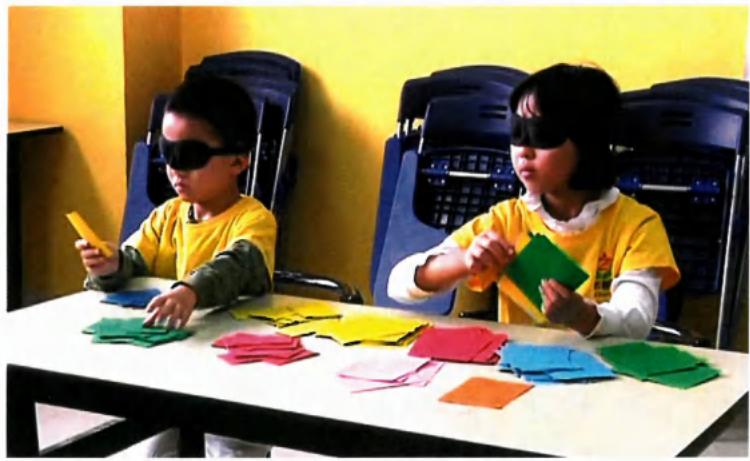
Blindfolded Color Recognition Card
Some children have unstable states; they may be able to identify well in the morning but not in the afternoon, or be able to do it today but not the next day. Others may progress slowly, where the identification of each color card makes one feel there is no confidence, and it takes a long time. For these students, you must be patient. Depending on the situation, you can conduct visual training again, provide more guided meditation exercises, and conduct attention training. Generally, once attention has improved to a certain extent, proceeding with ESP training will yield very good results.
If the accuracy rate reaches 100% in multiple tests over several consecutive days, we can consider the child’s blindfolded color recognition ability to be stable. Once the blindfolded color recognition ability is stable, blindfolded literacy training can be conducted. Although the state is stable and the child is generally excited and confident, it is not recommended at this time to perform demonstrations for people other than the parents.
2.6 Blindfolded Character Recognition
Children with exceptional concentration and acute perception, under the guidance of an excellent instructor, may be able to achieve blindfolded character recognition directly within a few minutes, without the need for visual training. However, I suggest that instructors not be too hasty; it is better to take things slowly. This is very beneficial for gradually building the child’s self-confidence and thirst for knowledge, especially their imagination and mental imagery ability.
Blindfolded character recognition generally starts with identifying character cards, because the characters on the cards are large and the information is relatively simple. Training should begin with simple, common, and pictographic characters. Using toddler flashcards works very well; they are available in bookstores or stationery stores, of course, they can also be handmade. Common toddler flashcards may have a picture on one side and text on the other, or a large character on one side and word combinations/sentences on the other. These are all good; how to utilize them should be judged based on the student’s situation.
The individual differences exhibited by students during touch-card training are greater than during color discrimination, so instructors must remain firm in their direction and purpose. Through the previous blindfolded color discrimination guidance training, everyone is already clear on the direction of guidance: try to get the student to generate a “brain screen” image, and then know the color information of the target object based on the brain screen information. This process exercises the nerves for touch, smell, and hearing, as well as the necessary focus and attention, rich imagination, and sense of imagery. The direction and purpose of blindfolded character training guidance are the same. When a student perceives a character card in some form, an “imagined” picture appears in their brain, and the student then uses a cognitive pattern to determine the information given by the picture, which is the result of the blindfolded reading.
Many children may see text directly on their brain screen after putting on the eye mask, so they will say directly what the character is. Instructors should still try to let the student “see” images. You can try having the image be half-picture and half-text, or having text superimposed on the picture, because our training goal is not just extrasensory perception, but more importantly to improve the student’s ability to present information like text in an image format. There may be students who, no matter what, cannot produce an image and only feel what the character is. For this situation, there is no need to be too forceful; this can also exercise focus and perception, which is equally good.
Below is a slightly more complex case for your reference regarding guidance when touching character cards:
Give the student the character card “柿” (Persimmon).
T: What do you see? S: I see an old grandma. T: Good, what is she doing? S: She is riding a tricycle. T: Oh? S: …She arrived at a vegetable market. T: Hmm. S: She picked out cucumbers and asked the boss how much the cucumbers were. T: Excellent, how much? S: The boss said two yuan. T: Hmm, very good, and then? S: The grandma bought beef again. T: Beef? S: Cooked beef, just cooked, still steaming. T: Hmm, what else? S: I can also smell the fragrance of the cooked beef. T: Touch your character card, and then? S: The grandma put the beef in the basket and walked forward. T: Hmm. S: She came to a stall again, there are many tomatoes here. T: Very good! S: The tomatoes are big and fresh, bright red. T: Touch the character card, smell it, flick it, listen to it… S: I know, Teacher, this is “Shi” (Persimmon). T: You are awesome! Open your eyes and take a look.
In this guidance, the instructor let the student imagine freely as much as possible without interfering, only constantly asking “What do you see? And then?” to let the student speak out the imagined scenes they saw. The teacher judged and then chose simple language to issue the next hint instruction. Especially when the child said many things unrelated to the test target, the instructor needed to have the patience to let the student continue free imagination and observation, while also using appropriate language to guide the student to do the training related to blindfolded reading. It can be seen from the case that this student has very rich imagination; at the beginning, the imagination might be a bit unconstrained and unrelated to the target, which can be said to be good mental imagery ability. If the goal were writing a composition, the instructor could guide the student more deeply to observe details, so that what they see could be quickly written down, possibly becoming a composition.
Before touch-card training, students must first perform breathing, relaxation, and meditation exercises to enter the optimal practice state. Start with simple, common, and pictographic characters, and characters the student knows and is familiar with. Gradually increase the difficulty of the characters after the blindfolded reading state is stable. When students reach a certain level, they will be able to capture more information contained in the characters they touch. Cases similar to the one in Chapter 1 of the Right Brain Development Training Manual where student Tianyi touched the two characters “Guangdong” and received different information (page 3) will widely appear in children’s training, requiring instructors to work hard to innovate, practice, and discover. Chinese characters are different from phonetic texts; even if they don’t know the character, children can generally describe information by looking at the brain screen, and this information always has a close similarity to the character, which also corroborates the function of Chinese characters to “convey truth through text.” Instructors and parents should pay attention to recording and accumulating some relatively special and interesting cases, reflect on them, and exchange them with peers. This is of great significance for their own growth as well as for further exploring the potential of students.
Blindfolded character recognition is not exactly the same as “ear listening” (clairaudience) or “finger reading” (dermo-optical perception). Blindfolded character recognition belongs to ESP games. This training process is not very rigorous for scientific experimental research. The purpose of ESP game training is to improve self-confidence, focus, sense of imagery, and mental imagery. “Ear listening” and “finger reading,” on the other hand, are much stricter in their operation; their purpose is to deeply develop and study human paranormal functions, so the methods of experimentation and testing are different. Related issues will be discussed later.
Blindfolded character recognition is achievable for most school-age children, but individual differences are greater than in blindfolded color discrimination. A very small number of children may stagnate or even stop here due to various reasons; instructors and parents do not need to feel entangled or depressed about this. Just believe that everyone will make the best choice. Of course, for most students, preparation for entering subsequent training will soon begin.
2.7 Follow-up training for “Superpower Children”
Children are easily induced to develop special functions, which may be related to the plasticity of the brain. Around the age of 10 is when a person has the most neural connections in their life; plasticity at this time is extremely high. When the brain at this age receives a signal, it can have many transmission paths, meaning that a mindset has not yet been formed. Children around 10 years old, with just a little training to let their neural signals travel to a specific pathway or node, can have their potential functions stimulated. However, as age increases and knowledge grows, some neural pathways or nodes may become blocked, mindsets gradually form, brain plasticity decreases, and it becomes increasingly difficult to bring out potential. 10 years old is the peak period for plasticity; basically, whatever you give a child, they will absorb it. This does not mean that it is impossible to induce functions after the age of 14, only that the training time may take longer. Just as the Japanese educator Hisayoshi Kimura proposed in the book Early Education and Genius the “Law of Diminishing Potential,” which means that potential is innate and gradually lost with age; the later it is developed, the harder it is to bring into play. Therefore, potential development education must bring out every child’s potential as early as possible.
There are many neural nodes in the brain. When signals are transmitted, they are actually looking for pathways through neural nodes. Frequently used neural pathways will become more and more accustomed to being used, while infrequently used neural pathways will slowly be abandoned, and the available neural pathways will decrease. A person has many more pathways in infancy than in adulthood. Originally there might be 100 paths, but they are only accustomed to taking 10 of them; many neural pathways are no longer used and slowly become desolate. If all 100 pathways are often traveled, then all 100 are open. What we call brain development is letting more neural pathways remain in an activated state.
370 years ago, the modern science master Descartes believed that human potential operates in the pineal gland. The pineal gland undergoes calcification with age. If the pineal gland is truly the command center of potential, it is active in childhood, and as it calcifies with age, it loses its function. For those developing potential, through continuous use, the pineal gland is constantly stimulated, so that even at an older age, they can still retain their potential. This statement has not been confirmed by scientific experiments, but potential does indeed exhibit the phenomenon of “use it or lose it.” Regardless of the reason, developing at the best age and persisting in training is the best choice to maintain this ability.
The complete curriculum setting and follow-up training depend on the guidance orientation of the tutoring institution, which we will discuss later. Here, we mainly discuss the content of other ESP game training.
When the state of blindfolded touch-reading of word cards is stable, gradually one can perceive the information of the word cards without the aid of tactile, olfactory, auditory, and other organs, simply by placing the word card in the position where books are usually read. At the same time, the characters to be identified can be gradually made smaller, from the large characters on the cards to title text, and then to the small text in the body of books and magazines. At the beginning, it may still be necessary to use finger touching to assist in positioning and recognition, just like a child pointing with their finger when reading. Before long, blindfolded reading will be as proficient as reading with eyes.
From deciding to accept ESP game training to being able to blindfolded read word cards, most children may only need one day. Slowing down the pace a bit to make students more relaxed and happy, three days may be enough. At the Shandong Shanglu Culture Potential Sensory Training Center, several children appeared on the first day of training who could rollerblade all over the yard while blindfolded. In many of my workshops or seminars, after instructors received simple training and practice, individual children could do almost all blindfolded ESP games on the second or third day, and it was not surprising to even achieve basic “Wave Speed Reading” or “Photographic Memory.” Many readers of the Right Brain Development Training Manual ask why there is only the class schedule for the first day, because the first day already allows most students to distinguish colors blindfolded. As we progress, individual differences among students become greater, and it becomes harder to unify the pace; one can only choose appropriate content for training based on the specific situation of the student. Of course, after most students can distinguish colors blindfolded, their curiosity and desire to win are quite urgent, hoping to enter the next stage of training as soon as possible. Generally, the progress of student practice can refer to the “Chapter 2 Right Brain Training Course Standards” in the Right Brain Development Training Manual.
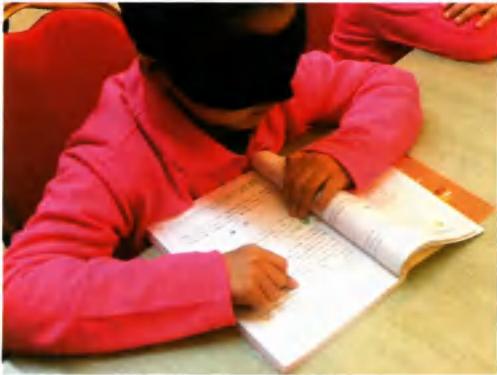 Blindfolded Reading
Meditation or imagination exercises are necessary subjects for daily class. This training can quickly make the brain enter an alpha wave state, which is a state suitable for both learning and training ESP extrasensory perception. Children are always more interested in new things, so instructors or parents need to frequently change scenarios when guiding children in meditation or imagination, otherwise, before you finish the previous sentence, they have already thought of the next guidance, the student finds it boring, and attention easily shifts. Meditation content should focus on beautiful, sunny content, considering that the content of meditation may have a certain psychological impact on the child. The guided imagery should be clear, the content rich, and images, sounds, smells, cold/hold tactile sensations can all be included in the guidance words to stimulate relevant nerves and have a positive impact on brain development. The Right Brain Development Training Manual provides a large number of guided words for meditation and imagination, some of which are cited from the book Meditation: A Magical Psychotherapy (authored by You Xuxu). Instructors should possess the ability to write their own guidance words, writing them themselves according to the student’s situation. When the student’s visualization is not strong, increase guidance on details of the scene; when the student confuses blue and green, increase color contrast and feeling; when the student is interested in science, they can visualize the process of a plant seed sprouting bit by bit; when the student is often uneasy, let the child feel sitting on a warm beach feeling the bathing of sunlight… In short, meditation scenarios should be flexible, changed often, and pleasant background music can be added to make students like listening to your guidance and follow your guidance to imagine. The duration of each meditation should not be too long; generally, 8~15 minutes is enough.
When blindfolded reading is possible, parents and instructors can let the child spend a certain amount of time reading texts or ancient poems blindfolded (see image Blindfolded Reading), while asking the child to describe the pictures they see, which is somewhat helpful for understanding articles and ancient poems. In addition, students can be asked to recite texts and ancient poems blindfolded; please note the comparison with the effects of not using ESP. If you find that the time taken to recite texts and ancient poems blindfolded is reduced, do not forget to praise the student well. Since one can read blindfolded, one can certainly do homework and take exams blindfolded. It is just that at the beginning it may be slightly difficult, but slowly one will adapt more and more. It is just that this training time should not be too long; when children are learning blindfolded, they need special concentration, and after a long time the brain will be very tired. Students should rest for about 10 minutes for every 20~45 minutes of blindfolded learning. When students start using the blindfolded learning method, they are generally willing to accept it, but the further they go, the harder it is to persist, and some students may use little tricks to deceive teachers and parents. When the student’s ESP ability reaches a certain level, instructors and parents sometimes stop taking it seriously, forget the original intention, let the child do as they please, and no longer have requirements, which is not good.
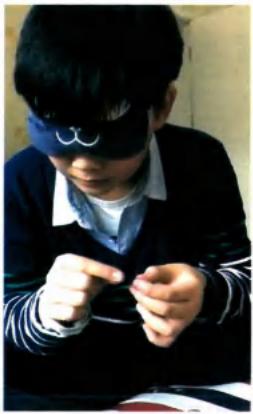 Blindfolded Threading a Needle
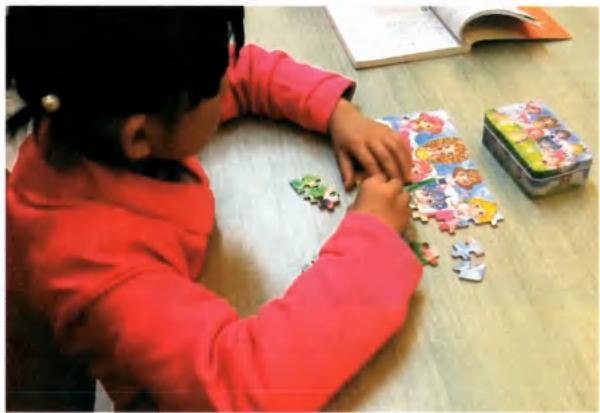 Blindfolded Puzzle
If the training is only used for content related to academic learning, the child will soon realize that the teacher’s and parent’s goal is to make them study, rather than hoping they are happier and learning is easier. Subsequent ESP game training must constantly innovate to make students constantly feel novelty. When parents see time and again that their child can do surprising things, the child will always be complacent, which makes it easy to form self-confidence. Chapter 10 of the Right Brain Development Training Manual gives nearly twenty types of games. The video The Secret of the Midbrain originally gave me the inspiration for ESP game training content. Parents and instructors should also constantly create new ways to play (as shown in images Blindfolded Threading a Needle, Blindfolded Puzzle). When designing ESP games, think about what other abilities the designed game can exercise besides the common ESP abilities. For example, the First International Sixth Sense Competition held in Hong Kong in November 2018 had five events: Blindfolded Dribble Shooting, Blindfolded Orienteering Walking, Blindfolded Orienteering Cycling, Blindfolded Memory Coloring, and Blindfolded Rubik’s Cube Restoration, which overall tested the contestants’ memory, spatial perception, and directional positioning abilities.
Below, three more examples of ESP games are listed for your reference:
- Blindfolded Restoration of the Wisdom Bead Game Puzzle (as shown in the Wisdom Bead Game Puzzle image)
Objective: To exercise hand-brain coordination, shape and color recognition, logical thinking skills, and memory, as well as to cultivate spatial concepts.
Method: After the instructor assembles a set of shapes, the instructor takes a photo to keep a record and allows the student to observe for a certain period of time (choose whether to wear an eye mask based on the specific situation). Then, the shapes are scrambled, and the student restores them while wearing an eye mask. The instructor verifies the result against the photo.
- I Do, You Learn
Objective: To enhance the parent-child bond and exercise physical coordination and sensory integration abilities.
Method: The child puts on an eye mask. The father or mother stands behind the child and strikes a stationary pose, and the child assumes the same pose as their parent.
- Blindfolded Spotting
Objective: To make students more focused and careful, and to exercise visual discrimination ability.
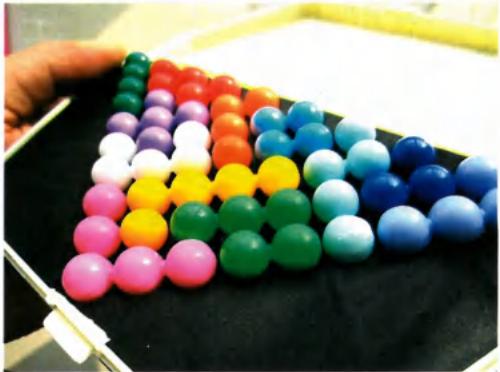
Wisdom Bead Game Puzzle
Method: The student puts on an eye mask. In the numbers below, each row contains some pairs of adjacent numbers whose product equals “18”. Focus your attention to find these numbers and draw a line under each pair.
For example: 2729183649
A29148756396471831345689876372966542128
B 91762934928765314215262518578079126536
C 12843678192345671521618613654795248463
D33647382914567349121298265198295738273
E51928774675370988018320324659353687536
Some institutions also include “Light Pulling” (La Guang), clairvoyance, and remote sensing in subsequent training. The term “Light Pulling” comes from a technique originating in Taiwan; it manifests as no longer needing to touch flashcards with hands, but viewing card information from a distance of a few meters to tens of meters. It can also be referred to as close-range remote viewing or remote sensing. True “remote viewing” belongs to the category of paranormal abilities (superpowers), allowing one to perceive target information from kilometers or even thousands of kilometers away. Clairvoyance involves using the naked eye to observe human internal organs, meridians, and the flow of Qi within the body, as well as observing target information through walls or other objects. Finger reading and ear hearing are forms of clairvoyance and also belong to paranormal abilities. As a field of human science research, experiments on ESP (Extra Sensory Perception) such as clairvoyance and remote viewing are very rigorous. The “clairvoyance” in some tutoring institutions cannot distinguish whether students are truly seeing or imagining it, and improper guidance can easily lead children to form false beliefs, deviating from the purpose of ESP game training.
In the process of developing children’s potential, it is only meaningful if parents and society can see the entire process and understand the purpose of every teaching design. The November 2018 special report “How Super Kids Are Made” by Guizhou Television (see video) typically represents the current views of local media and the majority of people. As instructors and potential development enthusiasts, we should understand and analyze this objectively.
How Super Kids Are Made
After watching this video and comparing it with the previously seen “The Secret of the Interbrain” video, it can be seen that different media, medical workers, and psychologists all hold different views. Although the total denial in “How Super Kids Are Made” is relatively common in local media, the criticisms of potential development by CCTV mostly target problems in the commercial operation process, such as high prices and exaggerated promotion. Apart from knowing the mainstream views of society on phenomena like blindfolded reading from the video, potential development institutions can also learn about the teaching situations of training institutions that have been exposed. More importantly, it provides inspiration for doing their own work solidly.
For trainers, ESP games are, as previously discussed, a way to improve self-confidence, concentration, image sense, and visualization power. Wave Speed Reading should also belong to the ESP game category, but since the perception of information in Wave Speed Reading can be deep or shallow, we will discuss it later. For people who have never seen ESP games, seeing them for the first few times is very shocking, and they dare not believe it is real. “How is this seen?” This question will linger in the mind for a long time. Indeed, how is this seen?
2.8 Where is this seen?
If you personally witness a child go from identifying colors while blindfolded to being able to play various ESP games, you will no longer doubt this potential in humans. However, at this point, many people have a new question: they want to know what the scientific principle is? How do these students “see”? To tell the truth, regrettably, there is currently no explanation that can convince everyone. There are still too many things that science cannot explain, and the simpler things are, the more this is the case.
There is a type of protozoan called slime mold. Although its name contains the word “mold” (fungus), it is neither a bacterium nor a fungus, but a type of single-celled amoeba. Unlike protozoa, the “wisdom” possessed by slime mold is unimaginable. It can start from one point and stretch out in all directions to search for food. Once a food source is found, those “tentacles” that did not find food will shrink and disappear. Finally, on the slime mold’s foraging network, only those lines and nodes that have food supply and can effectively transmit nutrients remain. Biologists have discovered that they not only can navigate mazes and possess learning abilities, but can even simulate artificial transportation network layouts. Tokyo’s railway system began operation in 1872, with the first railway connecting Tokyo and Yokohama. It took engineers more than 100 years to optimize this railway system into its current state, but the slime mold took just a short 26 hours to achieve equally efficient results, even more resilient than the Tokyo railway (as shown in the figure). And all of this is accomplished on the premise that the slime mold has no nervous system and no brain (see video “NetEase Open Course: What Humans Can Learn from Semi-intelligent Slime Molds”).
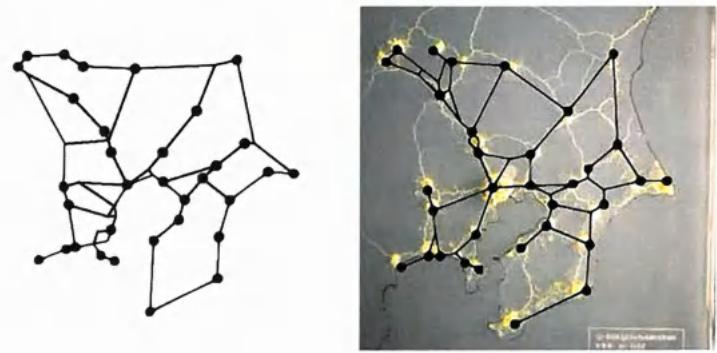
Left: The Tokyo railway network built by humans; Right: Built by slime mold
These brainless creatures figured out the railway network that took humans a century to plan and design in just 26 hours. If you ask what the scientific principle is, the answer is biological instinct. The problem is that blindfolded reading is also a human instinct, but to some people, this seems unscientific and is a deceptive trick. The Buddhist scriptures long ago gave answers to these questions: “Strange! Strange! All sentient beings possess the wisdom and virtuous characteristics of the Tathagata, but cannot attain them due to delusions and attachments.” Life is just like this; it has its magical and incredible aspects. If one insists on figuring out exactly how it works from a scientific perspective, we can only wait for it to be explained gradually.
NetEase Open Course: What Humans Can Learn from Semi-intelligent Slime Molds
Many animals have an organ called the vomeronasal organ (also known as the pheromone detector). It is a special sensory organ. Animals can collect residual chemical substances drifting in the air through the vomeronasal organ, thereby judging the other party’s gender, whether there is a threat, and even using it to track prey or predict earthquakes, etc. This is the “sixth sense” that people often say many animals possess. Unlike other mammals, the human vomeronasal organ is highly degenerated. In fetuses and newborns, the vomeronasal organ structure is obvious. Newborns also seem to be able to find the breast through pheromones emitted by the mother’s nipple, just like the offspring of other mammals. However, as the infant grows, the vomeronasal organ gradually degenerates. Anatomy performed on 564 adults showed that 70% of people do not have a vomeronasal organ structure, and the remaining 30% also have highly degenerated vomeronasal organs. ① Based on its sensory characteristics, some proposed calling it “olfactory-like” or “emotional sense”—a sensation that directly affects people’s feelings and emotions; the foreign term is “pheromone sense”. Therefore, this “sixth sense” of animals is obviously not the “sixth sense” we commonly refer to; there is still a big difference between the two, and what is seen in the blindfolded state cannot possibly come from the vomeronasal organ.
Previously, we said that the “brain screen” is an important channel for most people to obtain information related to the target object, and the information presented by the “brain screen” seems to have a certain connection with the pineal gland, the Niwan Palace, or the diencephalon. Lee Si-chen, former president of National Taiwan University and professor, conducted a series of experimental studies on the data of children’s brain screen imaging during finger reading through technical means such as cerebral blood flow and brain MRI scans. He discovered that when the subject’s brain screen presented an image sensation, the active cerebral cortex was in the same area as when the eyes saw an image, namely the occipital lobe of the brain. Before the so-called third eye opens for finger reading, voltage appears on the hand, indicating that brain discharge is transmitted to the hand. At this time, using a Doppler ultrasound velocimeter pressed against the temple to measure the blood flow velocity of the cerebral artery, the blood supply to the brain instantly drops by 20%. This is different from using the eye’s normal visual system, indicating that there is another visual system inside the brain. Lee Si-chen also found that the brightness of the “screen” inside the subject’s brain determines the accuracy of finger color identification. And the brightness of this “screen” is because he “sees” light, which illuminates the “screen” inside the brain before seeing the color, indicating that the two visual systems have a strong interaction (see video: Lee Si-chen Lecture “Human Body, Mind, and Spirit Science”). This point is different from our blindfold training, because when doing finger reading experiments, the target character is sealed, so one can keep eyes open. In blindfold training, to make the student’s brain screen clearer, we generally train the student to make the brain screen or the imagined light ball brighter and larger.
Lee Si-chen also found that the color sensation of the screen inside the brain is not exactly the same as the colors of normal vision. In identifying the seven colors of red, orange, yellow, green, blue, indigo, and purple, it was discovered that the brain’s specific vision (referring to looking through the brain screen) is exactly the same as normal vision for identifying colors with longer wavelengths like red, yellow, and green. However, for identifying colors with shorter wavelengths like blue and purple, the brightness seen by specific vision is weaker than that seen by normal vision, meaning specific vision is less sensitive to blue and purple. When there is red light interference, the blue seen on the brain screen turns green, meaning the identification of red, yellow, and green colors is almost the same for normal vision and specific vision, but there is a slight difference in the identification of blue and purple colors. When using specific perception, one loses the color constancy that normal vision should have, and it shifts towards red light, with blue being severely interfered with. “This indicates that there is another pair of eyes in our brain. Besides the normal two eyes, it is the third eye that has been legendary since ancient times. It is right inside our brain. Once opened, it is almost the same as our normal vision, just a tiny bit different. The identification of colors is almost the same, so strange phenomena like finger reading are using another pair of eyes, not the normal two eyes.” ①
Eye, ear, nose, tongue, and body are called the five human senses, corresponding respectively to the five perceptions of form, sound, smell, taste, and touch. Generally speaking, the perceptions of the five senses do not communicate with each other. Many scientists’ research shows that the five senses are independent of each other; visual impairment will not affect hearing, and vice versa. Therefore, most people probably think that the five senses have corresponding cerebral cortex areas to process related perceptions, and they are relatively independent. However, in April 1996, the world’s most authoritative scientific journal “Nature” published an experimental report. Scientists used Positron Emission Tomography (PET) and regional cerebral blood flow measurements to discover that when experienced blind people touch Braille, the visual cortex area of the brain will have an excitatory response. This was the first time the scientific community discovered that when blind people touch Braille, tactile signals are transmitted to the visual cortex, appearing to be a phenomenon of intercommunication between different senses. ② This is probably like the “conversion of the six roots” mentioned in Buddhism; many Buddha statues have eyes painted on the palms and soles of the feet, indicating that every part of the Buddha’s body can see the boundless world, possessing the function of a thousand hands and a thousand eyes.
Blindness is mostly caused by problems with the eyes or the optic nerves connecting the eyes to the brain, but the visual center of the brain in blind people is mostly still normal. Research from the Eye Center of the University of Pittsburgh School of Medicine shows that the visual center of congenitally blind people can be stimulated by the ear sense. Foreign scientists are now committed to researching the transmission and reproduction of visual information perceived by non-eye senses, such as converting information perceived by non-eye senses into visual information and projecting images onto a screen like AR (Augmented Reality technology). However, it is also a fact that blind people can regain their sight through ESP technology. In the 1990s, Liang Guangxiang, the inheritor of the China Mingjing Gong, opened non-eye vision for some blind children in a school for the blind, enabling blind children to “see” bright colors. After 2010, Liang Guangxiang also guided some institutions to conduct potential development training for blind children (see video “Blind Children Regain Sight After Potential Development Training”). Currently, one of the initiators of the International Sixth Sense Competition, Wu Zhengbing (original name Wu Zhengbin) of Huanlu Education, is committed to the cause of “New Light” for blind children, helping blind children train for independent survival abilities. Through sixth sense potential development, blind children can achieve free walking without guide dogs or canes, and can also ride bicycles, play ball, draw, etc.
All of this demonstrates that it is possible for the five senses to communicate and convert into one another. Buddhism also states that if an Arhat cultivates the Four Dhyanas and the Eight Samadhis, and develops supernatural powers (Sidhi), the six bases (faculties) can intercommunicate and share functions. Whether through touch, smell, hearing, or other modes of perception, if the information obtained is presented on a “screen” in the brain, scientists engaged in Humanistic Science research call this the Screen Effect. The appearance of the Screen Effect indicates that the brain has the ability to analyze, organize, and present chaotic external information. Once this ability is present, it can be exercised in different ways to increase brain function, gradually completing the connection pipeline between the brain and external objects. Of course, as mentioned earlier, this Screen Effect is not the form in which all students obtain extrasensory information; there are also some people who cannot summon the screen, yet for unknown reasons can accurately perceive target information. For this situation, we also believe that through exercise, the brain’s perceptual power can be similarly enhanced, though the specific reasons may take scientists a long time to reveal for us.
Blind Children Regain Sight Through Potential Development Training
The five perceptions of form, sound, smell, taste, and touch are indispensable basic abilities in our lives. They were formed over hundreds of millions of years of evolution as human beings as biological organisms and are innate to us. Extrasensory Perception (ESP) is currently in a marginalized state; it is unknown whether it is about to be lost through natural selection or if humanity is on the verge of a massive evolution in intelligence. Perhaps this ability is currently at a crossroads between being discarded or selected. Regardless, the exertion of this extrasensory ability is very easily constrained by various factors, such as the environment (light, noise, etc.), emotions, stress, and poor physical health (including the female menstrual period). Most ESP functions follow the rule of “use it or lose it”—if you don’t use it or practice it, it disappears; the more you use it, the clearer it becomes. It improves with use and fades with disuse. If left unused for a long time, the function will disappear. This is especially true for abilities developed through后天 training; without practice, the function will vanish. This is just like a person who has lain in a hospital bed for months; even when they can finally get out of bed, they still need exercise and learning to walk. Similarly, if one learns to drive but then does not drive for a long time, driving again will require a relatively long period of relearning and adaptation.
In the first issue of 1987, the Journal of Somatic Science Research (人体特异功能研究) published an article titled “Four Years of Exploration in Inducing and Training Special Functions in Youth” by Shao Shenglai, Zhu Yiyi, et al. It wrote: “Since Chen Shouliang and others at Peking University discovered in 1979 that special functions can be induced in elementary school students, large-scale induction experiments have been carried out on elementary school students across the country, with a success rate of 50% to 70%. The earliest group of children with special functions has also grown into teenagers or young adults; some have lost their functions, but others have seen improvements.”
The functions and levels of ESP ability developed will vary; not everyone who develops them will reach what we consider a very high level. This is just like how some people are good at art, some at music, and some at martial arts. Similarly, among those who can paint, play music, or do martial arts, some will become masters while others will remain amateurs. There are many factors involved. Potential abilities also differ; we cannot demand that everyone become a master. Individual treatment and teaching according to aptitude are required.
Although school-age children who can achieve blindfolded color discrimination and blindfolded reading account for over 90%, there will still be children who cannot do it. The reasons are complex and diverse. But one thing that can be confirmed is that whether one can perform functions like blindfolded color discrimination has no obvious relationship with the child’s intelligence or academic grades. Belief is one of the important factors determining whether functions like blindfolded color discrimination can be realized. It is precisely for this reason that younger children, with simpler thinking, who trust their teachers and parents, are more likely to activate these functions. Therefore, the secret to successful activation is eight characters: Simply Believe, Listen and Obey. People like to get to the bottom of the causes of things. Whether it is the “Triune Brain” theory of the reptilian brain and interbrain, or the theories of the pineal gland or the Niwan Palace, they all avoid the neuroscience conclusions regarding the function of the brain’s neocortex. Humanity’s unparalleled cerebral cortex enables us to process and synthesize information from various senses simultaneously, rather than being manipulated by a single sense. However, when using abilities like ESP, the trick to successfully realizing these potentials is to try not to use the brain to analyze, judge, or think. Just like the following little story:
A small child was lying on the ground watching a bug with many legs, feeling it was magical. There were so many legs they couldn’t be counted, yet all the legs cooperated very tacitly. The bug walked methodically on the ground, turned freely, and was at ease. The child said to the bug, “Mr. Bug, you have so many legs, which leg do you lift first when you walk, and then which leg do you lift next?” The bug heard the child ask, hesitated for a moment, went “pa,” and flopped onto the ground, unable to walk. It turned out that this bug didn’t know how so many legs were freely coordinated either. When it thought about this question, the bug suddenly didn’t know how to walk, and it fell down immediately.
People always hope to have a cause and reason to convince themselves, often this reason is not necessarily the fact, the key is that they believe it themselves, and once they believe it, their hearts are at ease. Li Sicen has had some hypotheses; let’s see if they can convince you.
“To explain the phenomena of finger reading and psychokinesis, I once proposed a theory of the unity of mind and matter, believing that the third eye in the brain, in a functional state, will produce a kind of physical phenomenon, forming a kind of macroscopic fluctuation that penetrates physical barriers to explore the surrounding world. This fluctuation will emerge from every part of the body, therefore there are phenomena such as hearing words with the ears, reading with fingers, reading with armpits, reading with soles of the feet, etc., where every part of the body can read. This macroscopic fluctuation will attempt to interact with the world surrounding the body, such as a folded paper slip in the hand. Once the interaction is successful, the paper slip is also induced into the same physical state, creating the phenomenon of the unity of mind and matter. At this time, the celestial eye in the functioner’s brain opens, the character or pattern information on the external paper slip flows into the brain and is presented on the celestial eye, and the functioner can clearly see it.” ① This theoretical hypothesis regarding the Spin Field involves a lot of obscure physical knowledge, which may make people fall into deeper confusion, but may also make people feel it is very scientific.
When encountering the unknown, people will first try to use the known to explain the unknown. Facing unknown phenomena that cannot be explained, we will instinctively feel uneasy, fearful, and resistant, because our subconscious lacks a program to deal with them. The situation we encounter now is that neither existing neuroscience nor physical theories can perfectly explain these phenomena. If these phenomena cannot be explained by various existing knowledge, we must learn to respect them, regardless of whether the surface of the phenomenon seems absurd or bizarre. The reality is not so simple; theories found online are often fabricated by certain manipulators for certain interests, and some even completely distort existing science, yet they are accepted by many people. In addition, some people are too “superstitious” about science; if current science cannot explain it clearly, they judge it to be pseudoscience. For these phenomena, we can only think that believers will always believe, and non-believers will never believe, waiting for time to prove everything. The best way we can avoid people not believing is to let more people participate in the courses and watch how students realize these abilities step by step.
2.9 Adults Also Want to Be Supermen
Children are able to develop these potentials, which is related to their neural development and mindset. Seeing many children possess this magical ability, many adults ask if adults can also practice and achieve it; my general answer is that it is difficult. Adults’ thoughts and psychology are much more complex than those of children under 12. As mentioned before, the eight-character secret to successful activation is: “Simply believe, listen and do.” It is truly too hard for adults to follow these eight words. Moreover, many people are obsessed with achieving blindfolded character reading; the more they think about the desired result, the more attached they become. This enters the realm of “Greed, Anger, and Ignorance” (greed, hatred, and delusion) as described in Buddhism, making it even harder to achieve the desired result. On the contrary, those with simple minds and open hearts find it easier to activate such abilities.
At a seminar, a 47-year-old lady accompanied her daughter, a graduate of a teachers college, to the meeting. Because they arrived a bit late, they missed the guided demonstrations of vision training and blindfolded color card training. Therefore, after the meeting ended, I communicated with them privately. While I was explaining to them how to guide the process, the lady closed her eyes to visualize. Seeing that her state was very good, I casually took color cards and handed them to her one by one. As a result, she identified every single one correctly. I then handed her two character cards. Although it took a little longer, the image she visualized conveyed exactly the same meaning as the words on the cards. This surprised everyone present. I had previously met several masters of Buddhism and Taoism and knew they had abilities even more profound than blindfolded reading. But at the seminar, I didn’t expect an ordinary person of such an advanced age to so easily know the information on the cards through visualization. I was very curious about this lady and felt that either she was born with special powers or she had practiced Qigong to a certain level. She told everyone that she was a doctor and had no special powers, but she had been a devout Buddhist since childhood and would spend a few months every year in Buddhist temples in Tibetan areas. Thus, it was not surprising that this lady could identify color cards and read characters while blindfolded.
Above, when talking about this lady, I used the word “visualization” (Guanxiang). The term visualization originates from Buddhism; for example, the various visualizations of the Esoteric sect and the contemplation of skeletons all start with “differentiated images” of consciousness. ①In our potential development, we can also understand visualization as mental imagery. If a child has the ability of mental imagery, there is a high probability of developing the ability to read characters while blindfolded. Therefore, the mental imagery we speak of is imagining an object in the brain, such as an apple, and seeing the image of the apple in the brain, while there may not necessarily be an apple in front of you, and usually the eyes are closed. The image of the apple created out of nothing in the brain must feel exactly the same as seeing a real apple with the eyes. The situation for adults forming mental imagery ability is more complex. For example, images in dreams can be colorful or black and white, clear or blurry. Most things in people’s dreams are not very clear and not bright. Dream imaging ability is related to mental imagery ability. Mental imagery is the foundation of visualization, and most people’s visualization ability needs to be trained and improved to be re-acquired.
There are a few adults who possess visualization ability. The group with the strongest ability in this regard is artists; almost all painters, especially, have visualization ability, and architects also seem to have this tendency. That is to say, people who are very sensitive to images, emotional people, and people with strong image thinking seem to possess this ability. For them, this ability is innate. They assume that everyone is the same and do not feel that they are different from others. Once they know that others do not have such ability, they are extremely surprised. Just like people who often have colorful dreams think others are the same, not knowing that more dreams are black and white. People who study music also have stronger visualization ability than the average person, so among adults, artists are more likely to develop ESP (Extra Sensory Perception) ability. I once developed blindfolded reading ability for an 18-year-old girl who had just finished the college entrance exam. She had been learning to play the Guzheng since she was little. The activation process was as simple and smooth as that of a 10-year-old child, while several other peers of hers could not even find the feeling of the “brain screen.”
Although it seems difficult, everyone still hides huge potentials. For example, telepathy can be induced in everyone in a certain environment. In the famous psychological writer Wu Zhihong’s book The Body Knows the Answer, there is an article titled “Cultivating Your Sixth Sense,” which talks about his experience practicing telepathy while taking a Family System Constellation course:
I once spent a week in Shenzhen studying Family System Constellation. The instructor was Zheng Lifeng, a senior therapist from Hong Kong. On the afternoon of the 27th, he asked us to do a small exercise:
Several people formed a group, and everyone took turns telling stories. The storyteller had to tell a sad story and a happy story, each for about two minutes, in no particular order. They just had to tell it with their heart, without making a sound. The listeners had to close their eyes or turn around to “listen” to the silent story. After the story was finished, the listeners had to judge based on their feelings which of the two stories was sad and which was happy.
When Teacher Zheng assigned this homework, I felt a bit uneasy. Being able to understand the other person’s heart voice in this way, isn’t this telepathy? Telepathy is very mysterious. Although I have encountered such things, they all had some special conditions. Could I sense other people’s heart voices in normal times?
The beginning of the practice seemed to confirm my worries.
There were 6 people in our group. I was the first to tell a story. I first talked about the happiest thing in the last few days, and then talked about a very sad thing during this period.
As a result, among the 5 listeners, only one person heard my heart voice correctly, while the other 4 guessed wrong.
But afterwards, we almost all heard the storyteller’s heart voice correctly, and 4 times we were all correct.
In the last time, the storyteller suddenly changed the original setting of the exercise. The stories were no longer happy and sad, but peaceful and angry. Moreover, she completely stopped “telling”; her lips didn’t move at all, and she didn’t use language to organize the story in her brain, but just imagined. She first imagined a peaceful natural beauty, and then imagined anger. As a result, everyone felt the difference, and one student clearly captured her heart voice, saying that the first story made her feel peaceful, while the second story made her feel anger.
These six rounds of experience completely smoothed out my initial worries. I began to think that telepathy is actually so simple.
This was not only the experience of our group, but also the common experience of the whole class of more than 30 people. A lady said that her skin was very sensitive. When listening to the story, she sometimes felt a warm wind, and sometimes felt a gloomy wind. When listening to a story, she felt the coldest gloomy wind. Afterwards, it was found that this story was about the tragic story of the “5.12” earthquake.
A man’s heart was relatively sensitive. He said that when listening to the story, his heart would sink for a while and rise for a while. This was the basis for him to measure the sadness and happiness of the storyteller. If it sank, it was naturally sad, and if it rose, it was happy. However, he found that this judgment was the result of natural reflection. He could not judge actively, or in other words, he could not start thinking first, because as soon as the brain thought, this delicate and weak feeling could not be captured.
This exercise, like some so-called adult pineal gland activation courses on the market now, requires long-term breathing training or other guided training, constantly letting go of judgment, analysis, and thinking, allowing students to completely trust the surrounding people and environment, and entering a state of relaxation, emptiness, and focus. At this time, human latent and sensitive perception abilities will appear, thereby developing ESP abilities to varying degrees. In most so-called adult pineal gland activation courses, the ability levels achieved by all students are not the same. Even students in the same period often have very large differences. No matter what method is used to get people into a sensitive perception state, the method of perceiving external information is to see it through the brain screen or intuitively perceive the information. Different courses use different methods to open the brain screen. Some use color cards to open the feeling of the brain screen, some use yoga or Qigong methods to open the brain screen, and some use music to open it. One thing is certain: in the short term, the images presented on the adult’s brain screen are rarely as clear and bright as those of children. It is not easy for the brain screen of most adults to present images at will. A trick is to “forget what you think you know.” When adults can do this sentence, they stand at the door of the potential world.
In the 1980s, the study of human body science in our country, which researches human special functions, had just started. There was an urgent need for a large number of people with human special functions for experimental research, so many institutes tried to hold special function training classes among college students and other adults, inducing a large number of young people who could specially perceive information.
For example, the Shanghai Human Body Science Research Association and the Shanghai Universities Joint Research Group on Human Functional State held a “Human Functional State Summer Induction Training Class” in July and August 1983, targeting students and young teachers from Shanghai higher education institutions.
Training proceeded as follows: Before training each day, a Qigong instructor would first lead the students in practicing Qigong. Students generally reported that through Qigong exercise, they felt a sense of happiness, emotional stability, and ease in concentrating their thoughts. Before distributing the first test samples, it was clearly explained to the students that the samples consisted of two-digit numbers from 10 to 99. It was emphasized that they should not guess but should focus their attention on “thinking.” After about 15 minutes, various numbers would generally flash before the forehead. If a number appeared frequently or appeared very clearly, it was often the number on the sample. This made the students feel they had a guideline to follow and made it easier to grasp the rules for entering the special functional state. There were 28 students in total. 16 students persisted with more than 10 training sessions (one hour each). The vast majority complained of sensations such as “numbers jumping in the forehead area” or “numbers flashing from time to time before the forehead.” ①
Student Self-Report (Wang ××, Male): I am a graduate of the 1981 class of the Shanghai Fisheries College, currently staying on to work at the school. I am 24 years old. This summer (1983), I participated in training for the induction of human body special functions. Through one month of induction training, I currently possess the preliminary function of recognizing objects via non-visual organs.
My process of recognition via non-visual organs generally proceeds like this: When I receive the sample, I attempt to quiet down, cast aside all distracting thoughts, and focus my attention on the sample. Then, I look at a solid-colored object, such as the floor or a wall, but my eyes’ focal point is not on these objects, so a blurred, solid-colored background appears before my eyes. After a while, a jumping/flashing figure lighter than this background color will appear on this surface; when the figure stabilizes, it is a success. If I wish to know its color, I focus my attention on the color, and after a while, the figure will display its color.
I gained some insights and feelings during the induction training: (1) Quietness. During recognition, first, the environment must be quiet; this has a significant relationship to success. A noisy environment causes annoyance and makes it difficult to concentrate attention. Secondly, the brain must be quiet. During recognition, one cannot let one’s mind wander, though it does not mean one cannot speak or do other things. (2) Concentration. This means attention must be focused. The part of the brain where attention is focused is the forebrain; for me, it is generally the right forebrain, possibly between the right frontal pole and the frontal lobe. Next, attention is focused on the sample. From my feelings during many practice sessions: we do not have visual organs in certain parts of our body; rather, as long as our attention is focused on the sample, it is unrelated to where on the body the sample is placed. I have succeeded with the sample placed on my hand, inside my ear, or on the table beside me; it is just that when placed in certain parts (like inside the ear), attention is easily concentrated, and the recognition speed is faster. (3) Recognition. This means recognizing correctly; there cannot be a feeling of guessing, nor can judgment be added. What is seen is what it is.
During the training period, I also felt some strange phenomena; for example, I was never successful in recognition at night…
Chen ×, Male, 19, Student majoring in Medicine, Shanghai Second Medical College
Student Self-Report: During the first two days of induction, although I felt there were characters jumping in the frontal lobe, because there were many things jumping and they were very blurry, I could not be certain which was correct. The results I spoke of differed greatly from the actual characters, without any similarity.
In the following days, I was gradually able to see more clearly. At first, I only felt something flashing before the forehead, like looking at a kaleidoscope spinning very fast, and then it was gone. Very quickly, a patch of bright stuff would flash. When I wanted to look carefully, the thing had already passed by. Afterwards, it reappeared several times, but because it appeared suddenly and disappeared quickly, it was very hard to see clearly. However, the results I spoke of gradually matched reality. With continued training, the accuracy rate became higher and higher.
This character recognition function is very unstable and is influenced by many factors. Although I succeeded in recognizing characters clearly several times, these instances were almost always when my mood was relatively happy and my confidence was high. When I was physically unwell or in a bad mood, there was no feeling of characters in my mind at all. Also, excessive nervous tension, muggy weather, etc., affect recognition. When several of us recognized characters together, we influenced each other. Sometimes, when everyone thought it was a certain character, but in reality, no one held that character, everyone thought of it simultaneously. Sometimes, everyone thought of the character on one person’s hand. When several of us recognized one sample simultaneously, even without touching the sample, the result was recognized much faster than by one person. Sudden changes in the environment also affect recognition, such as a change of venue, excessive noise, etc., making it difficult to concentrate thoughts, thereby affecting recognition. Additionally, in this induction training, practicing Qigong for half an hour each session had a certain effect on recognition. Through Qigong exercise, people can more easily enter that “state.” Practicing Qigong involves a series of so-called “entering stillness” stages—relaxing muscles, regulating breathing, controlling thoughts—and then entering the Qigong state. Just after finishing Qigong, a person feels a sense of comfort; at this time, the mood is relatively happy, emotions are relatively stable, and there is not as much nervousness, so during recognition, the speed is also faster, and the accuracy rate is somewhat higher. Through Qigong practice, one is also able to quickly concentrate thoughts, stabilize emotions, try to eliminate those factors unfavorable to recognition, and improve the speed and accuracy rate of recognition.
Nowadays, in so-called adult pineal gland activation courses, most students are driven by curiosity to learn. Moreover, the purpose of opening such courses is often merely for profit; some instructors do not have much of a sense of mission, let alone archives of teaching research. For adults, if they are learning merely out of a curiosity-seeking obsession, yet cannot clearly explain whether this learning will elevate their level of life consciousness, I am strongly opposed to being obsessed with functional training.
In Gao Ming’s book Geniuses on the Left, Lunatics on the Right, there is a dialogue record titled “Trepanation.” A smart-looking man, dressed smartly and clean, who appeared wise and intelligent, was very eager to undergo trepanation (also known as head perforation, which involves drilling holes in the scalp and skull; it was a folk therapy in 18th-century Europe. Many tribal mystics believe that drilling holes in the skull can enhance sensory perception.) According to his research, about one-third of the people who underwent trepanation gained special abilities shortly after surgery. “Some people can see ghosts and spirits, some can foresee the future, some received a certain kind of summons, some obtained abilities like apportation (fetching things from thin air), others gained extraordinary wisdom, and there are even records of flight.” Whenever he talked about these, his eyes would reveal determination and excitement.
When this ability seeker saw the author again about three weeks after the trepanation, his hair was messy like grass, his expression flustered, his sickly eyes full of anxiety, and he had the aura of a fugitive. He fiercely smoked one cigarette after another, recounting the terrifying things that happened to him: ghosts filled places where light couldn’t reach, and something unknown was constantly digging out his internal organs, making the sounds of organs tearing and nails scratching bone, and it would look up and stare dead at people…
However, when the author found the doctor who performed the trepanation surgery on this ability seeker, the doctor said that because he was afraid of an accident, he did not give the patient a trepanation; he only created a skin wound and shaved down a small piece of skull. Therefore, no substantial perforation surgery occurred at all; the patient belonged to a complete case of self-suggestion. The only place for this ability seeker is a psychiatric hospital.
This dialogue record easily reminds one of the text “Lord Ye Loves Dragons” (Xinxu [Han Dynasty]) learned in elementary school.
Lord Ye, son of Gao, loved dragons. He carved dragons on everything, painted dragons on everything, and decorated his rooms with dragon carvings. So the heavenly dragon heard about this and came down. It poked its head in at the window and left its tail in the hall. Lord Ye saw it, turned and ran, and was scared out of his wits, losing all color in his face. This shows Lord Ye did not truly love dragons; he loved what looked like a dragon but was not a dragon.
Translation:
Lord Ye, son of Gao, loved dragons very much. Dragons were painted on the utensils he used at home, and both inside and outside the house were carved with dragons.
The true dragon in the heavens heard about this and descended from the sky. The dragon head poked in through the window, and the dragon tail dragged in the hall. When Lord Ye saw it, he turned and ran, scared out of his wits, and his face turned pale.
From this, it can be seen that Lord Ye did not truly love dragons; what he loved was something that looked like a dragon but was not a dragon.
The explanation of “Lord Ye Loves Dragons” in the idiom dictionary is: A metaphor for claiming to love something, but not actually loving it, or even fearing or loathing it.
The functions of blindfolded reading are just like this. Whether for children or adults, one must be clear that mastering these functions is not the goal; this function is merely a tool for human growth. Like the dragon, it is a totem that people need to hold in awe. Possessing a dragon is not as meaningful as having the heart of reverence for the dragon.
2.10 Children Are Peeking
Children love trying new things and like to take shortcuts when doing things; they also hope to receive affirmation and appreciation from adults and wish to become outstanding among their classmates. Adults often think that children are simple, innocent, and cute, believing that they would never deceive anyone. In reality, all children are clever schemers with their own agendas. Especially lacking the moral sense and shame of adults, to gain temporary honor, benefits, or even verbal praise, they can easily learn to lie and fake it. For various reasons, in almost all organizations, there are always suspicions of little “smart alecks” peeking and cheating. Some make funny faces during blindfolded training or performances, some wear their blindfolds askew, and some have bizarre expressions (such as screenshots from TV reports where children are suspected of cheating); overall, it makes people very uncomfortable and leads to involuntary suspicion. We have to admit that some children do indeed peek.
When a student is training on a specific item, if the training time is too long, they may feel tired due to the long duration of concentration. When an item has been practiced to the point of mastery and no longer offers any challenge or novelty, and if parents or adults have become accustomed to it such that the child can no longer gain sincere appreciation and praise from them, the child may lose interest in ESP sensory games. At this point, if the child is asked to train or demonstrate again, they are likely to figure out some kind of “technique” to deal with the requirements of parents and teachers.
Screenshot from a TV report where a child is suspected of cheating
As mentioned before, this human ESP capability is not successful all the time; it is particularly susceptible to factors like physical health and psychological state, and even natural environmental factors (lighting, noise, etc.). For example, when having a cold or feeling unhappy, it is possible for a person to be unable to use non-visual vision to perceive external information.
There is also a possibility that when a child sees other classmates can do various blindfolded training games but they cannot yet do so, they may often “create” a method to allow themselves to see.
Sometimes they don’t know the reason why they can’t get into the right state, but adults force them to practice, and deep down, adults can hardly tolerate the child making mistakes. Some children are very sneaky; they start cheating self-righteously. Adults don’t know, or if they notice something, they don’t know how to handle it, or they even deceive themselves and continue to praise the child.
From then on, the child often develops a habit of cheating or lying regarding training matters.
In fact, even top-tier masters like Zhang Baosheng, who was considered a top “Vajra” expert in the 1980s and 1990s, sometimes failed during performances, also cheated, and experienced failures and “defeats.” On the other hand, when Sun Chulin performs for the public, she never promises that she can definitely achieve anything; this is both a fact and a reflection of her noble character.
It is precisely because of these myriad situations that potential development courses like “blindfolded reading” have been attacked and suppressed by some “warriors” as if they had discovered a rat. With the determination not to stop until they are beaten to death, posing as charging at the forefront of the battle to defend science, using the world’s most authoritative rhetoric, with loud voices fearing the world will not awaken, and with the ruthlessness to kill with a single stick, they attack and suppress to the greatest extent possible.
In Taiwan, China, there is a famous figure in the fields of parapsychology and spiritualism named Zhang Kaiji. He has written nearly a hundred works, one-third of which explore spiritualism and mysticism. He has done much to debunk scams, yet at the same time firmly believes that supernatural phenomena and souls do exist, though his understanding is not that of a religious believer. He insists that potential development courses such as “blindfolded reading” are a scam. In 2011, he specifically published the book “Hard to Believe: A Great Critique of the Visiting the Gods Website Book II” to criticize Li Szu-tsun’s research on special functions. In the media, he strongly exposed the fraudulent behavior of “inducing children to identify objects while blindfolded”:
If a person’s eyes are truly, securely, and tightly blindfolded, it is absolutely impossible to see things or scenes. Since the existence of humans, no one with 100% “clairvoyant ability” has ever been discovered. Whether using cloth strips or blindfolds to cover the eyes, claiming or performing “blindfolded vision,” “blindfolded reading,” “blindfolded cycling,” “blindfolded running,” or doing any activity while blindfolded is definitely cheating and peeking. If it is claimed that developing any part of the brain can result in “blindfolded vision,” “blindfolded reading,” etc., or possessing “clairvoyant ability” or other “superpowers,” that is 100% deception. If this gimmick trick is used to recruit students and charge for teaching, it is 100% a fraudulent scam.
Zhang Kaiji issued a special reminder and warning to society and children:
For children who have participated in this kind of course and go home to repeatedly claim in front of parents, brothers, and sisters, or among school classmates, that they have superpowers like “blindfolded reading,” “blindfolded card guessing,” “blindfolded book reading,” or “blindfolded cycling”—stop messing around! What superpowers do you have? Where is your clairvoyance? You are just using cheating methods under the pretense of needing to touch, smell, or listen, peeking through the tiny gaps on both sides of your nose! Repent and change your ways quickly! Be an honest good child and stop deceiving people. Otherwise, when everyone finally knows the truth and realizes that everything was a lie, they will spurn and reject you. You will lose many, many good friends because of this! ①
Many of us have dualistic thinking: either it is true or it is false; either someone is good or bad. Traditional Chinese Medicine is accused of being pseudoscience by some science popularization workers, while developed countries in Europe, America, and Japan treat it as scientific research; some animals being able to predict earthquakes is science, while children reading blindfolded is magic; foreign children identifying color cards by hearing while blindfolded is potential, while domestic children reading blindfolded is a scam—this is very puzzling. The following two videos are one from the Guizhou TV science exploration program “Truth: The Secret of the ‘X-ray’ Prodigy” on March 22, 2011, and the other is a news report from the CCTV-4 Chinese International Channel on October 9, 2017, titled “Singaporean 8-Year-Old Girl Has Extraordinary Brain Power, Can Identify Color Cards by Hearing While Blindfolded.” The different viewpoints of these two videos are very confusing, making one unsure what to believe. I believe the emergence of opponents and doubters has positive significance for the scientific understanding of the development of potential development like blindfolded reading. They prevent people from blindly superstitiously believing in these mysterious phenomena, and they also make potential development practitioners and researchers treat teaching and experiments more rigorously, waiting for the final complete revelation of truth from a scientific perspective.

If there is no correct guidance and strict requirements in the early stages of a child’s training, nearly half of the children may exhibit the phenomenon of lifting or tilting their heads, meaning the target object needs to be placed in a position extending downward from the face and chin or tilted to the side at a certain angle. This makes it seem to others as if they are looking for a gap in the blindfold, which indeed gives rise to suspicion of peeking. When asked why they do this, students generally answer that they are “looking for light,” and without the sensation of light, they cannot see. Students all affirm that they close their eyes when wearing the blindfold, to the point that instructors have to believe them. To this end, another theory has been circulated: when the pineal gland is first opened, the external information it can receive is at a certain angle, just like the external light reflections received by human eyes have an angle. When the pineal gland is first opened, the information received may take the pineal gland as the vertex, with one side of the angle being from the pineal gland position to the chin, within a range of 30° upward in front of the body (as shown in the diagram: Perceptible range when the pineal gland is first opened). After training and improvement, the pineal gland can then perceive in all directions. This theory was likely created out of thin air by a certain organization to cope with people’s doubts, and it is probably difficult to convince everyone.
There are also some instructors who say that students train normally in the institution, but parents suddenly tell the teacher that the child says they were peeking. There are three possibilities: first, the student is telling the truth and did see it by cheating; second, the student is lying to the parents; third, if the student is very young, they might not be able to clearly describe where exactly they “saw” it from. Regarding this issue, some psychologists believe the experimental research is too crude: children are uncontrollable and will naturally fake it. The phenomenon of cheating and faking existed 40 years ago during the “ears reading” era and is a complex issue involving social, psychological, educational, and scientific aspects.
When these situations occur, some instructors are paralyzed, unaware, turn a blind eye, or even cover it up; these are all manifestations of irresponsibility. Although the purpose of potential development training is to improve students’ self-confidence, concentration, and imagination, this problem may involve form
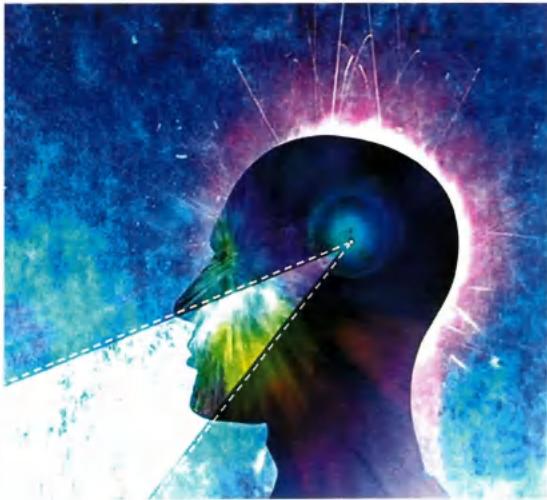
Perceptible range when the pineal gland is first opened
This is an issue concerning the principles and stance of being a person, so it must not be taken lightly. Regarding the issue of suspected cheating by children, tutors and parents should pay attention to the following points.
First, tutors and parents must be clear about their own identity; everything is for the child’s growth. They are not scientists and judges, and their stance must first be on the child’s side, which means believing in the child. If the child says they had their eyes closed, then the tutor and parent must subjectively believe that the child had their eyes closed. If there is a subjective premise of disbelief, the matter may become increasingly complicated. The case of “Little Cherry” discussed at the end of Chapter 1 of the “Right Brain Development Training Manual” is very typical. Not only could Little Cherry not recognize words or colors when her mother was nearby, but she eventually lost complete confidence in potential development. As long as she sat at the training table, she appeared irritable and had difficulty concentrating. One can consider whether the child’s initial interest in only computer and mobile phone games was somewhat related to her parents’ thinking and behavior patterns. In fact, Little Cherry’s father was always picky, highly suspicious, and half-doubting towards her mother, eventually leading to their divorce, which caused huge harm to the child.
Small children will watch insects; pay attention to stones kicked up while walking; notice reflections in puddles; see coins half-buried in the soil; when it snows, they will be curious about when to step down to make the unique crunching sound of stepping on snow; they will observe the patterns of the paving slabs under their feet. Tutors and parents may find the research on children silly, unreliable, and incomprehensible, but for the child’s growth, these are precious experiences. Adults perhaps also do not believe that children can sometimes see through the essence of things at a glance. Children’s instincts are stronger. Many children will get close to adults who like children, and distance themselves from adults who do not like children, without any prior communication or probing. Although there has been no communication, the child can always capture some clues, feed them back directly to themselves, form instincts, and do so while the brain is unconscious. Whether adults subjectively and completely believe in them, the child knows clearly in their hearts. For this trust, the child will certainly give back. If the child indeed did not cheat, the child will continuously improve their ability through training and will certainly be able to do it flawlessly, giving adults one surprise after another. If the child indeed has cheated, the trust of the tutor and parent will certainly be exchanged for the child’s honest admission. Which result is better compared to you accusing the child?
Secondly, try to avoid having students perform unnecessary displays and demonstrations. Student demonstrations are now almost the killer feature for student recruitment in every potential development tutoring institution, because such demonstrations can quickly attract parents and draw parents into the thinking range主导 by the institution, thereby guiding the parents’ consciousness to complete the closing of the deal. For students, why they are asked to perform demonstrations, even if the tutor has wonderful rhetoric, they know it clearly in their hearts. At the beginning, students often happily obey and participate out of the desire for praise and envy from their performance, but this will not be out of a sense of responsibility and obligation. After many times and a long time, students generally will no longer be enthusiastic about such things. Because they do not regard the performance as an obligation and responsibility, there may even be students who gradually raise their “appearance fee” to threaten the teacher, causing the child’s moral education to deviate. Another serious problem is that among the audience of the display performance, there will always be individual unforeseen doubts. Some doubts are undoubtedly huge harm to simple and fragile children. If this causes psychological harm to the student, the potential development tutoring institution must bear full responsibility. Doing education cannot treat children as a tool for recruitment and wealth. The student’s training process can be displayed as an open class, but those listening can only act as observers and auditors. The listeners can discuss the teaching content or process with the tutor but should not have dialogue with the student. In the tutoring institution, students can enjoy the fun brought by games such as blindfolded reading, blindfolded chess, blindfolded painting, and blindfolded homework, but when strangers arrive, they should not be eligible to casually interrupt the student’s focused training, let alone affect the student’s thoughts. The potential development tutoring institution must have corresponding regulations.
Thirdly, when students are training, tutors or parents must design the operation rigorously to avoid cheating as much as possible. Potential development training aimed at promoting learning is not conducting potential research after all, because researchers must adopt strict double-blind procedures, cut off all ways of obtaining information through normal senses, and the experimenter must ensure that the subject cannot master relevant information by cheating, and also control the problems brought to the sample by the subjective preferences of both the subject and the experimenter. The issue of cheating involves the issue of moral education, so it cannot be ignored. As a training game, double-blind procedures are unnecessary, but it is possible to avoid giving the child the opportunity to play petty tricks. In fact, it is not troublesome to operate; simply replacing the blindfolds used by students during training with full-face masks, or stuffing the inside of the blindfolds with paper towels, will have a much better effect. However, when using a full-face mask, the child’s ESP game ability may decline and need a certain amount of time to recover function.
Fourthly, integrating moral education into training courses and establishing students’ correct principles and stances is a basic principle. The training results of ESP are related to a person’s character. People who are pure in thought, know gratitude, and have firm beliefs often have better results. This book has told everyone since the first chapter that a person’s most important thing is character and quality. Cultivating a child is not cultivating from skills and knowledge, but the top priority is the cultivation of their quality. Ideological education with a righteous heart and mind must be integrated into the curriculum. For example, the first task for tutors and students every time they arrive at the Shandong Shanglu Culture Potential Sensitivity Training Center is to recite the “Di Zi Gui” (Standards for Being a Good Student and Child). Student education puts character first. Their students’ ESP abilities are far above the average level of potential tutoring institutions, and there has not been any situation suspected of cheating. Moral education is not preaching; preaching has the worst effect in student education. Let students feel that honesty brings a sense of pride. Quality education in many situations is about defeating oneself. Honesty, steadiness, and responsibility are essentially about defeating oneself. For adults, defeating oneself is the most difficult thing; for younger children, defeating oneself is relatively easier than for older children. For example, you have a piece of candy, and a 6 or 7-year-old child really wants to eat it. You say if you eat this candy you are a coward (bear), and if you don’t eat this candy you are a hero. Do you want to be a coward or a hero? If the child understands what you mean by coward and hero, most children will choose to be a hero. At this time, he is defeating himself, and this sense of honor and pride will have a positive effect on his entire life. Teenagers may more often choose to be a coward once, feeling it’s no big deal, because the thinking of children at this age is much more complex.
Of course, some people say this is inevitably too complicated; is there a simpler method? Methods need to be created by tutors according to their own characteristics. Some teachers often take photos of the children with exaggerated facial expressions to show them, making the students feel ashamed, thereby making the best choice.
In addition, it should be noted that when discovering a child cheating or lying, tutors and parents need to be calm and patient, do not lose their temper or use emotions with the child, and there is no need to be anxious. Adult fear, anxiety, and other bad emotions will only prompt the child to use more sophisticated means to cheat and falsify, making this naturally developing behavior a bad habit on the child.
Because adults’ accusations and criticisms stimulate the child’s attention to cheating, the child will apply their intelligence to cheating to practice their cheating ability. Over time, it will become a habit, and in the end, even they themselves cannot distinguish what is true and what is false. At this time, if cheating becomes a habit, it will be very difficult to correct. We must both ignore the child’s cheating and lying behavior and let the child discover that their cheating behavior does not work. If tutors and parents can treat the child’s behavior in a calm, composed, and understanding way, then cheating and unnecessary arguments can be avoided from the beginning. Children sometimes cheat because they are worried about being blamed, or because of shyness, not wanting to fail their parents’ expectations. Parents should not force the child to confess at all costs; otherwise, the child will make up more lies to justify themselves, making the situation worse.
Children cheating may also be due to parents’ distrust of them. Therefore, parents should often explain to their children and demonstrate through actions that if the child has done something wrong, they will give the child help, which may avoid cheating. Tutors and parents should be ready to forgive students at any time and help them out of difficulties, even if the student makes them angry or breaks their heart.
Chapter 3 Energy Supplementation
Potential development seems inseparable from the word “energy.” It is said that to activate the right brain, a facilitator must have sufficient energy; slow progress in children’s potential development and unstable states are caused by insufficient energy; if students learn to replenish energy, their functional progress will be rapid and robust; if a child lacks energy, right brain development training may affect their physical health; if a child has abundant energy, they can download wisdom from higher-dimensional spaces. It appears that energy is indeed crucial, seemingly determining the success or failure of all potential development. Energy is important not only for students currently undergoing potential development but also for facilitators, parents, and even everyone. Simply put, a person has energy if they possess love, self-confidence, happiness, correct values, and health; providing students with these constitutes replenishing energy. Of course, energy can also be replenished through other forms, such as light, sound, and Qi.
3.1 Energy Determines Everything
What is energy? How do you replenish energy? This has become a puzzle for countless counselors and parents. For children, as long as the pursuit of functional development is not enforced, energy is always sufficient. Children do not have too much discriminatory mind; they can treat all things in the world equally and believe in them simply. The energy channels within their bodies are very unobstructed. As long as they are happy and confident, there is nothing they cannot try. Just like the children in “YOU Talent Potential,” there is nothing they cannot learn or do. Therefore, if you want to replenish energy for children, counselors and parents only need to remember the simplest point: make students happy and confident. For children, as long as you remember this sentence, it actually does not matter if you do not read the rest of this chapter. As long as you can achieve this sentence, children can create one surprise after another for you.
However, a child’s energy is greatly influenced by the energy of adults, so what kind of energy adults have determines the level of the child’s energy. I still need to use a relatively long length to introduce energy. What is energy? I looked through various materials; some books use the word energy throughout but do not give a definition for this word. In the end, the definitions I found roughly include the following statements:
■ Energy is a measure of the possible degree of change in the space-time distribution of matter, used to characterize the ability of a physical system to do work, i.e., Einstein’s mass-energy relation.
■ Energy is the property of one thing that can cause other things to change.
■ Energy is a measure of the possible magnitude of an event or substance.
■ Energy is the influence capability between particles and cosmic matter in the universe.
□ Energy is a spectrum that can elevate the freedom of inner consciousness and raise dimensions.
■ Energy is a kind of spirit, associated with content that can support the meaning of life, bringing motivation to life, and providing supply and guarantee. Every thought, word, or behavior of a person can bring positive energy or negative energy.
Nikola Tesla, one of the greatest scientists of the 20th century and the inventor of the alternating current generator and motor, has a famous quote: If you want to find the secrets of the universe, think in terms of energy, frequency, and vibration. From a physics perspective, energy and matter are the same; the difference lies in the oscillation frequency. The famous German scientist, founder of quantum mechanics, and Nobel Prize winner in Physics Dr. Planck once said: “There is no matter as such in the world. All matter is composed of rapidly vibrating quanta.” He believed that the most basic constituent of matter in the entire universe is the vibration of quanta like strings; apart from vibration, there is no truly substantive matter. High vibration frequencies become intangible matter, such as human thoughts, feelings, and consciousness; low vibration frequencies become tangible matter, such as visible tables, chairs, human bodies, etc. “All matter originates from a force that brings the atomic particles to vibration and holds together this smallest solar system of the atom. We must assume behind this force is the existence of a conscious and intelligent mind. This mind is the matrix of all matter.” Although Planck and a few other physicists believe this, objectively the unity of the universe currently still lies in materiality; thus, the world is unified in matter, and matter determines consciousness. “Dialectical materialism does not deny the reaction of consciousness to matter, but believes that this reaction is sometimes very huge.” ①
So what is energy? Energy is thought, is information, is a wave; it determines matter, environment, and human quality and influence. The high dimension (dimensionality) spoken of by Professor Liu Feng is precisely thought, hence he named his book “Unlock Your High-Dimensional Wisdom.” The level of dimensionality manifests as the freedom of consciousness, which actually means energy determines everything.
Everything in the universe has energy, and all things that have energy can transmit information. For example, plants have energy, which means plants can also transmit information outward in some form. The famous Waldorf schools in Germany have a course that looks very mystical—Anthroposophy ②, where teachers teach students how to know a thing through feeling. For instance, observing a plant, open all your senses—five senses, the sixth sense, and others—let these senses receive the information transmitted by the plant, listen to what information these feelings are conveying, and use this to judge the efficacy of this plant; the results will be very magical. ①
Our universe is holographic, all things are connected in some way, and all things are constantly in a state of dynamic balance. We can look at a resonance experiment (see the video “Resonance Experiment”). The pendulums on the platform in the video are like every person on earth; seemingly independent pendulums, yet they have invisible connections with each other, and can also influence each other to achieve consistency.
Resonance Experiment
The human body is also holographic, constantly interacting with all external things and every cell within the body. When you treat the people around you with a resistant mindset, the information of “resistance” is also stored in every cell and starts to activate. Consequently, every cell in the body follows suit and starts to work against every other cell around it. They resist each other, find fault with each other, and refuse to yield to each other. Cells drag each other down, and organs fight for interests against each other. Nerve signals that could originally flow smoothly back and forth now find it hard to move an inch; no one is willing to yield, and no one is willing to offer convenience. Over time, one can imagine what will happen to the body. For example, cancer, in Traditional Chinese Medicine, is considered to be caused by the disharmony and injustice in the “society” of the body, where some cells take risks and collude with each other to forcibly seize resources within the body. Therefore, Traditional Chinese Medicine always speaks of balance, not of elimination.
If the various cells of the body, like the pendulums in the video “Resonance Experiment,” can achieve unity, where every cell is humble and altruistic, and can coordinate with surrounding other cells to live in harmony, then the world within the self will continuously optimize under such a virtuous cycle, becoming more and more harmonious. It is evident how powerful the vibrational energy of the same frequency is and how important it is to the body. The microscopic world within the body is like this; how can cells not be compared to people in society? In fact, your relationship with the people around you is the same as your relationship with the cells in your body. If you see many people around you that you cannot stand, there will be certain parts of your body that will not receive your love. If you treat the people and things around you with a calm mind, an equal mind, a joyful heart, and a loving heart, your body will surely be full of harmony.
In history, China has never had a long dark age like the European Middle Ages, and its civilization and culture have never been interrupted. This is because the descendants of Huaxia have always easily formed resonance in thought. The territory of the Huaxia nation, from the earliest middle and lower reaches of the Yellow River and Yangtze River to today’s 9.6 million square kilometers, was not acquired through war and plunder of a single inch; it can be said that it was all attracted through the energy of thought and culture. The Communist Party of China, in less than a hundred years, completed the establishment of New China and led the people to build a country that was extremely poor and blank into the world’s second-largest economy. I am afraid that only the Communist Party of China can do this in the world. A very important reason here is that our Party has always emphasized collective will, been able to sacrifice itself for the interests of the Party and the people, emphasized organizational discipline, opposed liberalism, directed efforts to one place when doing things, obeyed commands, and worked together with one heart. The entire Party and the people formed a resonance in thought, which enabled the giant dragon of China to gather energy and soar into the sky. If everyone only looks at themselves and lacks collective will, the aspiration to build a community with a shared future for mankind will be difficult to realize. From this angle, if you watch the “Resonance Experiment” video again, you can easily feel the greatness of the Communist Party of China and how shocking the development of New China under the Party’s leadership to this day is.
Because of the existence of quantum vibration, a person or any object has an energy exchange with the universe, and a thing often has certain similarities with the whole thing. Fractal geometry, which only emerged in the 1970s, is essentially this principle. You can casually pick up a grain of sand and look carefully under a microscope; the bumps and hollows of the sand are actually miniature mountains; the edges of a snowflake are actually a miniature of the entire crystal structure of the snowflake. For example, casually pick a tree and carefully look at a certain branch; you will find that that branch is very similar to the whole tree, and the proportions and positions of some branches are even the same as the proportions and positions of the tree itself. If you measure the branches of the branches of the branches, you will find it is still the same. If you directly measure the leaf stalk and leaf veins, it is still the proportion of the branches of the whole tree. Any cell on a person has exactly the same DNA as other cells, which means using cloning technology, taking any cell from your body, can replicate a person with exactly the same DNA as you. We can imagine that we also possess the DNA of the entire universe, which means we are the same as the universe. Therefore, your exterior and the interior of your body are in the same relationship. How you view this universe is how the cells in your body will view your entire body. How your relationship is with the people around you is how the relationship between the cells in your body will be. If your relationship with your parents and leaders is poor, you may often have headaches; if your relationship with your wife or husband is poor, you may be prone to male or female diseases; if you see the whole society as dark and negative, then your body’s meridians may be blocked, and the chance of cancer will greatly increase…
When we attend speeches, many speakers begin by saying: “Volume is energy, where is your voice? Where is your cheering? Where are your shouts?” This is essentially the creation of an atmosphere, the construction of a “field.” By creating a field, people’s excitement is raised, their body and mind are stabilized within this field, and their attention is focused on the stage. This is indeed a form of energy. When teaching children, we must also grasp this energy and use it well. For example, the layout of the classroom, the tone of the tutor, and the overall environmental setting of the tutoring school must possess an energy that attracts children, making them like learning there and focusing on learning. However, such energy is external; it is not stimulated from within a person. It is often easily influenced by factors like individual thoughts and emotions, making it difficult to maintain for a long time. Some children are in a very good learning state at school and in training classes, but when they return home, they cannot sit still and cannot continue studying. This is because the “field” at home has not been cultivated well; the home lacks the energy that allows one to settle down and study. Parents need to seriously consider improving their own energy.
Energy is ubiquitous, just like the radio frequency signals around us. The difference is that radio frequency signals require appropriate information technology equipment to receive, transcode, and reproduce them into information perceptible to humans. People are constantly influenced by the surrounding energy and their own energy is ceaselessly emitted outward. The exchange and influence of this energy cannot be detected by the subjective consciousness of most people, so we all feel that the word “energy” is too profound and abstract. In fact, it is not difficult to understand. Educators have a deep understanding and realization of the saying “children are copies of their parents.” Behind a child’s behavior is inevitably a control by their thinking patterns, and most of these thinking patterns are copied from their parents. Some say this is heredity and environmental influence. Yes, heredity is determined by the information contained in DNA, while environmental influence itself refers to the influence of thoughts and consciousness. As mentioned earlier, energy is thought, is information, is waves; it determines matter, environment, and human quality and influence. If the child is a copy of the parent, does this indicate that the child’s energy is inferior to the parent’s? Not so; on the contrary, a child’s energy is generally higher than an adult’s. Children have high energy and can absorb energy of various frequencies, receive various energy messages from the natural world, so it is not surprising that they can “read with blindfolds.” The frequency and amplitude of an adult’s energy are generally relatively fixed and singular, making it difficult to accept external energy and resonate with it. In other words, adults are only willing to accept energy with frequencies and amplitudes similar to their own, and only believe information they think is correct; this is a manifestation of low energy. Some people have very strong energy, such as revolutionaries, politicians, and scientists who seek happiness for the people, rejuvenation for the nation, and contribution to the world. When you communicate with these people, you will find that you can accept and are willing to accept whatever they say. You feel empowered and moved when with them. Would you say their energy is strong or not?
Leaving aside whether you can influence others by raising your energy, enhancing your own energy so that you can perceive and accept external energy is the first thing to do in potential development. How to do this? The practices of Buddhism, Taoism, Yoga, and other schools have been exploring the use of internal life energy for thousands of years. In these teachings, physical energy cultivation begins with opening the chakras. Let’s look at the diagram “The Seven Chakras of the Central Channel.” This diagram depicts the chakras of the human body.
The “channels” (Nadis) are the pathways or routes for energy flow inside the body, including the Central Channel (Sushumna), the Left Channel, and the Right Channel. The most important one is the Central Channel, which seems to be in the center of the spinal cord, descending from the top of the head to the “Sea Floor” (perineum). The Sea Floor is a triangular area in front of the anus; Esoteric Buddhism also calls it the Palace of Birth. If female, the Sea Floor is the uterus. From a physiological and anatomical point of view, the three channels are invisible. Only when doing the work of meditation and stillness, when the Qi channels are open, can one see them oneself. The “wheels” (Chakras) are energy wheels or energy centers; they are individual energy centers within the channels.
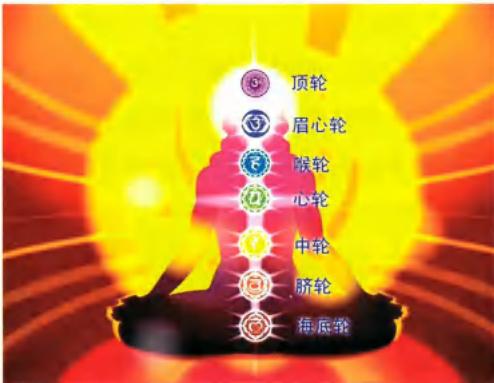
The Seven Chakras of the Central Channel
The Seven Chakras of the Central Channel include the Root Chakra (Muladhara, appears only during meditation), the Navel Chakra, the Middle Chakra, the Heart Chakra, the Throat Chakra, the Brow Chakra, and the Crown Chakra. When a person’s Seven Chakras of the Central Channel are fully opened and the energy wheels function normally, the body will be very healthy and feel very light. The nerves throughout the body will be very sensitive, able to receive information from nature and perceive things that could not be perceived before. After the Seven Chakras of the Central Channel are opened, one will also feel spiritually happy, emotionally full, inspired, and the source of wisdom will be opened. The Seven Chakras of the Central Channel have similar effects to the opening of the Ren and Du channels and the formation of the Small Heavenly Circuit (Microcosmic Orbit) mentioned in Qigong. Fundamentally, activating the pineal gland also relies on energy. Taoists cultivating immortality and those practicing meditation, after the Qi channels of the Brow Chakra are opened, will have a realm of similar supernatural powers called “Eye Penetration” (Clairvoyance). A person with the Heavenly Eye can have no material object obstruct their vision. In other words, with eyes closed or through walls, they can clearly see everything outside. Because children’s Central Channel and Ren/Du channels are basically unobstructed, children’s initial energy is sufficient, so it is relatively easy for them to “activate the pineal gland.” The pineal gland is located in the diencephalon; in Qigong terms, it is the place reached when the Du Channel ascends, and the Qi channels can influence its function. For adults who have opened the Seven Chakras of the Central Channel through Yoga, meditation, or Qigong, or opened the Ren and Du channels to form the Small or Large Heavenly Circuit, “activating the pineal gland” is not a difficult thing. Many adults are obsessed with activating the pineal gland and opening the Heavenly Eye, but the most fundamental method lies here. Without activating and improving one’s own energy, opening the seven chakras or forming the circulation of true Qi in the Large and Small Heavenly Circuits, other methods will ultimately be futile.
“Although Dialectical Materialism emphasizes that the unity of the world lies in its materiality, it does not deny the reaction of consciousness on matter, but rather believes that this reaction is sometimes very great.” The Communist Party of China “emphasizes that ideals and convictions are the ‘calcium’ in the spirits of Communists, emphasizing that ‘revolutionary ideals are higher than the heavens,’ which is the dialectic of spirit transforming into matter and matter transforming into spirit. If the vast number of Party members and cadres have firm ideals and convictions and ample energy for work and entrepreneurship, and the people are spiritually inspired and work hard to forge ahead, many human miracles can be created. If the ideals of Party members and cadres waver and their purpose fades, and the people are dispirited and seek comfort, then even things that could often be accomplished will not be accomplished.” ① This is essentially about increasing energy for Communist Party members. If Party members do this and truly realize it, their energy will increase. The famous American psychology PhD David R. Hawkins has a best-selling book “Power vs. Force: The Hidden Determinants of Human Behavior” (Note: translated as “Mind Power: Stimulate Your Potential Power” in text) which discusses the relationship between human beliefs, consciousness, emotions, all things, and energy. Hawkins quantifies human conscious energy, thereby telling people how to improve the quality of life and organizational effectiveness of individuals, groups, and organizations, and finding the magical power to provide miracles and make things come true.
Hawkins discovered that positive mental states such as love, gratitude, blessing, honesty, compassion, and understanding can enhance a person’s willpower and physical strength, change the physical vibration frequency of microscopic particles in the body, and thereby improve physical and mental health and the entire life process. He believes that every person’s energy level is determined by their beliefs, motives, behavioral norms, and spiritual realm, and a person’s energy level determines everything in their life. Therefore, each of us will eventually be responsible for our every thought, word, or deed, and will re-experience the suffering we caused others to endure, and re-feel the great joy we created for others. Hawkins studied a chart of energy levels for all human consciousness (such as the Energy Level Chart). He believed that the rise of one person’s energy level can drive the elevation of large numbers of low-level human consciousness, radiating from their place of residence, and even affecting the whole world. Every 1 point rise in the conscious energy level marks a 10-fold intensification of positive energy.
Energy Level Chart
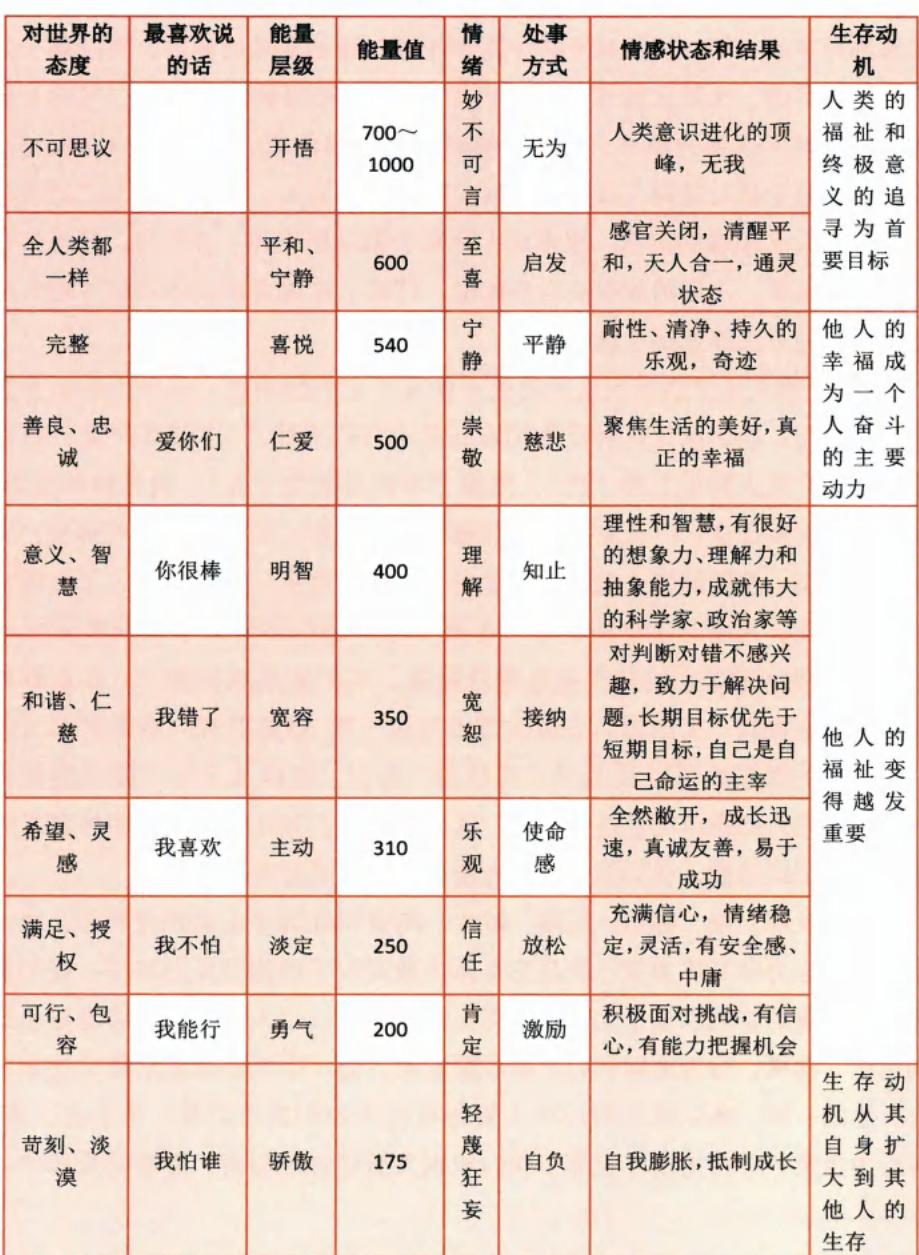
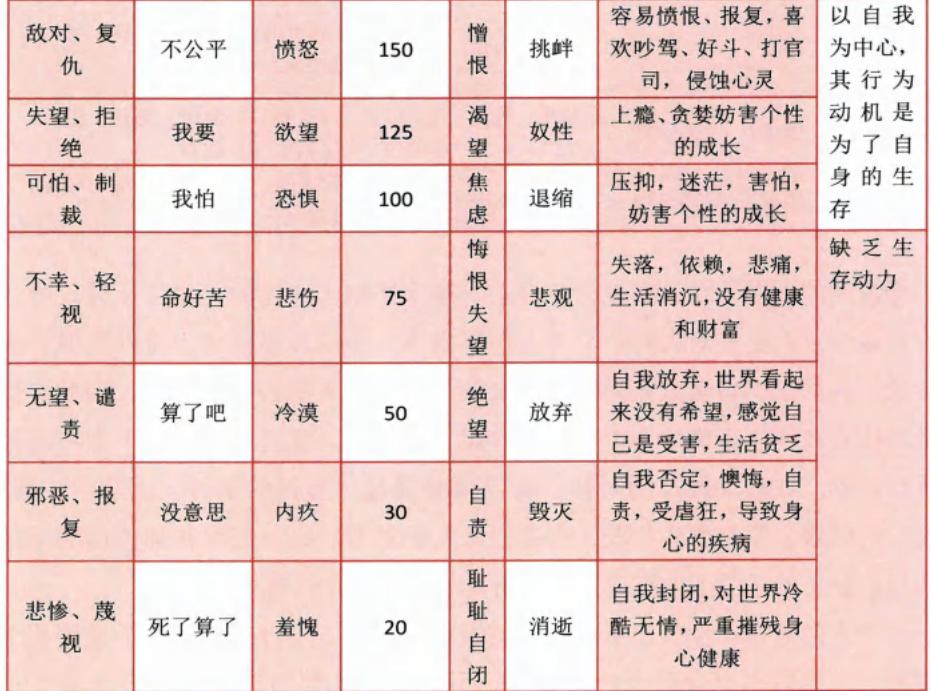
Hawkins’ energy levels have great similarity to the traditional Chinese Buddhist view of life. We can look at the energy table below combined with the “Ten Dharma Worlds” of Buddhism (such as the “Ten Dharma Worlds” Energy Level Table). From this, you can realize that whether it is Chinese tradition or modern science, a large part of energy is actually about one’s attitude toward the world.
*“Ten Dharma Worlds” Energy Level Table *
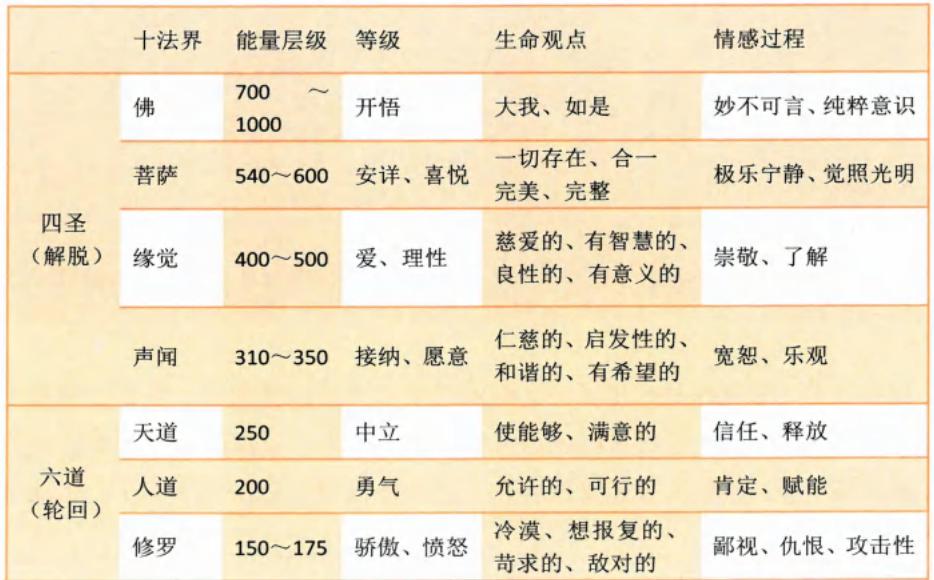
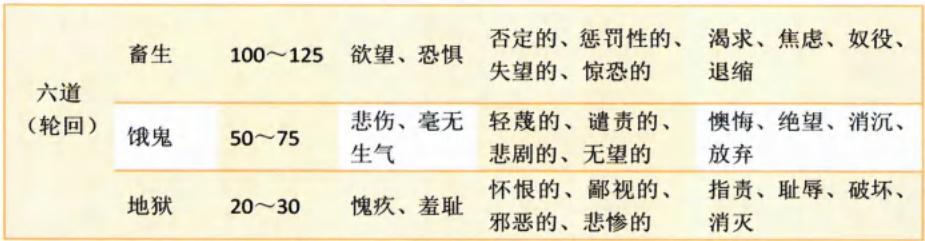
People with high energy manifest outwardly as having upright values and firm willpower; such people tend to live relatively long lives. In recent years, among the long-lived population, there is a high proportion of revolutionaries, politicians, and scientists who have sought happiness for the people, rejuvenation for the nation, and contributions to the world, thereby making significant contributions to humanity. Therefore, the core of elevating energy lies in establishing a correct outlook on life, the world, and values; in our educational activities, we refer to this as core competencies. When designing instruction, tutors must engage in deep reflection on what emotional, attitudinal, and values-based gains students should achieve through a single lesson. Every lesson conveys not merely knowledge and information; what is imparted to students should, above all, be the energy that elevates the level of their lives.
An individual’s conscious energy determines their mindset and behavior; conversely, the frequencies generated by things closely related to them also exert an influence on a person. The following table shows celebrities from the entertainment industry in recent years and their works:
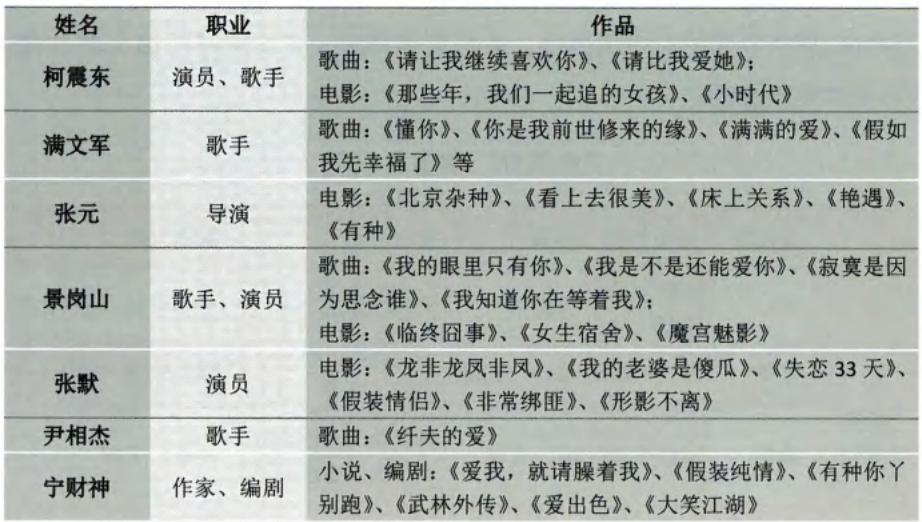
What kind of energy did these songs and film and television works produce? One can easily draw a correspondence by looking at the outcomes of these singers, actors, and authors. These former celebrities all ended up in prison due to drug use. Furthermore, looking at these works, without exception, they all feature themes of lust, love, and seduction that deviate from righteous thoughts. These themes seem to guide audiences and listeners to seek a certain “feeling,” and these celebrities were particularly fond of seeking sensations and indulging in romantic entanglements. In the end, unable to find that sensation, they turned to drugs, tested the law with their own bodies, and all ended up in prison. Moreover, among well-known public figures, the proportion of those in the entertainment industry who die prematurely is far higher than in other professions, a reason worth pondering.
Therefore, engaging in potential development requires elevating energy. This involves not only improving the flow of energy within the body but also elevating energy in terms of consciousness and emotion, and establishing a correct outlook on life and the world.
3.2 Light
Whether in China or abroad, it is believed that the most important thing in our world is light; therefore, in stories about the origin of the world, light always appears first.
A long, long time ago, when heaven and earth were not yet separated, the universe was a chaotic mass. A giant named Pangu slept within this chaos for eighteen thousand years. One day, Pangu suddenly woke up. Seeing darkness all around him, he grabbed his giant axe and swung it fiercely at the darkness before him. With a loud crash, light shot in, and the chaotic mass gradually separated. The light and clear elements rose slowly to become the sky; the heavy and turbid elements sank slowly to become the earth. This is the story of Pangu creating the world.
Christianity says that God spent 6 days creating all things in the world, and rested on the 7th day.
On the first day, God created light. God said, “Let there be light,” and there was light.
On the second day, God created the air. God created the air to separate the waters below from the waters above.
On the third day, God created vegetation. God said, “Let the earth produce grass, vegetation that yields seed, and fruit trees that bear fruit according to their kind, with their seeds inside them.” And it was so.
On the fourth day, God created luminaries. God said, “Let there be luminaries in the sky to separate the day from the night, and let them serve as signs to mark seasons, days, and years, and let them shine in the sky and give light on the earth.” And it was so.
Those who do not believe in God might think this story is silly, but the fact remains that, both in China and abroad, the birth of the world is inseparable from light.
Physically speaking, light is an electromagnetic wave. It generally refers to visible light, specifically electromagnetic waves capable of causing normal human vision, so visible light is a type of electromagnetic wave. The range of electromagnetic waves is broader than visible light. Arranged by frequency from low to high, there are radio waves (very long waves, long waves, medium waves, short waves, ultra-short waves, microwaves), infrared rays (far-infrared, near-infrared), visible light (monochromatic light from red to violet), ultraviolet rays (near-ultraviolet, far-ultraviolet), Roentgen rays (X-rays), γ-rays, etc. Visible light occupies only a very small portion of the electromagnetic spectrum, specifically the 400~700 nanometer range (as shown in the figure Electromagnetic Spectrum·Optical Spectrum).
A TV station once broadcast a report interviewing an American woman who had been abducted by aliens. The woman said that the aliens told her about the structure of the universe and some phenomena of life, telling her that “everything in the universe is composed of visible and invisible light.” Some also say: God is light. People who have had near-death experiences all say they entered another time and space and came to a world of light, which was very beautiful, peaceful, and warm, as if their whole body was bathing in light. What is amazing is that when Professor Li Szu-tsen, the former president of National Taiwan University, conducted experiments on “finger reading,” whenever the characters were related to gods or Buddhas, only light appeared on the children’s “mind screens,” without any other images or handwriting. We do not need to verify the authenticity of the above statements, but these phenomena all mention the existence of light, which at least shows people’s reverence for light.
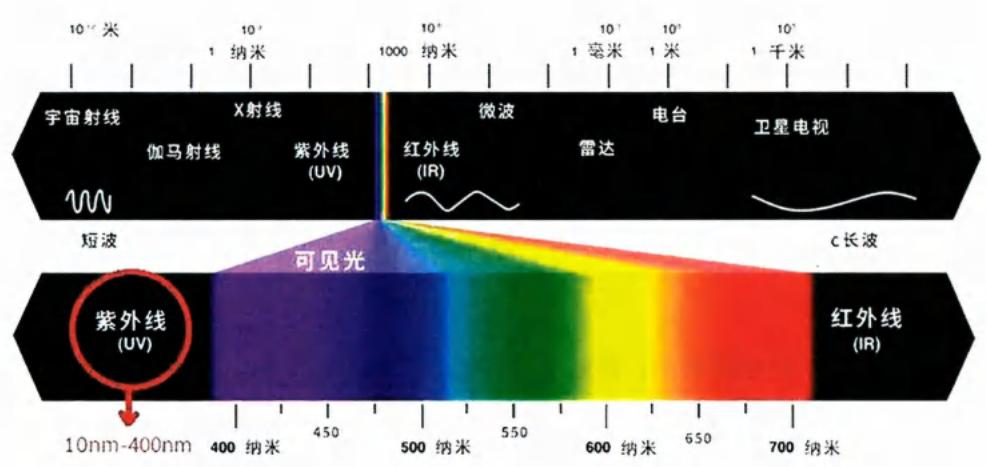
Electromagnetic Spectrum·Optical Spectrum
Without light, there is no energy. Before a child begins blindfolded reading training, they must summon a light sphere. If the child cannot bring out the light sphere or if it cannot change, it will be difficult for the child to stabilize their state and feel the colors. Moreover, if the child cannot summon the light sphere, it is also difficult to form a clear mind screen. Generally, adults also find it difficult to summon light in their brains. According to the Middle Channel theory, this is because the energy is blocked and cannot be mobilized to the head at will, resulting in insufficient energy in the brain, so light does not appear. Even if it appears, it often cannot focus like a strong flashlight, nor can it be maintained for a long time. Visual light training for children, on one hand, supplements energy, and on the other hand, helps children learn to focus energy and find the sensation of the light sphere. The light sphere and the mind screen are crucial to the level of effectiveness in potential development; special attention must be paid to this area.
During meditation, when light envelops the whole body, one will inexplicably suddenly feel warm, full of courage, hope, and strength, and can also experience tranquility and peace. The initial step of blindfolded reading is to generate the sensation of a spot of light, the purpose of which is to create an image that can help illuminate and draw out the image. If you want to strengthen the student’s blindfolded reading and other abilities, at the beginning of ESP games or training, you must guide their light sphere to become bigger and brighter. Professional institutions, especially counselors oriented towards spiritual development, will definitely regard energy training to increase the brightness of the light sphere as a top priority. For example, the Shandong Shanglu Culture Potential Sensory Training Center requires every child to be able to adjust the light sphere to a golden color. The methods of these institutions are not exactly the same; some use meditation training, some use attention training, some use Qigong training, and some involve teachers and students holding hands to directly transmit energy. These methods are different, but their purpose is the same. In the content that follows, friends can carefully experience and perhaps find a training method that suits them.
When a hypnotist conducts hypnotherapy, the subject must be fully relaxed, because after the body relaxes, the energy within the body may be able to break through blockages and allow energy to flow within the body. Many important hypnotic sessions, such as past life regression, must begin with relatively bright light during the induction. In most hypnotic inductions, light and crystal balls are also used to supplement energy.
When meditating, if there is no light, it is difficult for the meditative scene to be bright. One cannot “see” the true beautiful scenery; the images will be blurry shadows, though there will be a feeling, allowing one to only sense that scene, and the effectiveness will be discounted.
I have a young reader, 17 years old. He often tries to meditate, but frequently sees blue and black light appearing (this is how he described it; I don’t know what black light looks like), and sometimes feels afraid, trembling with fear. My analysis is that when he meditates, he likely ignores the absorption of light energy, or perhaps cannot find the sensation of light. I gave him the following advice:
-
When listening to lectures or doing homework, try to use abdominal breathing as much as possible. If you feel it will distract you and affect your studies, use abdominal breathing every day before sleep until you fall asleep. The purpose of abdominal breathing is to inhale more oxygen into the body. The method can be found online, or you can refer to the various breathing training methods on pages 55~57 of the Right Brain Development Training Manual.
-
You said that when opening the pineal gland, you felt afraid, trembling with fear, because your energy is insufficient. The things or scenes you see or feel should not be clear, and the colors should not be bright. Using the sun-gazing method to supplement energy is relatively simple and fast: when the sunlight is strong, you can close your eyes, face the sun, and feel and absorb the energy the sun brings you; in the early morning or evening when the sun is not dazzling, open your eyes to look at the sun for a while, then close your eyes and imagine the sun you just saw.
-
When finishing homework at night or during breaks, take deep breaths, relax your body, empty your mind, and look at a lamp (any lamp will do) for 1 minute. Close your eyes and imagine the lamp you just saw, trying to keep the brightness and shape of the lamp in your mind for as long as possible. You can also try to change the color, shape, and size of the light. Let everything be natural, calm, and very comfortable.
Stick to practicing the above content for a period of time.
A few weeks later, he told me that the feeling of fear no longer appeared, and his light sensation began to strengthen. Light is an important energy for healing. Generally, the light sensation in adults is not as intense as in children, but there will still be a sensation.
In the last two years, a fitness method called Brain Field Training has become all the rage. This method integrates some theories and practices from Buddhism, Taoism, and Qigong. Although Li Gao, the inheritor of Brain Field Training, used scientific terms such as cells and molecules to explain it, the main training method involves guided meditation through music called “Repentance Samadhi plus Brain Field Training.” In the guidance, the core source of energy comes from the “Source of Love and Light,” and the purpose is to adjust the human subconscious to achieve the effect of physical healing. In the guidance, “a ray of white light from the sun illuminates our crown; the white light is the energy of the sun. Wherever the light goes, there is health; wherever the light goes, the viruses there decompose and are discharged from the body as molecular information. The left brain and right brain begin to absorb the energy of the white light from the crown, rotating clockwise, activating 90% of the brain cells that have been dormant for many years.” Light plays an extremely important role in the healing process (see video Repentance Samadhi plus Brain Field Training).
In the practices of Buddhism, Taoism, and Qigong, such as alchemy, cultivation, and sitting in meditation, none are separated from meditation on light. Taoism and Qigong emphasize refining essence into Qi and condensing it to form the Elixir. After this Elixir is formed, it cannot be found by physical methods. In the view of practitioners, the Elixir is described as being like a light bead, possessing immense energy, capable of thousands of changes, and able to cure diseases and strengthen the body.
Repentance Samadhi plus Brain Field Training
Liao Yuepeng, a hypnosis master from Taiwan, also fully utilizes light to supplement energy for the body and heal physical and mental health during hypnosis, frequently using it in the music CD of his Complete Practical Hypnosis collection.
Tao Yongdi, the founder of the Inspiration Learning Method—which excels in the field of potential development—also places great importance on the manifestation of light in the brain. During the “Wisdom Opening” process, which is the most critical part of the Inspiration Learning Method, there is guidance instructing students to gently tap their foreheads. The purpose of this is to further induce the sensation of a bright light before their eyes; the sensation of this bright light is one of the important criteria for the successful opening of wisdom in the Inspiration Learning Method. Below is an excerpt from the wisdom opening guidance script of the Inspiration Learning Method:
Now, the energy for developing intelligence entering everyone’s brain begins to concentrate in the forehead, in the forehead, above the center of the two eyes. Now there is a spot of white light in the forehead, the spot is getting brighter and brighter, bright, the entire forehead is lighting up, glowing. Now your entire forehead is like a TV screen, a television screen, very, very bright. Okay, now the energy of heat begins to rotate freely in the brain, spinning faster and faster, rotating ceaselessly. During the spinning process, the brain gets hotter and hotter, as if there is a sun inside, getting hotter and hotter; in the process of spinning, the forehead gets brighter and brighter, brighter and brighter, spinning. Okay, now your forehead is brighter than before, brighter, very, very bright.
From this, we can see how important light is in potential development. We must attach importance to the techniques of utilizing light and flexibly incorporate them into teaching, so that students’ energy can be replenished through light during this process.
3.3 The Sound Gate and Alpha Wave Music
Whether in Buddhism or Taoism, great importance is attached to the cultivation of the Qi channels (Nadis), because the Qi channels are the pathways through which energy circulates within the body. This is particularly true for the Esoteric Buddhism (Vajrayana) tradition, which places special emphasis on the cultivation of the Qi channels.
Esoteric Buddhism stresses the “Three Mysteries,” which refers to the secret significance of the triad of Body, Speech, and Mind. The so-called “Body Mystery” can be summarized in two meanings: First, the inherent mysteries of the human body, which originally possess a function of intercommunication with the workings of heaven, earth, and the universe; however, people lack the understanding of great wisdom and have not undergone cultivation through proper methods, so this great function never manifests. Second, Esoteric Buddhism holds that there are various methods originating from ancient traditions that, when conferred upon a practitioner of the esoteric Dharma, can yield twice the result with half the effort, allowing for rapid communication with divine beings, a union of heaven and humanity, and ultimately leading to Buddhahood or sagehood.
The reason Esoteric Buddhism possesses mysterious characteristics lies in the secret of the divine incantations, or “Speech Mystery.” The “Speech Mystery” referred to here is the “Speech Mystery” (one of the Three Mysteries) of Esoteric Buddhism, also known to ordinary people as “Mantras.” This method of using sound production as a means of cultivation is called the Sound Gate (Sound Dharma Gate).
Long before Shakyamuni, the focus of traditional Indian culture—Brahmanism—had always placed importance on the mysterious nature of mantras. They shared the belief of Esoteric yogis that mantras can directly resonate with the minds of “Gods” and produce effects. Sinology master Nan Huai-Chin said: Cultivating Esoteric Dharma by reciting mantras is similar to the telegraph codes of Buddhas and Bodhisattvas; it can evoke a response and facilitate spiritual communication and mutual attraction. Therefore, when reciting mantras, there is absolutely no need to utilize conceptual thinking; one only needs deep faith and single-minded focus to recite.
In terms of the cultivation method of reciting mantras in Esoteric Buddhism, it utilizes specific musical notes to vibrate the Qi channels within the body, causing them to release life potential, transforming into a function that transcends the reality of the material world, and entering a divine realm, even to the point of triggering supernatural powers and high-level wisdom. The primary focus of the sonic secret of Esoteric mantras is the relationship between sound and the body’s Qi channels.
The sounds An (pronounced as Om), Ah (pronounced as A), and Hong (pronounced as Hung) are extremely important mantra sounds in the practice of Esoteric Dharma and are the comprehensive outline of Sanskrit initials. Therefore, combining only the pronunciation of these three characters forms a mantra, which is the Three-Syllable Root Mantra of Samantabhadra Tathagata. Samantabhadra Tathagata is an esoteric translation meaning “Universally Worthy,” also translated as “Universally Manifest.” Samantabhadra means to be universally present and worthy, filling all places, existing at all times and in all locations.
The sound An is the sound produced when the body’s Qi turns toward the brain. To produce this sound, one needs to use a rounded oral resonator and lip shape to express it, forming a perfect circle. It is the root sound of the primal life energy of the universe and the sound of the metaphysical celestial realm; it contains infinite functions. In terms of the human body, it is the sound inside the top of the head. It is similar to the sound of one’s own heart and blood flow that one hears when covering their ears. Therefore, anyone reciting mantras with An-section pronunciation must understand the subtle function of its pronunciation mechanism. At the very least, it can clear the mind and invigorate the spirit. If one has a cold, continuously reciting this sound can cause the head to sweat, resulting in a recovery without medicine.
The sound Ah is the sound produced when the body’s blood turns toward the heart and transforms into Qi, and also the sound produced when Qi reaches the throat. It is the root sound of the birth and generation of all life in the universe. It possesses immeasurable and boundless functions. At the same time, Ah is an open vowel, the sound that initiates the life of all living things in the world. For example, the recitation of “Amitabha” in the Pure Land tradition of Chinese Buddhism belongs to the open vowel of the Ah section of Esoteric Buddhism. It can also be said to be the basic Speech Mystery of the Lotus Family. If one can understand the subtle function of the continuous use of Ah-section sounds, one can open the knots of the internal organ meridians and simultaneously clear up various chronic ailments between the organs. If one truly understands and practices it lawfully, over time, one will naturally experience the effect of the vibration of the internal Qi channels.
The sound Hong is the root sound of the latent generation of all life. The sound An is the sound of the metaphysical celestial realm; the sound Hum is the sound of the physical earthly realm; the sound Ah is the sound of the human realm, the open sound between human and animal life. In terms of the human body, the sound Hong is the sound of the Dantian. If one knows how to recite using the Hong-section sound, it can shake open the knots in the meridians and trigger new vitality. At the very least, it can achieve the effect of health and longevity.
The “Om Ah Hum” Three Syllables are also known as Vajra Recitation. They are the root mantra of Vajradhara, i.e., Samantabhadra Buddha, the principal deity of Tibetan Esoteric Buddhism. Reciting these three characters possesses energy; they correspond to the seven chakras of the human central channel (Sushumna), allowing energy to flow unimpeded within the body. We often hear the recitation of the Six-Syllable Great Bright Mantra of Avalokitesvara Bodhisattva “Om Mani Padme Hum” (Scan the QR code to listen to the “Six-Syllable Great Bright Mantra”). Among them, the sounds of the four characters “Mani Padme” are all variations and subtle applications of the “Ah” section sound.
Six-Syllable Great Bright Mantra
Taoism also has its own Sound Gate, involving six important characters, which are actually six sounds affecting the health of human organs. These six sounds are the so-called Six Qi (Breaths): Xu, Si, He, Chui, Hu, and Xi. Those Taoists who cultivate immortality, in the early morning facing east, at the moment when living energy is rising, emit these six sounds to guide the flow of internal Qi channels. When emitting these six sounds, one should not shout loudly, but rather softly; the volume should be just audible to oneself. Practice continuously until there is no breath left in the abdomen. For patients where acupuncture treatment was ineffective, adopting this Qigong therapy was found to be quite effective, thus evolving into methods of Qigong healing or fitness. Therefore, Taoist healing sometimes fundamentally does not use medicine, but uses sound to make the body recover.
Early Chinese medical books often mentioned “sound color,” which is using sound methods to treat patients. In Traditional Chinese Medicine, a doctor can judge a patient’s condition by their voice. For example, liver disease produces an angry sound; patients who are easily angered and quick to temper must have liver disease. If one is constantly laughing, their illness definitely leans towards the heart. Lung disease involves grief, sorrow, and a love for crying. Kidney disease involves groaning; if turning, bending, rising, sitting, or moving the whole body causes pain, often accompanied by groaning sounds, it must be kidney disease and physical weakness.
Nowadays, some potential development institutions like to listen to some Buddhist music to enhance the energy of counselors and students, which is also acceptable, but Buddhist music must also be selectively listened to. Professor Liu Feng said: “The collection of frequencies is a frequency spectrum, so the frequency spectrum of high-level energy is mantras.” There are three types of Buddhist music: Mantras, Recitation of Buddha Names, and Sutras. Reciting mantras is tuning in with high-dimensional energy and resonating with high-dimensional energy; this is the function of mantra-holding. Some music only involves reciting Buddha names, over and over again; playing this in institutions can easily cause misunderstandings. Since education must not involve religion, this may be suspected of being illegal, so caution should be exercised.
All books that can be called “Scriptures” (Sutras) come from high dimensions; they were written when the scribes were in a state of connection with high dimensions, which we call “high-dimensional downloading.” “Scripture” does not refer specifically to religious texts; all classics handed down from ancient times can be called Scriptures. Many education experts now strongly advocate chanting Sinology classics. Sinology classics must be chanted or recited aloud, or one can buy a “Sinology Machine” for children to listen to repeatedly, which is also very beneficial for opening children’s wisdom.
In 2011, the “Wanzhou Escape Art” of Vajra master Yang Degui was selected into the Chongqing Intangible Cultural Heritage Protection Directory. Yang Degui is a farmer from Wanzhou, Chongqing. When young, Yang Degui took the Taoist Zhu Yuangao from Jingzhou, Hubei as his master and learned the Taoist art of teleportation, also known as the art of escape (Dun Shu). Yang Degui’s art of escape is like magic but is not magic; it belongs to the techniques of the Taoist Talisman and Mantra School. During performances, he would mutter some mantras that others could not hear clearly (sometimes silently reciting in his heart), causing people to feel surprise and mystery. Mr. Yang Degui’s art of escape was demonstrated in an experiment designed by Professor Gong Zhebing of Wuhan University on December 8, 2017, involving the transport of GPS terminals, which showed the trajectory of the equipment’s transport, proving that this art of escape is not magic (see video “Yang Degui’s Escape Art Performance”). How the talismans and mantras of this Taoist Talisman and Mantra School function is currently unexplainable by science.
Yang Degui’s Escape Art Performance
The frequency and sound pressure of musical sound waves cause a harmonic resonance phenomenon in the body’s tissue cells, enabling the cranial cavity, thoracic cavity, or a specific tissue to resonate. This resonance phenomenon caused by sound waves directly affects human brainwaves, heart rate, and breathing rhythm. At the same time, when a person is in a beautiful and pleasant music environment, it can improve the functions of the nervous system, cardiovascular system, endocrine system, and digestive system, prompting the body to secrete an active substance beneficial to health; this substance can regulate blood flow in the body and nerve conduction. Science has long proven the influence of music on humans and animals; playing certain music in chicken coops can make hens lay more eggs, and sounds in pastures can affect the milk production of dairy cows. It is said that Mandala patterns were visualized by ancient Indian yogis through chanting, who felt the form of sound, realized the wisdom hidden in sound waves, and drew them down, passing them down through the ages. Vibrations of sound waves of different frequencies, when resonating with matter, can produce different patterns; these patterns look as miraculous as Mandala patterns (see video “Showing You the Shape of Sound: CYMATICS Music”). When music of different frequencies resonates with human cells or brain thinking, it produces different effects on the state.
As early as thousands of years ago, those well-versed in the science of sound understood that certain specific frequencies have healing power for the human body. Overall, this is an attempt to create resonance. When two systems oscillate at different frequencies, another aspect of this energy conversion is called “entrainment,” which is the act of tuning to vibrate at the same frequency.
In 1924, German psychiatrist Hans Berger first used a string galvanometer to detect the brainwaves of patients with skull injuries during World War I. In 1925, he detected the brainwaves generated in his own son’s brain; these brainwaves were Alpha waves. In 1926, using a Siemens galvanometer again, he discovered Alpha and Beta waves and named the recording “Electroencephalogram” (EEG). Later, in 1929, he formally reported this to the scientific community. In 1934, Dr. E.D. Adrian and Dr. B.H.C. Mathew from the University of Cambridge in the UK reconfirmed the findings, thereby establishing the existence of brainwaves and initiating a wave of “brainwave fever.” Due to this timing, the development of radio technology in the 1930s combined with the emergence of brainwaves sparked infinite imagination. Popular writers wrote many science fiction stories depicting how humans could use radio receivers to intercept other people’s brainwaves to monitor their thoughts, etc. Of course, these fantasies have not been realized to this day, but brainwaves are indeed very useful in the diagnosis of nervous system diseases. The scenes in the movie Avatar are closer to reality. On Pandora, paraplegic Marines use complex wearable devices to collect EEG signals and use these signals to control artificial Avatars. However, existing research results are far from being able to perform the complex operations seen in the movie.
In this way, since the mid-20th century, research and experimental results on brainwaves, especially Alpha waves, have emerged one after another. This subsequently led to a global surge in the development of brainwave music for potential development, resulting in the now well-known application of brainwave music in prenatal education and potential development education. Can Alpha wave music actually develop brain potential? According to our trials, this type of music does have a certain promoting effect on potential development. However, there is no need to mythologize it. During potential development training, relevant music can be used as an aid, but not using music will not affect the training results. For usage methods, see Chapter 9 “Using Music to Assist Training” in the Right Brain Development Training Manual. Of course, there are also many institutions that claim that merely using headphone music can enable children to read while blindfolded; this is also a fact. We will discuss this situation later.
3.4 Magnetic Field, Qigong, and Meditation
Previously, it was mentioned that methods such as opening the seven chakras of the central channel or circulating the Microcosmic and Macrocosmic orbits can be used to elevate energy. Can one perceive the body’s energy oneself? How does one open the central channel’s seven chakras or circulate the Microcosmic and Macrocosmic orbits? How does one elevate the body’s energy field? Below, we can start with an experiential exercise.
The Magnetic Field Exercise is a simple and effective training method to activate and elevate one’s internal energy field. The key points are as follows:
- Sit on the front edge of a stool or stand with feet shoulder-width apart. When sitting, the calves should be vertical to the ground, forming a 90° angle with the thighs. The waist should be naturally upright, and the chest and back naturally expanded and straight. Relax the entire body, gently close the eyes, breathe naturally, and raise both arms to chest level, about 30 cm apart, with palms facing each other. When exhaling, bring the hands closer together (do not let the hands touch), and when inhaling, move the hands further apart (as shown in the Magnetic Field Exercise diagram).
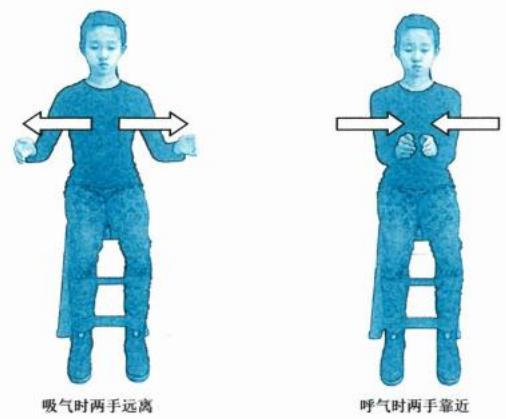
Magnetic Field Exercise Diagram
-
Focus your attention on both hands and the space between them. Maintain this focus for as long as possible. When your attention wanders, be aware of it, and simply bring your attention back to the hands and the space between them.
-
Practice for 15 minutes each time. After completion, place both hands on the kidney area of the lower back for 1 to 2 minutes as a closing movement.
-
Practice indoors as much as possible. Do not practice near hospitals or slaughterhouses. Do not practice under air conditioners, fans, or near water; do not practice when it is raining, thundering, when you have a cold, nasal congestion, or are angry.
Now, please set aside all thoughts, relax your body, and earnestly perform this magnetic field exercise for 15 minutes. After 15 minutes, carefully experience the sensations of your body, thoughts, and emotions.
As long as you earnestly perform this magnetic field exercise, you may experience the following sensations: numbness, swelling, or heat in the hands; a feeling like wind or needle pricks; when moving the hands apart, a magnetic attraction that prevents easy separation; when bringing the hands closer, a sensation of something obstructing them from coming together easily; chest tightness, shortness of breath, yawning, labored breathing, or asthma; a sensation of heat throughout the body, the body feeling light, or feeling cold; mental clarity, bright eyes, and agile thinking; a comfortable, joyful, or calm mood. These reactions are all possible, and they vary from person to person. Of course, there may be other sensations; only you can feel them. You only need to know that this is all normal, a dialogue between your body, mind, and emotions. Having this awareness is good.
This exercise has similar movements in many Qigong practices, so it can also be regarded as the simplest Qigong exercise. This exercise can strengthen the human magnetic field, thereby having a certain therapeutic effect on the body. A student from Guizhou had low immunity, had suffered from poor sleep for many years, had taken traditional Chinese medicine for a long time, and had a poor complexion. After attending my workshop, he persisted in the magnetic field exercise after returning home. More than a month later, he sent me a message: “In the past two days, I found that I suddenly perceive a bright light before my eyes when doing the magnetic field exercise. This has been happening for a few days! The yawning has decreased, but when I do yawn, the light dims, and then brightens again after a while. I feel my mental state and body have improved a lot. Thank you, Teacher!”
The most significant effect of this magnetic field exercise is the improvement of sleep quality. Regardless of the cause of insomnia, as long as you practice earnestly, with focus and persistence for a few days, sleep will show significant improvement. Long-term practice is also greatly beneficial to the body. For adults, concentration and memory will also improve. After persisting in the practice for a period of time, you may also feel sensations such as your legs disappearing, hands disappearing, the body floating up, hearing strange sounds, or seeing strange people or images. If these situations occur, simply maintain your awareness, do not fear or become obsessed with these illusions, and remind yourself: “This is imagined by the brain; I am the master of the brain.” Of course, if you are interested in these things, it is best to choose a specific Qigong practice and find a teacher to study seriously; that is the right path.
In recent years, there has been much research on the human magnetic field. Research results indicate that the human magnetic field is closely related to human health, thinking, and even mindset and luck. Naturally, it is also inextricably linked to the energy required for the potential development we discuss. Related instruments and theories are widely disseminated, but truth and falsehood are intermingled, requiring discrimination and verification. Many health or spiritual development institutions have an instrument called the QRS Quantum Resonance Spectrometer, which diagnoses physical health status and energy values by detecting the human magnetic field (or energy). It is said to have very miraculous effects. This instrument was invented in Japan in the 1990s. Although such instruments are rarely seen in hospitals, scientific papers on them are not uncommon, indicating that it has a certain scientific theoretical basis. However, the Kirlian camera (phonetic translation, also translated as Crean camera), which is widely circulated online as being able to photograph different energies of the human body, is currently not verified or recognized by mainstream scientific experiments (see the widely circulated photo of the human halo taken by the Kirlian camera). In core scientific journals, papers on this aspect are still hard to find. Therefore, from a scientific perspective, potential development institutions should be cautious in their promotion and publicity. Around 2014, a “Human Body Emotional Heat Map” was frequently seen in the media and online (as shown in the Human Body Emotional Heat Map). It looked very authentic, with different colors, English annotations, and a scale legend, looking very professional and much like a thermal image. Some versions were even accompanied by a solemn Chinese commentary, claiming that “Finnish scientists found that when people around the world experience different emotions, the body temperature of various parts also changes accordingly.” In fact, the color scale in the image represents the magnitude of the statistical t-value; this is merely a pseudo-color map and not a thermal image or body temperature map at all. The problem may lie with our Chinese media; those working in potential development must be careful to verify and treat this with a scientific attitude.
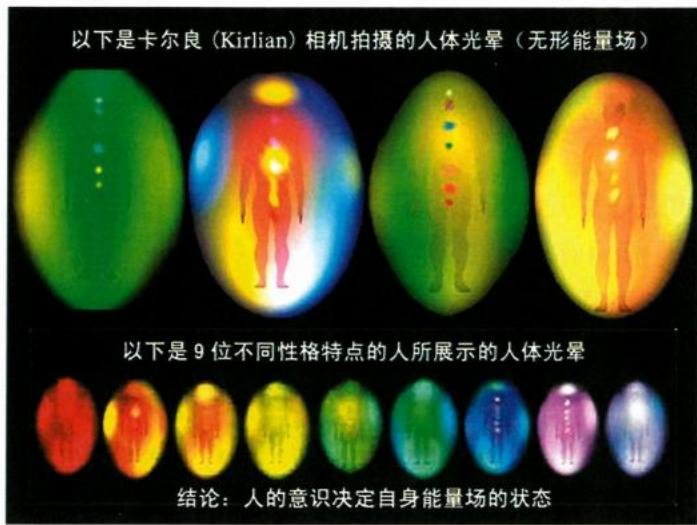
Widely circulated photo of a human halo taken by a Kirlian camera
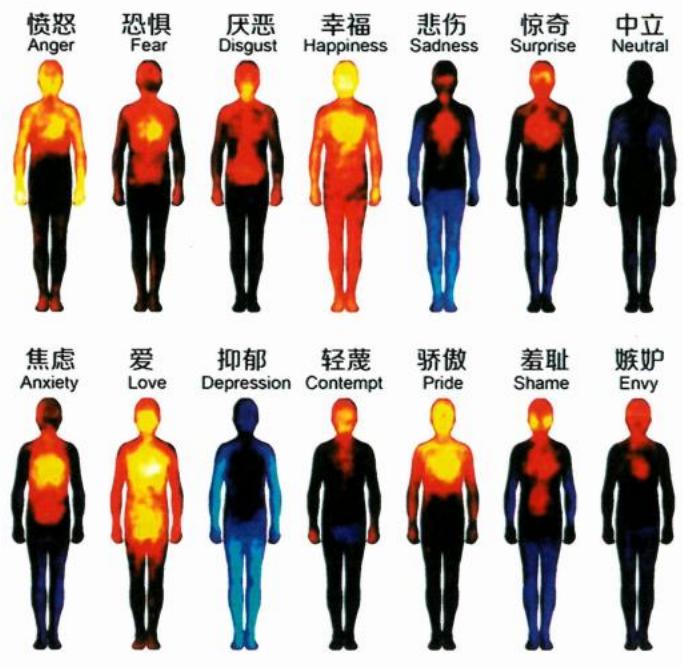
Human Body Emotional Heat Map
The magnetic field exercise can be regarded as the simplest Qigong exercise. What is the relationship between the magnetic field and the “Qi” in Qigong? Although many scientists have conducted extensive research, it is not yet widely recognized by mainstream science. However, from experience, anyone who can practice seriously and persistently will gain extraordinary results. If adults wish to acquire certain abilities in potential development, starting with Qigong is undoubtedly a wise choice. There are hundreds or thousands of types of Qigong in China, and all Qigong practices have the effect of “developing potential and increasing wisdom.” When choosing to practice Qigong, it is best to have a master lead you, because when Qigong practice reaches a certain level, without the guidance of a good teacher, situations such as “Qigong deviation” (fire deviation) may occur. In Jin Yong’s martial arts novels, many experts such as Yang Dingtian, Xie Xun, Ouyang Feng, and Murong Fu experience Qigong deviation. Whether this is a reflection of reality is open to interpretation.
Qigong has existed in China since ancient times and can be called a national treasure. Sun Simiao, a famous doctor of the Tang Dynasty, recorded a process of circulating Qi in Essential Formulas for Emergencies [Worth a Thousand Pieces of Gold]: “Close your eyes and meditate, imagining the Great Harmony Primordial Qi in the air, like a purple cloud forming a canopy, with five distinct colors, descending to the hairline, gradually entering the crown of the head, like rain clearing and clouds entering a mountain, penetrating the skin to the flesh, reaching the bones and brain, gradually descending into the abdomen, the four limbs and five viscera all receiving its moisture, like water seeping into the ground. If thorough, one feels a sound in the abdomen, gurgling. The will must focus on this, seeking no external aid. In a moment, it naturally reaches the Yongquan point.” This practice process is the pathway of the “Great Harmony Primordial Qi,” full of imagination and self-suggestion. Through imagination, one brings oneself into an artistic conception that makes one feel refreshed and happy, forming a beautiful psychological and emotional state, forgetting worries, and eliminating distracting thoughts. Practicing Qigong uses the method of concentrating attention to eliminate distracting thoughts, emptying the consciousness, and entering a state of “trance,” “floating,” “seeming to sleep but not sleeping, seeming to wake but not waking.” This is “entering stillness,” an important characteristic of Qigong exercise. The reason Qigong can replenish energy is precisely this; in this state, the body can automatically adjust bodily functions. As stated in the Yellow Emperor’s Inner Canon: “When the mind is tranquil and empty, the True Qi follows. If the spirit is guarded within, how can illness arise?” This means that when a person’s consciousness enters a very tranquil and joyful state of emptiness, the physiological functions of all systems of the body become coordinated. Persisting in this exercise of eliminating distracting thoughts and relaxing psychological tension will strengthen the body’s immune resistance and play a role in preventing and treating diseases.
There are over a thousand types of Qigong across various schools in our country; can one practice them independently? There is one Qigong method recommended to everyone: the Zhenqi Yunxing Fa (True Qi Running Method). Because the Gansu Health Department vigorously promoted the popularization of this method, it sparked significant discussion in the media in 2012. In 2017, Zhu Qingshi, an academician of the Chinese Academy of Sciences and former president of the University of Science and Technology of China, spoke about his experience practicing Zhenqi Yunxing Fa and his understanding of True Qi and meridians during a speech at the Beijing University of Chinese Medicine, once again pushing Zhenqi Yunxing Fa into the center of public opinion. Zhenqi Yunxing Fa is a self-practice healthcare regimen created by Li Shaobo, a centenarian renowned TCM expert, chief physician, and professor at the former Gansu College of Traditional Chinese Medicine. Based on the “Quanzhen Daoqi” (True Qi Guidance) theory from the Yellow Emperor’s Inner Canon and the essence of ancient breath cultivation and health preservation, combined with his own practice, and through decades of clinical observation and scientific experiments, he compiled this method. This method is relatively simple and easy to learn, and there have been no reports of negative phenomena like “zouhuorumo” (qigong deviation). For friends unable to attend training sessions held by the Li Shaobo Zhenqi Yunxing Research Institute, it is also possible to unblock the Ren and Du meridians through self-study. In Zhengzhou, a teacher named Monk Buzheng (Sha Haoyang) recorded a video titled “Learning TCM through 12 Days of Zhenqi Yunxing Fa Practice” and placed it on major video websites, which can serve as an introductory tutorial. When you can proficiently apply Zhenqi Yunxing Fa, such as in the Small and Large Heavenly Circulations, the development of various potentials will be as effortless as a fish in water or a bird returning to the forest.
Zhenqi Yunxing Fa belongs to static Qigong (Jinggong), requiring control by one’s own intention, making it difficult for outsiders to observe the effects of the practice. The practice time for Zhenqi Yunxing Fa is relatively long, so children may require strong willpower. Based on experience, this method is indeed not suitable for all children during potential development training; it is more suitable for adults to practice before developing potentials. However, magnetic field exercises for children take only 7~12 minutes per session with simple movements, making them relatively suitable for use in potential development schools. Besides this, some institutions have students practice Zhanzhuang (Standing Stake), Squatting Wall exercises, patting the Dantian, etc. The essential effects are actually the same; it depends on what the instructor specializes in, and there is no distinction between good or bad.
There is also a “Dr. Jiang Wan’s Secret Cultivation Method for Gathering the Spiritual Qi of Heaven and Earth and the Essence of the Sun and Moon” worth recommending. This set of exercises is very helpful for potential development institutions, whether the Third Eye has been opened or not, as it aids in boosting the energy for potential development.
This cultivation method draws from the essence of Buddhist, Taoist, and medical cultivation practices, specifically referencing the famous Diamond Master Sun Chulin’s “Opening the Third Eye Method” and Qigong master Liu Hanwen’s Chanmi Qigong (Zen Esoteric Qigong). This secret cultivation method is not a mandatory requirement for opening children’s Third Eyes, but it is extremely helpful. Particularly for children who already possess the ability to read blindfolded, they are often in a state of energy consumption. Since development institutions and teachers mostly lack cultivation experience, children consume too much energy during whole-brain training, causing their abilities to stagnate. This secret cultivation method is very convenient and effective for children to learn to absorb energy.
This secret cultivation method consists of six sections and a concluding routine (Shougong). Please refer to the video “Dr. Jiang Wan’s Secret Cultivation Method for Gathering the Spiritual Qi of Heaven and Earth and the Essence of the Sun and Moon” for practice steps and specific movements. Additionally, when practicing this method, Zhou Zhihong’s “Wind Moving Moon Shadows” can be played as background music.
In this secret cultivation method, besides teaching children the movements, teachers must pay special attention to adding positive intentions, namely absorbing the spiritual Qi of heaven and earth and the essence of the sun and moon, and absorbing positive energy and information. If the children train to proficiency, they can consciously open the pores of their whole body during the energy absorption process.
If you wish to enter a deeper level, you can chant the five “Secret Sounds” corresponding to the Crown Chakra, Brow Chakra, Throat Chakra, Heart Chakra, and Navel Chakra in the first through fifth sections respectively: “A, Zi, Ga, Sa, Za”. This can effectively vibrate the chakras, untie the knots in the meridians, and manifest supernatural powers and extraordinary abilities.
“A, Zi, Ga, Sa, Za” correspond to the five chakras respectively. When starting training, you can chant long tones, meaning one sound per breath. The five secret sounds correspond to the first five sections; do not chant during the sixth section. However, if someone automatically starts moving during the sixth section and cannot stop (finish the practice), they can chant continuously to help conclude the practice and gain protection. The five-character secret sounds “A, Zi, Ga, Sa, Za” are a special resonance frequency between one’s own body and heaven and earth. They are audio sounds of immense energy and power; please chant with a pious and reverent heart! As for the effects, the chanter will know for themselves!
Some institutions also require students to meditate (sit in meditation), hoping to elevate students’ energy through this method. Meditation is just one form of cultivation practice; it has the same effect as “Seiza” (kneeling sitting), knee kneeling, and Zhanzhuang. Some people, upon mentioning meditation, immediately think of religion. In fact, there are many disciplines that use meditation as a cultivation tool: Meditation is also known as “Cross-legged sitting” or “Quiet sitting,” and is a basic cultivation method in Taoism. In Buddhism, it is called “Chan sitting” or “Chan Ding” (Zen Meditation) and is a mandatory practice for the Zen sect. In Chinese martial arts cultivation, meditation is also a way to cultivate internal skills (Neigong), nurture the mind, and enhance mental strength. Yoga, meditation, and spiritual practices also require the meditation posture. Yes, meditation can both nourish the body to prolong life and open wisdom. The characteristic of meditation is “stillness”; “prolonged stillness leads to stability (Ding), prolonged movement leads to fatigue.”
I also have some friends around me who are interested in meditation. Some people, when mentioning meditation, talk about “Half Lotus,” “Full Lotus,” and how long they can hold the “Full Lotus.” Meditation is not physical exercise; it is not about spending a lot of time “enduring the legs.” Do not fight against your posture or your legs during meditation. Meditation is merely a method, a process of refining the mind, and is for adjusting our thinking, not training the body. If you cannot cross your legs, it is not related to your legs but to your mind. When the mind reaches a certain level and becomes soft, the body’s posture will naturally become standard. If we constantly struggle with our sitting posture, it will inevitably make it difficult for our mind to break through.
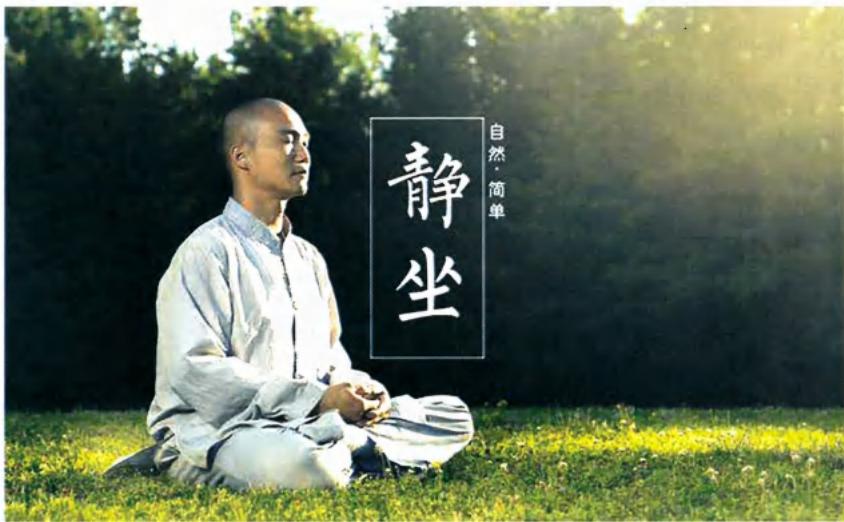
Standing is not conducive to relaxation, lying down easily leads to drowsiness, while sitting allows for relaxation without easily causing drowsiness, making it the best posture for entering stillness. “Entering stillness” (Rujing) means adjusting one’s thinking to a “subconscious focus” state. When we enter a state of subconscious focus, a sensation of joy arises. Anyone who has reached a state of subconscious focus once will never forget that pleasant experience. Therefore, meditation is not the suffering people imagine it to be; that is just fighting with one’s posture. Our normal state of focused thinking is selective thinking, clinging to a single point. For example, when we look at our mobile phone, we concentrate all our attention on the phone, and things outside the phone are ignored. Entering a state of subconscious focus is not like this; it is a waiting state for multiple things. The higher the level of subconscious focus, the wider the range of waiting. After entering the state of subconscious focus, one can focus on the phone while simultaneously focusing on multiple things. Entering this state of focus is the ultimate goal of meditation. In this state, or for those who can enter this state, their energy is very high.
For beginners in meditation, some basic points are as follows:
-
When meditating, use a posture that feels comfortable to you. Using the Full Lotus, Half Lotus, or Burmese style (Scattered Lotus) are all acceptable; sit in meditation in the posture you like and are accustomed to.
-
The waist should be naturally upright, and the chest and back naturally expanded and straight.
-
The left and right hands are clasped together below the Dantian (lower abdomen). The palms face up, hands stacked, left hand below and right hand above. The thumbs cross relative to the tiger’s mouth, naturally resting flat on the hip bones.
-
Relax the left and right shoulders, opening them naturally flat to a moderate degree; do not excessively slouch the shoulders or collapse the back.
-
Keep the head straight, the back of the head slightly pulled back, and the chin tucked in (not lowering the head, just enough to slightly restrict the movement of the two large arteries on either side of the neck).
-
Eyes look at the nose, nose looks at the heart; close the eyes naturally with a smile on the face.
-
Tongue touches the roof of the mouth, mouth naturally closed (if there is saliva, swallow it slowly).
-
Breathe naturally and relax, and when exhaling, count the breath firmly and attentively (Counting breath means counting exhalations; you can count from one to ten and then back to one, repeating back and forth).
Precautions to take when meditating:
-
When sitting quietly, do not sit in the wild, do not sit near doors or windows, and do not let wind blow directly on the body to avoid leaving hidden troubles for the body!
-
The light during quiet sitting should not be too dim, otherwise it is easy to become drowsy; nor should it be too strong, otherwise it is easy to become tense and scattered.
-
When meditating, cover the knees, lower back, back of the head, and shoulders and back. Even when meditating in hot weather, the knees must not be exposed. Do not meditate facing an air conditioner or electric fan to avoid direct wind.
-
The floor in the meditation area should be kept as dry as possible; it is best to use a dedicated meditation cushion. Wait half an hour after finishing for the pores to close before showering.
-
When beginning to learn meditation, most cannot do the Full Lotus, so Half Lotus or Burmese style is advisable. When doing Half Lotus, a cushion must be added under the buttocks. The height and softness should be moderate, otherwise it affects the mood and effect of meditation.
-
When meditating, it is best to wear a smile, as this is more conducive to the natural relaxation of the nerves.
-
It is best to meditate more than an hour after a meal; early morning meditation is better.
-
Beginners should not force themselves to sit for too long; the principle is short duration but frequent sessions. Gradual progression is more beneficial for building self-confidence.
-
For beginning students, the meditation posture must be correct. Before starting meditation, once seated, slowly lean the upper body forward and then return to the original posture, then adjust the head to straighten the body. Once adjustment is complete, do not move again.
-
When meditating, wear loose, comfortable clothing, and remove all restraints such as jewelry, watches, glasses, etc.
Spiritual practice, practicing Qigong, and meditation are about elevating one’s own energy and wisdom. The first step is to open one’s mind. With a loving heart and a mind free of emotional turbulence, one accepts the joys, anger, sorrows, fears, and worries of the world. If one can accept the suffering of the human world, the heart will inevitably be calm. Once the heart is calm, one can achieve focus and learn how to use intention to guide Qi, gradually strengthening the body’s energy field, gradually merging oneself into the energy field of nature, and developing abilities. Extrasensory abilities and special powers are something everyone can develop through spiritual practice and training, because they are human instincts and latent potential.
How well or how strong one can train depends on the individual and should be moderated by the degree of effort. Regardless of the results, as long as one is willing to practice and train, there will definitely be unexpected gains, even if it is just improved physical health, being less prone to losing one’s temper, finding the world more pleasing to the eye, or simply becoming happier. The true purpose of spiritual practice and training is to enable people to live happier and more freely, with a broader mind; to allow people to view things from a more comprehensive and complete perspective; to enable people to develop their own wisdom and energy, and to cultivate extrasensory abilities; and to allow people to better unite with the energy field of the universe and communicate with all things.
3.5 Confidence and Emotions
Confidence is a source of energy latent in our consciousness; once developed, it can generate immense power. Confidence is like the engine within us, always providing the driving force for us to move forward. Confidence is also infectious; have you ever felt this way? Being with confident people who are willing to take responsibility brings positive influence. For a person full of confidence, success is not far off. Confidence makes a person innerly strong; with confidence comes the courage to strive in life. When we discussed the qualities of successful people at the beginning of this book, “full of confidence” and “not afraid of failure” were listed among them, illustrating that confidence is very important for a person’s success. If a person’s confidence relies on external evaluation, that confidence has no foundation; inner cultivation is the soil of confidence. Confidence has nothing to do with what one possesses; the key is the belief in one’s own future and the belief in one’s own dreams. Nick Vujicic, an Australian motivational speaker, is a disabled person born without limbs—note, without limbs at all. He wrote a book called Life Without Limits, which tells stories full of hope, and what we see in him are the excellent qualities of being “full of confidence” and “not afraid of failure.” Let us watch this short video of just over 3 minutes, “Have You Ever Despaired?”, to feel the emotion and strength Nick Vujicic brings to you.
We all undoubtedly believe in the energy of confidence. One of the important reasons students cannot be successfully inspired to unlock their potential is that they do not believe it is real, let alone believe they can do it. In the process of growing up, children will undergo many tests and gain a lot of knowledge, but these tests and knowledge may make the child think the world is getting smaller and smaller, no longer believing in many things, and no longer believing they have more possibilities. This is also one of the reasons why potential development is generally not recommended for students over the age of 12 who are in middle school. As mentioned earlier, it is also not recommended for children who have successfully unlocked their potential to display their results excessively. Think about it, what is feared most at this time? The biggest fear is that someone will doubt him! A persistent adult says: “That was peeking, it’s fake!” How would the child feel at this moment? Indignation, sadness, helplessness, doubt, grievance, loss of confidence—all the negative emotions come rushing in, and all the effort is wasted! Why? Because emotion is also a form of energy, and emotional energy has levels.
Have You Ever Despaired?
David Hawkins, an American psychologist and author of Power vs. Force: The Hidden Determinants of Human Behavior, discovered that emotions are actually energy, and the essence of emotional change is the flow of energy. The energy characteristics of emotions can be displayed by measuring heart rate and heart rate variability. Negative emotional energy has low-frequency characteristics, while positive emotional energy has high-frequency characteristics. Therefore, regulating emotions from an energy level means adjusting low-frequency emotional energy to high-frequency emotional energy. Negative emotions disrupt the rhythm of the heart and the autonomic nervous system, thereby producing adverse effects on the rest of the body. Conversely, positive emotions create more harmonious and rhythmic heart patterns, improving the balance of the nervous system.
Physical health is usually accompanied by a positive and optimistic attitude, while poor health, whether physical or mental, is associated with negative attitudes and emotions such as anger, jealousy, hostility, self-pity, fear, and anxiety. In the field of psychoanalysis, positive emotions are called “favorable emotions,” and negative emotions are called “stress emotions.” Long-term immersion in stress emotions can lead to psychosomatic diseases and the loss of personal energy. Harvard University once conducted a survey: 90% of illnesses come from within us, originating from our emotions. Most cancer patients have a poor relationship with their parents, have excessive negative emotions, and complain that negative emotions account for the majority of their lives. Many people say that most cancer patients are literally scared to death, which shows how powerful the energy of fear can be.
The body is like a notebook of our history, hiding all memories, traumas, and stories. It usually reminds us in the form of illness. Emotions are conducted through nerves and meridians in the form of information. When a certain emotion is too strong, the conducting nerves are damaged and get stuck there, thereby forming a memory.
Psychology writer Wu Zhihong has an article titled “The Body is the Mirror of the Mind,” in which he mentions a 62-year-old man in Loudi City, Hunan Province, who was extremely afraid of the cold. In winter, he had to wear 38 tops and 11 pairs of trousers, while also relying on a stove for warmth, but he was still cold. This old man’s physical cold was actually a reflection of his psychological cold. According to reports, he developed this strange illness only after his wife passed away. It can be roughly inferred that after his beloved wife left, his heart became very cold—so cold that he couldn’t stand it—so he escaped this psychological cold and actively severed the connection with this inner pain. At this time, this inner cold would express itself through outer cold.
In his book The Body Knows the Answer, there is a similar case:
My client, L, was also afraid of the cold. I remember when she first came, the weather was a bit hot. I was wearing short sleeves, and the air conditioner was on in the consulting room, but when she came in, she was wearing a long-sleeved shirt and a sweater. Seeing her like this, I was a bit puzzled, but I didn’t rush to ask why. Instead, I talked naturally just as I do with other clients. As we talked, we got to her childhood. When she was very young, she was sent to other people’s homes by her parents twice. The second time she was sent to a friend of her father’s, and her parents wanted to give her to this comrade-in-arms as an adopted daughter. She said that winter, in her impression, she was always very cold. She had to wear a lot of clothes and rely on the stove for warmth, but she was still cold, and it was always snowing outside. Finally, she fell seriously ill and cried all day like a tearful person. Her father’s friend had no choice but to send her back to her parents’ home.
When I heard her talk about this experience, I felt very cold. I knew this was my body capturing her cold. With this awareness, I talked with her very fully about this childhood experience, letting her speak out those details as much as possible. During this process, she was raining tears.
However, as the expression ended, the cold in my body gradually disappeared, replaced by heat. I voiced this feeling, and she said she was now very hot and really wanted to take off the sweater outside. I said, don’t rush to change the outside; first experience the inner changes, and then slowly change your dressing style. It is best to reduce the thickness of clothing after the body has relatively stabilized and recovered from the cold.
The muscles on our back correspond to different internal organs. Excellent massage therapists can understand the inner state of the body and mind through massage. For example:
Stiffness and soreness in the shoulders and neck are usually caused by accumulated anger.
Stiffness between the left shoulder blade and the spine can easily lead to heart problems, mainly caused by the accumulation of emotions such as heartbreak and grievance.
Stiffness of the right shoulder blade is mainly caused by the accumulation of emotions such as complaining and dissatisfaction, which can easily lead to stomach inflammation.
Traditional Chinese Medicine believes that excessive emotional changes can cause diseases, but the theory of “emotions overcoming each other” can be used to treat diseases. Traditional Chinese Medicine applied psychotherapy very early on, calling it “Yi Liao” (Mind Therapy). Psychological treatment is especially indispensable for mental illnesses and often yields better results than drug treatment.
Ancient medical scholars had many discussions on this. For example, the Dongui Bogam says: “To treat his illness, one must first treat his heart; one must rectify his heart to aid in the Dao. Make the patient remove all doubts and thoughts from his heart, all wild thoughts, all injustices, and all self-centeredness; suddenly, regret and enlightenment will explain everything. Then the heart will naturally be pure, and the illness will naturally heal. If this can be done, the medicine has not yet reached the mouth, but the illness is already forgotten.” The Ming Dynasty text Bencao Jingshu states: “Use consciousness to dispel consciousness, use reason to dispel emotion; this is what is meant by ‘heart disease must be treated with heart medicine’.”
Wu Shiji said in Liyu Pianwen: “The feelings of desire cannot be cured by medicine; diseases of the seven emotions must be treated with emotions.” Traditional Chinese Medicine has always attached importance to the important role of psychological factors in treatment and has created and accumulated many psychotherapy methods.
When a person has emotions and can perceive, control, and make good use of them, their level of conscious energy is high. If a person is led by emotions and cannot perceive them themselves, they are slaves to their emotions, and their level of conscious energy is low. British psychology master Eckhart Tolle stated in A New Earth: Awakening to Your Life’s Purpose that awareness can not only protect our bodies but also strengthen our mental power. He wrote: “The more awareness you invest in your body, the stronger your immune system will become, as if every cell is activated and cheering. Your body loves your attention; it is also a very strong self-healing system. When awareness is not in your body, most diseases will take advantage of the void to enter. If the owner’s awareness is absent from the body for a long time, various roles will move in. When awareness enters your body, some unwelcome ‘guests’ will find it difficult to invade.” That is to say, when you are constantly aware of your emotions, not only is your body’s immune system strengthened, but your spiritual immune system is also elevated. At this time, you can protect yourself from the influence of others’ negative emotional power. Focusing on the body can strengthen the vibrational frequency of energy. Any low-frequency vibrating emotions, such as fear, anger, depression, etc., will not be on the same level as you at all, and they will no longer enter your field of consciousness.
Mobilizing human emotions and allowing energy to flow through the body is a common method for activating human energy and awakening awareness. Gratitude education is a common teaching method used to mobilize emotional energy. Using the video “Cesarean Section” for gratitude education is content frequently used in adolescent mental growth courses. I have used it during my work as a homeroom teacher and achieved excellent results. Here, I share it with you for your reference. I must remind everyone that there is controversy in the media regarding whether the use of a cesarean section video is too bloody and explicit; you should exercise caution in deciding whether to use it in your class.
Cesarean Section
[Turn off all the lights, play the video “Cesarean Section Live Recording”, use the music “Scent of Flowers and Grass in the Wind” as background music]
Students, please watch a video. This is the scene of your mother giving birth to you. After ten months of pregnancy, one day your mom had a stomach ache. She was sent to the hospital, sent to the delivery room, this is a video of your mom undergoing a cesarean section. The doctor used a scalpel to cut open your mom’s belly, cut through layer after layer of flesh. Then your mother, at this very moment, in order to bring you into this world, is enduring the greatest suffering in the world, even facing the danger of losing her life. In that moment, all the doctors and nurses used scissors and scalpels to cut open your mom’s belly layer by layer. The video you are seeing now is the real scene and situation of your mom giving birth to you back then; this is the scene of your mother bringing you into this world in the delivery room. I ask every student to open their eyes wide and watch this video seriously. What does this bring to you, exactly? As you watch, think about it, what hurtful things have you done to her over the years? What hurtful words have you said to this woman? The cut on your mom’s belly gets bigger and deeper, and the doctor reaches his hand into your mom’s pelvic cavity. At this moment, a doctor uses scissors and forceps to cut away your mom’s fat and polyps. He is also very afraid, because one careless touch could hit you, and if he hits you, you will be injured. At this time, your mother cannot withstand such great injury; she is enduring it for only one thing, which is to bring you safely into this world, to give birth to you as soon as possible. Please all students open your eyes and look at this bloody video. Students, please look, look at what exactly your mother experienced to give birth to you? If you feel scared, you can close your eyes for a moment. This scene right now is the scene of you coming out of your mom’s belly. At that time, you were only this big, maybe 7 jin, maybe 6 jin, or maybe 8 jin. Now, the child is born, and the doctor has to stitch up mom’s belly stitch by stitch, layer after layer, layer after layer, layer after layer stitching up your mom’s belly. But do you know? Even though your mother gave birth to you, she didn’t know the whole process because she was under anesthesia; she had been given anesthetic. Your mom is watching this video together today, and she can’t even imagine what kind of pain she experienced to give birth to you back then. Today, everyone needs to watch this video. You watch the video with perception, awareness, and love. This needle and thread is stitching your mom’s belly, but it pricks your heart. I believe that at this moment, not only does your mom hurt, but you hurt even more. At this moment, do you recall how many hurtful words you have said to your mother? How many hurtful things have you done to her? I want to ask everyone, all students, please watch this video seriously with emotion, love, gratitude, and repentance. Students, do you know, when you go home, touch your mom’s belly. Maybe there is such a scar on your mom’s belly, a scar stitched up like this with marks.
Those whose mom has this scar on her belly, please raise your hand. Okay, put it down.
Those whose mom doesn’t have this scar on her belly, please raise your hand. Okay, those without this scar is called natural birth. What is natural birth? It means for your mom to give birth to you, it is said—though not necessarily—that children born naturally are smarter than those born by C-section. However, the pain of natural birth is greater than a C-section! Why? She doesn’t get anesthesia. Your mom wants you to come out of her uterus. Your mom’s uterine opening is very small. In order to give birth to you, the doctor will roll up a towel and put it in your mom’s mouth for her to bite on, to prevent your mom from biting off her tongue when the pain hits. Because the pain of natural birth and the feeling of it being heart-wrenching and lung-splitting is more than 100 times more painful than a C-section! So natural birth is more painful than a C-section; it can be said to be heart-wrenching!
You have grown up, your wings are stiff! You have learned to throw temper tantrums! You have learned to talk back to your parents! You have learned to run away from home! I would like to ask a question: can you change your relationship with her? What kind of reason exactly makes you give the most hurtful language to your most beloved mother? What kind of cause exactly makes you let the most hurtful things happen to your mom? Your mother carried you for ten months. From the start of pregnancy, for ten months, you were in your mom’s belly. When your mom was sick, for your sake, she didn’t dare to take medicine! Because as long as she took medicine, it could produce a deformed child, a blind child, a disabled child. So your mother had high fevers again and again, got sick again and again, had diarrhea again and again, but she didn’t dare to take a single pill, didn’t dare to take antibiotics. She endured pain that ordinary people do not have, in order to give birth to a healthy child! When your mom was pregnant with you, she wanted to eat chili, she wanted to eat seafood and other delicious things, but because of allergies she didn’t dare to eat! When your mom was pregnant with you, she didn’t dare to do strenuous exercise, she was even very careful when turning over in sleep, afraid of crushing you! Before you were even born, your mother was thinking every day about how to make you healthy, how to give you a good education in the future, working desperately to earn and save money! When you came into this world, your mom, in order to give birth to you, suffered such tribulation. Whether it was a C-section or natural birth, your mother brought you into this world with the danger of losing her life! But, think about it, the first pee you peed was on your mother’s body; the first poop you pooped was on your mother’s bed; the first meal you ate, you bit your mother’s nipple; the first set of clothes you wore, was hand-sewn for you by your mom… Your mom paid such a great hardship to let you grow up, holding you in her arms, carrying you on her back. When you grew up, your mouth became hard, you grew tall, you had strength, and you hurt her?! She is always wrong, you are always right, she is “out”, her thinking is outdated! Everyone knows that when a lamb drinks milk, it kneels on the ground. When a lamb drinks milk, it kneels on both knees, and the mother sheep stands. All nursing lambs kneel on the ground to drink milk. But when you drank milk, mom held you in her arms. Mom’s milk is all transformed from blood; every mouthful of milk you drink is drinking a mouthful of mom’s blood. How much milk you drank represents how much of mom’s blood you ate.
Below, please have parents and children sit facing each other. Please children look into your parents’ eyes, look at the wrinkles at the corners of their eyes, and say to dad or mom: I’m sorry, please forgive me, thank you, I love you. Next, I will give everyone a little time. If children have other words they want to say to mom and dad, or want to express their love through a hug, take action quickly.
Letting emotional energy flow within the body allows students to obtain profound feelings and awaken awareness. In our teaching, we should carefully design and fully make use of such educational tools. Realizing and comprehending things in a state of awakened awareness often yields very good results. The two words “Living in the Now” and “Time” may not be easy to understand in general circumstances. In my class meetings, I have used the short video “Growing Old with a Lover for 50 Years” to mobilize students’ emotional energy and awaken awareness to think about these two concepts, as well as the relationship with parents and relatives, and the relationship with time. In class meetings, I let students watch the video seriously with feeling, and after watching, listen to the following guidance “[Audio: Growing Old for 50 Years (Remix)]“.
Growing Old with a Lover for 50 Years
Aging 50 Years
Sit up straight, adjust your breathing, and close your eyes slightly.
[Background Music: “Father (Chopstick Brothers)” once]
Imagine time flying by rapidly; your parents are already in their eighties or nineties in the blink of an eye, just like the actors in the video clip earlier. Look at their aged appearance. Their skin is no longer moist and lustrous, but dull and grayish; their hair is graying, and their eyes can no longer radiate a spirited brilliance. Their eyes, brows, corners of their mouths, and necks are full of wrinkles. Their backs are no longer as straight as before; they need a cane or to hold onto a wall to move around. They can no longer wash clothes for you, cook your favorite meals, or tuck you in when you are asleep. They can no longer earn money to buy you gifts; those once smooth hands are now covered in calluses. They can no longer take care of you when you are sick; they can only gaze blankly and kindly into the distance. They can no longer tuck you in when you are asleep, add clothes for you when it’s cold, drive you to school or pick you up, and they will never nag or criticize you again…
Time passes so quickly that you didn’t notice how they aged bit by bit. Now, let’s replay some images: You got sick, your parents added a measure of worry, a hair turned white, and a wrinkle appeared; You didn’t want to study, your parents added a measure of distress, a hair turned white, and a wrinkle appeared; You did something wrong, your parents got angry, a hair turned white, and a wrinkle appeared; You were lazy and only thought about playing, your parents added a measure of annoyance, a hair turned white, and a wrinkle appeared; You rebelled and argued with your parents, your parents were extremely anxious, even hiding in the shadows to weep, a hair turned white, and a wrinkle appeared… It turns out that your parents becoming like this, bit by bit, has everything to do with you. What have you missed, what have you missed! Just as all parents are unwilling to be absent from their children’s growth, you should not be absent from their aging. You raised me to grow up, I will accompany you to grow old! Do not wait until it is too late, do not wait until there is no chance left.
[Music: “Piano Music of the Night (Music Box Version)”, “Daughter of Heaven”, wait for music to end]
Imagine time flying by rapidly again. This time, the one who has instantly aged is you. You are already an old person in your nineties…
[Background Music: “Where Has All the Time Gone?“]
What happened, what is going on, what exactly is going on?! How did I become so old all of a sudden? What have I experienced? How come I don’t remember anything? Why are my eyes blurry and unable to see clearly? Why are there so many wrinkles on my hands and face? Why is my skin yellowish, dark, and rough? Why is my head full of gray hair? Why did time pass so fast?
Let me calm down and recall carefully, what did I experience before?
I harbored my dreams and studied at school, attending class after class. Sometimes I would zone out during class, and time slipped away while I was zoning out.
After class, I chatted, played around, and joked with my classmates. These had nothing to do with the realization of my dreams and wasted a lot of my time.
I sat blankly in my seat, not knowing what I was thinking about. Time flowed away as I stared blankly.
I thought about seizing my destiny through studying, changing my destiny through studying, but as I thought, I did nothing.
It is not enough to just think; you must take action! You must do it immediately! You must keep doing it!
Give students a few minutes to think and imagine, then ask them to pick up a pen and write down the feelings in their hearts or the images in their minds under titles such as “Time”.
Just as in the case of L mentioned by Wu Zhihong earlier, because of a certain past emotion, one may be unable to face certain things. When meditating, if the scene at that time can be reproduced and the meditator can see the details of the scene, the emotional blockage can usually be released. The design of “Aging 50 Years with a Loved One” is also about using the energy of emotions to cleanse oneself, to cleanse the relationship with one’s parents, and to cleanse the relationship with oneself in the present moment. This cleansing is just like when we have worn glasses for a long time; we may not have realized that the lenses have become a bit blurry, so we use a glasses cloth to wipe them to make them brighter. When our hearts are wrapped up by layers of things, our own energy will also be wrapped up and will no longer flow or function, so we need to cleanse it regularly.
Emotions affect the energy flow of the body. Sometimes problems that are difficult to solve with medicine need to be solved from a higher energy level. There are now many courses on improving emotional awareness energy levels, such as Yangming Xinxue, Yoga practice, and Oneness courses. Through understanding and experience, I feel that the one with the highest energy level is “Zhi Liangzhi” (Extending Innate Knowledge), and I recommend it to everyone here. I think this course can be read both as an introductory course and as a final course, because this course is not commercialized and allows for unlimited repetitions. We will introduce this course in detail later.
3.6 Meditation
The term “meditation” was originally the English translation for “Zen” (Chan Ding). When Zen became meditation, its form became more flexible. Meditation is a mandatory training subject in daily classes at all potential development institutions and is an important way for students to replenish their energy. Closing one’s eyes to meditate allows people to exercise their ability to enter stillness, concentration, and imagination, entering a mental state where consciousness and the subconscious interact. In this state, aided by physical and mental relaxation, a comfortable sitting posture, and appropriate breathing methods, it is easy to stimulate energy to perceive the essence of things and find solutions to problems. Furthermore, it plays a positive role in human physical and mental health.
Meditation is a static method of mental exercise. When meditating, the mood becomes peaceful, muscles relax, the body’s hormonal secretion activities become increasingly active, human immunity gradually strengthens, and resistance improves. At the same time, memory, thinking power, and creativity all improve… Japanese Medical Doctor Shigeo Haruyama’s The Brain Revolution, Japanese Right Brain Educator Makoto Shichida’s The Right Brain Revolution, and International HSP Brain Olympiad initiator, Korean Scholar Seung-Heun Lee’s Brain Respiration are all excellent books on theory and practice regarding how to use the brain and right brain to keep the brain in an Alpha wave state. American meditation coach and neuropsychologist Dr. Rick Hanson and neurologist Dr. Richard Mendius authored Buddha’s Brain: The Practical Neuroscience of Happiness, Love, and Wisdom, which concisely introduces the methods and principles of meditation practice. Meditation: A Magical Psychotherapy and Illustrated Meditation Techniques compiled by You Xuxu are compulsory textbooks for training meditation course counselors; parts of the meditation guidance in the Right Brain Development Training Manual are excerpted from this book, and I recommend everyone to read and study it.
Nowadays, more and more people are able to accept the concept of meditation and this method of exercise. It is said that as early as 2010, there were 20 million people in the United States practicing various forms of meditation to varying degrees; that is, one out of every ten American adults, more than double the number from the beginning of the century. Experts who teach meditation are not only active in schools and hospitals but are also invited into government and enterprises, and even go into prisons to teach inmates.
In 2009, there was a project led by Professor Catherine Maclean of the University of California, Davis①. Researchers divided 60 volunteers into two groups of 30. One group was invited to a mountain resort for three months of meditation training, while the other group was arranged with other activities at the foot of the mountain. Members of both groups underwent attention tests on computers before and after this activity. The results showed that the scores of those who underwent meditation training on the mountain had improved significantly compared to three months prior, and were significantly better than those of the group at the foot of the mountain. The scores of the group at the foot of the mountain showed no difference from three months prior. In terms of research design, this is a typical randomized controlled trial, and its results are very convincing. In addition, a study by the University of North Carolina① also found that students practicing 20 minutes of meditation daily significantly improved exam scores, mainly because those students improved their learning attention through meditation practice.
The two cases above can be found in academic paper databases and are achievements of psychological research. Through potential development training, many students at potential development institutions have greatly improved their academic performance in cultural subjects, but the heads and counselors of the institutions could not explain the reason clearly. The results of the two studies mentioned above tell us that meditation training undoubtedly played a role.
Yoga, Qigong, Zen practice, sitting in meditation, etc., are all closely related to meditation, but their essence is to let go of the “self” (i.e., a state of selflessness) and to focus deeply on the subconscious. “Ming” (冥) means to extinguish; “Xiang” (想) means your thinking and thoughts; meditation is the process of removing the thoughts and worries you want to think about to find perception. It allows people to enter a realm of spontaneous awareness and feelings arising from the heart. In this state, consciousness and the subconscious blend with each other, external information can directly dialogue with the subconscious and influence it, thereby clearing negative emotions and garbage information, forming a positive energy thinking mode.
When children undergo meditation training, counselors should frequently provide voice guidance and play Alpha wave light music as background music to avoid free meditation. When students engage in free meditation, their imagination is so rich that it is difficult for counselors to predict and control; inappropriate thoughts or images may arise, and the counselor cannot know about them, which may bring about various consequences. When designing teaching, it is best to have purposeful or tendentious guided words to guide students in meditation. Counselors should carefully consider the students’ situation, write or select more meaningful guided words and find the most suitable music to make meditation training more effective. Overall, meditation guided words should focus on positive energy, positivity, beauty, calmness, sunshine, etc. These beliefs will be implanted into the students’ subconscious through meditation and may influence the child’s entire life.
It is difficult for elementary school students to achieve the effects of a training institution when doing potential development at home, which is related to the different effects of meditation training. When children meditate at home, most do not like the guidance from their parents that implies a strong intention orientation. This intention orientation is in the subconscious; adults may not be aware of it at all, and the child may not be able to articulate it, but their intuition tells them they don’t like it. Therefore, when elementary school students meditate at home, especially when parents are nearby, many children do not truly quiet down. Some are putting on an act, letting their minds wander, and just going through the motions, so the effect is greatly reduced.
For students, meditation does not necessarily have to use a strict training form, but counselors should understand its essence and flexibly design application methods to achieve the goal of students’ mental growth. There are many meditation mobile apps that counselors or parents can use for daily training, such as “8-Minute Meditation” and others. There must be more and better software to be discovered constantly; of course, sometimes writing your own may be more suitable for your students. The duration of each meditation session should not be too long; generally, 6~15 minutes is sufficient. If the child falls asleep during meditation, it is best to gently stroke and wake them up, then continue guiding. However, if the child frequently falls asleep, one must consider whether the guidance is overly relaxing or if one should pay attention to the child’s psychological condition.

Nowadays, students often live only in their thoughts, are not firm in their goals, lack the ability to act, and lack the energy to “strive.” Based on the text in Shen Shixi’s novel The Snow Leopard’s Sad Song regarding the snow leopard’s focus on its goal while hunting, I adapted and designed a meditation training session titled “You are a Snow Leopard.” I played it to students during class meetings for three consecutive weeks (three times in total), allowing students to experience the feeling of “striving,” and achieved good results.
He (She) Held My Hand as I Grew Up
Students, below we will listen to a piece of music. While listening to the music, relax your body, follow the teacher’s guidance in the music, and keep your attention focused. The music will speak of the body’s Root Chakra; the Root Chakra is located at the very bottom of your belly, supported by the tops of your thighs. The more seriously you do this, the greater the energy you will receive, and you will also become smarter! Okay, straighten your body, hold your chest out and pull your back up, gently close your eyes, and listen carefully to the music.
[Meditation Music: Basic “Energy” Meditation Guidance Program]
Okay, very good! Students, gently open your eyes. Everyone, please look at the big screen. On the screen is a photo of the night view of your hometown city. Students, please look carefully at the photo; every bright spot in the photo represents a family. Please choose any position and bright spot that you like, and imagine that is your home.
Gently close your eyes, take a deep breath. With every inhale, let fresh air fill your belly, making your belly round, then gently, slowly, slowly exhale the air…
Your body, following your breath, becomes lighter and lighter, lighter and lighter, slowly rising upwards, rising upwards. You are floating up, floating up! You are slowly flying towards that bright spot that is your home! It turns out that bright spot is the light shining from your home’s window. You are getting closer and closer to your home, the light is getting brighter, you have arrived at your window, the light is very bright, the light envelops your whole body… You want to look inside the room, but your eyes are dazzled by the light and you cannot see clearly inside. The light gets stronger and stronger, stronger and stronger…

Suddenly, you seem to have entered the room, and the things in the room have become very clear. You are very familiar with this room; you grew up in this room. Hanging on the wall of the room is a photo. This photo has been hanging here since you had memories, yet you have never looked at this photo as clearly and seriously as today to see who is in it and what they look like…
[Background Music: Music Box Version - Piano’s Night]
Sitting in the room is the person who held your hand as you grew up. He (she) is sitting on the sofa, earnestly looking through photos from your birth to the present, looking at them one by one very seriously. Now please look carefully at this person. The photo on the wall was taken many years ago; over these years, what changes have happened to this person? Perhaps you haven’t looked carefully at this person for a long time. His (her) skin no longer has the rosy luster of a few years ago, wrinkles have crept onto the corners of his (her) eyes, his (her) originally full head of dark hair now has strands of silver, his (her) gaze, his (her) hands…
How did he (she) get old? Look at the photos in his (her) hand, the images flashing through his (her) mind, accompany him (her) to recall the little bits and pieces of your past together.
When you were learning to walk, a pair of hands supported you… When you went to and from school, a big hand held your little hand… When you ate, a pair of hands brought the meal before you… When you were sick, a hand stroked you…
In your life, there have always been warm big hands holding your little hand. Now I will give you three minutes to look clearly at the scenes you have experienced, and remember them in your heart…
[Background Music: Piano - Secret Garden]
Very good, let us save all the scenes we saw. In a moment, when you open your eyes, these scenes will be vivid in your mind and clearly reproduced. In a moment, I will count to 3. When I reach 1, please open your eyes. These scenes will all reappear. Pick up your pen, look at these scenes, and write them down in words. The topic we are going to write is: He (She) Held My Hand as I Grew Up.
Now, students, please adjust your breathing, fly back, fly back, come back. 3, 2, 1, students open your eyes, pick up your pen and paper, and quickly write down the scenes from just now. Open your eyes, write quickly, quick, quick! If you can’t write a character, use Pinyin instead! Write down whatever is in your brain! Write in segments, quickly write, the faster the better, hurry and write it out in your brain, however the scene looks, write it exactly that way.
3.7 Mind Power and the Subconscious
Spoon bending using the mind, like that of Uri Geller, is regarded as an entry-level training project in some adult psychic development classes. Indeed, just like the audience at the Jiangsu Satellite TV 2012 New Year’s Eve Concert, for some people, with simplicity, absolute belief, singular intention, and highly concentrated attention, it really takes only a few minutes to find the feeling and easily bend the spoon with the help of their fingers; this is real. Everyone please pay attention to some keywords in the sentences above; besides the words regarding psychological state and personality characteristics such as simplicity, absolute belief, singular intention, and highly concentrated attention, “finding the feeling” and “finger assistance” are also very important. It is precisely these two words that make scientists disdain judging their scientific validity. Because, the thing that is “found” is a kind of feeling; that feeling is only known to the person performing the operation. Human feelings are mostly difficult to measure and express with data, and many people cannot find that feeling even after using several hours. Therefore, “events such as mentally bending steel spoons or metal strips, or moving small objects, although attracting public attention, often lack systematic, controlled-condition experiments repeated by different experimenters over years of accumulation, so discussing metal bending and psychokinesis in the scientific community is not yet very well-founded”①. In addition, the bending of the soup spoon is not like in The Matrix, where you stare at the spoon and it twists by itself; rather, it requires the touch of fingers, and even requires some force, which some people might use quite a lot of. Therefore, mind-bending spoons is just a game to exercise human concentration and imagination, and is not necessarily a certain power of the mind.
This game can generally be guided like this: Use your thumb and index finger to pinch the position where the spoon connects with the handle, and try back and forth to find a point you feel most comfortable to pinch. Make a spiritual connection with this spoon, and ask this spoon to help you bend it. Say to this spoon, “I love you, thank you, you can do it!” Put your mind/intention on the position where you are pinching the spoon, imagine it is becoming hot, becoming scorching hot, becoming very, very hot; it is melting, becoming soft, becoming very soft, as soft as cooked noodles. The moment you feel the spoon becoming soft, use the fingers of your other hand to press the bottom of the spoon bowl or the belly of the spoon, or use the palm of this hand to hold the handle and quickly press the spoon part with your thumb. If your mental power is sufficient and the timing is just right, the spoon will be bent or broken, and the bent area can obviously feel hot or scorching. After you proficiently master this operation technique, you can try to twist one or two spoons into a twist shape using the power of your mind. Mind-bending spoons is like sucking steel spoons; as long as the thought is righteous, the simpler the better; the simpler it is, the easier it is to succeed; whereas people who are naturally suspicious and indecisive find it very difficult to succeed.
This guidance method has similarities to the process of mind bending introduced in Uri Geller’s My Psychic Life. “Let such a belief emerge in our minds: we can use the power of thought to do things we never felt we could do. Let us pick up a table knife, key, or tablespoon, or something like that, choose any one, then concentrate our thoughts, focus with all our heart, let your thoughts be deeply convinced that what you hope to happen will definitely unfold before your eyes. Gently hold the knife, fork, or key in your hand, and start silently reciting in your heart: ‘Bend, bend, bend.’ If the object bends, then be joyful and happy, hoping it will continue to bend. The key is to firmly believe in your own ability. To make the key bend, you can put the tablespoon and key inside a bottle, put on the lid, and then you touch the bottle to make the tablespoon inside bend. If the functional state is good, even if a coin is placed in someone else’s hand, I can use my mind to make it bend. Someone else holds a coin as small as a five-fen coin, and then without touching the coin, I can also use my mind to bend it.”
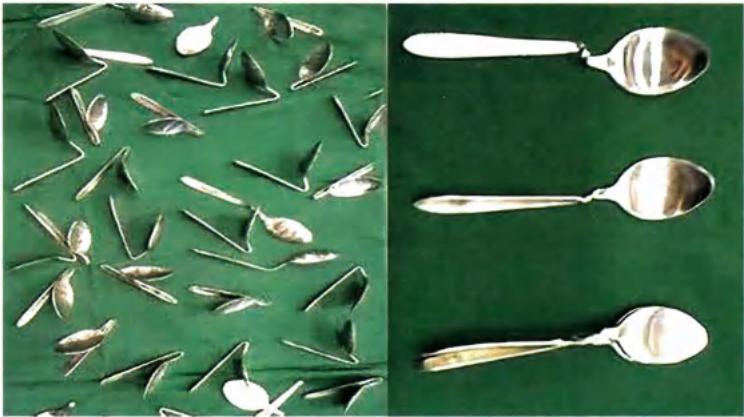
Picture of mind-bending spoon results
In actual operation, this game varies from person to person; some people may need several hours to find this feeling, while others may never find this feeling, and of course, some people may be able to complete it in a few minutes. For children, their thoughts may be simpler and their degree of belief higher, and after a period of practice, most can do it (see the picture of mind-bending spoon results).
We say that meditation and the mind contain huge energy; they are both the result of the interaction between consciousness and the subconscious. Consciousness and the subconscious are psychological terms proposed by Austrian psychologist and founder of the psychoanalytic school, Freud. Simply put, human consciousness includes the conscious mind (i.e., the consciousness referred to here) and the subconscious. The conscious mind is the more obvious mental activity of a person; the subconscious is the unobvious, not exposed on the surface mental activity. When studying psychology, when it involves the issue of the conscious mind and the subconscious, Freud’s iceberg theory is probably one of the contents that can leave the deepest impression on everyone. The meaning is that if the entire mental activity of human beings is compared to an iceberg, then the part floating above the water belongs to the scope of the conscious mind, accounting for about 5%, while the 95% hidden underwater belongs to the subconscious. It is evident that compared with the conscious mind, the energy of the subconscious is almost endless, and psychologists believe that the subconscious can overcome almost all problems. Therefore, any development of potential and any hope to be realized must rely on the human subconscious. Shichida Makoto also believes that the subconscious gives everyone special abilities, but most people do not know about it, so they cannot make full use of it, just like carrying a treasure without knowing where it is. If this secret can be unearthed, human abilities will completely change.
Although the energy of the subconscious is huge, it is difficult for people to see it, just like the iceberg under the sea surface (see the schematic diagram of the iceberg of consciousness and the subconscious). When using the energy of the subconscious, consciousness (i.e., the conscious mind) most of the time will suppress the energy of the subconscious. Only when consciousness is emptied or when consciousness and the subconscious interact, does the huge energy of the subconscious easily play a role, controlling and adjusting the human body, thoughts, and emotions, thereby bringing out potential. This means that if one can adjust one’s consciousness to interact with the frequency of the subconscious, or temporarily close the barrier of consciousness, one can let the energy of the subconscious operate. Through forms such as meditation, Qigong, Yoga, sitting in meditation, and hypnosis, one is opening the channel to the subconscious, allowing the subconscious to receive certain information commands and change the operating laws of the body, thoughts, and emotions.
The ancient Indian Vedas long ago proposed that clearing conscious thoughts can produce special functions.
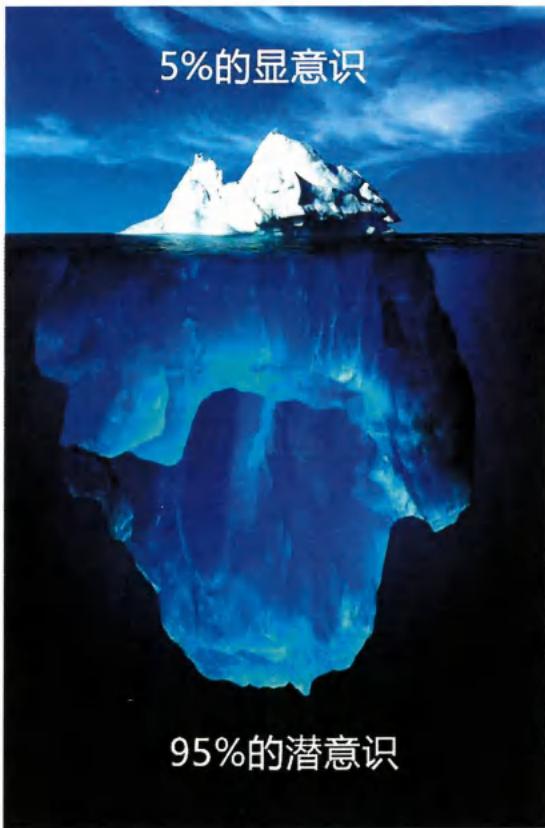
Schematic diagram of the iceberg of consciousness and the subconscious
The Yoga Sutras from 3500 years ago pointed out that long-term deep meditation can obtain various special functions. The mental state when dreaming, falling asleep, being hypnotized, taking certain drugs, or being confined with sensory information cut off is also similar to that during meditation. At this time, the brain remains awake while the level of external stimulation signals is very low. Clearing away a large amount of continuous chaotic information, leaving only the minimum information presented to conscious perception. At this time, we can hear someone calling our name in a very noisy environment, or when we are driving, although we did not clearly see the person rushing in front of the car, our foot has already stepped on the brake. This kind of meditation exercise has many methods; for example, it can also be done through “Ho’oponopono,” the ancient Hawaiian mind-healing method introduced in New·Zero Limits, to heal and clear the chaotic information inside. When the body is in a comfortable environment, using light irradiation or relatively loud sounds, human senses are easily in a deprived state. At this time, the brain cannot feel external images or sound changes, and it will autonomously produce some dim but sometimes very vivid images.
3.8 Love
We often see sentences like “Love is the greatest energy in the universe.” In David Hawkins’ Map of Consciousness, the energy level of the Love tier reaches 500, which is a very high value. According to Hawkins, only 0.4% of people in the world can reach this level of consciousness. Why have so few people reached this level?
We must start with the word “love” itself. When we say this word, it feels sacred, lofty, and full of aura. But what is love? If you try to explain it, it is actually very hard to say clearly what it is. Liu Huan sang a song called “Confused Love”: “How much of love can be explained clearly, and how much is just confused; how much of affection is tenderness, and how much is bitter astringency.” This is exactly how love feels to most people: confused and muddled, as if it really cannot be explained clearly. Why is this? Let’s sort it out. First, we usually think the word “love” expresses a kind of emotion or feeling. You love your spouse, you love your children, you love the world, etc. This shows that love is emotion and desire.
There is another old song called “Women Are Tigers,” the lyrics of which are based on “The Novice Monk Thinks of Tigers” from What the Master Would Not Discuss (Zi Bu Yu) by Yuan Mei of the Qing Dynasty:
A Zen master on Mount Wutai took in a novice monk who was just three years old. Mount Wutai is very high; the master and disciple cultivated themselves on the summit and never went down the mountain. More than ten years later, the Zen master took his disciple down the mountain. The novice monk did not recognize oxen, horses, chickens, or dogs, so the master pointed at them and told him: “This is an ox, it can plow fields; this is a horse, it can be ridden; these are chickens and dogs, they can crow at dawn and guard the gate.” The novice monk agreed obediently. A moment later, a young woman walked by. The novice monk asked in surprise, “What is this?” Fearing he would be tempted, the master told him sternly, “This is called a tiger. If a person gets close to it, they will surely be bitten to death, leaving no bones.” The novice monk agreed obediently.
In the evening when they went up the mountain, the master asked, “Of the things you saw at the foot of the mountain today, are there any you are thinking about?” [The monk] said, “I do not think of any other things, I only think of that man-eating tiger; I always feel I cannot bear to part with it in my heart.”
In Giovanni Boccaccio’s The Decameron, the story “The Green Geese” expresses something similar to this story. The story is about a man whose wife died in middle age; he took his young son into the deep mountains to cultivate himself. He absolutely refused to mention worldly matters to his son, only teaching him to recite prayers. Except for his father, the son had never seen anyone else. When the son grew to eighteen, he went down the mountain with his father for the first time and arrived in Florence. Palaces, mansions, churches, etc.—the young man had never seen any of them and was extremely surprised, asking about this and that along the way. Just then, they met a group of young, beautiful girls. The son asked his father what these were. The father said, “These are scourges, called green geese.” Strangely enough, the young man had never seen a woman in his life. Of the many fresh things before his eyes—palaces, bulls, horses, donkeys, money—he paid no attention at all. He suddenly said to his father, “Ah, father, let me take a green goose back.” The father said, “Don’t be silly, I told you they are all scourges.” But the son said, “I don’t understand your words, nor do I know why they are scourges. I only feel that I have never seen anything so beautiful and so lovable. They are better looking than the pictures of angels you often show me. For God’s sake, if you love me, let’s figure out a way to take one of those green geese back there; I want to raise it.”
These two stories actually illustrate that the “desire” for the opposite sex is innate; this is not love. We all feel that romantic love is sacred. The poem by the Hungarian poet Sándor Petőfi has been widely recited around the world for over 100 years: “Life is dear, love is dearer. But for freedom, both can be given up.” Seen this way, at least the pursuit of freedom is more important than romantic love; is romantic love still so sacred and noble? What exactly is love?
The love usually spoken of is often just a strong emotion that blends physical attraction, possessiveness, desire for control, infatuation, eroticism, and novelty. They are often fleeting, fluctuating, increasing or decreasing with changes in external circumstances. Once emotions are thwarted, the deep-seated anger and disguised attachment usually hidden away will reveal themselves. “Turning love into hate” because of love is easily understood by people; hating because one didn’t get the result one wanted—this kind of love is essentially selfish desire. Therefore, the love we usually speak of is likely merely a persistent emotion, not love. Some people date, saying “I love you” at every turn, but if they don’t get it, they hate, turning into “I hate you.” If that’s the case, love is very terrible. Some people say that love is selfish, that love itself is possessiveness—“I love you, so you belong to me”—and then, if the love is unrequited, they hate, or after getting along for a long time, the other’s faults are discovered, they become an eyesore, their thoughts differ, and resentment comes…
You see, romantic love comes along with “desire.” Liking the opposite sex and cherishing one’s own life are both manifestations of greed. Can the energy value of this so-called love reach 500? How much positive energy can it bring to people? So while romantic love might have power for a certain person, does it have energy for people other than that person? That is not necessarily the case.
On February 10, 2019, the “New Year’s Grassroots” segment of the Xinwen Lianbo (News Simulcast) recorded a true love story that occurred on the railway during the Spring Festival. Some netizens commented: I didn’t expect that watching Xinwen Lianbo could make people cry their eyes out. The story was titled “Meeting at 00:37” (see video) and recorded two railway workers who stuck to their respective posts during the Spring Festival, having only a brief 1 minute and 52 seconds to meet. The boy, preparing to propose, hurriedly stuffed the ring and a food box to the girl, and before he could say anything, they had to separate again. The boy waved to the girl on the train from the platform but could not speak; the girl in the carriage looked at the things the boy had stuffed to her and lowered her head to wipe away her tears…
Why did this short snippet of a love story move so many netizens to tears? And why was it called a “godly love story”? Because there is not only romantic love here, but also something higher than romantic love. This is the fact that both the male and female protagonists have things more important than themselves in their values and beliefs—sticking to their work posts to make others happier. This is the reason why this love generated huge energy.
It is undeniable to all that the greatest love in the world is maternal love. Because maternal love is the love of a mother’s nature; this is true for both humans and animals. A short video was also widely circulated on WeChat or Douyin: A dog got a piece of meat but did not eat it; instead, it carried it in its mouth and trotted all the way. The video shooter followed behind, and finally, the dog fed the meat to a few puppies. After watching it, people all sighed at the greatness of maternal love. Feeding, protecting children, and giving them meticulous care is something almost all mammals and even birds can do; it is a mother’s instinct. As for humans, a mother’s love for her child is not just in terms of birth and rearing, but more importantly, it must include the wisdom of education. In parent classrooms, we often use the story of the old eagle and the little eagle to inspire parents: what is raising, and what is truly loving a child.
When an eagle builds a nest on a cliff, it first uses its sharp beak to carry some thorns and place them at the bottom, then carries some sharp little stones to spread over the thorns, and then carries some dried grass, feathers, or animal skins to cover the little stones, making a warm nest for hatching eggs. After the little eagle hatches, the eagle regularly brings back small insects and meat, carefully feeding and protecting the little eagle. Later, the little eagle slowly grows up and its feathers become full. At this time, the eagle believes it is time for the little eagle to learn “independence.” So the eagle begins to ruthlessly stir the nest, causing the dried grass and feathers on the nest to fall off, exposing the sharp little stones and thorns. The little eagle screams in pain, but the eagle remains ruthless in chasing it away. The little eagle has no choice but to endure the pain, flap its wings, and fly away from the nest alone.
Or let’s talk about how a mother eagle teaches a little eagle to fly:
The little eagle has grown up and it is time to learn to fly. The mother eagle takes the little eagle to the mountain cliff and stands at the edge of the stone cliff, letting the little eagle fly down the mountain by itself. The little eagle is very afraid, standing there, looking down the mountain with its eyes, not daring to move a bit, nor daring to spread its wings. The mother eagle knows the little eagle has the instinct to fly, so she pushes it down all at once. In this way, the little eagle has no choice but to spread its wings and fly down the mountain. At this time, if there is any danger, the mother eagle will quickly fly down and catch the little eagle. After many efforts, the little eagle flies very well and can fly bravely and freely. Look there! They fly very high and very far, passing through white clouds, seeing the blue sky. This is their happiest moment!
We do not need to investigate whether the mother eagle really teaches the fledgling to fly this way; what is important to understand is that these stories all tell us some principles, how to educate children, and where we can learn from them. Is the mother eagle cruel and heartless? No, the mother eagle deeply loves the little eagle she gave birth to and raised. However, the mother eagle longs even more for the little eagle she loves to become an eagle that soars everywhere, so she must ruthlessly force the little eagle to “experience setbacks,” fly away from the comfortable nest, and bravely learn independence. Even if the little eagle stumbles at the beginning, the mother eagle still secretly cares for and protects it nearby until the little eagle can spread its wings and fly high into the sky. As the saying goes, “Seemingly heartless, yet full of love,” the cruel and heartless mother eagle forces the little eagle to leave the nest and fly elsewhere. The purpose is to let the helpless little eagle understand that it must stand up strong with tears, fly on its own, keep flying, and fly to a patch of clear sky and blue sky that belongs to it. These two stories illustrate the wisdom and greatness of the mother eagle’s love for the little eagle, which is very moving to hear.
Telling stories about animals is actually to draw a parallel with humans. Feeding children like animals—this innate maternal love of animals—can be far surpassed by highly evolved humans. Therefore, the maternal love involved in feeding children hardly creates great waves in civilized human society; its energy appears insignificant. If maternal love is to be great, it must transcend life and the instincts of animals. A mother eagle’s love for her eaglet is not merely about feeding; she always understands how to enable the eaglet to fly higher, further, braver, and freer in the future. She holds a belief in her eaglet—she believes it is an eagle that can pierce the white clouds, fly into the blue sky, and soar freely. Thus, the mother eagle’s love is filled with wisdom, provoking deep thought and emotion.
Some parents feel that they sacrifice a lot and love their children deeply. Whether they truly love their children is hard to say. You claim to love your child, yet are you constantly finding fault with them? Scolding and lecturing them back and forth? You say this is for their own good. I, on the other hand, feel you are treating them like your pet: if they are obedient, you treat them well; if not, you criticize and scold them. You simply haven’t treated them as an independent individual or a strong person in life. You have never let them make their own choices in your heart, and you have never raised your own child as a strong person! Perhaps you are just raising the child as a pet! In this way, where is the energy? Raising a child in daily life, giving them the best things even if you have to go without yourself, is merely animal instinct, not love. Not arguing with your wife or husband for the sake of the child, and only speaking well of the father or mother to the child, this is true love.
Many people keep pets, serving all their needs for eating, drinking, and relieving themselves. You play with them when you have nothing to do, and lock them in the house or a cage when you are busy. Just like this, you like it when others say you are compassionate and love small animals. Is it loving small animals? Do you love cockroaches? Do you love rats? Do you love tigers? These types of love all have an agenda; actually, keeping small animals is to give yourself a companion, using them to make up for your own inner deficiencies.
We may have seen such people: he keeps a dog, and every time after finishing a meal at a restaurant, he checks the leftover food and bones to see if there is anything his precious dog can eat, taking it back for the dog. The dog food he buys isn’t cheap; perhaps even the daily cost of feeding his dog exceeds a person’s meal money? Perhaps even exceeds the meal money of his elderly father or mother alone? You tell me, does he love his dog or his parents? Where is the energy in such “love”?
In the 2020 New Year movie Go Brother! (Jiong Ma), the love described in the parent-child and intimate relationships between the protagonist Ivan, his mother, and his wife is a deformed love. Although each party’s starting point is love for each other, this love is hoping the other person lives the way they want them to. This kind of “love” is not truly love that can mature the other person; it is very likely to limit or lower the other person’s energy. Therefore, love is not control and taking; love is acceptance and respect.
A boy once said to a girl’s father: “I love your daughter more than my own life; I can die for her!” The girl’s father said: “Oh, I see my daughter loves another boy; I hope you can let her make her own choice.” The boy met the girl and had a huge quarrel with her. The girl went to find her father, and the father said: “This boy does not truly love you; he just wants to possess you. Because he cannot possess you, he can irresponsibly go die. Such a boy is not worth cherishing. The person who truly loves you hopes more to see you happy!” Romantic love is unreliable because love is a feeling; you might have the feeling today, but it might be gone tomorrow. Feelings come just like that, and leave unconsciously. Therefore, if romantic love wants to be reliable, one must remove the “romance” (emotion) and keep only “love”; reliability relies on commitment and responsibility toward each other. According to surveys, most married people have various dissatisfactions with their families and spouses, and basically have all thought of divorce, feeling that marriage is simply the grave of love, so how can one still speak of love? But the reason they haven’t divorced is actually still love; it’s just that love has turned into responsibility. Loving the child is being responsible for the child; loving the family is being responsible for the family.
Before China’s Reform and Opening-up, the word “love” was rarely spoken. Even now, few people born before the 70s can often bring themselves to say this word. Because the word “love” is written in traditional characters as “愛” (containing the heart). Love is done with the heart, not hung on the lips. China views love as responsibility. Responsibility means being willing to be responsible for all things; all love has its principles. Love for parents is called Xiao (filial piety), love for children is called Ci (kindness/benevolence), love for one’s husband is called Jing (respect), love for one’s wife is called Yi (righteousness/duty), love for elder brothers is called Gong (reverence), love for younger brothers is called You (friendship), love for superiors is called Zhong (loyalty), love for subordinates is called Hu (protection), love for animals is called Chong (doting)…
Such love is responsible love. Achieving the willingness to be responsible for all things will form the largest energy field. When love has an order, it generates energy; when there is no order, love does not necessarily generate huge energy. For example, when you see young men and women hugging and cuddling in public, are you moved? Is there energy? Such love will not trigger energy. Does homosexuality move you? Will it make you feel envious? Will it make you feel that finding someone of the same gender to kiss is also happy? If not, such love is not love; it cannot generate energy in the universe.
Have you ever seen a family where the young are very filial to the elderly; is this family unhappy? Have you seen people who are very loyal to their superiors complain? Have you seen a leader who takes all responsibility upon themselves, protects their subordinates when problems arise, and thinks of their subordinates when there are benefits, not receive respect? Therefore, when using an ordered love to be responsible, energy is generated; when love has no order, it cannot be called love.
The simplest method to transmit the energy of love to others, using Master Jingkong’s method, is the “Four Goods,” namely: keeping a good heart, speaking good words, doing good deeds, and being a good person. To achieve these four goods, one must start with learning repentance and gratitude, using repentance to clear one’s distracting thoughts, and using a grateful heart to do these “four goods.” Gratitude is closest to awareness, closest to dreams, closest to success, closest to wealth, and closest to happiness; the essence is using the energy of love to attract good returns. As counselors and parents, filling the students’ growth environment with care and love, letting students truly learn gratitude, letting the information students accept be filled with emotion and shock, letting students establish correct beliefs, positions, and values, and finding their true selves—this is giving them the greatest energy.
At the end of this section, I will tell one more story. This story has given huge energy to countless people and unlocked their potential.
One day, an old kind man came to a chicken farm, the kind where chickens are free-range in the woods. The old kind man watched the chicken farm for a long time and suddenly discovered a chicken that looked different from the others. It was bigger than a chicken, with very long feathers. Occasionally it would flap its wings and run a few steps; its wings were very long. It looked like a chicken but also not like a chicken, very ugly. The old kind man asked the owner of the chicken farm what was going on.
“Half a year ago, I went up the mountain to look for herbs and saw a bird egg, so I picked it up and put it in a brooding hen’s nest. Not long after, this egg hatched too, but it didn’t look like a chicken at all. Now that it’s grown up, I see that it is an eagle. Seeing this eagle living with the chickens every day is quite fine; it seems the eagle thinks it is just an ugly chicken, so I just let them be together.” The owner of the chicken farm said the situation with great enthusiasm.
The old kind man looked at this little eagle and shook his head straight, feeling its fate should be chosen by itself. So the old kind man bought this eagle and took it to the edge of a cliff on the mountaintop. Below the cliff was a turbulent sea. The waves of the sea beat against the reefs on the shore, making a huge rumbling sound, making one feel that this place was soul-stirring.
The old kind man said to the little eagle: “Eagle oh eagle, you are an eagle, not a chicken! Your fate is in the sky. Today I brought you here to let you choose for yourself. I will throw you down from here. If you choose to be an eagle, you will spread your wings and fly from here into the blue sky. If you feel you are a chicken, then fall from here, smash your body to pieces, and be buried in the sea; that is better than being cooked, steamed, and eaten.”
After saying this, the old kind man threw it down from the cliff. This eagle still curled up like a chicken and fell down, down, down. Just as it was about to fall onto the reefs below the cliff, I don’t know if it was the huge sound of the waves that woke it up, or the splashing spray that awakened it, but it suddenly spread its wings and flew toward the distant sky…
3.9 Energy Implantation
Energy is a complex noun that is difficult to describe, making it seem extremely abstract and mysterious. Because of this, many potential development counseling institutions attribute all problems that arise during training to insufficient energy. This statement is a bit of a stretch; after all, careful analysis can often find the cause, which is mostly the impact of the environment on the child’s psychology. However, the word energy is also quite appropriate when used in potential development, as some institutions have achieved good results by having teachers with high energy directly transmit energy to students.
The most classic and magical example is Teacher Tao Yongdi, the founder of the Inspiration Learning Method. When students cannot write anything, their writing and learning speed cannot improve, or they even type slowly on the computer, the student holds Teacher Tao’s hand. A few minutes later, the student’s spirit is doubled, and when they go back to studying, it is as if they have become a different person, truly resembling a car that was low on oil being refilled and running smoothly. “Brain Cube,” once the leader in the potential development training industry, also had several teachers with certain abilities; they could tap a student’s glabella (the space between the eyebrows) a few times with their fingers to activate extrasensory perception functions.
Some potential development institutions use the counselor’s energy to activate the student’s light ball: the counselor and student sit face-to-face, holding hands, allowing the student to feel a strong energy flowing from the teacher’s hand through their own arm and neck to reach the brain, and seeing a light ball. As the energy continuously surges, the light ball becomes brighter and larger, turning into a golden light ball.
It is hard to say that these methods can be achieved merely through psychological suggestion. Many counselors taught by Tao Yongdi could not reach Tao Yongdi’s energy standard, so the results were less than ideal. Therefore, Tao’s franchisees can mostly only use Tao Yongdi’s method to teach writing, and cannot achieve the overall improvement of human spirituality. Regarding the technology of activating the light ball used by potential development institutions, if the counselor has not undergone long-term cultivation such as Qigong and possesses high energy, it is also difficult to use this method to activate the student’s light ball, or the activated light ball is too small and not bright enough. Few people master this method, and it has not undergone scientific testing. Here, I can only briefly share these energy implantation cases I have witnessed with everyone. If you are willing to try, start with cultivation.
If a child in a potential development institution makes slow progress during training or encounters certain problems, buying them a germanium stone necklace bracelet, crystal ball, energy patch, or other so-called high-energy items to wear is also difficult to solve the problem fundamentally. A long time ago, there were such advertisements abroad: “Magical sapphires excavated from the bottom of the ancient Mayan pyramid, scientists confirm can relieve headaches and enhance spiritual energy.” I believe most scientists and researchers of paranormal abilities would scoff at this.
It is possible that the photoelectric effects of substances like crystal and germanium have a large overlap with the vibration frequency of the human body, resulting in a strong resonance effect and thus producing a certain influence on body cells. However, there is insufficient scientific evidence to prove that it plays a decisive role in improving abilities such as extrasensory perception. These external energies are more of psychological suggestion, so they are easily changed by negative language and thoughts. Once the power of belief is missing, no matter how good the thing is, it is difficult to exert its effect. Some of these energy bodies do indeed produce some effects, but fundamentally, it is still necessary to form an internal energy supplement, starting from right heart, right virtue, and right thought, that is, working hard to establish a correct stance and beliefs. If a child has insufficient energy and the environment is not changed, and correct worldviews, outlooks on life, and values are not established for them, and no effort is made on their inner belief system, all external energy supplements cannot truly flow and function within their body.
I once used magnetic fields to heal myopia in children. Once, after completing an eye healing session for a friend’s child, the vision improved significantly. Except for slight difficulty reading small words in books, they could manage daily life without nearsighted glasses. Both the child and the parents were very satisfied. A few days later, when doing the healing again, the child’s vision had completely reverted to its original state, returning to the level before the first healing. Upon inquiry, they had almost none of the instructions regarding eye hygiene habits given to the child and parents after the healing. In fact, the things to do were very simple, with only two points: looking into the distance for two or three minutes during every break, and not wearing glasses whenever possible during study and life.
The child perhaps fundamentally does not want to take off their glasses. If the child has sufficient motivation and belief to change their original eye usage habits, using magnetic fields to heal myopia in children is still very effective.
Certain energy items, after coming into contact with the practitioner, can produce sensations such as the light ball becoming brighter and images becoming clearer and more realistic. However, these sensations vary from person to person and there are no scientific means to quantify them. When the energy items leave the human body, the various good sensations produced by most people also significantly decrease. Therefore, more people may accept the explanatory theory of psychological suggestion. Currently, energy items in society are mostly based on quantum energy implantation or quantum energy conversion loading standing wave technology. This kind of promotion that makes people feel very “high-tech” also appeared during the Qigong fever of the 1980s and 1990s. Many Qigong masters would transmit and send information to their followers, and there were also Qigong practitioners wearing aluminum pots or iron basins on their heads to receive “cosmic information.” After receiving the information, many practitioners felt a great improvement in their vitality, spirit, and energy, and some patients even saw their conditions improve or recover after receiving the “information.” I am not clear whether quantum energy implantation is the same as the aforementioned receiving of “information,” but to most people, both seem incredible or even ridiculous.
Although quantum mechanics was born more than 100 years ago, basic education currently only briefly touches on the knowledge of the wave-particle duality of light in high school physics. Quantum science has certainly not reached the level of popular science; it seems that only a very small number of scholars can roughly and accurately understand its theories. What makes quantum mechanics feel eerie is that consciousness and the material world cannot be separated, and consciousness may be the foundation of the material world. As early as 1944, Austrian physicist Schrödinger, in his book “What is Life?”, attempted to combine the research of quantum mechanics, thermodynamics, consciousness, and life sciences.
Emerging quantum medicine technology, also known as quantum energy technology, is a quantum medicine technology based on the principles of quantum mechanics, combining quantum biology, pharmacology, and life informatics. It utilizes forms such as electron fluctuation, radiation, and energy in microscopic states to conduct comprehensive, systematic, all-round, and developmental prevention, regulation, anti-aging, treatment, rehabilitation, and detoxification of the organism. Quantum energy intervenes through physical methods such as sound, light, electricity, and magnetism, and is loaded into so-called energy items
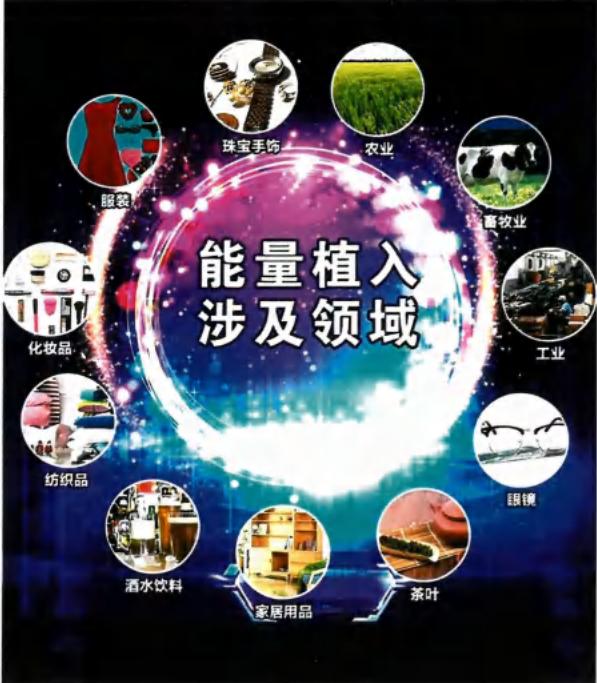
Quantum energy implantation product advertisement
It is said that on the basis of maintaining the original effects and characteristics of the product, the high-frequency resonance function of quantum energy waves is added. When quantum products come into contact with the human body, they can correct the disordered cell magnetic field of the human body and use the conduction characteristics of high-frequency resonance waves to generate harmonic resonance with water molecules.
One viewpoint in quantum theory suggests that a huge amount of energy is also stored in a vacuum, where it still exists under absolute zero conditions, called vacuum zero-point energy. Our Earth is situated in a sea of high-density energy, and this energy permeates every corner of the universe. Visible matter and invisible energy are interconnected through vortices: like a vortex in water, it is water, but different from the surrounding water, and it has a certain force on the surrounding vortices or water. Vortex phenomena exist at all levels of nature. From the spin of microscopic elementary particles, superconductors, and the helical structure of DNA to the macroscopic self-contraction of plasma, tornadoes, galaxies, quasars, and black holes, vortex phenomena exist. The entire universe is connected through the conservation of spinors. The vortices produced by particles and matter are carriers of information, and they interact almost instantaneously through torsion fields; therefore, some people call vortices the engine of the universe, serving as the bridge between invisible energy and visible matter. From a physics perspective, energy and matter are the same, the difference lying in the oscillation frequency. By adjusting the oscillation frequency, energy and matter can convert into each other. In reality, many abnormal physical phenomena are related to vortices. Jiang Xingliu, a professor in the Department of Physics at Beihang University, believes that point discharge from electrodes generates a vortex field (torsion field), in which abnormal physical phenomena will occur. He specifically cited that abnormal energy is generated inside tornadoes, leading to unreasonable phenomena such as wooden boards penetrating steel plates and straw inserting straight into tree trunks. He believes that the source of this abnormal energy is “vacuum zero-point energy.”

Cosmic vortex phenomenon

DNA helical structure model diagram
Research from the Department of Physics at National Taiwan University suggests that the aura of crystals is actually the torsion field. Crystals belong to the trigonal and hexagonal systems and possess a spiral chain-like structure. One silicon atom and four oxygen atoms form a regular tetrahedral unit cell. The unit cells rotate once every three layers along the axis direction in the trigonal crystal system, and once every six layers in the hexagonal crystal system; spiral chains combine side-by-side to form the crystal structure. If each atom possesses its own torsion field—a vortex shape—synthesizing molecules and solids forms the torsion fields of larger molecules or solids. The spiral structure of crystals may potentially form a macroscopic, coherent, large-scale vortex torsion field, which can thus be easily perceived by those who have achieved success in Qigong practice. Professor Chen from the Department of Physics at NTU spent two years researching the generation, amplification, modulation, and detection of crystal auras. According to his research findings, the aura of crystals seems to be able to penetrate almost all materials, such as metals, glass, ceramics, semiconductors, paper, and cloth, with only a few exceptions. This type of aura seems to have a residual effect and accumulates continuously, making it difficult to detect with AC signals. This aura may be connected to the information field, and since the information field is not bound by time or space, it is predicted that the speed of this signal transmission is very fast, far exceeding the speed of light.①
To most people, these quantum energy theories appear scientifically mysterious and somewhat baffling; they seem unfathomable, or perhaps completely incomprehensible, making it difficult to distinguish the true from the false. Like most people, I have never been involved in research in this area, having at most read some popular science books. However, I believe that although some things are not clearly understood, I feel that this may play a certain role in potential development. When visiting some potential development institutions, I sometimes hear suggestions such as “placing some crystals in a certain spot might make people feel more comfortable.”
Overall, energy items, much like products such as music, can serve as aids during practice, but they are not essential tools. In particular, one must not develop a dependency on these external things; believing that human beings are inherently self-sufficient is the foundation. One’s destiny must be held in one’s own hands and should not be swayed by external material objects or fallacious theories.
3.10 Will it cause physical harm?
Will the activation of latent functions, such as potential development, cause physical harm to the body? This question is very difficult to answer. As mentioned earlier, science cannot yet explain many of the abilities presented by human potential; that is to say, science cannot confirm their mechanisms and principles. Therefore, if someone really does experience health issues after potential development training, it remains difficult to judge whether there is a necessary causal link between the two.
For example, practicing cults like Falun Gong, some believers
-
A child’s growth environment creates psychological shadows such as repression, fear, sensitivity, and resistance. Personality traits like repression, fear, sensitivity, and resistance make it difficult for a person to open up. In the final section of Chapter 1 of the Right Brain Development Training Manual, it is mentioned that “Little Cherry” had already successfully unlocked the ability to read while blindfolded, but due to her mother’s disbelief, Little Cherry became sensitive, repressed, and resistant, to the point that she completely lost her ability. When children exhibit such situations, it is often directly related to the family. Such parents generally lack self-awareness and will not consider it to be their own problem; furthermore, in the end, they will even blame the training institution and the instructor. There was a little boy named Yiming, who had just turned 6 and had not yet started first grade. He found it difficult to settle down and liked to make faces and disturb others when the teacher was guiding them, so there was no change on the first day of learning. When school was over, the instructor communicated with the child’s mother and explained the situation. When they got home, the mother gave the child a severe beating. The next day, the parents brought Yiming back, and the situation was even worse than the day before. Parents’ education patterns determine their children’s behavioral patterns. For such students, if one-on-one teaching by the instructor still does not yield results, the parents should be reminded to attend parent classes, and the child should be allowed to learn courses they love and can focus on. When they are older, if they are interested, they can come back to learn potential development.
-
Children with a mental age that is too young. Children under 6 years old who have not yet started elementary school often lack self-awareness and collective consciousness, and their thinking is too simple. When guiding the child’s imagination, they sometimes cannot distinguish between the images imagined in their brain and the images seen by their eyes. Over time, this may cause certain psychological effects on the child.
-
Lack of self, chasing functions. Some people just hope their children are amazing. When they see other people’s children having “supernatural powers” (Shentong), they also want their children to have all sorts of incredible abilities, and they must be better than others. Seeing such parents, instructors must be especially careful, because the purpose of their students coming to learn is to learn “magic arts” (Fashu). If one only pursues the “technique” (Shu), it is like a tree without roots or water without a source; they will undoubtedly be harmed. Page 45 of the Right Brain Development Training Manual states: “After the Third Eye is opened, Primordial Qi (Yuanqi) easily leaks away. One must have wisdom but not use it (Hui er bu yong) to increase wisdom; otherwise, it will shorten one’s lifespan. Use it sparingly and cautiously.” Although this sentence is more of a warning, it is a saying that has been passed down since ancient times in all Third Eye opening techniques and even Qigong. The purpose of quoting this here is to tell readers that traditional cultivation has always warned the world to be in awe of supernatural powers. “Wisdom but not use” for most people means that the purpose of learning potential development is to improve self-confidence, concentration, and image thinking ability, rather than for skills like blindfolded reading. Abilities like blindfolded reading can also be called supernatural powers in religion. If obtaining supernatural powers is the goal, one has gone astray. If one casually attempts to develop difficult special functions such as “clairvoyance,” “remote viewing,” or “psychokinesis,” it is very likely to hurt the body, especially the kidneys.
Doing ESP games like blindfolded reading is shallow-level development, and conducting purposeful training will not cause any harm. However, if children are made to practice deeply, especially free meditation exercises, mind power exercises, etc., it may cause the child’s energy to be insufficient, leading to this or that problem, or even physical harm. Individual children may sometimes experience physical discomfort reactions during blindfolded reading training, such as headaches, head distension, and eye pain. This situation is generally caused by relatively long training sessions recently; one can pause for a few days or pay attention to supplementing energy during meditation training. Supplementing energy can refer to the content of the previous sections, but fundamentally, one must be clear about establishing a correct outlook on life, worldview, and values.
A reader from Pingyuan County, Shandong wrote me a letter: “I have a student here whose right brain potential is particularly powerful. Right after awakening, he could easily remote view 30 to 40 meters. He has studied for two months, and now there are two problems: First, his memory is not good; second, he tells me every week that he sees many strange things and cannot control it. For example, he can see what neighbors he doesn’t know are doing at home, and he can walk into trees and water. He also says he sees many children with the same name as him in various places, some older than him and some younger. He can also see people with the same name as his classmates. Is this situation true? He is 10 years old, and now I am afraid his thoughts will be confused.”
I do not easily admit that anyone with normal intelligence has a poor memory; it is only a matter of wanting to remember or not wanting to remember. Memory has methods and techniques, as well as laws of forgetting, but one cannot easily conclude that “memory is not good.” With this sentence, once it becomes the child’s belief, I am afraid it will be relatively difficult to awaken memory potential again. That this child can see strange things is often discovered among children of the same age.
A boy from Tianjin was also 10 years old. After having the blindfolded reading function turned on for a while, he often chatted with his mother about things he saw, and he could often see “colorful dragons” flying around. Children all say they see these things, describing them clearly and vividly, but parents and teachers cannot see them. When the child says it often, parents and teachers become worried and noncommittal. Children around 10 years old love fantasy. In the process of potential development, because image training (Xinxiang) strengthens this “visual” ability, fantasy things become more numerous and concrete.
There are three situations here: First, the child is lying, and the purpose may be to cover things up or attract attention; Second, they cannot distinguish between imagination and reality, which can be said to be in a kind of magical realism; Third, other unknowable situations. The strategies for the first two situations are that we only need to patiently listen to the child’s narration. No matter how far-fetched their narration is, we must not evaluate the content of the child’s narration. Just say “So that’s how it is” or “Oh, I see.” The purpose of doing this is to dilute the child’s interest in such matters, that is, as the Prajna Paramita Hrdaya Sutra (Heart Sutra) says, “Mind without hindrance, because of no hindrance, there is no terror.” If this does not work, it is best to guide the child to use this imaginative ability to “see” meaningful things related to science and learning, to cultivate the child’s scientific view. The first two situations generally will not cause psychological problems in children. If there are exceptions, psychological intervention should be carried out in time. The third situation is quite special. Often the child has depression, anxiety, fear, etc. In this situation, parents should be advised to take the child for psychological counseling in time. No matter what happens, I think brave facing and love are the most energetic. The American film The Sixth Sense released in 1999 might be able to bring some inspiration to everyone.
In May 2018, the principal of a training institution in Anhui Province told me about the situation there:
“There was a child who was in training, and his expression was very painful. He said he saw his past lives, and there were many lives. In one life he was born in a war, and he saw some very bloody scenes around him, and he felt very scared and terrified. Once he was a cactus, in the desert, and finally died of thirst. Another life he was a duck, and later was killed by someone. Another life he was hit in the waist, so his waist now often hurts and is uncomfortable, saying that there is still a blood clot in his waist now. After listening to his description, I was indeed very worried and asked the parents to take the child to the hospital for an examination, but the hospital examination results said the child had no problem.”
Regarding the issue of past lives and present lives, it is often mentioned in hypnotic healing. American Yale University Medical Doctor Brian Weiss wrote five best-selling books on “Many Lives, Many Masters” (past lives and present lives). The books introduced a large number of cases, using some techniques to inspire patients’ “past life memories” and achieve healing of mental and physical diseases through subconscious adjustment. I was quite puzzled why this situation would appear. The principal added:
“Our training once had a meditation for students to see past lives and present lives. Did this wake up some past life memories? Is his waist pain precisely because he was hit? I feel that this course is very dangerous. My original intention was to hope that through the course, our potential development could help children learn better and learn easily. Now that these situations have appeared, I am not particularly clear on how to help the child get out.”
Whether through hypnosis or some Taoist techniques, inspiring past life memories for certain people with special needs is not something that potential development instructors can get involved in. Such special techniques, if used casually by people who have not studied them professionally, are very dangerous and can easily cause mental and physical harm to people. There are also some institutions that clearly hope students can learn more easily and efficiently, but insist on teaching students special functions like Psychokinesis (PK), clairvoyant healing, and remote viewing prediction. The instructors leading the students have completely deviated from the correct worldview and values. It would be strange if such institutions did not have problems.
“Why did I have the child learn this? It is because I saw a teacher in that group saying that if a child cannot replenish their own energy, their complexion will turn earthy yellow. This point really frightened me, because our original intention was to be able to help the child. But if it is because the child doesn’t know how to replenish their own energy, it would cause great harm to the child, and that would be impossible to explain to the parents. When we are in class, I thought, could the children see the condition of their internal organs? If they could see that they are healthy, that would be great. That was my initial thought. During our classes, some children saw their own blood flowing, saw that the physical wear and tear at that time was a bit uncomfortable, saw a few white blood cells chasing those virus cells, and so on. Later, the children who participated in the practice would tell other children about it. In this way, our children can basically all see it now. The children can see themselves, but I told them not to look at others. However, they can also see where something is wrong with others, and so on.”
If training institutions move towards pursuing fantasy, seeking to attract attention, and seeking special powers without self-awakening, and remain obstinate, it is like taking drugs—harming others and harming oneself.
“There is now a child who, after taking classes with me for a while, became able to see inside his body. His courage became particularly small; he didn’t dare sleep alone and needed his mother to accompany him at night. Sometimes he would suddenly become very agitated, sometimes he couldn’t eat, and he would even wake up multiple times during the night. The child’s parents have come to make a fuss several times.
I am now thinking, why does the child have this ability of internal vision? It is because isn’t there something in your book about a beam of white light? Saying a beam of white light goes to the top of the head, or a blue light to the heart, a purple light to somewhere—I don’t remember exactly what it is. I wanted to increase the child’s energy. I thought this light is all energy, so I wanted to increase their energy. During training, I would guide them to look at this light quite a lot, which might have allowed them to see certain parts of their bodies. For example, the structure of the heart.
After every meditation session, I would have them do a sharing. Some students would say they saw this or saw that. At that time, I didn’t realize the severity of this problem and felt that this was something that could be seen. I also said that since this student saw it, what did the other students see? So most children should be able to see it. Now that this situation has arisen, should I let the child continue on their own? Should that child’s energy be further strengthened, and then see some things that shouldn’t be seen?
After this child saw this, I did some guidance later, and he slowly calmed down. However, now as soon as he closes his eyes at night, he sees some scenes, as if they are flowing out in his brain, causing the child quite a bit of trouble. How should I guide the child now? Actually, I have made some efforts; for example, I am now having him recite the Heart Sutra.
I now feel like there is a stone pressing on my chest. How should I talk to the parents about such a matter, explain such a matter, and dispel their concerns? Also, I am worried whether the child might have some other bad things happen to him?”
This is just an isolated case and is not universal. However, this counselor was indeed too self-righteous and reckless. Relying solely on the Right Brain Development Training Manual textbook, he not only taught students functions like blindfolded reading and photographic memory, but also indulged in wild fantasies, taking steps towards special powers like clairvoyance, remote viewing, and seeing past lives. Although the initial intention was for students to learn well, while doing it, they couldn’t hold on to that original intention, went astray, and thus all functional development became water without a source, a tree without roots. Teaching students without starting from a correct stance, but guiding them to pursue the strange and entertaining, easily leads students onto an evil path. The counselor’s own learning and cultivation are even more important; if their own energy is not correct or insufficient, they cannot enable students’ potential to function to a better state.
Chapter 4: The Origin and Development of Blindfolded Reading
To know where ESP game training like blindfolded reading is heading, we must first clearly understand where the development of these potentials comes from, what similarities and differences it has with the “supernatural powers” (Siddhi) of Buddhism and Taoism, and what its past and present are. The functions displayed by ESP games are clearly the “primary version” of “supernatural powers.” The human body science research started 40 years ago was the prelude to today’s potential development education, and the development of brain science has given a scientific flavor to the naming of potential development.
4.1 “Supernatural Powers” in Buddhism, Taoism, and Qigong
Blindfolded reading has attracted attention because it appears magical and mysterious, triggering people’s imagination. If we provide a scientific definition for blindfolded reading, it belongs to a fringe discipline; specifically, it falls under a non-mainstream discipline—parapsychology. Blindfolded reading can be regarded as a warm-up game for special abilities. In the eyes of Buddhists or Taoists, it might be viewed as a supernatural power, just like other special abilities, while Western occultism calls it channeling. For three thousand years, whether it be Easterners longing to become Buddhas or Immortals, or Westerners believing in God, people have been fond of pursuing and fascinated by such mysterious phenomena. The term “supernatural power” (Shentong) was translated into Chinese from Sanskrit in ancient times. There are Five Supernatural Powers. Buddhism speaks of cultivation through methods such as entering meditative absorption (Dhyana) to develop five functions inherent in the human body; these are the so-called Five Supernatural Powers, namely: the Celestial Eye, the Celestial Ear, Knowledge of Others’ Minds, Knowledge of Past Lives, and the Supernatural Power of Transformation (also known as the Power of Magical Transformation, Divine Feet, Freedom of Will, Supernatural Power, or Body Power).
Esoteric Buddhism (Vajrayana) is one of the few sects that maintains a focus on the cultivation of secret methods for supernatural powers. In Chinese Buddhism, Esoteric Buddhism is listed as one of the ten major sects. It is also known as the Secret Teaching, or Secretism for short. Its alias is Lamaism, which comes from the customs of the Tibetan language. Because Esoteric Buddhism is prevalent in Tibet, the ordained monks are called Lamas, thus the teaching was named after them. Mr. Nan Huai-Chin wrote in Taoism, Esotericism, and Eastern Occultism: The so-called “Three Mysteries” in Esotericism refer to the triple secret connotation of body, speech, and mind. The so-called Mystery of the Body can be summarized as having two meanings: (1) The mysteries inherent in the human body, which originally possess an interactive communication function with the universe of heaven and earth. It is just that people have not understood it through great wisdom and have not undergone cultivation through reasonable methods, so it has never brought its great role into play. (2) Esotericism believes that there are various methods with origins in ancient times that can be bestowed upon those studying the secret methods. This can give them twice the result with half the effort, allowing them to quickly communicate with divine beings, achieve unity of heaven and man, and furthermore, attain Buddhahood or Sainthood.
From this, we can know that for thousands of years, these magical phenomena have long been the focus of people’s attention and cultivation.
There is a method in Buddhism called the “Contemplation of Skeletons” (White Bone Visualization), which was first transmitted by Shakyamuni to Katyayana. Katyayana started from “turning his mind inward to gaze, fixing his attention on the big toe of his left foot, and mindfully observing the front half of the left big toe, imagining it as if it were just starting to fester after death, with pus-filled blisters,” until “he could observe the joints of his own body, linked to one another, like a pure snow-white person.” That is, until he saw his own whole body of white bones and skeleton blooming with white light. He experienced at least ninety days of single-minded cultivation, never shifting his mind or thoughts, and “sequentially attained the fruits of the four Sramana stages (Stream-enterer, Once-returner, Non-returner, Arhat), the Three Knowledges (Knowledge of Past Lives, Divine Eye, Extinction of Outflows), and the Six Supernatural Powers (Celestial Eye, Celestial Ear, Knowledge of Others’ Minds, Knowledge of Past Lives, Supernormal Feet, Extinction of Outflows) and other spiritual achievements.”
Shakyamuni then said to Katyayana, “You have now obtained the results of cultivating this method. You are now able to freely perform eighteen kinds of transformations.” “Katyayana, receiving the order, immediately leaped up and stood in the void, performing eighteen kinds of transformations at will and at ease: emitting water from the right side and fire from the right side, emitting water from the right side and fire from the left side, emitting fire from the upper body and water from the lower body, emitting fire from the lower body and water from the upper body, emitting water from the upper and lower body simultaneously, emitting fire from the upper and lower body simultaneously, treading on water as if on land, treading on land as if on water, vanishing from the air and reappearing on the ground, vanishing from the ground and appearing in the air, walking, sitting, and lying down in the air, the body emitting smoke and fire, leaping and vanishing freely without touching anything, or emitting water and fire filling the air, manifesting a huge body filling the void, manifesting a small body after manifesting a huge body, being free in size and smallness. At that time, the many Bhikshu monks who had not yet dispersed personally saw that Katyayana was originally a person with a lot of pride (ego). Once he turned his heart to subdue his arrogance, sincerely sought the Way, followed the Buddha’s teachings, did not follow the six roots (eye, ear, nose, tongue, body, mind) and six dusts (form, sound, smell, taste, touch, dharma) to seek outwardly, but only fixed his mind on one place, he was able to achieve the fruit of Arhatship.” ①

Contemplation of Skeletons, Meditation on Impurity
Why does Buddhism have the method of Contemplating Skeletons, and what is the purpose of cultivating the Contemplation of Skeletons? “Shakyamuni very solemnly said to Ananda again: Those who cultivate the Contemplation of Skeletons, when they truly see this scene appear before them, should turn to Right Mindfulness (Right Thought), and realize that everyone in the world is nothing more than a walking corpse made of a skeleton.” If the contemplation is successful, one can truly smell one’s own stench. In the method of Contemplating Skeletons, “For those who find it easy to contemplate, when outside the foul smell at a distance, create a clean object, and teach them to fix their mind on it, thinking of a clean object.” The contemplator must watch their own flesh rotting from a distance like a third party, turning into a pile of white bones, focusing on this process, and thinking about the relationship between their body and the contemplator, “I” am clean after leaving my body, but the body becomes smelly and rotten, so there is nothing to be attached to. In the iconography of Esoteric Buddhism, many Bodhisattvas hold skeleton staffs in their hands. (The skeleton staff has evolved into the Khakkhara [tin staff] in Exoteric Buddhism.) “Staff” implies reliance; taking the Contemplation of Skeletons as the foundation of cultivation.
The Contemplation of Skeletons belongs to the method of Visualization (Guantao). Buddhism attaches great importance to this “Guan” (Observation). Buddhism uses the character “Guan” rather than “Kan” (Look). “Guan” is “seeing again,” called the second sight, meaning that this sight is not seen with the naked eye, but is a higher level of seeing. Therefore, “Thinking/Imagining” is the key to the method of Visualization. When the “Thinking” is successful and one reaches One-pointedness of Mind (Ekaggata), the Visualization is accomplished. This is the so-called “All is created by the mind,” which is the Visualization and Mental Image we mentioned earlier. In Buddhist temples, Buddha statues, burning incense, candlelight, and murals are indispensable. Being in the quiet and elegant environment of a temple makes it very easy for believers to enter a state of Visualization, either visualizing the golden body of the Buddha or visualizing the magnificent Pure Land. If visualizing a Buddha statue, such as Guanyin Bodhisattva or Amitabha Buddha, it is best to visualize the statue as a hollow Lapis Lazuli body, transparent and bright. After the image of the Buddha is visualized, following the solemnity and purity of the external environment, one then imagines oneself merging into this realm, transforming one’s own body and mind. Finally, one feels the Pure Land realm spoken of by Amitabha Buddha. Transforming the impurity of the real Saha World—body, mind, objects, and various impurities—into the Pure Land of the Ultimate Bliss World—purity of mind, purity of Buddha Land. Honestly speaking, this “Change of Contemplation” from impure thought to Pure Land is the foundation of the method of Reciting the Buddha’s Name (Buddha-anusmrti). Constantly visualizing the realm of the Pure Land in this way is cultivation.
Shakyamuni Buddha established teachings based on the capacity of the listener, evolving into various cultivation methods such as the Five Periods and Eight Teachings. Similarly, this Contemplation of Skeletons has also been divided into more than thirty methods of contemplation due to individual differences in psychology and physiology, or in Buddhist terms, differences in karma and nature, such as wisdom power and temperament. A “Dharma Gate” (Famen), as the name implies, is the door to the Dharma; it is through this door that one enters the inner sanctum of the Dharma. One Dharma Gate is one method, one path. Different Dharma Gates treat different afflictions. Humans have eighty-four thousand afflictions, so the Buddha spoke of eighty-four thousand Dharma Gates.
One of the typical examples that proves the existence of supernatural powers in Buddhism is the “Sutra on the Monastic’s Entry into the Womb Taught by the Buddha to Nanda” in Volume 56 of the Maharatnakuta Sutra, also known as the “Sutra on Entering the Womb” (also called The Buddha Speaks of the Womb Sutra, Entering the Womb Sutra). The entire sutra takes the story of the Buddha persuading his brother Nanda to become a monk as the origin, and the Buddha’s teaching on entering the mother’s womb as the main body. It narrates the origin of the individual life entering the womb, the process, and the specific development process of the fetus in the mother’s womb for thirty-eight weeks. Many details of fetal development correspond with modern medicine. In the absence of any medical imaging technology 2600 years ago, the weekly changes of the fetus could probably only be obtained through the method of supernatural power “perspective” (clairvoyance). This makes people involuntarily marvel at the supernatural powers and wisdom of the Buddha.
In the view of Buddhism, which pursges great wisdom and great freedom, various supernatural powers are merely a Dharma Gate or a skill. Moreover, this skill easily leads people astray, causing obsession and an inability to extricate themselves. In the Buddha’s view, all things in the world do not have the good or bad, good or evil, beautiful or ugly defined by humans; the difference lies only in cognitive ability and wisdom. Everything on the “Way” leading to great wisdom has the possibility and significance of existence. Supernatural powers are just an ordinary and easily confusing tree on this road. This tree is by no means the end point of this road; Prajna is the distant goal. Prajna is also transliterated as Boruo, Boluoruo, etc. In the Yoga (Union) Sutra and in Buddhism, Prajna is ultimate wisdom, the wisdom to cognize the source of all things and all creation. To use an analogy, what we call “cleverness” is like raindrops falling from the sky, “wisdom” is like the ocean, and “Prajna” is the universe. On this Great Way, nothing is strange. Only by possessing higher wisdom can humans cross over to the “Western Pure Land of Ultimate Bliss.” People walking on this Great Way can be called practitioners. Supernatural powers are a scenic tree on this Great Way that easily makes people lose themselves and their direction. People outside this road are easily attracted by this seemingly magical tree, but if they cannot therefore walk on the path of cultivation, the consequences may be unimaginable. Once a person truly walks on the right path of cultivation, the human heart is comfortable and determined. Trees like supernatural powers are everywhere, and one will feel that supernatural powers are nothing strange.
Orthodox Buddhist concepts do not encourage the display of supernatural powers. Buddhist masters hope that disciples will concentrate on cultivation to realize the Way; after realizing the Truth, they will naturally possess supernatural powers. If one abandons the root to pursue the branch (abandoning the essentials to pursue the trivial) to pursue special functions, one will instead neglect the true Buddhist coursework. Therefore, special functions are rejected by the majority of Buddhists.
The foundation of human physiology, pathology, diagnosis, and treatment in Traditional Chinese Medicine (TCM) is the Huangdi Neijing (The Yellow Emperor’s Inner Canon). Over two thousand years ago, it provided detailed descriptions of the physiological functions, pathological changes, and interrelationships of the human body’s Five Zang Viscera (organs), Six Fu Viscera (bowels), Twelve Meridians, and Eight Extraordinary Meridians. However, even today, no scientific instrument can allow one to directly see these human meridians like one sees blood vessels. This implies that our Chinese ancestors must also possessed extraordinary abilities to “see” them; the author of this text may perhaps have been such a master.
Daoist schools after the Song and Yuan dynasties emphasized practices such as opening the Ren and Du meridians. These practices actually originated from the Buddhist contemplations of “Skeleton Visualization” and “Impurity Visualization.” Later, Daoism also developed cultivation methods such as “Sun Gazing” and “Candle Gazing.” These methods all emphasize the character “Guan” (Observation/Contemplation). Like Buddhism, they focus on “Samatha-Vipassana” (Stopping and Seeing)—meaning abiding in contemplation, resting in contemplation, and continuously observing. This is consistent with what we now call “Mental Imagery Training,” though in the context of potential development, attention must be paid to the guidance of this imagery training.
The term “Daoyin” (Guiding and Pulling) originates from traditional Chinese medicine and Qigong. In the early Han Dynasty, Zhang Liang “wished to abandon worldly affairs and follow the Red Pine Master (Chisongzi), so he learned Bigu (grain avoidance), Daoyin, and Qingshen (lightening the body)” (Records of the Grand Historian: Hereditary House of the Marquis of Liu). Figures like Li Shaojun and Dongfang Shuo practiced “guiding qi to nourish nature” (Lunheng: Treatise on Tao). The renowned Eastern Han physician Zhang Zhongjing also introduced the use of “Daoyin” methods to treat diseases in the Essentials from the Golden Cabinet. During the Five Dynasties period, Tao Hongjing, a medical expert of the Liang Dynasty, was the first to record the use of the six sounds “He,” “Hu,” “Chui,” “Xi,” “Xu,” and “Si” to treat diseases of the Five Zang organs. Daoyin is an ancient term for Qigong. Beyond Daoyin, there are over 30 other terms, including Tuna (Expelling and Drawing), Shouyi (Guarding the One), Dandao (Elixir Way), Buqi (Distributing Qi), Xingqi (Circulating Qi), Xiudao (Cultivating the Way), Zuochan (Sitting Meditation), Taixi (Embryonic Breathing), Zhoutian (Cyclical Circulation), Zuowang (Sitting in Oblivion), and Neidan (Internal Alchemy). It is a psychosomatic exercise method that uses the regulation of breath, body activity, and consciousness (Tiaoxi, Tiaoshen, Tiaoxin) as a means to strengthen the body, prevent and treat diseases, promote longevity, and develop potential. Li Shizhen stated in his Study on the Eight Extraordinary Meridians: “The internal tunnels are observable only by those who turn their gaze inward.” This means that these meridians and acupoints can only be seen by those possessing the function of “inner vision.” All this indicates that ancient Chinese medical experts and Daoists likely knew of various human potentials, but they never regarded them as special abilities, merely utilizing them for health preservation and healing.
Whether for Daoism or Chinese Qigong, physical cultivation is certainly not the ultimate goal. Through cultivation, using the enlightenment of the Dao-nature as a switch to connect the body’s postnatal Qi with the prenatal Qi, allowing it to circulate throughout the body and release the extraordinary energy of the highest dimension, thereby achieving the realm of “Unity of Heaven and Humanity”—this is the true purpose of cultivation. Therefore, all Qigong manuals contain the phrase: “Strengthen the body and increase wisdom.” However, Qigong always emphasizes that “Virtue precedes Gong” (skill/merit) and “Without virtue, one cannot establish oneself.” Qigong speaks of regulating the mind, body, and breath; if one’s moral conduct is chaotic, how can one settle the spirit and enter stillness? The depth of one’s cultivation (Kung Fu) corresponds to the degree of alignment between Virtue and the Dao. “The benevolent are invincible” is a true portrayal of this highest realm. Therefore, true Qigong masters are mostly individuals of high moral character. In the lectures of many Qigong masters, the transmission of specific techniques is rare; mostly, they teach through personal example and moral edification, which can be called the quintessential secret of Qigong transmission. If a practitioner lacks correct moral character, even if they achieve some success, it will inevitably be difficult to sustain in the long run; they will deviate or be abandoned, eventually meeting failure. Those who can truly go far are definitely people of high virtue. Zeng Guanming, a well-known figure in national whole-brain development, spends most of his time in whole-brain teacher training discussing “Correct Virtue and Correct Thought,” advocating dual cultivation of Buddhism and Daoism.
Regarding the attitude of orthodox religions and Qigong practitioners toward “Supernatural Powers” (Siddhi), Zhang Kaiji from Taiwan told a story:
There was a man who had always been obsessed with various supernatural powers and magical abilities. After finally going through immense hardships and traveling across mountains and rivers, he found an old master reputed to possess incredible “great supernatural powers.” He devoutly bowed to this old master to cultivate. However, for three years, the master only made him meditate, contemplate the Zen, and chant scriptures like the other disciples, teaching him nothing else. He finally could not help but confront the master. The master said: “Solely practicing supernatural powers is of no use. Moreover, as long as you cultivate properly, once the timing is ripe, supernatural powers will appear naturally.”
The man was very dismissive of this and insisted on learning “supernatural powers” directly. The master tried to persuade him repeatedly, but to no avail. So, the man left the master to seek another enlightened teacher elsewhere.
Ten years later, this man returned to the old master, smugly showing off: “Hmph! I followed you for three years and you didn’t teach me any supernatural powers. I went elsewhere and learned them!”
The old master asked him: “Oh! That’s not bad. What incredible supernatural power did you learn?”
The man proudly extended his right index finger, quickly recited a mantra, and immediately a blazing flame appeared on his index finger.
The old master: “Oh! Very good, very good. And then? What other supernatural powers?”
The man: “Hey! This is very hard to learn. I painstakingly practiced for ten years to finally master it!”
The old master could not help but smile. He called a young disciple over and signaled him to perform. The young disciple obediently reached out, and sure enough, a flame appeared. The man looked closely and saw that the young disciple was actually using a lighter to produce the flame. The man angrily wanted to argue, but the old master spoke first: “You spent ten years of hard work to produce a flame. My young disciple spent 1 yuan to buy the cheapest lighter, and it can also produce a flame. You wasted ten years for something worth only 1 yuan.” ①
In the early days of Buddhism, some Bhikkhus (monks) were fond of displaying supernatural powers to entice believers to become monks. After Gautama Siddhartha became Shakyamuni (the Buddha), he strictly ordered his disciples not to display supernatural powers before the public. He believed this would cause people to lose faith in the True Dharma and instead worship individuals, ignoring the True Dharma in favor of prostrating before miracles, thereby causing them to lose themselves. In reality, when practitioners naturally develop “supernatural powers” on their path, they often do not care about them and do not feel surprised or different from others; they have their own higher aspirations. Therefore, for thousands of years, only ordinary people have worshipped and pursued “supernatural powers,” until 1979, when it was discovered that ordinary people could also possess “supernatural powers,” causing a great stir in the scientific community and society.
4.2 The Beginning of Potential Development
On March 11, 1979, the Sichuan Daily reported “Child Capable of Recognizing Characters with Ears Discovered in Dazu County; Provincial Scientific Research Departments Have Taken Measures to Conduct Scientific Research on This Phenomenon.” It stated that Dazu County had recently discovered a child, Tang Yu, capable of recognizing characters and identifying colors with his ears, adding new research content to human physiology. Furthermore, responsible comrades from the Provincial Party Committee met with Tang Yu and his family, and relevant provincial scientific research departments had taken measures to conduct scientific research on the matter. From March 14 to May 5, 20 individuals capable of recognizing characters with their ears, noses, fingers, toes, armpits, stomachs, and foreheads were reported across 12 provinces nationwide. In June 1979, Gu Hansen from the Institute of Nuclear Research at the Chinese Academy of Sciences published a paper titled “Research on the Material Basis of External Qi” in the 6th issue of Volume 2 of Shanghai’s Nature Magazine. On June 4, the famous scientist Qian Xuesen visited Nature Magazine and proposed the concept of “Human Body Science” for the first time. In July, the editorial department of Nature Magazine published an “Observation Report on ‘Non-Visual Organ Image Recognition’,” stating that this anomalous function of non-visual organ image recognition was indeed a fact and worth exploring. Subsequently, the magazine published a large number of papers on similar topics; for example, in August, Chen Shouliang, Professor of Physiology at Peking University, Vice Dean of Academic Affairs, and Director of the Office of Natural Sciences, published “An Investigation Report on a Special Sensory Function of the Human Body” in Nature Magazine.
At the end of 1979, the Harbin Institute of Technology was the first to confirm that “ear-reading” could be “induced.” As long as children were led to believe the phenomenon existed and stimulated one another, they could practice and develop the ability. This allowed not only for special character recognition but even for snapping matches and opening locks with the mind.
After demonstrating the authenticity of the human body’s special sensory functions, a question naturally arises: Is this function possessed by only a very few people, or does it have a certain universality among the population? Peking University Professor Chen Shouliang believed that as a physiological function, if it is real, it may have a certain universality, and the number of people possessing this function might not be extremely small. At the end of 1979, Chen Shouliang discovered that his youngest daughter also possessed this function, which brought great convenience to his research, allowing for testing under various conditions. He used the method of feeling pictures with hands inside a dark cloth sleeve as one of the basic testing methods. Through practice, he gradually formed a set of methods to induce and test children for special sensory functions. The Research Group on Human Body Special Sensory Functions at Peking University, led by Chen Shouliang, induced 40 children aged 6 to 14. Sixteen of them tested positive for special sensory functions, accounting for 40%. In other words, a considerable proportion of children around 10 years old can be induced to develop varying levels of special sensory functions. Therefore, the research group determined that this special sensory function has a certain degree of universality among children. To further explore the issue of universality, they tested a class of 40 fourth-grade students at the Peking University Elementary School. After induction testing, 25 of the 40 children tested positive, accounting for 63%. Among them, 13 were boys and 12 were girls, accounting for 59% and 67% of the participating boys and girls respectively. It appears that gender has no obvious connection to this function. Among these 25 children, there were both those with the best academic performance and those with poorer performance; academic excellence or deficiency seemed to have no correlation with the strength of the special sensory function. In this class, children who enjoyed sports were more easily induced to develop human body special sensory functions.
The Peking University Research Group on Human Body Special Sensory Functions, centered on Chen Shouliang and including Wang Chu, He Muyan, and others, made the greatest contribution to human body science: they discovered that human body special sensory functions have a universality and inducibility rate of 40%–70% in children aged 9 to 12. This enabled research on special functions in China to expand to dozens of universities and various regions, achieving very fruitful results.
Dr. He Hong graduated from Huazhong University of Science and Technology, obtained his Ph.D. in Germany in 1990, and later conducted postdoctoral research at the Department of Physics at the University of Oxford in the UK. From his special recruitment into the army in April 1995 to his transfer to civilian work in August 2000, he was responsible for full-time research on “Human Body Science” at the 507 Institute (Institute of Space Medico-Engineering of the Commission of Science, Technology and Industry for National Defense). He translated the book The Conscious Universe: The Scientific Truth of Psychic Phenomena, which has had a significant impact in the field of parapsychology research. Because He Hong neither acknowledged those like Guo Zhengyi, Yu Guangyuan, He Zuoxiu, and Sima Nan, who considered special functions to be pseudoscience, nor did he refrain from questioning and criticizing many special function research results, he became a person who pleased neither side. His mode of thinking basically represents the relatively rigorous Western science. He Hong was very affirmative about Chen Shouliang’s research on human special functions:
“Mr. Chen was a student of biology and did not believe in ‘ear-reading’ at first. However, because friends and colleagues talked about it so much, his curiosity was aroused, so he went to verify it personally. As a result, he was confident that under the strictest controls, he still saw ‘real’ special functions. Consequently, he devoted himself wholeheartedly to researching such phenomena. Personally, I think his work basically represents the highest level of special function research in China over the past twenty years. His research mainly falls into three categories: first, non-visual vision, namely perceptive character recognition; second, the universal induction of ear-reading in children; and third, residual information, that is, seeing the patterns on original cards from an empty box that once held text or pictures.”
“Looking at the experimental reports for the first category of research, they are written quite meticulously, and I can find no loopholes. The only thing that puzzles me is that the few subjects who were tested under his supervision were quite suspicious to other skeptical observers, and were even caught cheating multiple times. Whether the ‘true’ he judged was true, or actually false, I feel there are still doubts. As for the second category of research, Chen Shouliang can be considered one of the pioneers in ‘inducing special functions’ in China. But truth be told, many of the so-called ‘functions’ that were induced were discovered by others to be fake when subjected to rigorous testing, so the persuasiveness is not strong. However, regarding the phenomenon of ‘residual information,’ his research is very distinctive. Especially since this type of test is relatively easy to control, I cannot find too many faults with his research in this area. I still feel it should have a certain degree of credibility. ①
Lee Si-chen, the former president of National Taiwan University, due to his status and his high-profile preaching, is known by far more people in mainland China for his finger-reading research than other researchers. However, his research started about 16 years later than Chen Shouliang’s. From 1996 to 2001, he trained 101 children in classes, and only about 16% developed finger-reading abilities. Lee Si-chen’s highest success ratio was around 40%, which was about the same as the research and training institutions in the mainland at the time. His research on special functions benefited greatly from the help of mainland researchers.
The notes used for ear-reading and finger-reading are identified after being folded so that the eyes cannot see them, which is different from our current blindfolded reading. Blindfolded reading only involves the reader being blindfolded, while bystanders can use their eyes to see the content being identified. The first person to have children wear blindfolds for potential development perception training was Liang Guangxiang.
The famous writer Ke Yunlu conducted in-depth research on special functions in the 1990s. In his article “The Development of Human Potential (Special Functions),” he introduced the experiments conducted by Liang Guangxiang, the inheritor of the Mingjing Gong, on developing non-visual visual functions in blind children and developing non-visual visual functions in healthy children:
From January 10 to March 13, 1994, I led the “Life Science Exploration” production crew to cooperate with Qigong master Liang Guangxiang in conducting scientific experiments on developing children’s special functions that were extremely important in the history of human life sciences.
Liang Guangxiang was born in 1968 in Xiuwen County, Guizhou Province, and graduated from Guizhou Normal University in 1990 with a Bachelor’s degree in Education. He began practicing Daoist Qigong under a master at the age of 14. In 1991, he began using the “Mingjing Qigong” method in Guizhou to develop children’s supravision (or non-visual vision) functions. According to our preliminary understanding, the results of hundreds of experiments he has conducted show that the success rate for development in children aged 6 to 14 is over 90%.
Liang Guangxiang’s potential development training lasts for 6 days, combining indoor and outdoor settings, and combining in-class instruction with homework assignments. Liang Guangxiang calls his potential development “opening the third eye.” In addition to using Mingjing Gong, he provides some guidance each time the students train. We can take a look (see the videos “Developing Children’s Potential” and “Opening the Third Eye”):
“Don’t put your feet together, separate them slightly. Place the palms of your hands slightly facing the center between your two eyes… The third eye is rotating constantly. Concentrate your attention and think of nothing. Look at the ball of spiritual light between your eyes, follow it as it rotates. After it gets bright, rotate gently, follow it as it rotates…”
“Relax your shoulders, keep your head straight, waist straight, and close your eyes slightly. Focus your attention slightly on the ball of light, follow it as it slowly rotates. The more the ball of light rotates, the brighter it will become. Quietly let it brighten up. Focus your attention slightly between the two eyes, looking at that ball of light.”
Students described their feelings when using the “third eye” to see things as follows:
“I think it has something to do with brain thinking. Every time I see something with the ball of light, I’m afraid it’s not right, so I use my brain to think about that shape again. After thinking about it, it’s basically correct.”
“I feel that you can’t just use your brain to think; many things have very similar shapes. If you rely on thinking, what if you happen to be wrong? So you must use your eyes (the third eye) to look. Only after seeing clearly what the object actually is can you speak; blindly guessing won’t yield very accurate results.”
At that time, Liang Guangxiang had his own considerations and sense of measure regarding the training of children’s potential. His development of potential was not purely a functional development, but rather a method of physical and mental cultivation. He believed this was greatly beneficial to children’s physical health and intelligence, and that this training could unlock students’ intellect. Children and parents provided the following feedback:
“For mental arithmetic problems that were originally very difficult, I used to have to use pen and paper to calculate. Now, I can figure them out just by thinking with my brain, and it’s very fast, not as strenuous as before. I used to not be able to do the critical thinking problems, nor would I even look at them. But now, when I see critical thinking problems, I am particularly interested and want to see if I can solve them.”
“At home, I play the piano and the trumpet. I always practice my exercises before playing the piano or trumpet. After practicing, my mind must be very still. When I play the piano after practicing, I feel the results have improved.”
“Wen Yilin is in the fifth grade this year. For the past five years, his homework has always been a headache for me. My work is also very busy at night; after coming home and eating dinner, I still have to help him with his homework. Since he started learning from Teacher Liang, beginning this semester, he has been able to complete his homework consciously every day. Furthermore, the accuracy rate is very high, so I don’t need to check it anymore. In Math, he has only gotten one question wrong since the start of the semester, receiving a score of 4, but basically he gets scores of 5.”
Teacher Liang Guangxiang’s methods were also rapidly disseminated at the time. However, due to the sharp cooling of the “Qigong fever” shortly thereafter, potential development within the country almost vanished along with it.
Developing Children’s Potential
Opening the Third Eye
4.3 The Development of Potential Development
Nowadays, many people believe that potential development training, such as blindfolded reading, originated with Makoto Shichida of Japan. In reality, there are two misconceptions here. First, the target of Shichida’s education was primarily infants aged 0 to 6, an age group unsuitable for blindfolded reading training. Second, Shichida’s education only expanded beyond Japan in 2000, when a Shichida infant classroom was established in Taipei, and it was not until 2010 that the Shichida infant early education brand was founded in Shenzhen. Although there is little overlap between Shichida infant early education and current brain potential development, Shichida created concepts and practical training methods such as “Super Right Brain,” “Mental Imagery,” “Photographic Memory,” and “Wave Speed Reading,” which have had a significant influence on brain potential development education.
Makoto Shichida was born in Dashiqiao, Liaoning, China, in 1929 (though some say he was born in Shimane Prefecture, Japan) and passed away in 2009. Shichida began his early education research career in 1958, and in 1976, based on his theories, he opened the first Shichida-style kindergarten. In the late 1980s, Shichida, who was then past the age of 60, began to encounter research on Chinese special functions and in 1991 founded the journal “Potential Development,” focused on adult function development, and began proposing concepts such as “Super Right Brain.” Although Shichida proposed ESP abilities and the “Super Right Brain” concept, his main energy remained on infant early education and his right brain research; therefore, he did not possess rigorous research data and reports regarding the development of ESP super-sensory functions.
Shichida’s focus on the “Super Right Brain” was due to the massive social reaction in Japan caused around 1990 by sisters Wang Bin and Wang Qiang performing “ear reading” on Japanese TV programs such as NHK. In 1993, Zhu Runlong, editor-in-chief of the Chinese journal Chinese Human Body Science, conducted an academic exchange visit to Japan for nearly 3 months. Subsequently, Japanese television personnel brought 6 Japanese children to Yunnan University to receive “ear reading” and other activities, which truly set off a small wave of inducing “special functions” in Japanese children. Japanese scholars, including former president of the Japanese Society for Parapsychology Soji Otani, publicly acknowledged that Chinese-style extraordinary perception research promoted the development of Japanese parapsychology. Shichida’s “Super Right Brain” research was initiated against this background. However, the training and development of ESP abilities during Shichida’s era remained at a relatively low level and did not truly achieve a breakthrough reaching the level of Teacher Liang Guangxiang’s children’s potential development training. Japan’s Sony Corporation established a laboratory for extraordinary perception and functional state research in 1991. Their experimental children were generally sent to China to receive induction training for extraordinary perception functions, which also indicates that Shichida’s level of ESP development for children over 6 was not high.
The person who achieved a technological breakthrough in Shichida’s “Super Right Brain” research was Yumiko Tobitani, who joined the Shichida Education Group Research Institute in 1992 to engage in right brain inspiration education. Yumiko Tobitani conducted research on wave speed reading with Makoto Shichida, achieving huge success around 1999, and she became a key developer of Quantum Speed Reading (QSR). After serving as the director of the Shichida Education Group Research Institute for 5 years, Yumiko Tobitani founded the Tobitani Children’s Research Institute, named after herself, in 2005.
An article circulating online titled “The Truth Revealed about ‘Blindfolded Reading’” written by Qinxin Wuyan describes the events that happened at that time:
On the evening of March 3, 1999, Japanese TBS television broadcast a special feature on children’s right brain abilities. Children who had received Shichida-style right brain education demonstrated their speed reading abilities on the program.
The children took the books and, at the starting command, flipped through the books rapidly together. After a period of time, the host shouted stop, and the children stopped together and wrote down what they had read. The content they wrote down was exactly the same as that in the books.
This is the situation described by a parent whose own child participated in the performance that evening:
They began performing wave speed reading. TV program host Mr. Ota challenged the children with a book prepared in advance. This book was prepared by the TV station, and the content was known to them, but my child was indeed reading this book for the first time. The children began their performance; they flipped through the books with a “rustling” sound at an extremely fast speed. At this point, the studio became restless, and the live audience was very surprised; they found it hard to believe that children could read a book using just this method. But later, the children described the content of the books they read in great detail, which stunned the live audience because, compared to the content of the book summarized by the TV station in advance, the children’s descriptions were even more detailed. The audience was in an uproar.
The person who brought Yumiko Tobitani’s potential development technology to China was Ms. Ding Yifan, who studied under Yumiko Tobitani in Japan from 2004 to 2010. After returning to China in 2010, Ms. Ding Yifan established whole brain education courses in Shanghai, aiming to cultivate children with “balanced brain usage and efficient learning,” focusing on brain potential inspiration education for school-aged children aged 5 to 12.
Because the right brain development education theory established by Makoto Shichida aligned quite well with the brain science theories of the time, Shichida’s unique teaching methods—aimed at opening right brain learning circuits and based on mental imagery training—and his amazing teaching results quickly gained recognition and popularity among Chinese student parents. Added to this were various books written later, some genuine and some fake, in Shichida’s name (a portion of the books on the market purportedly authored by Shichida were written by franchisees or publishers and cannot be found in Japan), which further won the market for Shichida. Later, most brain potential development in the name of right brain development borrowed Shichida’s right brain education theory. Despite this, Shichida’s brand in China remains early education, while Ms. Ding Yifan and the Shanghai Daohe Huiming Culture Communication Co., Ltd., where she later served as vice president, placed greater emphasis on education quality. They were obviously inferior to professional merchants in market operations, so more institutions franchised and learned potential development techniques from merchants in Taiwan, Singapore, Malaysia, and other regions.
Taiwan, Singapore, Malaysia, and other regions were able to access technologies from China, the US, and Europe. One of the technologies researched by US human potential research institutions with military backgrounds in the 1970s and 1980s was the use of sound wave stimulation to develop human potential. Many US potential research institutions closed one after another in the 1990s due to the withdrawal of military support, and some research results spread to the private sector. Among them, sound wave technology drew considerably from the Monroe Music of the Monroe Institute, a non-profit educational and research organization based in Virginia, USA, dedicated to the exploration of human consciousness (scan the QR code “Monroe Institute - Binaural Beat Resonance Music” to listen to music). Later, claims by some potential development institutions in Taiwan and Singapore that the Malaysian Chinese scientist Xia Jiewen was a student of Shichida were purely borrowing Shichida’s reputation in the Asian Chinese community. This Xia Jiewen, who mastered the key sound wave technology, if he really existed, could only be someone who brought out some technology after the closure of relevant US research institutions. This sound wave technology is called Binaural Beat technology by the Monroe Institute. It adds sound waves of different frequencies to music, allowing people to reach different states of consciousness, thereby treating headaches and various types of pain, treating long-term insomnia, treating long-term psychological stress, helping people concentrate while learning, and helping people enter a state of relaxation. The initial purpose of this technology was to help people achieve astral projection.
Monroe Institute
Binaural Beat Resonance Music
Those who mastered this technology quickly associated that if children mastered this ability, incredible things might happen in their studies and future lives, which filled people with curiosity and reverie. Some merchants with unique vision blended various related theories together and began promoting them with extremely seductive language, causing widespread concern in society. Because Westerners consider the pineal gland to be equivalent to what the Chinese call the “Third Eye,” and the location of the pineal gland is in the area of the interbrain, regions such as Singapore, Taiwan, and Hong Kong, which are more influenced by the West, call this type of potential development “Interbrain Development.” Since the sound wave technology used is essentially binaural beat technology, it is also called “Dual Brain Development.”
This method of interbrain development is very simple. At the start, students are allowed to get to know each other and do some warm-up activities to make them happy, feeling very relaxed, safe, comfortable, and happy; this is very important. Then, the child’s interbrain is stimulated with special sound wave frequencies. After repeated stimulation with sound waves of different frequency bands, the interbrain, which is like a dormant state, is awakened and activated. When the interbrain is opened for the first time, a bright light appears on the head, and then flashing on and off, one can see words. Headache and fatigue from using the brain too long are symptoms that may occur during the practice process. The entire activation process takes about 15 or 16 hours.
The method of using sound waves to activate potential such as blindfolded reading can allow up to 60% to 70% of school-aged children to achieve results. Those who have listened to this type of music know that some of this music is far from pleasant to listen to, and some children nowadays are very picky and simply unwilling to wear headphones to listen to this type of music. However, some children whose potential was activated through this method have improved their school performance due to enhanced attention and comprehension, which has undoubtedly injected huge motivation into those engaged in this undertaking.
Around 2011, potential development technologies centered on the interbrain development from Taiwan and Singapore entered mainland China. Their commercial tactics knew no bounds. Wherever recruitment and investment conferences were held, the venues were packed with distinguished guests and bustling with activity, causing potential development to regain its vitality in the mainland. In just six or seven years, potential development institutions spread across the country; there are at least ten thousand studios, companies, schools, and other institutions nationwide with extrasensory perception training as their curriculum, and the number of practitioners has exceeded 100,000. These commercial activities, which make money under the guise of education, have in fact helped the Chinese general public and the academic community focus on the potential development of human body science. They have also caused human body science research to heat up and placed greater emphasis on scientific and rational discussion. Over 90% of people interested in potential development, such as blindfolded reading, first ask about pineal gland music, resulting in the formation of a huge market for brainwave music headphones. The interbrain development technology of using sound waves to stimulate the brain and unlock human potential has also brought important inspiration to human body science research: research on human body science should generate practical value, and the subsequent testing, development, application, and promotion of scientific and technological achievements should lead to new products, new processes, and the development of new industries.
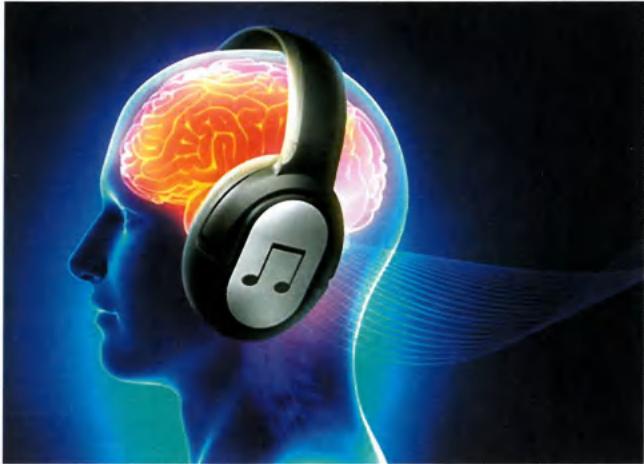
Brainwave music headphones have formed a huge market
4.4 From Right Brain Development to Whole Brain Development
Although in Taiwan, potential development based on blindfolded reading is called midbrain development or dual-brain development, there are not many instances in the mainland where it is named midbrain development. In fact, our country proposed the initiative of developing the right brain very early on. Li Lanqing, the former Vice Premier of the State Council in charge of education, stated at the 1998 education work conference: “Quality education must develop the right brain, and the role of developing the right brain is even greater than that of developing the left brain.” In 1999, the Ministry of Education also listed right brain education as a national key research project and wrote it into the Tenth Five-Year Development Plan. Therefore, the name “right brain development” aligns more with people’s cognition; the sudden emergence of “midbrain development” leaves people quite confused. However, the idea of right brain development was also quickly questioned and opposed by some neurologists and education experts, the most influential of whom were experts from the Quality Education Research Institute of the China Management Academy. Experts believe that education must focus on the comprehensiveness and integrity of brain development, as well as the harmony between brain functions, rather than one-sidedly pursuing the development and application of a single brain function, let alone extremely pursuing the development and performance of a specific special function. From an educational perspective, this argument is indisputable. Since the Eleventh Five-Year Plan for education, the Ministry of Education has ceased to mention any brain development issues. Around 2005, “Whole Brain” began to lead domestic education brands, such as Whole Brain Speed Reading and Whole Brain Memory. After right brain development and midbrain development were closely combined with education, many educational tutoring institutions changed their name to Whole Brain Development. In recent years, with the attention from the state and parents to myopia, even myopia treatment has been called “Whole Brain Vision Restoration.” Professor Han Hongyu, Director of the Quality Education Research Institute of the China Management Academy, proposed the “Whole Person Education Theory” again during the “Twelfth Five-Year” research. It is unknown whether education brands will develop towards “Whole Person” next?
Biological evolution reached vertebrates and began to have a clear brain structure, and this structure is symmetrical. The brains of birds and mammals have obvious left and right hemisphere structures. In the 1860s, French neurologist Paul Broca discovered a language center in the left hemisphere whose main function is to program pronunciation; it is called Broca’s area. In the 1870s, German neurologist Carl Wernicke discovered the function of Wernicke’s area, which is to understand and produce language. These discoveries led people to believe that language is the standard that distinguishes humans from animals, language ability is located in the lateral region of the brain, and the frontal lobe where the language center resides is the key to making humans human.
It was not until 1981, when American psychobiologist Roger Sperry won the Nobel Prize in Physiology or Medicine, that a revolution was brought to the fields of psychology and neuroscience research. The left and right brain hemispheres are not two independent structures but are connected by the corpus callosum, which is composed of approximately 300 million nerve fiber bundles. In the 1930s, the method of cutting the corpus callosum was used to treat mental illnesses and epilepsy. People who had their corpus callosum cut were called “split-brain patients.” In 1961, Sperry’s laboratory began using “split-brain patients” as objects to study left and right brain functions. Over the next 20 years, they conducted countless “split-brain” experiments. Finally, Sperry concluded that the left brain is somewhat better than the right brain at recognizing, cognizing, and memorizing numbers and text, while the right brain is superior to the left brain in image and graphics processing. Later research found that when the contralateral brain has a disorder, the ipsilateral brain hemisphere will compensate for the deficit of the contralateral hemisphere. The human left and right brains are connected by the corpus callosum, which allows the left and right brains to communicate and work as a whole. Functionally speaking, the left and right brains have overlapping and complementary functions, which determines that independent testing of the left and right brains cannot be performed under normal circumstances.
In the 1970s, the Japanese, represented by Makoto Shichida, distorted the theory of the division of labor between the left and right brains, proposing the statement that “the left brain is responsible for abstract thinking, and the right brain is responsible for imagery thinking” and promoted it. This statement was later introduced to China and evolved into a version where “the left brain is responsible for language, and the right brain is responsible for graphics.” Entering the 21st century, at education conferences around the world, educators, psychologists, and brain science experts began to oppose this statement originating from Japan, believing it to be a fallacy. Although each hemisphere does indeed exhibit specialization (functional specificity), such as Broca’s area being in the left hemisphere and controlling most speech production, in reality, the two hemispheres possess more similar functional characteristics. This explains why patients with damage to key unilateral brain areas still retain certain brain motor functions. In real life, unless a person’s corpus callosum is severed, both hemispheres participate in the vast majority of tasks, and the roles of both the left and right hemispheres are very important. “No scientific research can classify learners as left-brained or right-brained, nor is there effective teaching for left or right brain development.” ① After this, the domestic education community no longer spoke of “developing the right brain,” instead replacing it with the promotion of “whole brain education.”
Whole brain education is essentially the combination of neuroscience and education. From the perspective of neuro-education, there is no such thing as right or left brain development, only brain neural remodeling. However, from the perspective of potential, some functions indeed feel “developed,” so whole brain development is a part of whole brain education. Abilities that can be “developed” are generally considered to include human memory, thinking power, etc. Therefore, whole brain development can be divided into two categories: one is functional, including the development and training of special functions like ESP games and psychokinesis; the other is technical, such as mnemonics, rapid calculation, and speed reading.
Because people believe students need to spend more energy and time on exam subjects, courses such as art, music, and physical education are severely neglected. The distorted left and right brain theory actually makes it easier for people to accept and value comprehensive brain exercise, so this book will continue to use the two concepts of left-brain thinking and right-brain thinking (this is not a completely scientific expression). Left-brain thinking, with typical left-brain functional characteristics—sequential, superficial, functional, textual, and analytical—is widely popular in the information age and is highly valued in research institutions and schools. Right-brain thinking, with typical right-brain characteristics—simultaneous, metaphorical, aesthetic, contextual, and comprehensive—has not received sufficient attention in the information age and is ignored by various institutions and schools. What role do these two types of thinking play for a person? What help do they offer for social development? The book A Whole New Mind: Why Right-Brainers Will Rule the Future ① very well interprets the 6 abilities needed in the new era determined by these two types of thinking. This book mainly covers the following content:
The two hemispheres do not work like a switch, with one side turning on and the other turning off; for everything done, they work in division and cooperation. The left and right hemispheres of the brain collaborate synergistically, just like an orchestra; if any party is absent, the performance will be terrible. Cognitive neuroscientists are now studying what role each region of the brain plays in how we behave and understand the world, and have achieved a large amount of research results. In everything we do, the left and right brains work in collaboration. Neurologists believe that the two hemispheres play different roles in how we behave and understand the world. There are mainly the following 4 points regarding the differences between the left and right hemispheres of the brain:
-
The left brain controls the right side of the body, and the right brain controls the left side of the body.
-
The left brain acts in sequence, while the right brain acts synchronously and simultaneously.
-
The left brain focuses on understanding the literal meaning, while the right brain excels at grasping the situation and context. Or to put it another way, the left brain controls what to say, while the right brain controls how to say it (including those non-verbal, emotionally charged signals, such as eye contact, expressions, and tone).
-
The left brain analyzes details, while the right brain looks at the big picture. Sperry wrote in an article: The right brain, which lacks language function, is good at the overall reflection of various different attributes of things and their interrelationships, mainly synthesizing externally input information. The left brain, which has language function, is exactly the opposite; its mode of operation is very similar to that of a computer, focusing on logic and analysis. The left brain cannot achieve the rapid and complex synthesis of information like the right brain.
In summary, the left brain focuses on single answers, while the right brain focuses on gestalt perception ②; the left brain focuses on categories, while the right brain focuses on relationships; the left brain captures details, while the right brain looks at the big picture.
In the new era, the following 6 major abilities people must master involve the right brain and left brain complementing each other, opening up a whole new thinking for the new era.
-
Not only utility, but also a sense of design (artistic sense).
-
Not only arguments, but also story power.
-
Not only professionalism, but also symphony power.
-
Not only logic, but also empathy power.
-
Not only seriousness, but also a sense of play (entertainment).
-
Not only the pursuit of wealth, but also a sense of meaning.
Design sense, story power, symphony power, empathy power, playfulness, and the search for meaning—these six abilities will increasingly dominate our lives and reshape our world.
The latest research results indicate that human emotions occur in the brain nucleus, and human reason is related to the prefrontal cortex, not just the left brain. However, people still habitually use left-brain thinking and right-brain thinking to distinguish between the two modes of thinking. Due to the absolute advantage of left-brain thinking training in current school education, emphasizing “whole brain” is essentially to remind education to attach importance to developing the right brain. The reason why I chose to use the term “right brain” in my Right Brain Development Training Manual is also to improve students’ image-based and emotional right brain thinking abilities, serving as a supplement to school education.
For example, some teachers now teach writing by having students memorize fancy words and sentences, as well as model essays. Many students are able to write high-scoring essays through this method, but this is mostly just the left brain playing language games. Do the students truly have that kind of feeling? Not necessarily.
Once, I went to Jiuru Mountain in Jinan with friends. The most beautiful thing about Jiuru Mountain is the water. High-hanging waterfalls pass through the canyons, cascading down in nine layers, hanging in dozens of places, displaying a myriad of postures. Silver snow pours down, steam rises, and the water and mountains reflect each other, birthing beautiful scenery. Some impress with grandeur, shouting and whistling; others charm with grace, swaying and flirting. While we were enjoying ourselves, two friends were arguing the whole time about whether the water was pumped to the top of the mountain by pumps and then flowed down, completely immersed in a scientific discussion. Where was the appreciation of touring the mountains and waters? Where was the cultivation of sentiment? If they were to write a travelogue, where would be the inspiration that comes from the heart?
People who have traveled to Dunhuang generally have a high opinion of it, because it is easy to integrate into the environment in Dunhuang. In Dunhuang, seeing Buddhist grottoes, murals, deserts, Gobi deserts, Yardang landforms, and other artistic and natural sights easily brings people deep feelings. However, some people rate the Yumen Pass, the Han Great Wall, and the immersive play “Encounter Dunhuang” relatively low, but many others feel that these places are truly awe-inspiring. Because if you don’t place yourself in the space-time of thousands of years, these places are nothing more than a pile of earthen walls and a performer’s show. These attractions interpret 2000 years of Dunhuang’s history, just like a handful of sand from Mingsha Mountain held in your hand, slipping away in an instant. It brings a shock, a reflection, and a resonance that one can only physically grasp when one’s heart is in it. This is the best place to understand what time is.
In The Hypnotist’s Notebook, there is such a passage: “You understand that love is the result of chemical secretions, but you do not know how wonderful a feeling it can give you; you can imagine beautiful scenery, but you have not experienced the shock of seeing it with your own eyes; you have seen history in books, but you cannot see the vicissitudes between the lines; you understand the profundity of advanced mathematics, but you cannot understand the numerical barrier that once made people forget to eat and sleep; you have learned two or more languages, but you do not understand the connotation hidden in that rhythm; you understand what psychology is, but you have not explored those complex causes. Your intelligence allows you to imagine and deduce many correct conclusions, but it is precisely your intelligence that keeps you only in imagination. You haven’t experienced anything, you don’t know what cruelty is, what being moved is, what passion is, what sadness is. Without experience, you won’t understand what friendship is, what love is, what despair is, what shock is, what helplessness is. Before you experience them, they are just vocabulary, nothing more. You cannot truly understand the world through books, you cannot realize how important ‘experiencing’ is.” And this kind of “experiencing” cannot be achieved by the left brain alone.
The left brain may be an important area that distinguishes humans from other animal brains. We know that the characteristics of the left brain are a greater focus on language, details of things, logical order, and right and wrong. People with severe left-brain thinking tendencies may bring about some drawbacks. For example, Feng Xiaogang’s movie I Am Not Pan Jinlian tells the story of a woman who was slandered by her husband as “Pan Jinlian” and who, in more than ten years of appeals, persisted in seeking justice for herself. The protagonist is a person who cares too much about specific matters, wording, and right and wrong. Just this one sentence caused her life to be wasted in the appeal process for more than a decade. The movie left the audience feeling entangled, depressed, stifled, and inexpressible. It can be said that this is a typical left-brain thinker who cannot view things, life, or the world as a whole. To use our dialect, “this person has fallen into the matter.”
The number of children suffering from autism (childhood autism) is showing a clear upward trend, which may also be related to the left-brain thinking mode of mothers of autistic children. Autistic children have the following seemingly unrelated characteristics: the proportion of patients’ families in cities is higher than in rural areas; the majority of patients’ parents have a certain level of education or high academic degrees; the proportion of patients’ parents who both have jobs is very high; the income of patients’ families is higher than the local average; the prevalence rate of children born by Cesarean section is higher than that of children born naturally; the male-to-female ratio of patient children is close to 9:1. The language-related mechanisms of men and women are distributed differently in the functional areas of the cerebral cortex. This difference in functional distribution directly affects the different thinking styles of men and women, and this reason determines the huge difference in the male-to-female ratio of patient children. Other circumstances are all related to the thinking characteristics of the patient’s mother during pregnancy. The mother must have placed very little focus on her own body and the baby-to-be during pregnancy, and more energy on things outside herself, either busy making a living or busy with her career, lacking self-emotional experience and communication. This is also a typical left-brain thinking mode. During pregnancy, the expectant mother rarely forms a spiritual connection with the fetus, and after the child is born, they still cannot form a psychological connection with others, resulting in autism. Therefore, autistic children can only recover by allowing the mother and child to form a spiritual connection to make up for the regret during fetal development. All treatments that leave the child without the mother’s cooperation are difficult to achieve results. This emotional blending is dominated by right-brain thinking.
Science is the study of separate disciplines; it is the process of dividing a whole into smaller and smaller parts for research. When you see an apple under an apple tree, without much consideration you know it fell from the tree, rather than being there eternally since ancient times. Much knowledge, common sense, and conventional things that adults already know cannot attract adults’ attention. But children don’t know those things; they will be curious and ask about the root of everything. You tell a child about photosynthesis, and the child will ask you to explain it in more detail, and then you will find that you do not know the most fundamental cause or how it originally appeared. Many professional scientists also do not know the cause; they can only tell you vaguely: it evolved from something specific, which still needs investigation. This little bit in front of us is just a point in a line; forward and backward, it is an objective existence, and we are just moving along an invisible line. And the vast majority of the time, we only focus on this current point, but ignore the line itself where we are. Focusing on this point and observing it by dividing it into extremely tiny particles for research seems to be the function of the left brain. Holistic thinking is the function of the right brain.
The right brain is so important, so how can it be developed? Developing the right brain, like other intellectual developments, is not something that can be accomplished overnight, but a process accumulated over a long period of learning and practice. Now, when children are learning to speak, adults teach them what this is and what that is. When they put their fingers in their mouths, they are told: “Dirty, don’t put it in your mouth!” This is obviously cultivating the child’s left-brain thinking, thereby strengthening certain functions of the left brain. Then, during the child’s growth process, what they hear most is that this is wrong and that is wrong. Children like to ask why, and parents feel that being able to tell their children the reasons and knowledge is a matter of great pride. After starting school, there are more rules, exams, and evaluations. In doing anything, teachers require calculation, reasoning, analysis, and judgment, all of which are reinforcing left-brain thinking. Training beneficial to the right brain, such as letting children focus on appreciating music, painting, doing handicrafts, playing games, reciting classics, etc., seems to be something only done by extracurricular interest classes, because music and art classes are relatively “minor subjects” in the basic education stage and are generally in a relatively awkward position. In essence, the right brain also gets exercise in the life experiences, observations, and listening during the child’s growth process; it is just that the reinforcement of left-brain thinking will inhibit right-brain thinking.
Betty Edwards, a lecturer in art at California State University, published a book called Drawing on the Right Side of the Brain in 1979, opposing the view that some people are born without an artistic sense. She believes: “Drawing is actually not difficult; what is difficult is observation.” The real secret of observation is to quiet the “domineering, seemingly all-knowing” left brain, allowing the more mature right brain to begin to exert its wondrous effects.
Allan Snyder, a brain scientist at the Centre for the Mind at the University of Sydney, once conducted such an experiment: using a transcranial magnetic stimulation technology ① to artificially and temporarily inhibit the functions of the prefrontal and temporal lobes of the brain, and comparing the results of behavioral experiments before and after inhibition. The study found that after these brain areas were inhibited, the subjects showed significantly improved drawing skills, such as the ability to depict more details, the ability to discover grammatical errors that were previously missed, and more accurate counting results of spots on the screen. Snyder’s explanation is that the transcranial magnetic stimulation device temporarily reduced the function of the left brain area, while the function of the right brain was relatively increased, thereby improving the subjects’ attention and imagination. ② The human right brain may come pre-installed with a “system” to help us process what our eyes see, or to understand the “inner laws” of music, art, or mathematics. It is just that people who have undergone right brain development are better at developing and utilizing those innate talents than the average person.
Although the education sector has long ceased to discuss the issue of the brain, the scientific community continues to this day to advocate for the enhancement of right-brain thinking in education. In 2017, I attended a lecture by Professor Li Xiangyi, a pioneer of multiple science popularization undertakings in China, the first Chinese person to win the UNESCO “Kalinga Prize” in the 60-plus years since its establishment, the former Director of the China Science and Technology Museum, and the former Director of the Science Popularization Department of the China Association for Science and Technology. In the lecture, he called on school education and science popularization workers to focus on developing students’ right brains, because the right brain plays an extremely important role in improving thinking abilities related to promoting scientific levels, such as creativity and innovation. It is not just him; Mr. Cheng Bushi, a first-generation aircraft designer of New China, also spoke about the importance of developing the right brain on the CCTV-1 program “Lecture Room” (see video: Cheng Bushi on Right Brain Development). Former Vice Premier Li Lanqing stated in his “Music, Art, and Life” lecture: “Beautiful music is beneficial for the development of human intelligence, mainly developing creative thinking, imagery thinking, and creative thinking, as well as aiding our memory; this memory is mainly stored in the hippocampus of the right brain. The right hemisphere of the brain is more developed in those who study music, and imagery thinking and creative thinking receive constant exercise. However, excessive training can result in relatively poor logical thinking and critical thinking, so many highly accomplished musicians do not know how to live, nor can they handle some of their simple affairs. For example, Beethoven could not do simple multiplication, and he often made mistakes in simple arithmetic.” (see video: Edited Li Lanqing “Music, Art, and Life” Lecture) Stanford University Physics Professor and Visiting Professor at Tsinghua University Shou-Cheng Zhang wrote in the preface to The Light of Civilization (by Wu Jun): “Today, whether it is personal development or the advancement of research fields, [the scope] is becoming increasingly narrow, seeing only the trees, not the forest. Very few people can be like the Renaissance master Leonardo da Vinci, able to hold the essence of all human knowledge at the time in one head, including art, medicine, engineering, science, etc., thereby bursting forth with amazing creativity.” This “holistic thinking” and “artistic thinking” are both functions of the right brain.
Cheng Bushi on Right Brain Development
Edited Li Lanqing “Music, Art, and Life” Lecture
Therefore, while schools traditionally focus on cultural coursework to improve students’ learning abilities and knowledge levels, they should also strengthen the teaching of subjects such as art, sports, and labor. Only in this way can students cultivate the most powerful brains with left-right balance.
Chapter 5: The Essence of Potential Development
The manifestation of all potential is inseparable from the states of concentration, imagination, and introspection; in this state, everything is possible. The essence of potential development is to enter this state. The practices of Buddhism, Taoism, and Qigong also require entering this state to attain health and wisdom. Understanding the essence of potential development allows one to know the essence of so-called advanced technologies, to see the essence of life clearly, and to understand the relationship between potential development and human life.
5.1 Śamatha-Vipaśyanā Dharma Gate and “Light Sphere”, “Brain Screen”
In blindfolded perception training, the ability of the light sphere to change is a sign that one’s own subconscious energy has begun to awaken and operate; it is a very important step. Most potential developers only know the “what” regarding the light sphere but not the “why”; the light sphere is inherited from Buddhism. In Buddhist cultivation methods, regardless of the sect of Exoteric Buddhism, or even Chan Buddhism, aside from using methods like Dhyana (meditative contemplation) and Śamatha-Vipaśyanā (stopping and seeing) as a basis for practice, the remaining theoretical knowledge is generally the result of wisdom-based thinking.
There is a Buddhist scripture called Śamatha-Vipaśyanā Practice, translated as The Dharma Gate of Stopping and Seeing (Śamatha-Vipaśyanā), which states: “Focus and stop within the body, observing in the middle, without delusional thoughts; stopping within the body on the Dharma-affinitied light sphere, the longer [you stop], the larger it becomes, reaching the supreme and unattached, the completion of the Path fruit can be expected; otherwise, it is attached to improper concentration, therefore right concentration is the foundation of success. If visualizing the initial directional light sphere arising, one should stop thoughts, focus on the center of that initial directional light sphere, and concentrate right concentration upon the center core point of that light sphere, stopping again and again. Make it brighter and more lucid; the longer the duration, the larger the diameter; the more right concentration, the brighter.” The entire scripture explains what the “light sphere” looks like, how to look at it, and how to “stop” on it. “Stop” (Śamatha) means to abide, halt, fix, be fixed in, and focus; the meaning of “Observe” (Vipaśyanā) is a bit deeper, it has the meaning of looking, and also the meaning of “second sight (seeing again)“. “Second sight” is not seeing with the eyes. Then who is seeing with this “second sight”? It is the “mind” (heart) that is seeing. The “mind” can see “my” body, thoughts, emotions, and many things that the eyes cannot see. Therefore, “Observe” can also be called “Visualization” (Guanxiang). “Stopping and Seeing” means to focus on “seeing”. Stopping and Seeing is the combined term for meditative concentration (Dhyana) and wisdom, and is an important method of Buddhist practice.
“Seeing the light sphere” is a very difficult thing for many people, so in the Dharma Gate of Stopping and Seeing, there is also the “Method of Guiding the Initial Directional Light Sphere into the Body”. “The form of the initial directional light sphere is a round glazed bright pearl, crystal clear, bright, white, and flawless. At minimum, it is not smaller than a star; at maximum, it is not larger than the moon disk and the sun disk. However, this glazed sphere varies in size, determined by each person’s Dharma affinity and magnitude.” After seeing the initial “light sphere”, one must then “Right Concentrate in
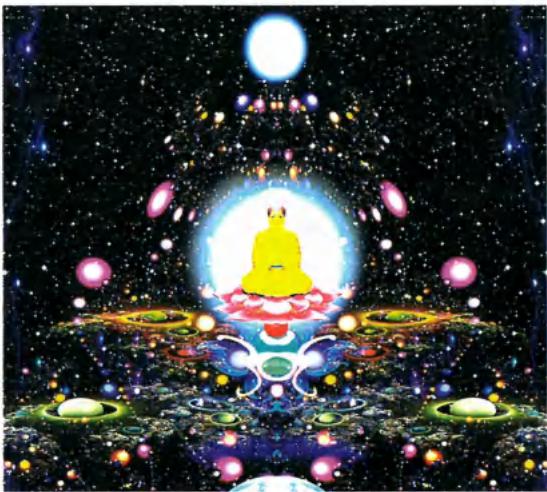
Stopping and Seeing
the ‘Precepts’ light sphere”, then “from the ‘Precepts’ sphere see the ‘Concentration’ light sphere”, then “from the ‘Concentration’ light sphere see the ‘Wisdom’ light sphere”, “within the ‘Wisdom’ light sphere there is also the ‘Liberation’ light sphere”, and finally “within the ‘Liberation’ light sphere there is also the ‘Knowledge and Views of Liberation’ light sphere”. In The Dharma Gate of Stopping and Seeing, does one only look at the “light sphere”? Of course not. The light sphere is just the initial stage; the objective is not to look at the light sphere, but in the long process of looking at the light sphere, one must see the changes of the light sphere. Seeing the “Knowledge and Views of Liberation” light sphere counts as arriving at the entrance of the Dharma Gate of Stopping and Seeing. Afterward, one must also be able to see the immature Rūpakāya, coarse Deva body, immature Deva body, coarse Rūpadhātu body, immature Rūpadhātu body, coarse Arūpadhātu body, immature Arūpadhātu body, coarse Dharmakāya, immature Dharmakāya, coarse Srotāpanna Dharmakāya, immature Srotāpanna Dharmakāya, coarse Sakadāgāmi Dharmakāya, immature Sakadāgāmi Dharmakāya, coarse Anāgāmi Dharmakāya, fine immature Anāgāmi Dharmakāya, coarse Arhat Dharmakāya, immature Arhat Dharmakāya. “When sitting quietly reaches the Arhat body, it is the final eighteen bodies; one can cut off obstacles completely and gradually reach the stage of entering the stream of sages.” Being able to see this light sphere is like a newborn baby; one must be able to see it grow to attain great wisdom.
In Chinese Buddhism, people feel that Esoteric Buddhism (Vajrayāna) is the most mysterious. Based on geographical distribution, Esoteric Buddhism is divided into Eastern Esotericism, centered on Japan, and Tibetan Esotericism, centered on Tibet (methods of Tibetan Buddhist practice). The methods of body secrecy (Kāyamudrā) practice passed down in Eastern Esotericism are mostly visualizations combined with Sanskrit character wheels, filling various parts inside and outside the body; it utilizes consciousness to approach a state of “singleness” in concentration. As for the methods of body secrecy practice in Tibetan Esotericism, aside from a part that still maintains the visualization of character wheels and their functions combined with parts inside and outside the body, its unique feature is placing special emphasis on the practice of Qi-channels (prana/nadi). Tibetan Buddhism mainly has four major schools: Nyingma (Red Sect), Kagyu (White Sect), Sakya (Flower Sect), and Gelug (Yellow Sect). Each school has its own methods and characteristics of practice. Below are two examples of their visualization methods introduced by Mr. Nan Huai-Chin in Taoism, Esoteric Buddhism, and Oriental Mysticism:
One of the Yellow Sect’s practices is the ritual of the “Thirteen-Deity Yamāntaka” (Great Terrifier), requiring the practitioner to “visualize” in a single instant the achievement of nine heads, eighteen hands, and thirty-six feet. Each head has three eyes, two horns, and the bracelets, armlets, and necklaces worn on the neck, arms, wrists, etc., as well as the poisonous snakes, beasts, humans, ghosts, and Rakshasas trampled under the feet—too many to list (see the Yamāntaka Vajrabhairava Thangka). Therefore, some people, although having studied Esoteric practices for many years, or even a lifetime, have not completely “visualized” it, so how can one speak of achieving “visualization” in just a single instant? This is because the practitioners do not understand the theory and are not through the true realm of “stopping” and “seeing” in Dhyana. Therefore, it is often futile, falling into contradictions instead, even falling into mysterious demonic obstacles, becoming similar to neurological or psychotic states, or what might be called symptoms of religious pathological psychology; it is truly deeply to be sighed at.
Another example is the ritual of “Dakini” in one of the White Sect’s practices. If according to strict transmission rules, one must also “visualize” in a single instant that one transforms into the body of “Dakini” (see the Vajra Yogini Thangka), the three channels (center blue, left red, right white), four wheels (or seven wheels), and the Qi-channels connected between each wheel position: such as the 32 channels of the crown wheel hanging downward, the 16 channels of the throat wheel spreading upward, the 8 channels of the heart wheel hanging downward like tassels, the 64 channels of the navel wheel supporting upward from below—all must be distinct, with clear forms and colors. At the same time, the “Tummo” spiritual energy of the perineum and navel wheel must also simultaneously ignit
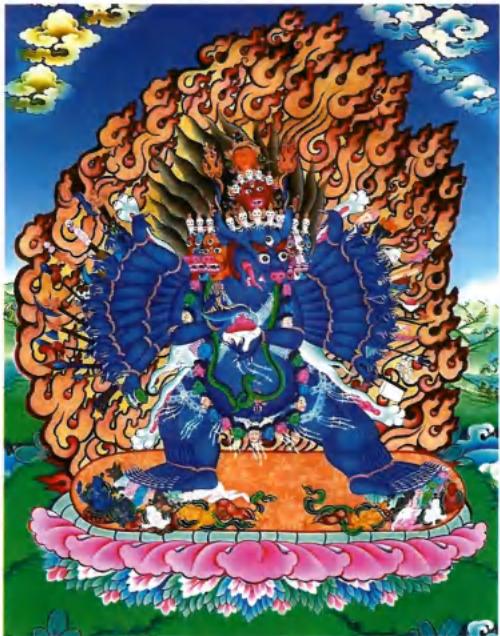
Yamāntaka Vajrabhairava Thangka
e, cooperating with intention and Qi-channels, used to reach the realm of union of mind and Qi. In this way, how many practitioners can truly “visualize” achievement in a single instant and get their wish fulfilled? Of course, if one cultivates Esoteric practices and cannot yet achieve “visualization” in a single instant, then one cannot speak of the achievement of the “Generation Stage” (Utpattikrama) at all. In other words, if the efficacy of this “Generation Stage” cannot appear, it is naturally because one cannot accomplish the preliminary foundation of true “simultaneous practice of stopping and seeing” (Śamatha-Vipaśyanā-yuganaddha).
From the introduction above, we can know that the “light sphere” of Buddhist practice is ultimately to appear as a clear image on the “brain screen”. When one can reach this point, one is about to enter the realm of opening great wisdom. To facilitate the practice of Buddhist disciples, the environmental layout of temple halls is invariably connected to visualization. The Buddhist hall is extremely quiet; apart from the sounds of wooden fish and singing bowls that lead people into deep tranquility, there is only the chanting of sutras and mantras by monks. The layout of the hall has appropriate brightness and darkness, and the eternal candles shine brightly. The huge Buddha statues and the banners filling the hall are mostly golden yellow, or the Buddha statues are gilded, catching the eye. The colors of the murals are vivid with strong contrast, making them unforgettable to those who see them. The sculptures of Bodhisattvas and Arhats have exaggerated expressions and distinct personalities, strongly impacting the inner heart of the viewer and leaving a deep memory…
Let us come back and think about brain potential development training: using a 60W light bulb to let students find the feeling of the light sphere, and allowing the light sphere to arbitrarily change size, shape, and color; using a yellow card to train the student’s “brain screen”, seeing the original color from the complementary color, and being able to arbitrarily change it into a clear, vividly colored image; Mandala cards
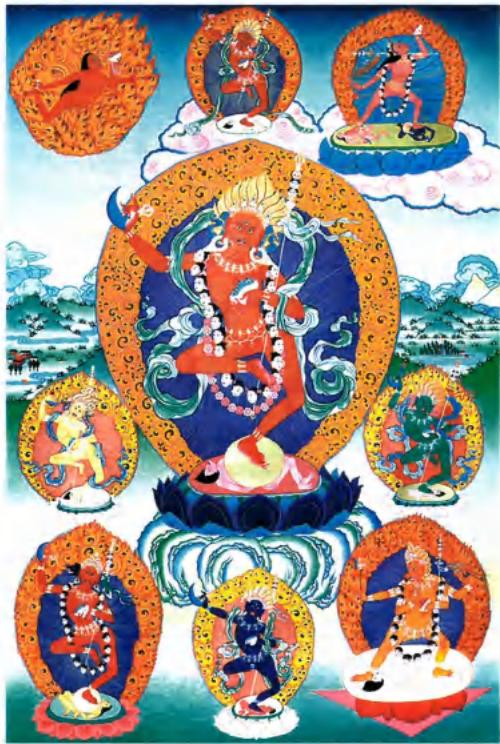
Vajra Yogini Thangka
train the student’s brain color and image memory abilities, allowing seen images of different colors to be memorized in the form of images, and accurately restoring blank Mandala cards; all information must be realized as fast memory using images as clues as much as possible; so-called Alpha wave music can be used to assist in training. Light bulbs and candles have no essential difference; both use light to guide people to find the feeling of the “light sphere”. Why is the yellow card called a yellow card? Is this the same as the yellow commonly used in temple halls (the main reason is because the brightest light perceived by the eye is yellow, which happens to be within the peak region of the strongest solar radiation)? Why is it not called a green card or red card? And the Mandala card is directly taken from Buddhist or Yoga cultivation methods; Alpha wave music has a feeling somewhat similar to the sound waves of chanting sutras and mantras. Therefore, we can easily find the connection between these tools and Buddhist practice.
Hypnosis is one of the fastest ways to unlock human potential. Psychology defines hypnosis as a special psychological state of consciousness, similar to sleep yet distinct from it, induced by artificial means (such as relaxation, monotonous stimulation, focused attention, imagination, etc.), which narrows the scope of consciousness, placing the individual in a trance state. Its characteristics are the weakening or loss of autonomous judgment and voluntary action in the hypnotized person, and the distortion or loss of sensation and perception. However, in this state, consciousness and the subconscious interact, often mobilizing human potential to produce incredible effects, such as in stage hypnosis shows. Utilizing hypnosis can also allow for memorizing vast amounts of information in a very short time, increasing reading speed, and writing effortlessly without overthinking. It can even facilitate physical and mental healing, past life regression, and seeing “past and present lives,” among other things.
Coincidentally, hypnosis also places great emphasis on “visualization.” First, the subject must be able to “see” light, which seems to be a marker for being able to enter a high-energy state. For example, using the elevator descent method: take an elevator down from the tenth floor; for each floor down, you can see different colors. Upon reaching the bottom floor, you enter a tunnel with a spot of light at its end. As you walk toward the light, it grows larger, revealing itself to be a door. Opening the door, you are surrounded by white light, and then a wonderful scene unfolds before your eyes. Hypnotherapists believe that light is a necessary channel for unlocking human wisdom. Dr. Brian Weiss, an American medical doctor and graduate of Yale University, emphasized in his book Same Soul, Many Bodies: The Journey of the Soul (Note 4) that “the ignorant cannot see the light,” “the more ignorant one is, the less light there is,” and “evil is the greatest ignorance, allowing almost no light to be seen.” Only with light is it possible to have a “mental screen” and wisdom.
The mental screen, also known as the mental screen, screen effect, intuitive vision, manifesting scene, or seeing through the “Third Eye,” feels like a screen to some, while for others, it is like seeing directly with their eyes. For some, the images are clear; for others, the images seem to exist, but it is uncertain if they are truly “seen,” perhaps remaining merely a feeling or perception. Regardless, this belongs to the realm of personal subjective perception; the content “presented” on the mental screens described by everyone cannot be detected through scientific means. Therefore, this is not a scientific term, but rather a psychological description.
Therefore, when asking people with extrasensory perception (ESP) reading abilities how they know, the term “subjective report” often must be used. In 1979, the first person discovered who could read with his ears, Tang Yu, gave a subjective report stating that when he received the crumpled paper with writing on it, the handwriting began to reflect in his mind. There was a silver screen in his mind, and when the paper ball was placed into his ear, the strokes appeared one by one. Other children have also reported subjectively that if they looked hard straight ahead, they would see a square frame, and then pieces of red things would slowly come together in front of my eyes to form a character, and I would read it out. These instances of “seeing” are understood by researchers as being seen on the mental screen.
Some adults find it very difficult to find the sensation of this mental screen. Therefore, the purpose of Light Vision training is to first find the sensation of light, use Yellow Card training to locate the mental screen, and enable the images on the mental screen to be recognized by the consciousness and to change. If there are no images in the mental screen, even a senior hypnotherapist can only wait patiently and guide. Brian Weiss encountered this once while performing hypnosis on a client: “I performed hypnotic induction on Jessica, guiding her back to a past life. Initially, she saw only some blurry colors, like waves or spots. Within ten minutes, she saw nothing but light. Suddenly, amidst the fluctuating light, an apron pattern appeared in Jessica’s mind. I secretly breathed a sigh of relief.” ①
We know that the energy of the subconscious is immense, and human wisdom and potential are likely the result of the functioning of the subconscious. It is difficult for the subconscious to be mobilized by the conscious mind, and it is difficult for the conscious mind to perceive information from the subconscious. Sometimes the subconscious gives people the feeling of being a bit “silly.” It is often heard that psychological counselors, NLP masters, or hypnotherapists say that the subconscious cannot hear the word “not” or negative semantics. For example, if you tell a child “cannot watch TV,” the information the child’s subconscious receives is “can watch TV,” so after you leave, the child often unconsciously turns on the TV and starts watching. Another example: please do not imagine a little pink elephant flying back and forth in the sky; if your imagination is particularly good, I am afraid there is already a pink elephant flying back and forth in your brain, right? In general, it is difficult for the consciousness to communicate with the subconscious. If the ultimate result of practicing the Samatha-Vipassana method is to obtain great wisdom by seeing the “Arhat Body” (or subtle body), could we understand that at that time, one is seeing clear, brightly colored images transmitted by the subconscious? The information transmitted by the subconscious is unabstracted information such as images and sounds. If this is the case, we can make this hypothesis: if one can see and understand information such as images and sounds sent by the subconscious, human potential can naturally be stimulated. This is a state of interaction between consciousness and the subconscious, and the realization of this state is the necessary state that must be entered for potential development. Of course, regardless of whether this hypothesis is correct, the basic state of human operation when potential is functioning is the same, and entering this state is the essence of potential development.
5.2 The Essence of Potential Development
The ability of children to recognize characters while blindfolded, the various functions possessed by Jin Gang masters, and the manifestations of other potentials are not possible at any time and place. That is to say, the manifestation of potential is unstable; physical health, mood, surrounding environment, the magnetic field of special individuals, etc., can all affect the display of potential. Sometimes, the inability to repeat a performance is also one of the reasons why Jin Gang masters’ performances are often mistaken for fraud. In the previous section, we learned that the stimulation of potential is the result of the interaction between consciousness and the subconscious; that is, only when a person is in such a state can potential be easily stimulated. Therefore, the essence of potential development is to bring the developer into this state, and the core of this state is concentration, imagination, and introspection.
Personal experience in this state usually manifests as physical relaxation and the emptying of the mind. This state can also be called channeling, Alpha waves, unity of heaven and humanity, trance, or a high-dimensional state. In this state, everything is possible. We may all be familiar with or have heard of super-learning methods, inspiration learning methods, ESP (HSP), photographic memory, wave speed reading, etc. Almost all kinds of mysterious and incredibly amazing human functional phenomena are realized in this state. There are also many ways to enter this state; practices such as yoga, meditation, contemplation, Qigong, hypnosis, spiritual cultivation, and Zen meditation may all allow one to realize these functions and phenomena.
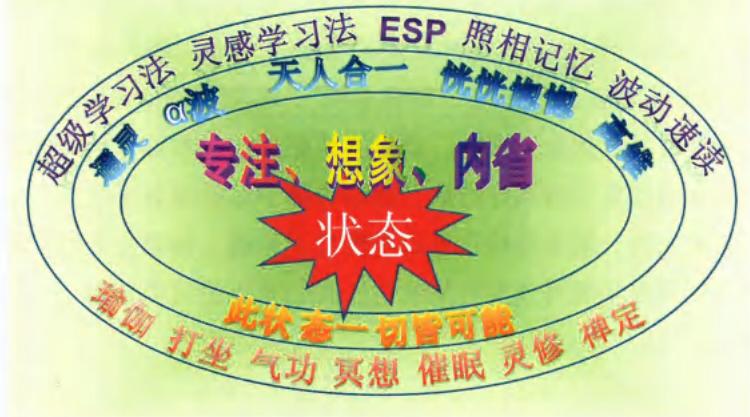
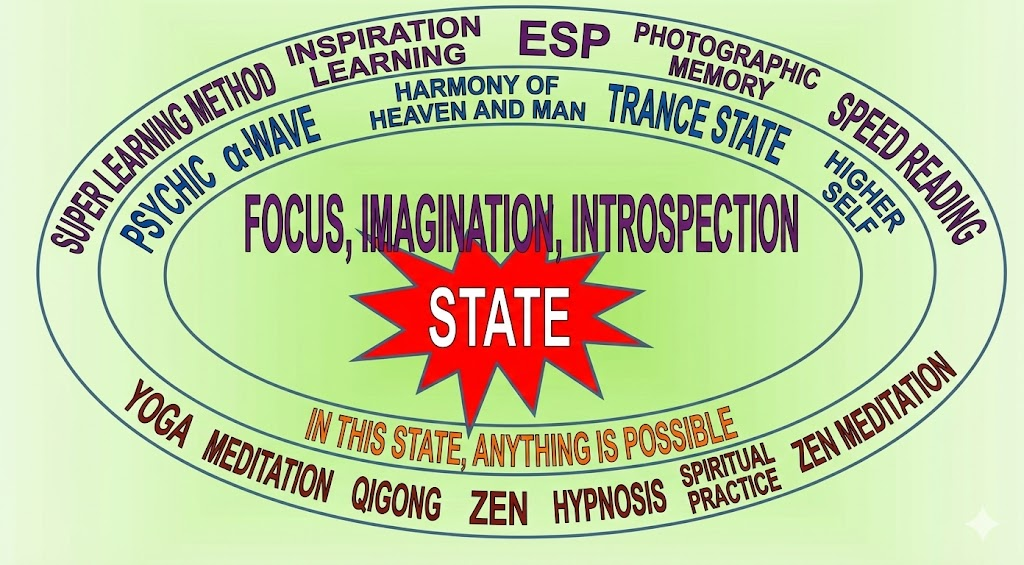 The Essence of Potential Development
“Consciousness” in human life is the source of thought, feeling, and perception, and is also the foundation for people to sense the existence of “I.” Under normal circumstances, we cannot perceive the operation of the subconscious, and it is difficult for consciousness to communicate with the subconscious. Consequently, consciousness finds it difficult to mobilize the huge energy of the subconscious. Using hypnosis techniques is a relatively fast way to achieve interoperability between the two.
Hypnosis itself is a state of physical relaxation and focused attention; it is not time travel, nor is it supernatural power. In the state of relaxation and concentration, memory function is greatly enhanced. Many people have observed the past in deep hypnosis, like watching a movie; your consciousness is always observing everything you experience. Besides contacting the deeply hidden subconscious, your mind can also judge, criticize, and inspect. This is also why people under hypnosis, after entering childhood or past lives, can still answer the therapist’s questions in their current language. The key is that through this method, almost all experienced things that we consider impossible to remember can be recalled, but facts show that this can indeed be done.
“Recalling these early memories is not difficult. I first guide the trainee into a state of high concentration and relaxation. Then we trace back along time, passing through adolescence and childhood, until infancy and the gestational state. I count down from five to one, guiding the trainee to imagine a picture, a scene, a smell, or an event, and have them focus their attention completely on it. Initially, the picture may be more like a snapshot or an ordinary photograph, sometimes like a movie. As I continue to guide, the scenes accompanied by perceptions, feelings, and emotions become further clear. At this point, the regression is successful, and the wonderful reunion and memories remind us of love that never ends; we know that relatives live both in the past and in the future.” ①
Fuji (Planchette Writing) is a method of divination in ancient Chinese folk culture. Believers use this method to communicate with spirits to understand their instructions. Because of a horror movie and horror novel named The Pen Fairy (Bi Xian), a spirit-summoning game—Pen Fairy—entered people’s field of vision. The Pen Fairy game is a variant or simplified version of Fuji. It communicates with an energy entity that we will tentatively call the “Pen Fairy” through a pen. Inviting the Pen Fairy is just a game, sometimes possibly influenced by some kind of psychological suggestion. Some psychologists also say that the difference in the effect of “inviting the fairy” depends on the degree to which the questioner is in a state of self-hypnosis. According to the answers given by the “Pen Fairy,” it can be judged that in many cases its answers are not effective, and sometimes are extremely absurd. The key points of the Pen Fairy game are belief, relaxation, concentration of attention, and letting go of left-brain thinking. This game is likely mobilizing the human subconscious, in a process where consciousness cannot truly interact with the subconscious, leading consciousness to believe that a “fairy” is speaking or writing. The Pen Fairy game is just a superstition, but training human concentration and triggering the spirituality of the subconscious through the form of pen and drawing can indeed be achieved.
British famous illustrator Johanna Basford’s coloring books Secret Garden and Enchanted Forest, which use colored pens to add gorgeous colors or use fine-tipped black pens to create more doodles and details, can help readers of different ages relieve stress, relax body and mind, purify thoughts, improve concentration and inspiration, discover the beauty of life, and create artistic beauty. Similar to the coloring book Secret Garden is the popular Zentangle in recent years. It creates beautiful patterns within a set space using constantly repeated basic shapes. Drawing Zentangle is relaxing, fun, simple, and easy to learn. It requires no deep painting foundation, no specific venue; a black pen, a pencil, and a piece of paper are enough to enjoy Zentangle anytime, anywhere. The winding and twisting lines form the basic patterns of Zentangle, and the free combination of various patterns constitutes a complete Zentangle (as shown below). It is not only a kind of artistic creation but can also be used to relieve stress, so it is also called “Brain Yoga.” It is precisely because through the entanglement, the human brain can easily enter a meditative state and gradually reach deep concentration. When repeatedly drawing figures with exquisite lines, everyone can focus on every stroke. In this state of consciousness, the mind, intuition, and knowledge can all operate quickly, precisely, and effortlessly. In the world of Zentangle, there is no comparison, no right or wrong; just follow your feelings to draw, and be free and happy, so it is also called “soulful drawing.”
Zentangle
Whether it is religious spiritual practices, witchcraft, or Zentangle and coloring, they all look very magical to people. In the art that people are familiar with, the creation process is also full of practice. Some of China’s most typical ancient instruments, such as the Guqin and the Xun, have deep, simple, and distant timbres. When they first appeared, they were not intended for others to appreciate, but for a person to play alone, using the instrument to express their inner feelings. When playing, one must be extremely focused, placing the mind into a certain artistic conception, allowing the “before eyes” scene and the emotions evoked in the performer to be expressed through the instrument. This is a special information language. Those who can understand this language and cause the listener’s soul to resonate are also few, so there is the saying “high tunes find few singers, and a soulmate is hard to find.” These instruments are tools for human beings to express information about the inner world, as well as ways to cultivate bright virtue, practice being a human, and improve self-awareness, concentration, and imagination. In this state, it is also very easy to stimulate inspiration and wisdom. Obviously, many children now learn various instruments just to learn techniques, without reaching the realm of quieting the mind and spiritual practice, which runs counter to the true purpose of learning music, so they will feel bored and unable to persist.
Regardless of the method used, potential development is about making people learn to follow their consciousness into this state. This state sounds simple, but it is indeed not easy to achieve, especially for adults. For example, asking you to observe your breathing and focus your attention on your breathing for 1 or 2 minutes without distraction is not easy for most people, but for a longer time, it is probably very difficult; it is relatively easy to think abstractly about something, but it is difficult to make the imagined images vivid, colorful, and clear; it is relatively easy to keep your thinking clear and mind sharp, but it is difficult to constantly introspect the relationship between “I” and “I“‘s body, thoughts, and emotions. Of course, because children’s physiological and psychological characteristics are different from adults, it is much simpler for children to achieve these than for adults.
Zhiguan (Stopping and Seeing) is a combination of Samadhi (Stopping) and Prajna (Seeing). It refers to suppressing the delusions produced in the mind due to worldly thoughts, keeping the mind calm and stable, in order to focus thoughts on observing and thinking, and reaching the realm of Buddhist wisdom. At the beginning of each contemplation in the Buddhist Skeleton Meditation mentioned earlier, Shakyamuni Buddha required disciples to “bind the mind to one place,” or “bind the mind to dwell.” To “bind the mind” means to tie the mind, making the mind single-minded. Why “bind the mind”? Some friends may often meditate, sit in meditation, do yoga, etc. Think about it, when you are still, with your eyes slightly closed, what is your mind thinking about? Maybe thinking about the scene or body part you should be thinking about; how long can you think about it? Are you always thinking about this one scene or body part? Do you end up thinking about the child’s things, thinking about work, thinking about friends? The thoughts run away just like the clouds in the sky, coming unconsciously, and leaving unconsciously, sometimes more, sometimes less? Human concentration, maybe nothing for a few minutes or ten minutes, but for dozens of minutes or hours, it is not easy.
The Buddhist experience regarding this practice is worthy of learning and practice: “To traverse this path, one must only let go. In the beginning, there is nothing unusual; apart from chaotic illusions, nothing is visible. To ensure meditation is unaffected, one must possess perseverance and patience during practice. These two are extremely important. Simultaneously, one should carefully control the mind, observing with wisdom. Whichever method facilitates the severing of impurities, one should adopt that method to keep the mind in a balanced state, without deviation. Regardless, one must strive to use the Three Learnings of Discipline, Concentration, and Wisdom to eliminate the Three Poisons of Greed, Anger, and Ignorance, making the mind as still as stagnant water, clear and delighted, to accord with Dhyana (meditation).” ①
“When sitting quietly, let go of delusional thoughts, untouched by external conditions, and rest firmly in the center of the body. Stop and stop again. In the beginning, there is nothing unusual; apart from chaotic illusions, nothing is visible. This is because the human mind only seeks outwardly. Sensation, Perception, Volition, and Consciousness constitute the mind. Only by fixing the mind in one place can it rest, achieving Right Concentration; with Right Concentration, one can see the fruits to come. To perceive the realm of an ‘Arhat’, one must obtain it from Right Concentration and from Cessation. Cessation and Concentration mean success.” ①
Even if one practices the method of Cessation and Observation (Samatha-Vipassana) with dedication, the final results achieved by everyone, the duration required to obtain results, and the results “seen” will all differ. “Focus your will on one purpose, gazing at the light within the center of the physical body. Whether walking, standing, sitting, or lying down, continue on, unremitting, without discouragement or slackening of will, like a lion exerting itself, allowing no doubt. One day, there will be a result. How does it come about? You will realize it for yourself in the future.” ②
This practice of entering stillness and Dhyana is not merely a matter of method; more importantly, it concerns human willpower and the quality of persistence. Even with the best methods, if you do not act or practice them, these methods will not be empirically verified. Chapter 3 briefly discussed sitting meditation; sitting meditation cultivates the mind. It is very normal for beginners to experience numbness and pain in their legs after sitting for a long time. This is not just an issue of leg flexibility, but a problem of being unable to settle the mind. Even those who meditate frequently find it difficult to sit for long periods when they are distraught or have too many thoughts on their mind. Therefore, practices like Yoga and Dhyana all utilize sitting meditation for cultivation to attain empirical verification. Beyond this, there are many other methods of Buddhist practice. For example, the painting of Thangkas and the creation of Mandala sand paintings in Tibetan Buddhism are, from a certain perspective, ways of cultivating focus, willpower, patience, and meditative power.
Thangkas are hailed as treasures of Chinese national painting art, known as the “Encyclopedia” of the Tibetan people, and are a precious form of intangible cultural heritage within Chinese folk art. They use bright colors to depict the sacred world of the Buddha. Traditionally, pigments are made entirely from precious mineral gems like gold, silver, pearls, agate, coral, turquoise, malachite, and cinnabar, as well as plants like saffron, rhubarb, and indigo to signify their sacredness. The creation of traditional Thangkas requires strict standards and extremely complex procedures. It must be carried out according to the rituals in the scriptures and the requirements of the Guru. Completing a Thangka takes a short as half a year or as long as over ten years.
A Mandala is not a city, but a sand painting, and even more so, a form of faith. In Tibetan, the Mandala sand painting means “Mandala of Colored Powder.” As the most unique and exquisite art in Tibetan Buddhism, the Mandala sand painting is extremely secret and precious. Whenever there are large-scale events, Lamas in monasteries of the Qinghai-Tibet region use millions of grains of sand to depict a singular Buddhist world over several days or even months. Traditionally, the production process was only open to initiated disciples during the Abhiseka (Empowerment) ritual, but later it was selectively opened to the general public. The creation of a sand painting Mandala requires the cooperation of several or even dozens of trained Lamas. Before production, the Lamas will first draw vertical lines, diagonal lines, and circles on the pedestal as a basis for composition and positioning, then draw the outline lines, and finally start drawing from the center, gradually moving outwards. The Lamas making the sand painting Mandala must undergo very strict training; every detail must be memorized, and no improvisation is allowed. Drawing a Mandala sand painting is an arduous and meticulous process. Pre-ground granular colored sand is placed in a special conical container. By tapping lightly or heavily to control the flow, the sand is leaked onto the template, carefully piled up and outlined. It requires absolute concentration and meticulous attention; the slightest carelessness will ruin all previous efforts. The entire picture must be completed in one go, just as if the monks are writing out from memory the worldview they have thoroughly mastered in their brains. Once the sand painting Mandala is completed, it is placed inside a square wooden frame. The top of the frame is filled with banners and flags, and a Vajra Kilak (peg) is placed at each of the four corners, symbolizing the eight retinue deities of the Yidam (deity). In the following days, the Lamas of the temple chant scriptures and perform Dharma services daily. On the last day, a solemn Fire Puja ceremony is held to pray for peace and prosperity. The final moment arrives; the presiding Lama chants scriptures while taking a small amount of sand from the center and eight directions of the Mandala into a small plate; then, using the Vajra in hand, he pushes from the eight directions of the Mandala toward the center until the entire Mandala is completely destroyed. “Prosperity is but a handful of sand.” The sand painting Mandala is hard to build and easy to destroy, beautiful yet fragile, vanishing in a blink of an eye, all to reveal the empty nature of the world as “illusory and impermanent.”
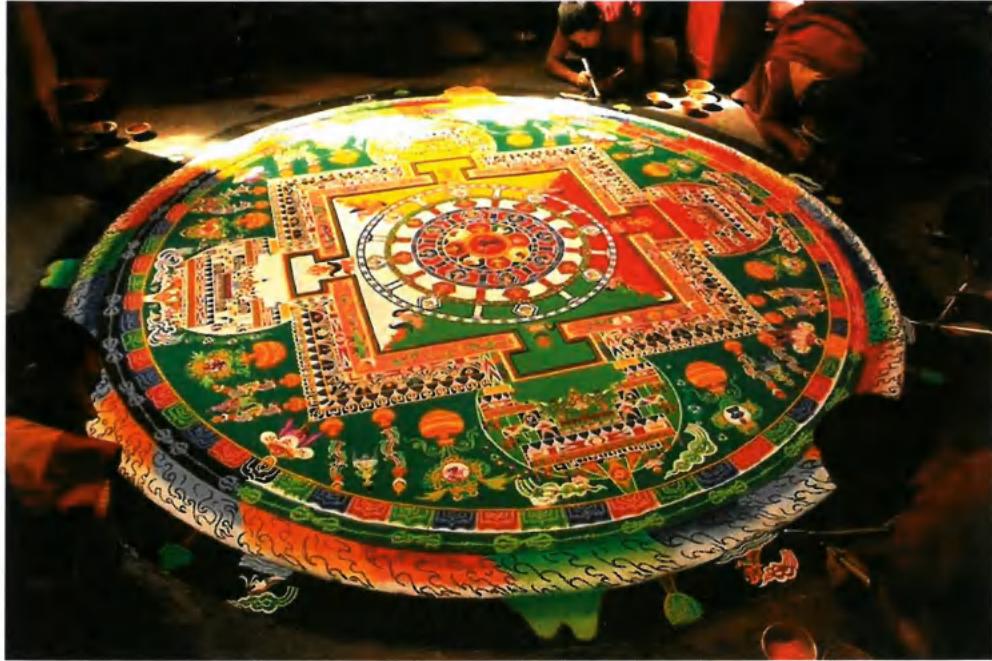
Lamas are making a Mandala sand painting
The Diamond Master Sun Chulin said that when she “enters the functional state, it is a feeling and state of being so focused that one is entranced and selfless. When not in the functional state, she is no different from ordinary people.” “I slowly expand the image from a spot of light. For example, if I want to see this pattern, first I will see a spot of light, and then as the spot of light slowly scatters and enlarges, the image emerges from within. At the beginning, it is just a window, but looking into that window, that world comes out.” “I feel that time and space have no distance. As long as I enter the functional state, everything is easy to do. To enter the functional state, one’s health must be very good, there should be no noise, and no one smoking. If I see that this person is uncomfortable, I can’t do it. I must forget the occasion I am in, throw away all distracting thoughts, and think of nothing, so that I can enter a quiet state. I basically enter the functional state with my eyes open (this is quite unique about Sun; most others find it easier to enter the functional state with their eyes closed). Everyone is watching me; what if I can’t do it? If I keep thinking about this, I can’t relax. Mood is very important.” ①
Many Diamond Masters, like Sun Chulin, place great importance on the practice of Qigong. When we conduct potential development on children, if the children are willing to persist in practicing simple Qigong, that is best. Children can not only elevate their function to a very high level but also play a significant role in cultivating their virtue and kindness. From a psychological perspective, potential development only needs to replenish energy to keep children confident and happy, but this cannot be mentioned in the same breath as the effect of replenishing energy through practicing Qigong. When Qigong reaches a high state of stillness, external interference ceases to elicit a response; breathing becomes continuous, deep, and long, as if existing yet not existing; mental intent is free, as if present yet not; sensation deepens, and the entire organism feels like an empty frame, light and floating, with a clear and happy mind. After practice, it feels like having taken a bath; the mood is comfortable, and the spirit is full. Comparing the sensation of entering the special functional state with the Qigong state of stillness: in the Qigong state, the mind is clear and happy, whereas in the special functional state, the brain feels groggy, with an indescribable feeling of discomfort, which only disappears after the screen flashes. After entering stillness through Qigong, one feels as if they have taken a bath, the mood is comfortable, and the spirit is full. However, after the end of the special functional state, the body feels tired, and sometimes one feels a headache. Thus, it can be seen that Qigong exercise is beneficial to physical health, while the exercise of special functions consumes the body’s energy; the effects they display go beyond our current scope of understanding. ②
Li Szu-tsun, former president of National Taiwan University, conducted brainwave research on Diamond Masters: “I measured the brainwave changes of people practicing three methods: ‘Emptying’, ‘Relaxing’, and ‘Microcosmic/Macrocosmic Orbit’. I found that when ‘Emptying’, brain α-waves are suppressed and disappear, but when practicing ‘Relaxing’ and ‘Microcosmic/Macrocosmic Orbit’, brain α-waves increase significantly. This is used to define the difference between a ‘Resonance State’ and an ‘Absorption State’ during practice. Experiments further confirm that whether it is Zen or Tao, the final realm is the ‘Absorption State’. In terms of brainwave states, the ‘Resonance State’ is the preliminary skill, while the ‘Absorption State’ is the high-level realm. We know that during Absorption (also known as entering stillness or emptying), brain α-waves present a calm state, indicating that the brain has effectively excluded external interference. At this time, consciousness can directly control the autonomic nervous system, adjusting the body and mind to a specific state. Therefore, on a small scale, one can repair organ ailments, and on a large scale, do things that are ordinarily impossible.” ③
The simplest purpose of practicing Qigong is to strengthen the body and improve health, but Qigong is truly not something to be practiced casually. If your character is not cultivated, and you still have so much unhappiness every day, with so much negative information within your body, practicing Qigong in this state—revving up your internal environment to high speed—means that negative information will follow right in; this is far too dangerous. Therefore, the most important thing is to cultivate your mind before practicing. If a person can cultivate their mind well, possessing a firm ordinary mind, an impartial mind, a joyful heart, and a loving heart, then no external interference can harm them. Negative information such as anxiety, anger, inner conflict, self-struggle, and self-contradiction will find it difficult to enter their being. The various organs and cells within their body live in a pure land, so the systems and order are well-organized; every organ and cell performs its own function and does its duty with joy and delight. At this point, even if this person does not practice, their energy is unfathomable. A person with high energy, even without speaking or moving, just sitting beside you, allows one to feel a field of joy, tranquility, comfort, and brightness. Regardless of the circumstances, our goal is only one—to let you slowly return to within yourself, and first resolve the problems inside yourself; this process is introspection.
The essence of potential development is all the same: it is adjusting the body to a certain state, namely a state of focus, imagination, and introspection. Everyone has already personally unlocked the blindfolded color-differentiation ability for children, so you should be able to sense that this is really nothing complicated. Everyone should also be able to believe that since blindfolded reading has already been realized, what other difficult problems could there be? From a technical perspective, these are all just a layer of window paper; once pierced, it is very simple. However, everyone gets stuck right on this paper. Now, telling everyone that the initial state required for all potential development is the same: focus, imagination, and introspection, and among these, focus is the top priority.
5.3 Advanced Development Techniques?
In recent years, whenever “blindfolded reading” is mentioned, many people ask what kind of music or headphones are used. When told that these are completely unnecessary, these people are full of disbelief and are very puzzled: without equipment, how is it possible? They completely do not believe that the potential inherent in humans can be activated and controlled by oneself. The origin of music, headphones, or other so-called instruments and equipment for activating the pineal gland has already been discussed earlier.
Nowadays, there are more and more mobile apps for various trainings such as meditation, attention, speed reading, visual eye muscles, and memory, and their application effects are getting better and better. The application of brainwave instruments is also becoming more widespread. Brainwave instruments can not only measure various brainwave states of children during measurement and analyze their brain usage such as attention, memory, and rest ability, but the design of games controlled by brainwave instruments is also very attractive. Through these games, children’s relevant qualities can be improved. The emergence of these technologies has greatly promoted the attractiveness, fun, and training effects of potential development courses. However, the appearance of these products can only serve as auxiliary technologies for potential development; relying solely on these things is impossible to develop deeper human potential. Therefore, do not be superstitious about these things; see the essence of things clearly and be clear about the purpose of potential development.
People often ask me: What is the most advanced potential development technology? Potential development technology is just a tool, just like a screwdriver is a tool. If I ask you what the most advanced screwdriver is? There are ones with interchangeable bits of different specifications, electric ones, long ones, short ones, and even ones that can bend. You can see a box of different screwdrivers at a mechanic’s shop; which one is more advanced or better? The choice of a screwdriver must depend on the situation; one can only say it is suitable, not necessarily advanced.
Relying on music to unlock brain potential is like entrusting health to health supplements and medicine, rather than putting effort into self-cultivation and spiritual practice, and working to improve one’s own immunity and resistance. Nowadays, indeed too many people believe more in machines than in humans, thinking that high technology represents a more advanced standard of technology. Actually, this is not the case. Technology and tools are not the goal; they exist to serve humans. Humans should not become decadent because of the existence of technology and tools. For example, if a person’s leg is injured and they cannot walk, a cane can assist walking. Later, wheelchairs were invented, and now there are electric wheelchairs. Let me ask, which user is better off? Decades ago, walking on country paths, if one was thirsty, one could drink water from the roadside stream. Now, does anyone dare to drink water from the stream? Is this progress? Therefore, technological progress may bring about human regression.
On March 10, 2019, an Ethiopian Airlines Boeing 737 MAX 8 passenger plane crashed six minutes after takeoff, killing all 157 people on board. The Boeing 737 MAX 8 possessed the most advanced automated control functions and was once a passenger plane that airlines competed to buy. Possessing powerful automatic flight functions is a boon for pilots, freeing them from manual labor and making them managers of cockpit resources. However, faced with powerful autopilot programs, even trained pilots cannot fully figure out the autopilot’s behavior patterns and temperament. This leads to extreme situations where pilots do not know what the plane is going to do or how to stop it. The cause of this accident was a sensor fault that transmitted error messages to the aircraft’s central control system. The central control system stubbornly processed them autonomously and refused to execute manual control instructions, leading to loss of control. Did the plane become advanced, or did the pilot fall behind?
The person who first invented “midbrain development audio” as a marketing tactic created some music and headphones to make people believe more in the power of technology. Now, many people still believe that spending over 10,000 to buy a headset and insisting that the child listen to it will not only develop the child’s potential but also make them smarter and excel in their studies. Without the connection between people, this method is more conducive to marketing and also reflects people’s trust in objects and distrust in humans. People believe more in the tangible headphones, thinking the headphones are worth the money, and no longer fully recognize humans, entrusting the child’s fate to the machine. In fact, as long as there is belief, and the child persists in focused learning of music, painting, reading classics, etc., why can’t this make the child excellent? Buying headphones now reminds one of 20 years ago, when computers first became popular, and many families bought them as an excuse to help their children learn. May I ask, how much time now is the child actually using the home computer for learning? The same goes for mobile phones; how many people are already inseparable from their phones and have become slaves to them?
Brain science is amazing and also abstract. Current neuromodulation technology experiments can use different sound waves or electrical stimulation to activate certain human functions (see video: Brain Manipulation, It Tempts Humanity), and can also greatly improve students’ abilities in certain areas. However, how to make these technologies and tools truly beneficial to a person’s development is worth thinking about and exploring. Some people say that we are now in a stage of “transition from computers to human brains, and human brains need to be used as computers,” which indicates that technology is developing in a more intelligent direction. In May 2018, the Second World Intelligence Congress was held in Tianjin. At the meeting, Liu Qingfeng, Chairman of iFLYTEK Co., Ltd., demonstrated the latest achievements in intelligent voice and artificial intelligence such as speech synthesis, speech recognition, and simultaneous interpretation, committed to enabling machines to listen, speak, understand, and think, and to building a beautiful world with artificial intelligence. After watching Liu Qingfeng’s speech, one cannot help but lament the infinite convenience artificial intelligence brings to people, and it feels even more mind-blowing and unimaginable (see video: Liu Qingfeng’s Speech at the World Intelligence Congress). In fact, the development of artificial intelligence is just a glimpse of the leopard through a tube; we see only one spot. Our lives are already surrounded by artificial intelligence unknowingly, and some people’s jobs have long begun to be replaced by artificial intelligence. At least 80% of the articles we read on mobile apps are written, typeset, and pushed to us with the participation of artificial intelligence, so the news you see always has a lot that fits your taste and needs very well.
Brain Manipulation, It Tempts Humanity
Liu Qingfeng’s Speech at the World Intelligence Congress
In 2019, a report attracting similar attention to the Second Session of the 13th National Committee of the Chinese People’s Political Consultative Conference (CPPCC) was the following piece of news:
Xinhua News Agency, Beijing, March 3 (Reporter He Qiang, Feng Songling, Zhou Xiaoli) The world’s first AI-generated female anchor officially went on duty today. Xinhua News Agency and Sogou Company recently released a newly upgraded standing AI synthetic anchor in Beijing and launched the world’s first AI synthetic female anchor. This is the latest breakthrough achievement in the deep integration of artificial intelligence and news gathering and editing following the joint release of the world’s first synthetic news anchor by both parties last year. The release of the upgraded version and new product of the AI synthetic anchor once again triggered the attention of the global media circle. The website of Russia’s “Russia Today” TV station and the UK’s DailyMail and other overseas media carried out extensive reports. ①
Watching the video broadcast of this AI synthetic female anchor, except for the slightly unnatural matching of mouth shape and sound, it is impossible to distinguish whether this is a real person or not. AI synthetic image technology belongs to a type of virtual reality technology. Among virtual reality technologies, there is another piece of equipment that everyone should have used or heard of, which is VR (Virtual Reality) glasses. VR glasses are a type of virtual reality head-mounted display device, called a VR head-mounted display, and there are also VR eye masks, VR helmets, etc. VR glasses use head-mounted display devices to close off the human’s external vision and hearing, guiding the user to produce a feeling of being in a virtual environment. Through computer technology, it can apply virtual information to the real world, and real environments and virtual objects are superimposed in real-time into the same screen or space to exist simultaneously. Therefore, watching movies and playing games through VR glasses has extremely realistic and vivid visual effects, just like being there in person. The development direction of VR technology is to possess all perception and natural skills that humans have. In addition to visual perception generated by computer graphics technology, there are also auditory, tactile, force, motion, and other perceptions, and even include olfactory and gustatory perceptions, also called multi-perception. Natural skills refer to human head movements, eyes, hand gestures, or other human behavioral actions, which are processed by the computer to adapt to the participant’s actions, making real-time responses to the user’s input, and feeding back to the user’s five senses respectively.
The information technology we understand now is like this; it is a sharp amplification of the abilities of human organs such as hands, feet, eyes, and ears themselves, and a change in human mental models, ways of thinking, and lifestyles. This technology is serving humans. However, in 2016, the US military developed and tested a “transcranial direct current stimulator” helmet, changing the perception that information technology is only an amplification of the functions of various human body organs. The book Sapiens: A Brief History of Humankind (Note: Text says A Brief History of the Future, likely referring to Homo Deus) describes this case in detail:
The US military hopes that this helmet can enhance soldiers’ focus, performance, and cognitive abilities during training or actual combat. Sally Adee, a reporter for New Scientist, was granted permission to visit a sniper training site to personally test the effects. Before wearing the helmet, she performed poorly in the battlefield simulation room, appearing clumsy; however, after putting on the helmet, she was suddenly like a specially trained anti-terrorism soldier—calm, skilled, and effortlessly took down all 20 virtual terrorists. Adee described her experience: “The almost spiritual experience wasn’t about feeling smarter or learning faster; it was the first time in my life I felt my brain suddenly go quiet… without any self-doubt, as if seeing a new world. The sudden silence in my mind was incredible… In the weeks following that test, the one thing I wanted to do most was go back and hook up the electrodes again. Many voices popped up in my head: who am I really? Where are these voices coming from?”
So far, enhancing abilities through this method can only be maintained for a short period. Sally Adee’s experience lasted 20 minutes, which might be an extreme exception (or perhaps even just a placebo effect). Regarding transcranial direct current stimulators, most published studies involve very few human subjects and have specific situational limitations, and the long-term effects and dangers remain completely unknown. However, if this technology matures in the future, or if we find other methods to manipulate the brain’s firing patterns, what impact will this have on human society and humanity?
If humans can one day truly control their own brain circuits, besides hoping to take down terrorists more effectively, they might also wish to achieve some more mundane, liberal goals. In other words, being able to learn and work more effectively, allowing oneself to fully immerse in games and hobbies, or being able to focus on interesting things at any moment (whether it is mathematics or football). However, if such manipulation becomes commonplace, the will that was originally supposed to be freely manipulated by the individual will become just another purchasable commodity. You want to play the piano well, but want to watch TV as soon as you start practicing? No problem: put on the helmet, install the appropriate software, and you will be able to focus entirely on practicing the piano. ①
Let us not imagine for now whether computers will develop consciousness and control humans in the future; let us connect the previous events and imagine artificial intelligence continuing to develop for several more years. Those wearable devices will no longer be so bulky, but will be comfortable to wear, to the point where you hardly feel them on your body. Your VR glasses can show you everything you wish to see; whichever celebrity you like, simply summon the software, and the person will appear before you, identical to a real person, conversing face-to-face. Their gaze, expressions, and skin—your mind will tell you this is real. Not only that, but you can also shake hands, hug, or even kiss this person; you cannot resist, because in your senses, this is truly happening. Your wearable device can send corresponding electrical signals to you, and your nerve impulses will be normally transmitted to the brain’s center. You go to eat the most delicious top-tier gourmet food with this celebrity; you can not only chew and swallow the food bite by bite into your stomach, but also taste the food and feel the sensation of gradually getting full, because this is all nothing more than micro-electrical information generated by nerves, which wearable devices can easily achieve.
It is hard to imagine, if such a day really comes, whether people who cannot even put down their phones now would be willing to take off that set of wearable devices? What is even more worth thinking about is, how do we determine that we are not currently wearing such a set of devices?
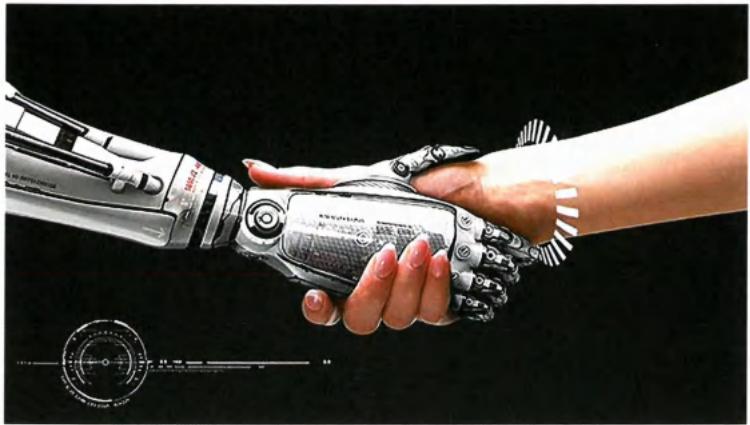
How to know what is real?
As Liu Cixin published a short science fiction story “Feeding God” in 2005, the white-bearded grandfather in the story is the creator of the Earth, the so-called God. These grandfathers grew up in a fully intelligent environment from childhood, losing all skills; they cannot repair spaceships, nor can they solve quadratic equations… because intelligent machines can not only satisfy their material needs but also their spiritual needs, handling everything for them, so life lost its ambition and creativity. When the machines became old and they could not repair them, they chose to come to Earth to retire, hoping humans would take them in and support them. In the end, these grandfathers found the heart of glory, courage, and enterprise pioneered by their ancestors on Earth, and began wandering the universe again. The 2019 New Year movie Crazy Alien tells the story of a high-civilization alien from outer space who comes to Earth; after removing the “tightening spell” that allows the alien to become a superman like “Sun Wukong,” this “alien” who relied only on the high-tech headband immediately turned into an ordinary monkey, and was even soaked in medicinal wine, no longer having any magic. Both of these science fiction works trigger thinking about the future of artificial intelligence development; what will be the fate of humans when they overly rely on technological products?
Li Kaifu, an IT elite who served as Global Vice President of Google and Microsoft, said: “In the AI era, people who only engage in simple work in a narrow field can never compare with artificial intelligence in terms of efficiency and cost. If you do not want to become a ‘useless’ person, the only way is to start now, find your own uniqueness, embrace human unique values, and become a more comprehensive person in terms of emotion, personality, and literacy. In the AI era, we can leverage the power of machines and the Internet to better perceive the entire world and universe, and experience the many possibilities of human life—only then is our short life in the vast universe like a meteor’s journey not in vain. Indeed, man is but a reed, but he is a thinking reed. AI is here, but a thoughtful life will not lose its luster because of it, because all our dignity lies in thought.” ①
Liu Cixin has a famous quote: “Give civilization to the years, not years to civilization.” The builders of civilization are humans, and human destiny cannot be controlled by machines and equipment. Science and technology are tools for humanity to conquer nature, transform nature, and create civilization, and humans themselves are part of nature. Engels said, “Let us not flatter ourselves overmuch on account of our human victories over nature. For each such victory nature takes its revenge on us.” In the process of the advancement of human civilization, if we do not master the development of technology well, it will not only provoke nature’s revenge on us, but we must also be careful of the backlash of technology against humans.
Do not focus on the appearances of technology, magic, and functions; excessive focus will lead to falling into the vortex of desire, the capacity of the mind will become narrower, energy will become lower, and training institutions will find it increasingly difficult to move forward. The best technology is human cultivation; instructors and parents must guide students to walk on the path of being a human and cultivation. When walking on this path, what they gain will absolutely not be simple potential games like blindfolded reading, but arbitrary possibilities. After persisting in correct and appropriate cultivation, things like remote viewing, clairvoyance, photographic memory, wave speed reading, premonition, healing, and disaster elimination are no longer surprising. It can be said that any current technical things or supernatural powers are just a matter of a layer of window paper; as long as there is an opportunity, one can come and try. We research potential development, and we need to figure out what is the essence of life? Where do humans come from? Why are there various potential functions?
5.4 Everyone Possesses 3.6 Billion Years of Wisdom
What is life? We generally consider things that are born, die, grow, and reproduce to be living organisms; this includes plants, animals, and microorganisms. It is precisely because the Earth has such a rich diversity of biological populations that it is so vibrant and beautiful.
There was originally no life on Earth; the Earth was born 4.6 billion years ago. If we compare this moment to 0:00 in a day and 2019 to 24:00, the signs of the most primitive life appeared in the early ocean around 5:00 in the morning; various lower organisms appeared between 20:00 and 22:00; around 23:00, gymnosperms and reptiles began to flourish; around 23:30, birds, mammals, and angiosperms began to appear; the emergence of primitive humans and modern Homo sapiens occurred in the last minute of this 24-hour period; the various civilizations of Homo sapiens all took place in the last less than one second of this 24-hour period.
In the evolutionary process from the most primitive life forms to the era of the greatest proliferation of life, what essential changes have occurred in life forms? Life is born, dies, grows, and reproduces; its essential characteristic is that every species contains all the information regarding its gestation, growth, apoptosis, and other processes within its genetic material, DNA or RNA. The interdependence between the environment and genetic information enacts important physiological processes such as life reproduction, cell division, and protein synthesis. Therefore, organisms possess the dual attributes of materiality (mode of existence) and informativity (fundamental attribute). The process of biological evolution is essentially the process of rewriting biological DNA or RNA information—genes.
Now, the simplest life forms are not single-celled animals, plants, bacteria, or fungi, but non-cellular microorganisms like viruses that lack even a cellular structure. Viruses have simple structures and are tiny individuals; they are a non-cellular form of life without their own metabolic mechanisms, but they contain genetic information and can utilize the nutrients of host cells to autonomously replicate their own genes, proteins, and other life-sustaining substances. Although we do not know if such non-cellular life forms are the most primitive life forms on Earth, we can confirm that even the smallest life possesses the ability to reproduce its own life information, and the most primitive life was no exception.
3.6 billion years ago, the most primitive life forms were born in harsh environments and survived by relying on extremely limited absorbable energy from the outside world, beginning to record the most primitive life information. This information coding constantly changed and was rewritten, making their vitality increasingly tenacious so they could better adapt to life on Earth. On the other hand, the Earth’s environment began to calm down, allowing primitive life to reproduce and evolve rapidly, forming various single-celled organisms. Some of their metabolic products could be utilized by one another; some cells were interdependent, and different life forms with common interests began to share genetic information through infection, starting to form multicellular organisms with division of labor. With the rapid growth in the number of organisms, the products of biological metabolism even began to affect the overall environment of the Earth; for example, as oxygen gradually increased, organisms that required oxygen began to emerge and evolve rapidly, leading to the differentiation of animals and plants. Some life forms acquired more usable genetic information, thereby allowing themselves and their offspring to split into cells with various different functions, forming a larger life form with common interests. Different organisms continuously wrote their respective genes, forming the rich biodiversity on Earth. Some communal life forms became larger and stronger, while others became smarter and more agile; in short, for survival and reproduction, they all continuously wrote or rewrote their own genetic information. The writing of genes relies on the tacit understanding formed through billions of years between various cells. Some species with imperfectly written genetic information were eliminated by natural selection. Or perhaps due to other circumstances, some organisms and their genes were accidentally destroyed and disappeared. Regardless, all organisms on Earth share a common ancestor; the closer the kinship between two types of organisms, the closer the era of their common ancestor is to the present. The food we eat can essentially be considered our distant relatives (see the Tree of Life image). Whether in terms of time or space, the infinite distances and countless lives are all related to us humans.
How life information is stored and condensed in DNA seems unclear to anyone. However, in the process of biological evolution, we can see that these genes determine the traits and functions possessed by different life forms, and also form their respective relatively stable species, hence the situation where “dragons beget dragons, phoenixes beget phoenixes, and a mouse’s children can dig holes.” It is precisely because genes determine that different lives have their own “innate” abilities: some can fly in the sky, some can swim in the water, some can make their bodies glow, some can change the color of their skin, some can predict weather and disasters, some can spray poison or release high-voltage electricity, some have bodies with bones as hard as rock, and some are as weak as water. These life forms seem like superpowers to us humans, making humans marvel and envy them; the slime mold mentioned earlier is one of the wonders of microorganisms. In fact, all life on Earth is nothing more than carbohydrates; they are all communities of destiny formed by a large number of small life forms like cells, formed according to their own life genetic information through protein synthesis and cell division. Some people are born vegetarians, some like to eat meat, some grow up eating wheat, and some rely on rice as their staple food. No matter what humans eat, they all grow up the same way. Those who have never eaten meat or gnawed on bones will still grow hard teeth and bones. In any case, life information determines that the food humans ingest is converted into a prescribed form. If the information coding of certain genes of a life form is altered, it might be possible to change certain traits of its body and achieve some special functions. For example, in 2013, South China Agricultural University in China successfully developed 10 fluorescent pigs (short for green fluorescent protein transgenic cloned pigs); these pigs display a fluorescent green color in the dark. Transgenic corn and soybeans can not only increase yield but also resist pests and diseases. Perhaps it is also possible to be like the mutants in the sci-fi comics and movie “X-Men,” where genetic mutations give them various strange abilities. Of course, these trans
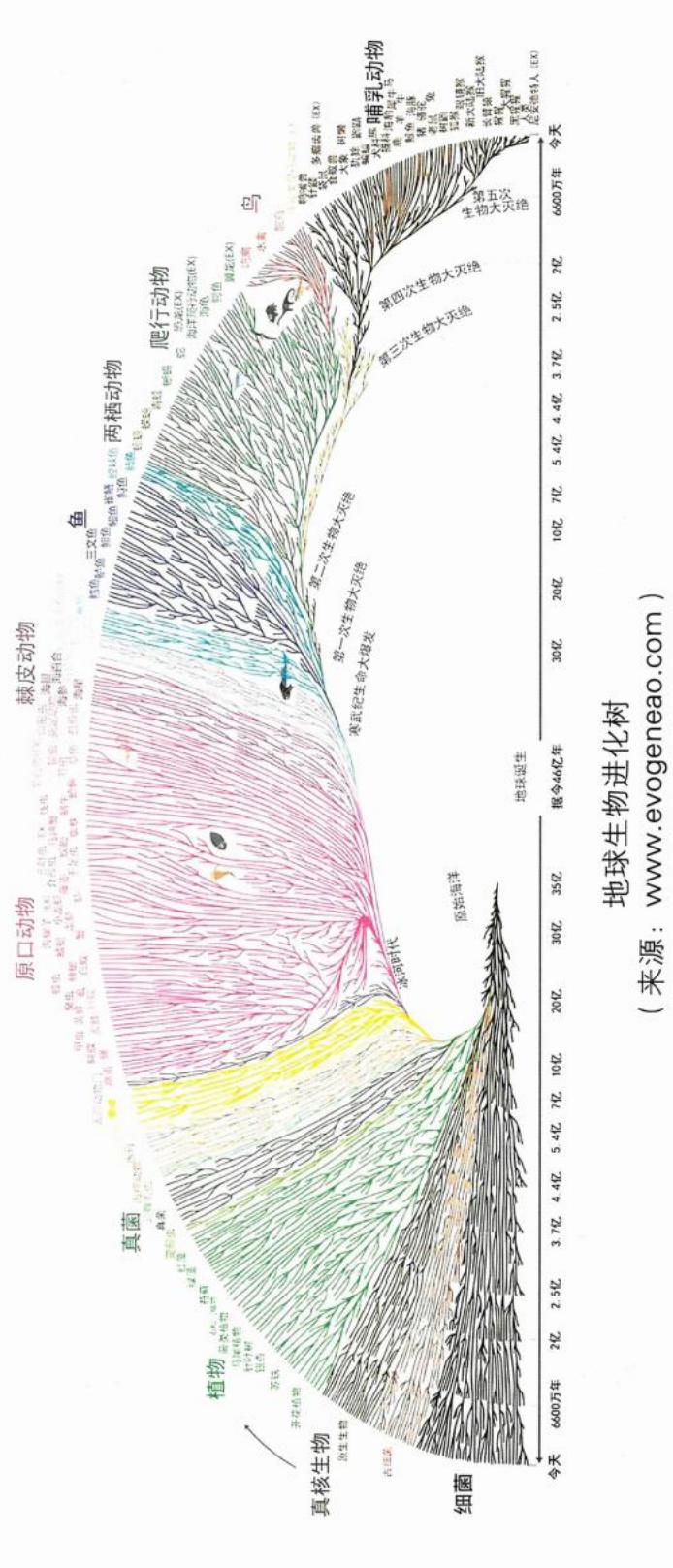
genic technologies are the result of human manipulation or genetic mutation, and have not withstood the test of natural selection over tens of thousands of years.
All of this verifies one fact: the essence of life is information.
From the birth of the most primitive life to the present, represented by humans who possess the highest form of life, a total of 3.6 billion years of evolutionary process has been experienced. The human body therefore contains 3.6 billion years of information, and everyone possesses 3.6 billion years of “wisdom.” The reading and writing of this information are autonomously completed by the components of the human body—cells and microorganisms—and do not go through human awareness or control. In human genetic information, how many special functions were once possessed but were no longer needed in the evolutionary process and were shut off, we still do not know. Various organisms on Earth have different exclusive skills, such as bees dancing, spiders weaving webs, birds migrating, bats using ultrasonic positioning, dolphins using sonar perception, some snakes using thermal imaging, some insects being able to see light in wavelength ranges unreachable by the human eye, and cocklebur being able to easily latch onto small animals passing by to take them to distant places… Compared with these distant relatives, humans seem to exhibit weaker self-survival capabilities from birth. Although we cannot find any unique unique skills on the surface of humans, it cannot be denied that the human body harbors “wisdom” and energy accumulated over 3.6 billion years. This wisdom and energy require a certain opportunity and method to be activated; potential development might be such a tool.
The human body is composed of ten trillions of life forms including microbes and cells, adapting to changes in the external environment, seeking survival and reproduction, and producing a pursuit of a higher spiritual world unique to humans. Animals evolved vertebrae, thus having brains, and were able to better perceive the external world and coordinate body movements. 2 million years ago, the brains of primitive humans were already very different from the brains of other primates, beginning to possess complex thinking, judgment, and imagination. Approximately 70,000 to 30,000 years ago, humans began to use a completely new type of language for communication. The new cerebral cortex developed rapidly; under natural selection from generation to generation, Homo sapiens with larger brain capacities were preserved. Humans began to have beliefs and dreams, possessing wisdom unattainable by animals. However, in terms of DNA life information, gorillas differ from humans by only 1%; this 1% difference determines the gap between gorillas and humans in appearance, wisdom, and other aspects.
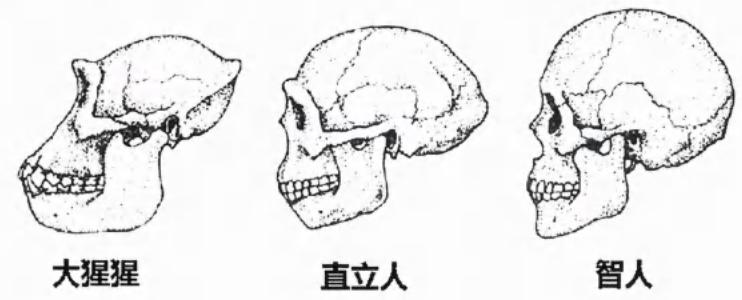
Compared to gorillas and Homo erectus, Homo sapiens have a larger brain capacity
The neocortex endowed humans with language and consciousness, thereby possessing more complex thinking, generating the ability to manufacture tools, and through the created tools, possessing and surpassing the unique skills possessed by countless biological instincts. How human consciousness mobilizes thinking to make people become “higher, faster, stronger,” thereby discovering the laws governing the operation of everything in the universe and conquering and transforming this world, is science. At the same time, humans also began to want the tools they created to possess and even surpass human thinking and capabilities; this is artificial intelligence. Let us draw an analogy with the micro-robots invented by Hiro in the movie Big Hero 6. Are these micro-robots not just like the individual cells and microbes within our bodies? All cells pile up together to form a whole human. By the same logic, every person is also such a “micro-robot.” When a community with a shared future for mankind can be formed, it is imaginable that at that time, humanity and the Earth might achieve ascension①.
The micro-robots invented by Hiro in the movie Big Hero 6
The internal operation of the body and the systemic balance of the trillions of little life forms that constitute the body are controlled by the primitive brain, that is, the subconscious. Consciousness and the subconscious appear to have no connection on the surface, but in reality, they are a unified whole. When the excitability of the conscious brain areas drops to the minimum and it cannot distinguish the authenticity of images in the brain, the brain adopts a mode of taking them as true. At this time, the subconscious is mobilized, which can stimulate potential and also rewrite life information. When certain emotions erupt in a person, and consciousness cannot yet perceive them, over time, life information will be rewritten, breaking the original balance within the body, thereby triggering corresponding diseases. A person’s life information determines that they can have consciousness and awareness. “Human nature is good at birth,” meaning human nature is complete and perfect; this is determined by life information. However, in the process of growth, people will rewrite their respective original information along with differences in desires, emotions, worldviews, and other personalities, leading to a reduction in human original abilities.
The “Five Poisons” spoken of in Buddhism—namely greed, anger, ignorance, arrogance, and doubt—are not poisons, but refer to the roots of various human sufferings and vexations, and are also the five fundamental habits that have a bad influence on human life information. Buddhism believes that because of the existence of these habits, the original mind and original awareness of practitioners will be obscured, making it impossible to enlighten to the mind and see the nature. “Enlightening to the mind and seeing the nature” is actually the process of reaching the state of a spotless mind and finding the “I” whose nature is complete. If consciousness can distinguish the relationship between one’s own body, thinking, emotions, and the inner self, then “I” am a pure person, a person whose mind will not be polluted. That is also what the Avatamsaka Sutra says: “Wonderful! Wonderful! All sentient beings possess the wisdom and virtuous characteristics of the Tathagata. It is only because of delusional thoughts and attachments that they do not attain it.”
To find the complete “I,” one must erase the various negative information wrapping the “I” and restore the initial life information. This not only allows the meridians to flow smoothly, the body to be healthy, and negative emotions to disappear, but various human potentials will also reappear. We often speak of human destiny; “Life” (Ming) is the material basis of life, and “Luck” (Yun) is life information. Developing potential requires both cultivating life information well and exercising the body well. In 2009, when Nan Huai-Chin delivered a speech titled “On Supernatural Powers and Special Functions” at the Nanhu University Hall, he said: “In the past, Buddhists laughed at Taoists, saying, ‘Cultivating only life and not nature is the number one illness in cultivation.’ Cultivating qi on the body, practicing breathing, opening qi channels, having special functions, being able to lift things with the hand, pointing a finger and breaking a bottle, breaking a house—these are all cultivating only life and the body, not cultivating nature, and not enlightening to the mind and seeing the nature. And Taoists laugh at Buddhists, conversely saying, ‘Cultivating only the ancestral nature and not cultivating the elixir, the dark spirit cannot enter sainthood for eons.’ You meditate, recite the Buddha’s name, cultivate the Six Wonderful Dharma Doors—these are only cultivating the ancestral nature, seeking to enlighten to the mind and see the nature, not cultivating the elixir, not exercising this body, failing to refine essence into qi, refine qi into spirit, and refine spirit to return to emptiness, and you will never succeed. Both sides criticize each other. In reality, one must cultivate both nature and life; duplicating another body from the physical body, and also enlightening to the mind and seeing the nature, is called an Immortal Buddha, and is called supernatural power.”
Cultivating nature, that is, clearing habits and correcting life information, is the foundation of cultivation. Some people practice cultivation by abstaining from this and that; these are all rules and regulations artificially set for cultivating nature. In fact, as long as a person can treat all things equally and is willing to accept the original face of all things, why is there a need for precepts? Therefore, what a person does, says, or eats is not important; what is important is the mindset with which they do, say, or eat. As long as one can achieve a mindset free of greed, anger, ignorance, arrogance, and doubt, one has cleared habits and corrected life information. Even if you eat meat or kill mosquitoes, bad information will not be left in your body. The Platform Sutra of the Sixth Patriarch has long since clearly stated the inherent information characteristics of humans: “How amazing is our self-nature, it is originally pure; how amazing is our self-nature, it is originally neither produced nor destroyed; how amazing is our self-nature, it is originally self-sufficient; how amazing is our self-nature, it is originally immovable; how amazing is our self-nature, it can give rise to all dharmas.”
On October 16, 2018, Reference News published an article titled “‘Superman’ Race Will Occupy Dominant Position,” a pre-mortem prophecy by the famous British physicist Stephen Hawking. The article introduced Hawking’s prediction: “I am sure that within this century, people will find ways to modify intelligence and talent, such as aggressiveness.” “Laws prohibiting human genetic engineering may be enacted. But, some people will surely be unable to resist the temptation to improve human characteristics, such as memory, disease resistance, and lifespan.” Hawking’s prophecy and worry are not without reason. If humans do not follow the natural laws that have settled over hundreds of millions of years, it will inevitably trigger nature’s revenge against humanity.
Due to the high-speed development of science and technology, the philosophical foundation of traditional Chinese culture, the thought of “Unity of Heaven and Man,” is almost being abandoned. The Unity of Heaven and Man means aligning with innate nature, returning to the Great Dao, and returning to the root and restoring life. The Unity of Heaven and Man is not just a thought, but a state. In April 2016, the Ministry of Science and Technology and the Publicity Department of the CPC Central Committee incorporated this thought into the National Benchmark for Scientific Literacy of Chinese Citizens, indicating the state’s emphasis on this issue. Entering potential development is essentially, in the state of “Unity of Heaven and Man,” releasing the capabilities that the subconscious can control, one of the important methods of which is to read and control the life information of the human body.
Chuan Wen, the author of the book Brain Imaging: Decoding the Information Codes that Control Life①, served as a teacher and principal in middle school for many years. He has an accurate grasp of student psychology and is good at grasping the psychological secrets hidden in children. He is best at adjusting the ratio of negative information to positive information that affects a child’s abilities in a certain aspect, and through guiding the erasure of negative information and increasing positive information to change the ratio, he quickly enables students to achieve incredible improvements in certain learning abilities. Chuan Wen calls this method of regulating human information brain imaging technology, and this research of his won the first prize of the National Education Science “Twelfth Five-Year” Plan project. According to Chuan Wen, he can also use brain imaging methods to make short adolescents who have not yet gone through puberty grow to a normal height; he can even regulate information for expectant mothers preparing for pregnancy, making the gender of the born baby consistent with expectations, with an accuracy rate that is astonishingly high.
Chuan Wen’s brain imaging theory clearly explains the effect of information within the human body on the human body, and also confirms that through the combined action of consciousness and the subconscious, information within the human body can be changed, thereby achieving the effect of releasing potential. Therefore, the purpose of potential development is to master the method of rewriting human body information, discover the laws of human body and universe operation, and improve the level of human consciousness.
Chapter 6: The Purpose and Significance of ESP Games
If the purpose of potential development is not clearly understood, it is easy to feel lost during teaching. People all believe that potential development can improve students’ learning efficiency, memory, calculation power, self-confidence, concentration, imagination, creativity, and can even improve self-discipline, improve interpersonal relationships, improve art appreciation ability, etc., but in essence, it is the improvement of self-confidence, concentration, and imagination, and the core is the awakening of human life. Without awakening, one cannot form stable introspection ability, will be entangled by the body, emotions, and consciousness, and cannot cognize the world essentially. Self-confidence is the accumulation of success and happiness; concentration is the foundation of energy focus; imagination is the key element of various potential developments; appropriate mental imagery training will form valuable learning experience.
6.1 The Awakening of Life
Many religious practices contain methods that we now refer to as potential development, but clearly, none of them aim to obtain “supernatural powers.” Whether it is Buddhism, Taoism, or anything else, the purpose of practice, simply put in modern language, is to allow people to live more freely and elevate the level of their lives. Whether becoming a Buddha or an Immortal, one must first complete the purification of the self and the perfection of one’s personality. During these processes, some latent functions of the human body are occasionally produced as a byproduct. There has never been a manual for human life information; it relies only on people to experience and discover it.
Potential development is undoubtedly just a scenic spot on the path of practice, an inconspicuous tree. People walking on the path of practice seem to regard this as ordinary and common scenery, and do not think much of it. But now, this tree has been seen by people walking on other paths, and even surrounded—“Wow, it’s too magical!” Thus, fantasies begin: if one learns this, one can get good grades without studying; if one learns this, the child’s life will be smooth sailing; if one learns this, one can predict everything; if one learns this, the child will never have to suffer again; if one learns this, I as a parent have finally made it through the hard times, look! My child is about to become a star! … So now we should shake these people full of fantasies, especially the parents who are fantasizing, hey! It’s time to wake up! You can take the seed of this tree, but please do not hug this tree and think that the road ahead no longer needs to be walked, and do not think that possessing this tree means you and your child will be happy and forever! We are accustomed to seeking outwardly, thinking that once we get something, we will be happy. But what is it that we get?
From the previous chapter, we know that life has material attributes, but the properties of this matter are determined by the information attributes of life. What is information? Is it the arrangement of cellular protein molecules? Or is it waves produced by the vibration of smaller particles? Yellow—perhaps there is no color in the world; to a physicist, it is just a transverse electromagnetic wave with a wavelength in the range of 590 nanometers. The yellow you see is merely the sensation of yellow produced when these vibrations contact the retina of the eye and are interpreted by the visual center. This is because different wavelengths produce different color sensations, and this only occurs when the wavelength is between 400 and 760 nanometers; beyond this range, the retina of the eye cannot receive it. Although humans cannot see infrared and ultraviolet rays, to a physicist, infrared (over 800 nanometers) and ultraviolet (less than 400 nanometers) are basically the same phenomenon as light waves of 400–760 nanometers that the human eye can perceive. The retina converts the light it can receive into information through the retinal nerve network, transmits it to the visual center of the brain via the optic nerve fibers, and the visual center works with other structures of the cerebral cortex to generate consciousness, letting a person know what they have seen. What we see is merely information conducted by the nervous system. Our visual system cannot see ultraviolet light, but bees’ vision can; we cannot hear high-frequency vibrations (ultrasound), but bats can; therefore, “our perception of all external things is merely a limited range of sensory responses generated by infinite possible stimuli” ①. In other words, everything is just neural information, just what humans arrogantly assume to be sensation; everything we see is not necessarily the truth.
The Diamond Sutra says, “All forms are illusory. If one sees all forms as not forms, one sees the Tathagata.” This means that the appearance of everything you can see is false and unreal; as long as you do not become attached to it, wisdom will arise. If you can guard your original mind, and when seeing these appearances, not be confused by them, and realize that the forms seen are not real forms, then you can attain the realm of the Tathagata. Practitioners should not be attached to all the forms they see, but gradually let their minds become quiet, that is, “give rise to the mind without dwelling anywhere.” When the mind can obtain the truth, the mind is awareness and enlightenment. Believing that “seeing is believing” is neither objective nor scientific.
Enthusiasts of brain potential development are no strangers to the animation “The Spinning Dancer.” Many people think this animation is used to judge whether a person is a left-brained thinker or a right-brained thinker, but in fact, this animation only proves that the brain produces different conscious results when processing visual information. Is this dancer spinning clockwise (right) or counter-clockwise (left)? Some see it spinning to the right, others see it spinning to the left; sometimes you see it spinning to the right; sometimes you see it spinning to the left. Because the original information is incomplete, processing it into a right-spinning or left-spinning image is both possible; that is, she is both spinning right and spinning left. When our brain processes the observed information, if the subjective consciousness perceives a right spin, it assumes it sees a right spin; if the subjective consciousness perceives a left spin, it assumes it sees a left spin. Many people see it spinning left one day, but see it spinning right the next. Many children who have undergone potential development can control the result they see. This all illustrates that human perception of the outside world is an image formed by the consciousness processing partial information from the outside world; one simply cannot say whether what you think is true or false. As Schrödinger, one of the founders of quantum mechanics, said: “Every man’s world picture is and always remains a construct of his mind and cannot be proved to have any objective existence.” ①
Among the fifty demons in the Surangama Sutra, there is one called “demon power,” which is the possession by other life forms. Relying on power, demon power, and ghost power all rely on another life. For such people, medical examinations would undoubtedly show 100% schizophrenia, abnormality, and problems with brain nerves ②. Therefore, what should be most careful about in potential development is that when a person cannot distinguish between imagination and reality, a diagnosis of mental illness must be performed. For children, during development, one must constantly emphasize “I am the master of my big
The Spinning Dancer
brain, I have the ability to control my own body, thoughts, and emotions,” otherwise the child will easily mistake imagined scenes for reality.
Dr. Jiang Wan from Shenzhen University discussed such a case in an article titled “Unveiling the Truth of ‘Blindfolded Reading’” published online:
In the research on children’s potential development by the Parapsychology Association, there is a very enlightening case: Once, a child cried and made a scene when he saw that his classmates had largely developed the ability to distinguish colors while blindfolded, yet he did not have the ability to distinguish colors himself. He told his parents who were present that the other students must definitely be peeking, causing the surrounding students and parents to move away one after another to avoid them. Through the comfort of parents and teachers, this student began to train hard. He wanted to surpass the other students and strove to distinguish colors without peeking. But when he suddenly discovered that he could actually distinguish colors while blindfolded, he began to cry and make a scene even more intensely. He angrily asked his parents: How is this possible? My eyes were closed, how could he see? He just saw it, how is this possible?! This child used “he” instead of “I” to express his indignation at this matter, which had caused a huge impact on his heart due to being difficult to understand.
Such stories actually remind us that although children have shallow life experience, they have already formed the concept that they cannot see objects without using their eyes. Therefore, when they are first trained in extrasensory abilities and can indeed distinguish color cards like seeing objects in a dream, their own hearts are also subjected to not small vibrations or shocks, and they are also suspicious of the whole matter. At this time, if parents repeatedly force the child to ask if they are peeking, the young child will doubt themselves; if they didn’t peek, how could they see? Therefore, they will often admit that they are peeking. In this way, the parents who were just a little surprised will feel extremely disappointed. And since the child admitted to peeking themselves, the parents will believe it without doubt.
If at this time the parents scold the young child again, and then let the child undergo blindfold training again to try, while constantly and sternly warning the child not to peek, then I can tell you that the child will absolutely not be able to distinguish colors again; that bit of tender inspiration and potential has been scolded and criticized away by you. But at this time, the parents believe that this training again verifies that the reason the child could distinguish colors while blindfolded before was entirely because of peeking.
Children do not believe that they can see things with their eyes closed, leading to various farces, and similar cases are not uncommon. Let’s do an experience, feel and think:
When your eyes are closed, or covered with your hands, looking forward, what do you see? (Most people will say, I don’t see anything.)
Then you quiet down, take a few deep breaths, and look slowly. Oh, you see it, right? Even if you don’t see an image, you will see some colors, or at the very least you see “black”! So why did you answer that you saw nothing at the beginning?
My daughter and I were traveling by car on a highway in the Loess Plateau of Northern Shaanxi. I saw some cave dwellings hidden within the plateau, and scenes of the birthplace of Mao Zedong Thought, the base area of the Communist Party of China and the people’s army, and literary works featuring people living in cave dwellings surfaced in my mind. When I came back to my senses, several of the cave dwellings were already out of sight. I asked my daughter, who had been looking out the window the whole time, if she had seen the cave dwellings just now. The puzzled look in my daughter’s eyes made her seem innocent. What did our eyes see? We only see what we want to see; even with our eyes open, we don’t necessarily see what we don’t want to see. When our eyes are covered, we can no longer see the things we want to see, and we often say, “I didn’t see anything.” But we can still see blackness; it is not that we see nothing!
Because people do not see what they want to see, they say they cannot see or did not see. Everyone looks outward for objects of observation because the outside world is wonderful, but in fact, the inner world can be just as wonderful. Cover your eyes; what do you see? This process of looking with your eyes covered is actually Vipassana (introspection), which allows one to observe the reality as it truly is. Vipassana is a method of observing the true face of one’s own body and mind inwardly, using wisdom to gain insight into the root of everything; Vipassana is a process of developing inner wisdom, enabling one to face the ups and downs of life with a peaceful mind; Vipassana is a good medicine for curing physical and mental suffering, enabling the mind to achieve complete purification and filling it with love and compassion for all sentient beings. ①
Video: The Last Knitting
Vipassana, the first step of self-awareness, is to cut off the temptation and attraction of external things. Only by cutting off the attraction of external things, calming down, finding oneself, and discovering one’s own completeness, can there be a joy that comes from within one’s own heart. This is a feeling completely different from the joy gained from the outside, and life will thus enter a different realm. However, most people have no chance to experience this feeling, and do not even have the ability to stop or pause what they are doing at the moment. The video “The Last Knitting” depicts a life state of most people, awakening people to the ability to stop. This is the primary stage of “Sila” (Morality) in the Three Learnings of Sila, Samadhi, and Panna. It is also the stage of “Zhi” (Stopping) in The Great Learning: “Knowing where to stop leads to stability; stability leads to tranquility; tranquility leads to peace; peace leads to deliberation; deliberation leads to attainment.” The inability to stop is due to the fear of losing what one currently possesses, which is caused by desire. With desire, it is inevitable that various emotions and habits will be produced, and one will easily be dominated and controlled by emotions and habits. If a person cannot break free from the entanglement of emotions, it is difficult to find the mind. What is the mind? The mind is the Self. So, who am I? Let’s do an experience and reflection again:
Find someone to pinch your arm hard. Does it hurt? Yes. Who hurts?
I hurt.
Think carefully, is it the arm that hurts or you that hurts?
The arm hurts.
Why did you say “I hurt” just now?
Because it is my arm.
Is the arm “me”?
The arm is not “me”.
The dialogue above is an interactive experience between Teacher Ru Ping and students in the “Conscience” (Zhi Liangzhi) class, used to illustrate that “my body” is not “me”. Teacher Ru Ping designed many such interactions, allowing people to experience the relationship between the body, thinking, emotions, and “I”. Most people in reality have their bodies, thinking, emotions, and “I” mixed together, which will result in a state of “unable to sort out, and cutting still entangles” (a chaotic mess), leading to many troubles. The Diamond Sutra states, “Give rise to the mind without dwelling on anything,” which is a method suitable for analyzing and experiencing the state of the human mind. When not attached to any appearance, the essential truth of things will reveal itself. When a person closes their eyes or covers them, external senses are restricted, cutting off the stimulation of external things to the eyes, thereby making it possible for the “mind” or “self” to emerge.
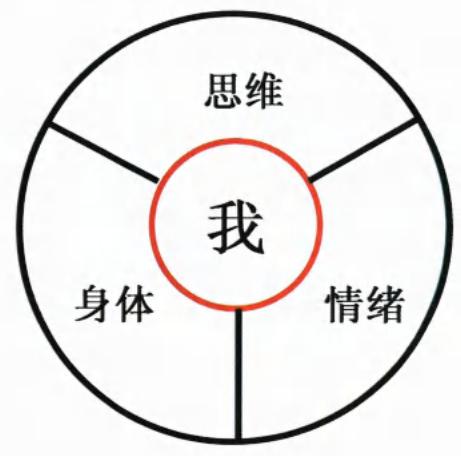
Body, Thinking, and Emotions are not “Me”
When the “mind” or “self” emerges, one is no longer entangled by the body, thinking, or emotions. This is also when the subconscious can be released. Applying this to learning and work often yields incredible results. For example, in the movie Dead Poets Society (also translated as O Captain! My Captain!), when teacher Keating faces the student Todd, who is lacking in passion and timid/nervous, he finds a way to activate his subconscious energy. Following the “heart” to “see,” he instantly creates passionate and vivid poetry (watch the Dead Poets Society clip). Although the methods of activating the subconscious may not be the same, this principle of following the “heart” to “see” and describing the seen images without hesitation is the fundamental principle of various emerging courses such as inspirational composition, zero-thinking writing, automatic writing, zero-second composition, and direct imaging composition. Through these trainings, it is relatively easy to awaken students’ awareness of the true self. Someone said, “Homer, the ancient Greek blind poet who created the Epic, had to be blind; Cupid, the god of love in Roman mythology, must be blindfolded when shooting arrows; the Goddess of Justice above the courtroom must also be blind, because only the heart can see the truth clearly, and the eyes cannot see the essence of things.” The truly important things in the world are not seen with the eyes; truly important things must be seen with the heart, because only when looking with the heart can you truly see clearly. Therefore, when students memorize, read, and do problems with their eyes covered, their comprehension and speed will greatly improve.
Finding a way to make students consciously separate themselves from their environment in their consciousness is of great benefit to the growth of children’s self-cognition and plays an important role in stimulating their potential. Experienced parents have had this experience: after the age of 3 or 4, the child’s cognition of “I” becomes relatively strong, and some children are unwilling to share their things with others no matter what. In fact, attention should be paid to the method of guidance when they are even younger. For example, when asking a child to share an apple in their hand, do not say “Give your apple to Dad, okay?” but rather use the child’s name, such as “Give Weiwei’s apple to Dad, okay?” In this way, it is easy for the child to detach “I”. When we guide students in meditation, we often ask them to imagine coming to a secret garden, a beautiful beach, a coast under a warm sunset, etc. We can also ask them to imagine coming to a classroom, a venue, or an exam hall. Students must be able to see themselves and let them see their confidence, passion, bravery, happiness, etc. Frequently seeing these images, their subconscious will accept this information and will

Statue of the Goddess of Justice above the High Court in Hong Kong
turn themselves into this way, and subsequently, the performance through the external body, thinking, and emotions will also present this way. Therefore, through potential development, one can awaken the awareness of life, rewrite the code of life information, and be able to rewrite the cognitive model of the external world, calmly facing all problems in the external world.
Many parents of children who have undergone brain potential development report that their children are more self-disciplined and focused (engaged) in doing homework at home than before. This is actually through brain potential development that the child’s awareness is awakened, and they know what they should do and how to do it. If a person does not awaken, it is difficult to find the meaning of life, difficult to establish correct values, outlook on life, and worldview, and life goals remain unclear, leading to many hardships in life. Naturally, this awakening comes earlier for some, later for others, and some may never awaken in their lifetime. When a person awakens, they will consciously seek the direction of life, be able to establish great ambitions, and have the willpower to overcome various difficulties. Shi Yigong, Academician of the Chinese Academy of Sciences, Structural Biologist, and President of Westlake University, said on CCTV’s Lecture Room that he was also muddled when he was in school, and it was not until after his Ph.D. that he determined to devote himself to scientific research. Liu Shaoqi determined from childhood to let all the poor eat rice, and Zhou Enlai also determined from childhood to study for the rise of China. Mandela also germinated the ideal of seeking justice and equality from childhood. Potential development is not the only method for life awakening, but too many cases prove that potential development can really allow children to achieve rapid mental growth, instantly changing from a chaotic life state to a mature, calm, and sensible person.
Furthermore, once a person’s life undergoes awakening, it becomes easy to perceive information and communicate with other lives and with all things in the universe. After Teacher Cai’s two daughters from Guangdong attended a workshop and went to the zoo, their behavior deeply moved Teacher Cai. Although the Jinan Zoo is quite large, the two daughters acted as if they had been there before; they did not let their mother take a photo of the map, but instead relied on their intuition to find the places they wanted to go. When the two daughters quietly watched the elephants, they unconsciously shed tears. The daughters told their mother: “The elephant told us that it is not happy here at all…” The younger daughter is usually very timid, but to Teacher Cai’s surprise, she bravely climbed onto the artificial rock and uttered the bold words, “I am a great adventurer, I am not afraid of anything!” Potential development not only enhanced her perceptive ability but also awakened qualities inherent in her life, such as confidence and strength. Since undergoing potential development, the two daughters have become more well-behaved than before and are better able to understand their mother’s thoughts. These are results that can only be achieved in a state of human life awakening.
Wang Jinzhan ① is a famous education expert. Although he does not explicitly inspire students’ latent functions in his educational work, he is very good at stimulating students’ potential energy and awakening their inner life awareness, enabling countless students to challenge the “impossible” and achieve perfect breakthroughs and turning points in their lives. From his teaching experiences, it can be seen that once his students’ inner lives awaken, their attitude towards learning changes, they can create learning methods on their own, and their motivation for learning becomes sufficient (see the video “A Date with Lu Yu — Wang Jinzhan”).
The primary purpose of potential development is to enable human life awakening. Only after life awakens can one find the method to rewrite life information and correctly rewrite human life information. And the essence of information is the comprehensive sensory (psychological) perception of images, sounds, touch, taste, temperature, etc.
A Date with Lu Yu — Wang Jinzhan
The purpose and significance of potential development are discussed at length in the book Right Brain Development Training Manual, and there are also some case studies; ultimately, they boil down to four aspects: life awakening, self-confidence, concentration, and imagination (or imagery sense). These
6.2 Self-Confidence
We can observe and imagine that when a student closes their eyes to touch color cards, and the information presented in their brain matches the color of the card in their hand, what kind of psychological state would they be in? Curiosity? Disbelief? Excitement? Delight? These emotions are multiplied by the teacher’s affirmation and encouragement. From then on, the child’s active desire for knowledge and proactive, courage-driven action are unleashed. Children often find it hard to hide their inner excitement and proceed to perceive the next card with some trepidation. The previous emotions repeat themselves, making the child increasingly courageous, interested, and confident for the next attempt. In this way, after a student successfully touches several color cards in a row, even if they are correct every time, they will still be eager to continue training, but the instructor must stop them promptly in time. Letting the child stop and rest allows them to savor the experience. During the break, with time to themselves, the child begins a process of self-awakening. They discover they possess an ability that ordinary people do not have; they feel they are different from before, seemingly able to feel the energy emitted by everything in the surrounding world. A sense of genuine joy and power, never felt before, begins to rise in their heart.
When able to correctly distinguish color cards while blindfolded, some children might even be unable to resist going home to show their parents and relatives. To a large extent, such children do this to prove themselves, to prove they are very capable, thinking “You adults are stunned now, don’t look down on me.” Children love to see adults dumbfounded by them, love to have everyone look at them with expressions of blank-minded, helpless delight, and love to be praised by everyone, believing they have achieved it. However, the instructor should strictly prohibit this and instead make the child wait, wait until they discover there are even more amazing things. This is because if adults question this small victory, it could extinguish the small flame of victory and joy in the child.
As the training state of the blindfolded games stabilizes, the content of the mental imagery becomes richer, images and sensations become clearer, and the perception of external objects becomes increasingly rapid and accurate. The student gradually begins to truly believe in their own abilities and truly accepts that possessing these abilities is a completely natural thing, regarding it as an innate function. At this stage, if someone questions them again, although they might feel angry or even sad, and in the future might dislike displaying or using this skill, it basically will not affect their affirmative cognition of possessing this ability. They can already accept the fact and will not doubt themselves. Throughout the entire potential development process, students receive approval from teachers and parents countless times and experience various wonderful sensations created by their own brains from the joy of overcoming themselves countless times. If they can further apply this perceptual ability and mental imagery ability to other aspects of life and learning, it will greatly promote the formation of full self-confidence in the student.
Self-confidence is believing in oneself; confidence is believing in one’s own heart. Self-confidence is a stance, an attitude, and the foundation for establishing a solid worldview, outlook on life, and values.
Self-confidence is not built on the pursuit of external things, but on the discovery and cognition of the self. If a child wants to eat ice cream today and you buy it for them, or wants to go to McDonald’s tomorrow and you take them, this will not help increase the child’s self-confidence, because this is seeking external things, not based on overcoming oneself. A mindset of seeking can only result in greed, not self-confidence. Self-confidence should also not be built on defeating others. If a child fights with someone today and wins, or outperforms a competitor in tomorrow’s exam, the self-confidence built this way is twisted and unstable, and will easily be defeated by setbacks in the future. If he fights with someone for justice and loses, but adults discover his quality of justice, then he will also generate self-confidence and won’t care too much about winning or losing; after an exam, if he loses to his competitor, adults should direct the focus to himself, telling the student: “You have improved a lot compared to last time, that’s great,” thus increasing his self-confidence again.
In his book Such Couples, Such Parenting, Ru Ping told a story about him and his son:
Ru Ping passed by the entrance of McDonald’s with his 6-year-old son, and the son stopped, pointing at McDonald’s and saying: “Dad! McDonald’s!”
Ru Ping: “Hmm, McDonald’s! Want to eat it?”
“Yeah! Want to eat it!”
“Son, if one eats whenever they want to eat, that is called a bear (fool); if one wants to eat but is able not to eat, that is called a hero!”
The son thought for a moment, made up his mind, and said: “Dad, of course I want to be a hero!”
“Awesome, a hero! Let’s go home.” The son, mouth watering, followed Teacher Ru Ping home.
This is a story of Teacher Ru Ping cultivating a child’s ability to resist temptation. Its essence is the process of finding a way to let the child defeat their own desires. The highest level of self-confidence is the ability to defeat oneself. The essence of building self-confidence is still the awakening of the “I” in life, where this “I” defeats the self, defeating one’s own desires and fears. Self-confidence needs to be gained in the experience of winning again and again, and accumulated after success again and again.
The Avatamsaka Sutra says, “Strange! Strange! All sentient beings possess the wisdom and virtues of the Tathagata.” The Platform Sutra of the Sixth Patriarch says, “How wonderful is our self-nature, originally pure; how wonderful is our self-nature, originally without birth or destruction; how wonderful is our self-nature, originally complete; how wonderful is our self-nature, originally immovable; how wonderful is our self-nature, capable of generating all dharmas.” The Three Character Classic says, “At the beginning of life, nature is good. Natures are similar, habits make them distant.” These all say that humans are originally complete, and there is no need to seek from the outside for everything. If one can find the complete self, that is finding self-confidence, then their abilities can be like those of the Tathagata Buddha.
Through right-brain development, students initially gain happiness and self-confidence. Because during the process of right-brain development, the child’s brain is always actively thinking on its own, and the images are created by themselves. Perceiving colors and characters while blindfolded is difficult for adults to do, but he has done it. He can perceive the surprise and excitement of adults; having successfully challenged his own impossibilities, his self-confidence begins to be established. Once he has self-confidence, what will his attitude be toward doing homework? Will he be happy to try? When encountering difficult problems, what will he do? Will he be willing to face them actively? You tell him that he has developed his right brain and is smarter than before, that he can understand everything the teacher says in class, and that he is also more focused. Does he believe it? Yes, once a child has self-confidence, everything is easy to say, because he himself feels he is awesome, smart, and excellent. This activates his inner energy, and his potential begins to be released.
Knowledge and skills do not lie in how much you master, but in whether you can bring out what you already possess. Some instructors with zero foundation participated in my workshop, and most could smoothly design courses and teach students after returning. However, there were also个别 instructors who were taught hand-in-hand but still could not successfully guide students to start blindfolded reading games on their own. Similarly, many students seem to have mastered the knowledge learned in daily life quite well, but their results are not ideal during major exams. What are the reasons for all this? Spider-Man: Into the Spider-Verse, the best animated feature film that won a series of international awards including the 2019 Golden Globe Awards and Academy Awards, might bring us some inspiration: The middle school student Miles was bitten by a radioactive spider and gained a series of superpowers such as venom blast, camouflage, spider climbing, super hearing, and spider-sense. However, no matter what method Miles used, he could not control or use these abilities, including when his uncle died and he was grieving, when friends provoked him, or when his own life was in danger. It was either that he didn’t want to or he couldn’t bring them out. The accidentally gained superpowers made the distraught him even more burdened; he wanted to achieve something but dared not take the step. Finally, when his dad said to Miles, “I see the spark in you, it’s great! No matter what choice you make, you will be great!” The father’s recognition inspired Miles’ self-confidence, thereby allowing his already possessed superpowers to be brought into play, making him a true superhero. Some children, when training for functions like blindfolded reading, have unstable effects or difficulty starting. The first thing to consider is whether he has enough self-confidence; believing that his energy is stimulated makes it not difficult to bring out the functions.
Nowadays, when parents educate their children, they often criticize more and appreciate less. Just like in the video “The Score the Child Gave the Mother,” the child easily becomes increasingly unconfident and slowly buries the potential they originally possessed deep inside. With the development of society, the amount of information in knowledge is growing, and the scope of knowledge an individual can master can only become narrower. For information that is strange to oneself, the ability to perceive it comprehensively is lost, manifesting as a distinction between believing and not believing: what one believes is right, what one doesn’t believe is wrong; what fits one’s cognition is right, what doesn’t fit one’s cognition is wrong. The ability to accept everything entirely, as in early childhood, is almost gone. With the progress of science and technology, people are even more accustomed to not looking at themselves anymore; the more they look outward, the smaller they feel, the less satisfied they are with themselves, the more they hope to seek, and the less confident they are. In fact, change your gaze, look inward, look at yourself first. Once you understand yourself clearly, you won’t be tangled up anymore. After finding self-confidence and then doing things, you will have energy, and there will be more chances of success.
If a child loses self-confidence, the child’s potential will be lost. In Talking with the Master: Silence: Joy ①, there is a story:
There was a civil servant who wrote excellent articles. However, his daughter had been poor at writing compositions since elementary school, and by middle school, she still hadn’t improved. She lost many points in the Chinese section of every exam due to her writing. By the third year of middle school, with the High School Entrance Exam approaching, the civil servant became very anxious and decided to personally tutor his daughter’s writing. He made her write one composition a day for a month. He corrected and explained her work every day, using every trick he knew, yet his daughter’s writing showed no improvement whatsoever.
He sought advice from a friend who was a teacher. The friend told him to change his approach. No matter how poorly the child wrote, with his years of leadership experience, he could certainly find a merit. He should then praise her vigorously, saying the composition was well-written! Then, every day, he should find the strengths in her writing and areas where she had improved, and continue to praise those improvements fiercely! Just doing this every day would be enough.
Think about it: this civil servant writes excellent articles, so how would he judge others’ writing? Right, because he knows how to write, he would think writing is very simple, and his standards for what constitutes “good” writing would be quite high, wouldn’t he? In this case, how would he feel looking at his daughter’s compositions? Yes, he would think they were a complete mess. At this point, he probably felt nothing but anger and impatience. This makes it difficult to see the good parts, leading only to criticism of his daughter’s writing. Consequently, from childhood to adolescence, all his daughter ever received regarding writing was criticism and unhappiness. If you grew up with this kind of experience, how would you feel about writing compositions? Yes, disgust and fear. It would be impossible to write well.
The father listened to the teacher, went home, and did exactly as suggested, forcing himself to find merits in his daughter’s compositions. Although it felt very hypocritical, fortunately, having been a leader for many years, he was still full of smooth talk when it came to praising people. When the daughter heard her father praise her composition for the first time, how would she feel? She would be very surprised, but also very happy, right? So, she went back and read her composition over and over again. This was likely the first time she treated her own writing with such seriousness and joy. She would begin to truly engage her brain to face writing, and the guidance her father and teachers had given her in the past would begin to surface in her mind. In this state, would there be obvious improvement in the next day’s composition?
Her father would naturally be able to discover where the child had improved, and then vigorously praise that merit. In this way, the daughter became more confident and engaged in her writing. If this cycle repeats, what would be the result? The child would feel that nothing brings her more joy and confidence than writing compositions.
A few months later, this girl was admitted to a key high school with a high score. In high school, her compositions remained outstanding, and her grades were excellent.
This story illustrates how a child’s innate wisdom and potential are bit by bit lost, and how they can be regained bit by bit through rebuilding confidence.
In potential development courses, the training content for ESP (Extra Sensory Perception) games must be constantly innovated, and the difficulty should be moderately increased at times. This keeps students in a state of excitement every day in class. They will be surprised by themselves every day, never imagining that they are amazing geniuses. With the praise and encouragement of instructors, parents, and classmates, they will become more and more confident, eventually stimulating abilities that were previously undiscovered in a continuous stream.
In the teaching design of National Brain Potential Development Expert Teacher Zhang Xuexin, the 1-2 minute “Standing Tall” exercise is a mandatory segment at the beginning of every class. This segment not only allows students to relax their body and mind and enter a focused state for class, but also injects the energy of confidence through their imagination:
Stand with feet closed, eyes closed, feet naturally separated shoulder-width apart, hands joined together, palms facing, raised vertically past the face, assuming a posture of holding up the sky. Imagine: My feet tread on the earth, my hands hold up the blue sky, I am a giant standing tall between heaven and earth. Strive to grow upwards with the teacher’s commands, holding up the blue sky: 1, 2, 3, 4, 5, 6, 7, 8, 9, 10. My feet tread the earth, my hands hold the sky, I have grown tall, not only my external body but also my inner thoughts. Let us try to grow once more: 1, 2, 3, 4, 5, 6, 7, 8, 9, 10. Hands relax gently past the face, turn the body left and right, open eyes, sit down.
In potential development, when a student encounters problems, one must generally consider whether it is an issue of self-confidence. After a midterm exam, a parent asked: “My child was very accurate when continuously training to feel color cards and word cards at home initially, but the results haven’t been good these past few days. The error rate for feeling color cards is high, and he can’t feel the word cards accurately either. He says the small light sphere isn’t as bright as before. What is the reason for this?” I suggested he work backwards from the significance of ESP game training to see if he could find the reason. The parent said: “It’s possible that he didn’t do well in the midterm exam a few days ago, which caused him to lose confidence.” Subsequently, he provided psychological counseling to the child, and the child quickly returned to the previous good state.
Self-confidence is the foundation of students possessing a healthy mind. Potential development is an excellent tool for cultivating students’ self-confidence and is also an important teaching objective of potential development.
6.3 Concentration
The interaction between consciousness and the subconscious in states of concentration, imagination, and introspection can stimulate the infinite energy of the subconscious; this is the essence of potential development. In this process, concentration training is the most core training; elevating concentration to a certain level is the basic condition for realizing various functions and developing higher wisdom. Concentration is the essence and training core of cultivation methods such as Qigong, hypnosis, meditation, yoga, and sitting meditation, and it is also a necessary quality for improving academic learning outcomes.
There are 15 million bits of information generated in every present moment, yet consciousness can only process 15 bits of them. Countless pieces of information face everyone; some are human desires. Desires often attract people, leaving no spare time to think about their true goals, while simultaneously inhibiting human potential. Stop the interference of all information and place oneself in a state of “emptiness” to be able to concentrate on processing the information that should be processed. In Buddhist practice, there is a “Samatha-Vipassana method” (Method of Stopping and Seeing), whose core discusses the abilities of “stopping” (Samatha) and “concentration” (Samadhi). The Diamond Sutra speaks of “arousing the mind without dwelling anywhere,” which is discussing “stopping.” In the Chan (Zen) tradition, this stopping is “cutting off the flow,” because our thoughts are like a stream of water that flows forever; how can we cut it off? When the past thought has already passed, and the future thought has not yet arrived, the space in between is empty; stopping on this emptiness cuts it off. No matter which method one cultivates, if the intention cannot achieve stopping at a single point, then all effort is wasted.
Ding (Concentration), translated from Sanskrit as Samadhi, means the mind focuses on one realm without scattering. Chumeng Zhiguan (Samatha-Vipassana for Beginners) states: “To counteract the initial coarse and chaotic mind, one cultivates Samatha-Vipassana. This means when a practitioner first sits in meditation, because the mind is coarse and chaotic, one should cultivate Samatha to eliminate and break it. If Samatha does not break it, then one should cultivate Vipassana.” ① The meaning is that the human mind is originally coarse and chaotic; if one wants to govern this coarse and chaotic mind, one should apply the method of “Samatha-Vipassana.” When people start learning to sit in meditation, because their thoughts are coarse and chaotic, they should use “cultivating Samatha” to eliminate and break this obstacle. If “cultivating Samatha” cannot break it, then one should “cultivate Vipassana.” “Restrain the mind in one place, and nothing cannot be accomplished.” Mr. Nan Huai-Chin explains this sentence in Zongjing Lue Lue (A Brief Talk on the Tsung-ching Record): “As long as the single-minded focus of the mind can be achieved, if you want wisdom, wisdom will be developed; if you want spiritual powers, spiritual powers will be manifested. Whether it is transcending the world or entering the world, it can all be done. The problem lies in our inability to restrain the mind in one place.”
Sitting meditation is an important content of cultivation in Confucianism, Buddhism, and Taoism, and is also an important posture for practices like Yoga and meditation. The most important essential point in sitting meditation is “returning ten thousand thoughts to one,” which is to restrain scattered thoughts into a single thought, focusing on one content. In life, the central point is “awareness without discrimination,” that is, perceiving all things without making distinctions. Thinking Ontology calls this “universal attention,” focusing on the phenomenon of thinking, not on the content of thinking.
For example, visualizing a very beautiful scene of a water drop reflecting the light of energy falling, placing the emphasis of meditative observation on the clear awareness of the entire process of the water drop falling, and extending this awareness in time as much as possible. If the meditation focuses on the entire process and the continuity of the process, then when other thoughts can no longer intervene, the meditator enters a state of “focused stillness.” This state is a “higher state of derived thinking states” ②. When observing the water drop falling, do not add any subjective concepts, do not inject any thinking content; just observe the water drop falling and experience this profound state of mind. In this process, to cultivate concentration, one must pay attention to appropriately extending the time of meditative observation.
In potential development, the existence of “light” or a “light sphere” is emphasized from beginning to end. It not only represents the level of energy and determines the ability to form clear images on the brain screen, but it is also related to a person’s concentration. Li Penggang, who has long been dedicated to the study of Thinking Ontology, stated in Scientific Empirical Evidence:
The “ball of light” seen when closing the eyes is not the light seen by the naked eye. The size of the “ball of light” corresponds to “concentration power”; a larger light ball represents that concentration is not very strong. As concentration gradually improves, the light ball will gradually become smaller, even forming an extremely bright and beautiful “light pearl.” When this kind of “condensed light” appears, concentration is very strong; it is a state of high concentration corresponding to this condensed “light pearl.” This “light pearl” is highly condensed, the light sensation is particularly strong, and it appears as a crystal-bright pure white, continuously radiating light. In the “higher thinking state,” when “universal concentration” is truly formed, the light pearl will become larger again. This larger light pearl is incomparable in quality to the previous larger light ball and has far surpassed it. This shows that “light” has a certain intensity, and the intensity of “light” in different thinking states is different. The intensity of “light” corresponds to “concentration”; the stronger the concentration, the stronger the intensity of the “light”; conversely, the poorer the concentration, the poorer the intensity of the light. In extremely low thinking states, the intensity of light is extremely poor, and we can even only feel pitch darkness. This does not mean there is no light, only that the state we are in has significant problems, causing us to be unable to perceive the light. If we can be in a very high thinking state, then even in the pitch-black night, we can live as if it were daylight, without feeling the slightest bit of darkness.
This shows that the generation and strength of “light” when closing the eyes are related to concentration and also to the thinking state. The essence of the higher thinking state is the interaction between consciousness and the subconscious, that is, using consciousness to mobilize subconscious energy to play a role, and the thinking results of the subconscious can be fed back to consciousness, thereby realizing various potential results. It can be said that high concentration is the most important factor in realizing potential, and potential development training is also a very good means and tool for improving concentration.
The second paragraph of The Great Learning explains the pathway to becoming a person of great knowledge, great awakening, and perfection: “Knowing where to stop, one has concentration; with concentration, one can be calm; being calm, one can be at peace; being at peace, one can deliberate; deliberating, one can attain. Things have roots and branches, affairs have an end and a beginning; knowing what comes first and what comes last is close to the Way.” This is consistent with the Three Learnings of Buddhism: Precepts (Sila), Concentration (Samadhi), and Wisdom (Prajna)—cultivating precepts to perfect moral character, cultivating concentration to devote oneself to inner peace, and cultivating wisdom to nurture wisdom.
It is evident that the ancients long ago concluded that concentration training is a necessary channel for investigating things to extend knowledge, illuminating the mind to see one’s true nature, and achieving wisdom. For parents who expect their children to learn easily and improve their grades, they must be clear about this process and know the importance of concentration for students. Potential development training is invariably related to concentration training, so one of the very important meanings of potential development is that it can improve concentration.
As the saying goes: “The way of teaching values specialization.” The cultivation of concentration is also the core of traditional education and teaching. Concentration is not a psychological term; the word “concentration” comes from Chen Tingzhuo’s White Rain Studio Ci Talk (Baiyu Zhai Cihua), Volume 8: “For troops, it is better to be refined than numerous; if refined, there is focus; if numerous, there is scattering and disorder.” From this sentence, we know that “concentration” is used to solve “scattering and disorder,” and this extends to psychological states as well. The psychological term “attention” is a conditioned reflex, the direction and concentration of psychological activity on a certain object, belonging to a part of the cognitive process, and is a very important concept in educational psychology. Concentration can be understood as being about a person’s inner self, related to the overall goal, process, and results of things, and the corresponding state is “scattering.” “Attention” is generally directed at external objects, related to interests and target objects, related to specific things, and involves the distribution and shifting of attention. It is a psychological phenomenon accompanying psychological processes but does not belong to the psychological process itself. Persistent and concentrated attention is concentration. The results obtained from immersive learning with total concentration on the content are necessarily different from the results obtained from learning with scattered attention.
Concentration is related to a person’s powers of observation, memory, willpower, and intuition, all of which are related to learning. Careful tutors and parents will discover that almost all children who have undergone potential development will see a significant improvement in their ability to memorize things compared to before. The reason is actually very simple: their concentration has improved. For example, in reading, if one cannot achieve “photographic memory” or “extensive knowledge and strong memory,” it is either because the brainpower is insufficient and lacks memory training, or because the mind is scattered and the will cannot be concentrated. ①
If a student’s mind is scattered and their concentration and attention are low, it is difficult to activate various blindfolded game functions. Progress in training such as blindfolded color identification will be slow, or the state will be difficult to stabilize after activation. If a child can cooperate with the teacher, they can improve their level of attention through attention training (there are many professional courses and materials related to attention training, so this book will not elaborate further), thereby enabling potential functions. It is generally not recommended for children with psychological obstacles such as attention deficit to undergo potential development training. Students with attention deficits have many external behavioral manifestations, such as some children frequently not hearing things, losing things, not using their brains, being disorganized, often being careless, not finishing things, not concentrating, being easily distracted, often forgetting things, etc. Such children should be diagnosed and treated by professional institutions to avoid missing the opportunity for treatment; potential development training institutions should not blindly accept and train them.
6.4 Imagination
Potential development training is permeated with imagination exercises from beginning to end. Children who are confident, focused, and imaginative can easily activate the perceptual functions of ESP games. The state during activation is focused, imaginative, and introspective. Through long-term potential training, imagination will develop well.
Many people ask, what is the use of imagination? Can a child just daydreaming improve their grades? This statement shows that some people really care too much about grades, while losing something 10,000 times more important than grades. Einstein once said: “Imagination is more important than knowledge, because knowledge is limited, whereas imagination embraces the entire world and stimulates progress; it is, strictly speaking, the source of knowledge evolution.” How to expand imagination? Einstein was a master of playing the violin. He once confessed: “Physics gives me knowledge, art gives me imagination. Knowledge is limited, but the imagination opened up by art is infinite.” The German poet Goethe said: “Only through art, especially through poetry, can imagination be activated.” What enhances imagination is not necessarily art; potential development can also do it very well.
When instructors teach students to read while blindfolded, they should try to let the text and images appear on the child’s “mind screen”. Images correspond to the text. The form of the student’s image varies from person to person; it may be static, cartoon-like, or like a movie. Regardless of the type of image, the scene is always vivid and relevant to the meaning expressed by the text. This not only helps the child understand the text and knowledge but also makes memorizing the content simple. Therefore, blindfolded reading can make imagination stronger, and also improve comprehension and memory.
Imagination is closely related to memory, comprehension, creativity, and IQ. Brain scientists at VU University Amsterdam in the Netherlands have shown that, compared to people with relatively lower IQ scores, brain cells in high-IQ individuals are significantly larger. Larger cells have more protrusions connecting to other neurons—dendrites—and these dendrites are longer, indicating that these neurons can receive and process more information. They believe that the connections between neurons are related to memory storage. Therefore, larger cells likely leave more “room” for memory. ① Unconstrained free imagination can avoid simple connections between neuronal dendrites and fixed signal transmission routes, promoting the generation of more dendrites. In other words, this can avoid rigid thinking and instead form more divergent thinking.
From birth, abilities like imagination and creativity are infinite; it is the postnatal environment that limits the development of people’s imagination. When Taiwanese writer Wu Meiyun interviewed the art master Shen Mo, the master shared a case study ②:
When I was teaching creativity at the university, I drew a dot on the blackboard and asked the students: “What is this?”
The students said: “That is a dot, that is a chalk dot, that is a chalk dot on the blackboard.” Usually, students would not have other answers.
I asked the same question to kindergarten children, and no two of them gave the same answer.
“That’s a big dog.”
“That’s an alien.”
“That’s dad, because after dad dropped me off at kindergarten, he left. I looked out the window, watching dad get smaller and smaller as he walked away, until he finally turned into a dot.”
This shows that in childhood, a person’s imagination is completely free, and their creativity has no obstacles. He can communicate freely with this world, talk to a cloud, make friends with a rag doll, tell stories to the rag doll, and coax the rag doll to sleep. He can freely connect emotionally with this world. Creativity means that when facing any problem, you can come up with endless methods. This thinking mode is called divergent thinking mode.
Our education has never been divergent. For any problem, no matter how many people are in the class, there can only be one standard answer. Anyone who deviates from the standard answer is immediately marked with a cross, so they dare not deviate again next time. University students have been influenced by right and wrong for too long and too deeply. They dare not think or write because their thinking has been completely blocked.
There are also some people with very strong natures who have never been truly blocked. They keep making small movements and persist in having their own ideas. As soon as the teacher turns their head and isn’t paying attention, they do their own things. They reserved a small world of freedom for themselves, a channel for innovation, a small door and window. But this is still far from enough. I usually require students to open up completely. If they can truly do this, then all sorts of incredible ideas will flow in endlessly. Over the years, the reason why so many of my students have been able to take the stage and compete with the world is because the penetrating power of this method is very strong; it can turn an ordinary person into a very extraordinary person very quickly.
We must not let a child’s imagination continuously decrease due to the influence of the social environment. This impact on the child is often caused unconsciously by adults. Adults also often cannot understand this kind of imagination in children. Let us conduct the following experience and reflection. The content in parentheses represents the answers many people have given previously:
We came to the Inner Mongolian prairie. The grass on the prairie is lush, and the prairie is extremely vast. At this moment, we see a what coming from afar on the prairie? (Horse)
What color is it? (Red, white)
Is it big or small? (Big, small)
Does it run fast or slow? What kind of sound is it?
What kind of person is riding on it? (Adult, child, man, woman, etc.)
What kind of clothes is he/she wearing?
What is he/she holding in his hand? (Horse whip, lasso, etc.)
For the above questions, children can easily “see” the image, while we adults often find it difficult to “see” it so vividly. Therefore, it is difficult for adults to experience the feeling of seeing what the child sees and being on the scene. Adults’ answers are judgments of thinking and imagined, because I did not preset any answers before asking; I only guided everyone’s imagination. A few friends may be able to imagine it vividly, but most friends can only answer by thinking of related words and phrases based on language associations. However, children can do it as if they are seeing it, and what each child “sees” is different. Children not only possess this visual imagination ability, but more importantly, besides vision, senses such as hearing and movement can also be trained in the same way, and this feeling of being on the scene also exercises human nerves or forms richer neural connections.
Imagination is the ability of image thinking, capable of being rich in association and drawing inferences from one instance. It is the process of transforming representations in memory to produce new images in the brain based on oral language or written descriptions. Some people often read ancient poetry masterpieces in their spare time, which can expand their imagination. Imagination is one of the abilities most likely to trigger inspiration, creativity, and appeal. We call this psychological activity “mental imagery.” Let us look at the video from Jiangsu TV “Variety Show: Body Painting Displays Extinct Animals” together, look at this imaginative video, and think about what feelings the visualization of information can bring to people? What kind of harvest will there be if the ability to process information visually is applied to students, life, and work?
Variety Show: Body Painting Displays Extinct Animals
Having imagination in the brain and generating corresponding emotions and feelings is mental imagery. Potential development training cannot be separated from imagination, but more importantly, it is about improving people’s mental imagery ability. Mental imagery is more generalizing than representation, imagination, and imagery. The term mental imagery is quite important in cognitive psychology, but it is a relatively vague concept in general psychology and is not mentioned in many psychology textbooks. According to the depth of information processing, psychology divides mental imagery into representation and imagination, but mental imagery is closely related to sensation and perception, and is even equivalent to the function of perception. Mental imagery is not a copy of the perceived real image in the brain; it has a more highly organized structure and is more plastic. The brain can process visual and spatial information through mental imagery without any external stimuli. Therefore, improving mental imagery ability can make human perception more acute and rich, and make human brain nerves more active and plastic. This is the significance of potential development, which instructors should pay attention to mining during training.
There are a large number of guided words for imagination training and meditation training in the “Right Brain Development Training Manual”. These guidances are relatively classic training that can improve mental imagery. Many people ask what is the difference between imagination and meditation. In fact, in terms of form and content, there is no difference. It is just that imagination is a psychological activity in which the human brain organizes and processes existing representations to create new images. Meditation is a method of spiritual practice, and imagination is also a common meditation method.
The research on meditation improving student grades by the University of California, Davis, and the University of North Carolina mentioned in Chapter 3 of this book shows that meditation can improve students’ attention. At the same time, it can also enhance the understanding and perception of information and knowledge by improving mental imagery power, allowing nerves and psychology to grow.
During the process of potential development, attention must be paid to the “maintenance” of the light sphere. The purpose of “cultivating” the light sphere is to form a clear mental screen. For most adults, it is difficult to produce a “light sphere” that is bright, stable, and capable of changing; for children, it can be considered that both the images on the mental screen and mental imagery must start with the appearance of a light sphere. Some children, when opening their ESP, say that a “little elf” appears; this is actually the light sphere. The “little elf” tells them the color of the color card they touch, the answers to homework questions, and can even chat with them. The descriptions of the “little elf” by children who see one are not exactly the same; for some, it is just a light sphere, for others, they can only hear a voice with no particular form, and for some, it is even a colorful dragon. There are quite a few children in this situation; generally, it is the child who tells the parents first, and after hearing this, the parents are often quite worried and panicked, not knowing what to do.
I call the “little elf” a “spirit pet.” Because only the child knows of its existence and can communicate with it; others cannot see, touch, or hear it, and even scientific means cannot verify its existence, making it feel very supernatural. The character “宠” (pet) combines "" and “龙” (dragon) to signify “snakes raised inside the home.” Its original meaning is non-venomous snakes raised at home; it implies a fondness and doting on those below, used by superiors towards inferiors, or people of high status towards those of lower status. Therefore, you must let the child know that they are the master of the spirit pet, and the spirit pet is their own pet; they can treat it as a companion, but must not obey its commands and must have their own opinions. The spirit pet may seem whimsical, but in reality, it possesses neither much intelligence nor autonomous consciousness. Some children are quite mischievous and dislike using their brains when doing homework, so they ask the spirit pet. When they start asking it questions, it might be able to tell them the correct answer, but later on, it will become more and more ridiculous, speaking entirely wrong answers. On serious matters, it is simply not trustworthy. Of course, if there is a temporary interest in the spirit pet, as long as the child does not experience negative situations such as fear, anxiety, obsession, or distraction from studies, instructors and parents need not worry too much. Instructors and parents must make the child clearly understand: “I am the master of my brain; I have the ability to control my own thinking, body, and emotions.”
All ghosts, gods, monsters, or demons that appear during meditation, sitting in contemplation, or at any other time are imagined. The Diamond Sutra also says, “All phenomena are illusory.” Even if gods or demons have boundless magic powers, they cannot directly manipulate humans because humans possess free will. Gods admonish humans, demons tempt humans, and as for what to do, humans can choose; what tests humans is their willpower and ability to choose. Throughout history and across the world, all stories of humans dealing with the devil or gods have already told us that the final outcome is either humans defeating the devil or gods, or the devil or gods compromising with humans. What gods or demons can do is use human greed and desire to make humans become devils. Therefore, if there are no demons in the human heart, there will be no demons in this world, and thus there is no need to fear demons; everything lies in one’s own heart. This heart is one’s belief and stance, one’s worldview, values, and outlook on life.
For ordinary people, the spirit pet is the result of imagination. Instructors and parents should not continue to reinforce the child’s feeling of having a spirit pet; if this matter is not mentioned, it is possible that it will gradually not be found, or that feeling will not be found, and the spirit pet will slowly disappear. If a child is very attached to communicating with the spirit pet and this has persisted for a long time, one should consider issues such as parent-child relationships or interpersonal relationships in the child’s life, rather than getting entangled in the issue of the spirit pet. Regarding this, I will tell a joke, hoping to give everyone some inspiration:
Qingming Festival is approaching. If children can see unclean things, adults must not take this lightly! A friend said that when he was a child, he saw two children on the air conditioner, so he told his family that there were two children on the air conditioner. This scared his family enough; they were busy inviting great masters and semi-immortals, but when asked again, he could still see the two children. Later, because of this, they sold the house and didn’t want any of the furniture or appliances. When he grew up, his family finally found out that the two children on the air conditioner were actually the Haier Brothers; his father almost beat him to death.
I believe that children under the age of 6 are not suitable for ESP potential development. The brain development of toddlers is still very immature, with image-oriented thinking dominating and rich imagination. Most importantly, toddlers sometimes may not be able to distinguish the difference between imagination and reality, and cannot distinguish themselves from others. Many people also say that children can see things adults cannot see; this statement has no scientific basis, and it is perhaps the most appropriate explanation to say that children cannot distinguish between imagination and reality. Children have just developed from a body of pure yang; improper guidance might affect their bodies. Moreover, children under 6 can basically achieve non-visual perception without the need for development. For children under 6, it is very helpful for forming rich neural connections to meaningfully engage in games, painting, music, reading aloud, listening to stories, crafts, parent-child interaction, etc. Parents should put effort into this aspect.
We had best subjectively believe that imagination is entirely based on cognition and cannot transcend cognition. A small bug on a tree cannot understand what the ocean is like or what the desert is like; that is beyond its scope of understanding. If you believe that imagination is entirely unrelated to cognition, this is of no benefit to the cultivation of students. If a child sees the word “apple” and thinks of an apple tree, feels the taste of an apple, and associates stories related to apples, this is a very good exercise for the child’s imagination and thinking. When a child sees the word or picture of an “apple,” adults should wait and let the child imagine to their heart’s content, or give the child some prompts through questions like “What do you think of when you see the apple? What color is it? How big is it? What does it taste like if you take a bite?” This not only exercises the child’s concentration and imagination but, more importantly, develops the habit of the child’s thinking and ability to look at problems in depth.
Teacher Zhang Xuexin, who founded his own private school in 1997 to begin exploring whole-brain quality education, has achieved remarkable results in the cultivation and training of multiple learning abilities such as “photographic memory, instant recitation, whole-book storage, audio and video recording, fluent recitation backwards, and the wordless heavenly book,” receiving recognition and commendation from educational professional institutions and experts such as the China Education Development Strategy Society. In 2011, due to Principal Zhang Xuexin designing and formulating the “Little Prodigy” award at his school, he attracted social attention. Multiple TV stations across the country reported on him, not based entirely on objectivity and science, adopting the stance of anti-pseudoscience fighters to determine that he violated scientific and educational laws, believing this was a scam. In fact, this kind of rhetoric itself lacks a scientific spirit. From the video clips of “Prodigy School,” it can be seen that Zhang Xuexin, in his training, merely stimulates the qualities children inherently possess through mental imagery and image thinking training, enabling children to achieve phenomena such as “superpower” iconic memory that are rarely seen in current education.
Imagination is a key element in all potential development. Meditation, memory methods, ESP games, wave speed reading, and even special functions are inseparable from imagination. Imagination also plays an important role in the application of various “superpowers.” Below, we give two examples:
In February 2015, on the stage of the second season of “The Brain,” a project called “Microscopic Water Identification” left a deep impression on countless viewers: Wang Yuhui accurately identified the previously randomly selected cup from 520 cups of water of the same quality, source, and quantity at a speed of one cup every four seconds. He even saw that this cup had been rotated by 15 degrees from when it was selected, picked up for observation, and then put back in its original position. Relying on god-defying observation skills, “Brother Water” Wang Yuhui was pushed onto the altar by fans overnight. Facing an interview, Wang Yuhui calmly stated: I actually rely on “imagination” to distinguish these waters. I will quiet down, turn off my breathing and heartbeat, and imagine the water in the cup as a picture, such as a starry sky or a child’s face. ① In his eyes, no two things are alike; he can even directly see parasites growing on coral with the naked eye. Peking University Professor Wei Kunlin called him the only genius in “The Brain.”
The Brain - The Gifted Eye Wang Yuhui Microscopic Water Identification
Famous writer Ke Yunlu’s documentary “Life Science Exploration,” Episode 23 “Black Lightning,” introduced the miraculous ability of Qigong master Shen Chang to treat illnesses. In the documentary, there is a segment recording the process of Shen Chang treating a woman with a breast tumor, the dialogue is as follows:
Imagine stretching your hand into the interior of the breast tumor, what does it feel like? (There is a heat sensation) Use force and strength to pull backward, while pulling, feel it, is there a sense of mutual attraction? If there is mutual attraction, an action point of force is formed. At this time, make a vigorous effort and pull backward with the strength of nine oxen and two tigers. Do you see it? What is at the top of your fingers?
(Gray light) People call it filthy air; this thing is filthy air, commonly known as evil energy. Okay, now eighty percent is eliminated.
Shen Chang believes that the “theory and technique of imagination” he uses is the theory and technique of using mind power to directly achieve the purpose of treatment. All healing behaviors begin with intention, that is, the thought of wanting to heal the other person. Then, it acts on the other person through indirect means such as surgery and drugs. Special functions start directly from intention and act directly on the other person in the form of intention to achieve the goal. When you truly imagine that your hand reaches into the other person’s diseased part and truly pull outward, feeling the connection between the force and the point of action, then your mind power can influence the other person’s illness.
Chapter 7: Qualities of Excellent Instructors
7.1 Basic Scientific Literacy — Psychology and Brain Science
7.1.1 Psychology is Also Magical
Psychology is a fundamental subject that teachers must study, yet the majority of people do not care for it much. This is because psychology involves extremely numerous and complex concepts; not only is it difficult to grasp, but it is also very easy to confuse them during exam revision. As a teacher with over 20 years of teaching experience, I believe that although the psychological knowledge memorized in school was for the purpose of passing exams, it plays a significant role in actual work. It is just that when we need to use it, we recall having learned that bit, but often need to consult the books again to understand it carefully. Therefore, my advice to counselors is that you must master the basic knowledge of general psychology and educational psychology; as for other psychological knowledge and techniques, the more you master, the better.
The abilities demonstrated by potential seem like watching a magical trick to those who do not understand it. In the late 20th century, there were many books on “special functions” (supernatural powers); looking back now, they were more impactful than online fantasy novels, practically at a pace of “shattering one’s worldview”①. About 10 years after the Qigong fever of the late 20th century cooled down, along with “blindfolded reading,” things like “mastering the I Ching,” “Xiangshu (Image-Number),” “Human Design,” “Dermatoglyphics testing,” and “Hypnosis” became popular. These are various “scams” that equally blow people’s minds and that science disdains to explain. These are perhaps more easily classified in the same category as traditional Feng Shui, the Mai Yi physiognomy, incense observation, character analysis, and astrology, both ancient and modern, domestic and foreign—so-called feudal superstitions. These theories, termed “fortune telling,” often analyze certain patterns of people and things that leave the analyzed person surprised and deeply convinced, because their analytical theories and processes use “atypical scientific algorithms.” Therefore, it is often indeed difficult to easily provide a scientific explanation for this. “Atypical” science is also difficult to be recognized by the scientific community and may be regarded as superstition or pseudoscience.
In April 2016, China’s Ministry of Science and Technology and the Publicity Department of the CPC Central Committee released the “Benchmarks for Scientific Literacy of Chinese Citizens.” Among them, in the category of “Knowing how to use systematic methods to analyze and solve problems,” a clause stating “Knowing traditional Chinese philosophical concepts such as Yin-Yang and the Five Elements, Unity of Nature and Man, and Gewu Zhizhi (investigating things to acquire knowledge) are China’s ancient naive materialism and holistic systematic methodology, and possess realistic significance” once sparked intense discussion among many experts and scholars.
Those seemingly “fantasy” phenomena, just like science itself, require us to constantly understand ourselves, allowing us to have awareness and awakening. Counselors cannot hold onto phenomena that are unclear and indistinct, propagating, performing, and preaching them everywhere. Instead, they must constantly explore, research, and summarize in practice to find scientific explanations. Those “fortune telling” methods, like potentials such as blindfolded reading, are essentially reminding people to know themselves and find the “I,” thereby grasping their own destiny and truly achieving “My life is determined by me, not by heaven”②. These “evil arts” of “fortune telling” are now gradually finding certain patterns in psychological research. For example, a popular image psychological test online “21 Little People Standing in a Tree, Where Would You Choose to Stay?” (as shown below), is to some extent really very similar to you who are making the choice; you can give it a try.
Test Results:
Choice 1: You are a person who is working hard and striving, not afraid of any obstacles or difficulties. Currently, you need support and help.
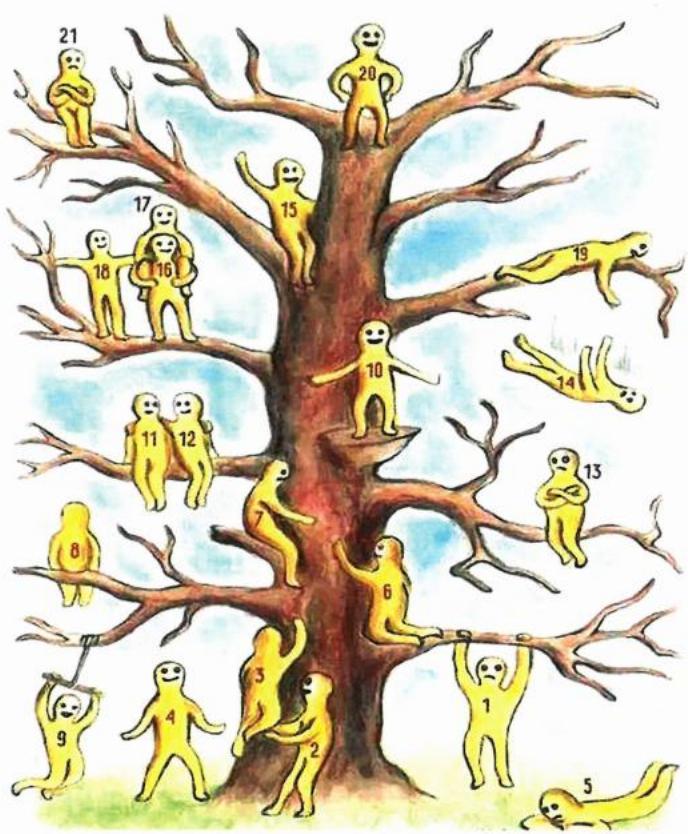
21 Little People Standing in a Tree, Where Would You Choose to Stay?
Choice 2: You are a sociable person and willing to give unlimited support to good friends.
Choice 3: You are a positive person who continues to move forward when encountering difficulties, and you can currently feel support and help.
Choice 4: You long for a stable living environment and a comfortable lifestyle, hoping there are no obstacles on the road to success.
Choice 5: You often feel tired and powerless, yearn for comfort, and have no motivation for life.
Choices 6, 7: You are a positive person who has already achieved some success and is still moving forward.
Choice 8: You love to immerse yourself in your own world, finding satisfaction in your imagination, and do not care about others’ opinions.
Choice 9: You are a happy-go-lucky person who loves to play and make mischief.
Choices 10, 15: You have certain requirements for your living environment and are relatively satisfied with your current status.
Choices 11, 12, 18, 19: You are a sociable person who can achieve goals through teamwork.
Choices 13, 21: You are somewhat eccentric, focus on yourself, prefer to close yourself off, and are not good at communicating with people.
Choice 14: You may be falling into a dilemma or unable to extricate yourself from the abyss of a relationship.
Choice 16: Good at comforting others, willing to give, but you yourself also often need the attention of others.
Choice 17: Often feel tired and need the support of others. Or lack a sense of autonomy.
Choice 20: Long to be a leader, feel personal advantages and achievements, hope others have an obedient and led relationship with you, and may also have an arrogant character.
Psychology is the science that studies human psychological phenomena, and it is highly practical. Psychologists can obtain your deepest true thoughts through various tests. Various forms of psychological tests popular on the internet are not real psychological tests; they can be called fun psychological tests. They skirt the edges of psychology, utilizing the psychological projection techniques of psychological testing. They should only be treated as games. Standard psychological tests have a lot of clinical significance, so one should still go to formal institutions to receive testing. Although these fun psychological tests are not recognized by rigorous scholars and have little reference value for actual psychological analysis, they do not view this kind of entertainment, an event to make netizens laugh, as “pseudoscience.”
Psychology as a compulsory subject for educators is not boring; on the contrary, just like potential development, it is full of magic everywhere. For example, in the 2018 CCTV “Impossible Challenge Season 3,” Dr. Yan Hu saw through people’s hearts through their paintings, which was amazing. These connections hidden in external things and people can reveal certain patterns to judge a person’s personality and thinking patterns. In this way, psychologists also have the ability to “tell fortunes.” We can use this kind of “fortune telling” to “calculate” our inherent patterns, understanding, knowing, and discovering ourselves more clearly, thereby possibly changing ourselves.
[Impossible Challenge Season 3] Yan Hu searches for clues in paintings to identify people with precision, shocking the audience
Yan Hu is a leading expert in the field of drawing psychological technology in China. He treats paintings as people’s second language and understands the decoding password of paintings. This technology is based on a large amount of psychological foundation, including projection tests known by many people. When it comes to projection tests, many people might associate them with fixed-form tests such as the Rorschach Inkblot Test, House-Tree-Person, and Draw-a-Person. But in fact, the key to projection tests lies in human free association. Only when a person cannot think of specific associative content for a while, or does not know where to start, is an ambiguous, unstructured external stimulus needed to guide the generation of associations.
Most projection tests provide initial materials that are often static images, which are then described and interpreted by the subject through free association. In this process, the content of our automated thinking, originally hidden in the subconscious world, is presented. Even without applying additional intervention during this process, the mere process of “presentation—perception” can already have a significant impact on our psychological state.
When people delve into various phenomena with a scientific attitude, the patterns within them will emerge, and boring psychological theories will become vivid and interesting. There are many such interesting psychological tools that can effectively explain and solve psychological problems in education, teaching, life, and work. Besides formal psychological counselor courses, there are applied psychology tools such as NLP, Family System Constellations, Satir, and Home Chess (Jiaqi) technology. Any one of them, as long as you are interested and study and practice deeply, can allow one to witness miracles.
7.1.2 Multiple Intelligences to Understand in Whole-Brain Education
The “Long Board Theory” is also known as the “Long Board Effect” or the “Anti-Bucket Theory”. It means that one should not focus too much on the short board of the bucket, but rather concentrate on the long boards, identify the longest one, and even lengthen it further,
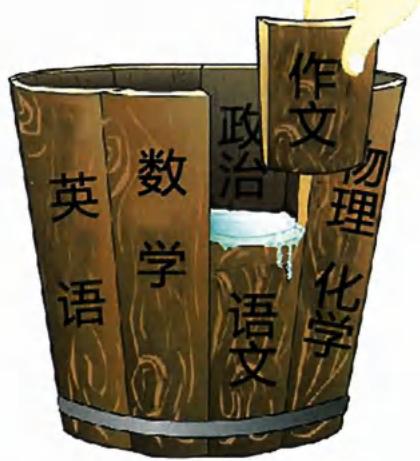
Bucket Theory: “A single short board affects exam success”
allowing the function of the long board to be maximized. For an individual, the longest board in the bucket (relative dominant intelligence) is the foundation of success, while the shortest board (relative inferior intelligence) is the root of failure. The “Long Board Theory” holds implications of materialist dialectics and systems theory within groups and society (see Figure Long Board Theory: “We only lack a long board”). For example, in the story of Tian Ji’s horse racing during the Warring States period, Tian Ji’s three horses were individually inferior to those of the King of Qi. If following the logic of the “Bucket Theory,” the outcome of Tian Ji’s race would depend on his slowest horse—which was slower than any of the King’s horses—meaning Tian Ji would undoubtedly lose. The racing strategy proposed by the strategist Sun Bin is well known: have Tian Ji use his lower-class horse against the King’s upper-class horse, his upper-class horse against the King’s middle-class horse, and his middle-class horse against the King’s lower-class horse. The result was that Tian Ji won the match. From this case, we can grasp the core utility of the “Long Board Theory,” which is that the short board is not short,
the long board is longer, and both lengths have their uses: “engage with the main force, win with the surprise force.” Applying the “Long Board Theory” to education means that after discovering an individual’s talent, efforts are concentrated on cultivating it, allowing for specialized learning and becoming a leader in a professional field. This serves as the foundation for establishing a career and securing a job, doing what one loves, and maximizing the achievement of a fulfilling life. As for one’s deficiencies, one no longer needs to exhaust all effort to compensate for them.
In the short term, students’ entrance exams are constrained by the Bucket Theory; in terms of long-term development, human happiness stems from one’s strengths. The Long Board Theory is not suitable for all people and groups, nor is it suitable for all stages of a person or group, but the Long Board Theory provides us with a direction of thinking, and we should apply it based on actual circumstances.

Long Board Theory: “We only lack a long board”
7.1.3 Foundations of Brain Science
Understanding the brain is rapidly changing our educational concepts. It has taken only a decade or two to move from focusing solely on children’s behavioral performance, to focusing on their potential development and inner world, and then to focusing on their brain function development. Currently, various curricula and the internet are flooded with numerous “neuromyths”—accepted notions that result from misunderstanding and erroneous inference. Examples include: the brain is only 10% utilized; brain plasticity stops after age 14; and Makoto Shichida’s claim that “the right brain develops first and the corpus callosum grows to the left brain only after age 3.” Potential development has created a greater need for counselors to understand brain science; they can be described as explorers at the forefront of Neuroeducation (or Educational Neuroscience). Neuroeducation is an interdisciplinary integration that combines neuroscience, psychology, cognitive science, and pedagogy, attempting to create more effective educational methods, curricula, and learning styles, ultimately influencing the development of education. This science provides valuable explanations and theories for certain phenomena in potential development education, helping more students benefit from potential development.
7.1.3.1 Basic Structure and Function of the Brain
The brain constitutes the material basis of consciousness and psychology; education inevitably links biological science, cognitive science, and developmental science. The science of the mind, brain, and education is called Educational Neuroscience or Neuroeducation. The functions realized through potential development are, fundamentally, the result of brain activity, and scientific explanations must ultimately be achieved through breakthroughs in brain science. The combination of Electroencephalogram (EEG) technology and functional Magnetic Resonance Imaging (fMRI) technology means that these cognitive neuroimaging technologies will provide inspiration for all aspects of education.
Educators need to understand at least some knowledge of the structure and function of the brain. The brain accounts for about 2.5% of total body weight, yet its energy consumption accounts for approximately 20% of the body’s total energy consumption, a ratio 10 times that of other body organs. The brain is composed of hundreds of billions of cells, which fall into two types: neurons and glial cells. Neurons have many wire-like axons that transmit electrical pulses generated by neuronal “firing” to another neuron. Each neuron connects to thousands of axons of other neurons, so intercellular communication forms very complex neural pathways (as shown in the neural network diagram). Glial cells, or neuroglia, occupy more than half the volume of the brain and far outnumber neurons; their primary function is to provide structural support for neurons, as well as to generate the insulating, protective sheath for axons—the myelin sheath.
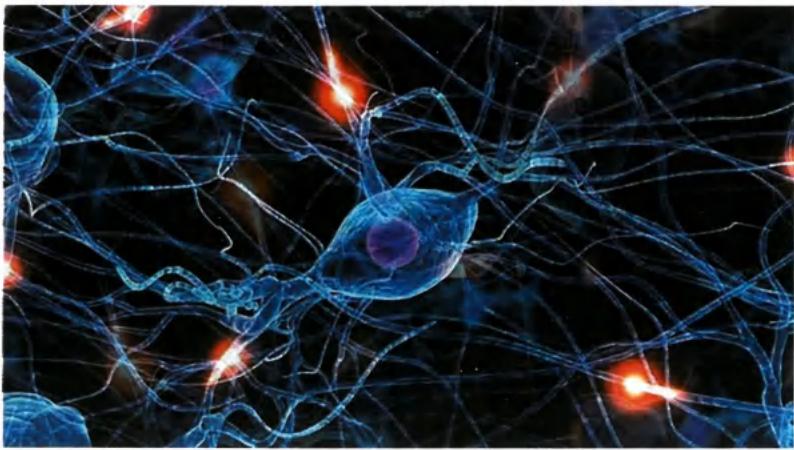
Neural Network
The hypothesis of the “Triune Brain” theory mentioned in Chapter 1 of this book was born more than 50 years ago and still holds significant importance for explaining human cognition, psychological analysis, and neuroscience research (see Table: Triune Brain Theory). From a modern perspective, the “Triune Brain” hypothesis is a simplified model in the field of neuroscience; although from a purely scientific standpoint it has some inaccuracies, it remains one of the theoretical hypotheses closest to the truth: the Neocortex (neomammalian brain, human brain, rational brain) controls cognitive functions, including language comprehension, learning and memory, reasoning, and planning, etc.; the Paleomammalian brain (emotional brain, intermediate brain, limbic brain) relates to social, reciprocal, and parenting behaviors that have been present since early mammals; the Reptilian brain (reptilian brain, instinctual brain, basal brain, brain stem) is associated with territorial protection, ritualization, and other similar reptilian behaviors.

More than a hundred years ago, education was not yet a science; the first person to view education as a science and conduct empirical research was the psychologist Piaget. Over the last century, pedagogy has evolved through psychology, cognitive science, and learning science. Entering the new century, pedagogy and neuroscience have linked together to form Neuroeducation. Similar to medicine and engineering, Neuroeducation is a highly practical applied science aimed at solving problems. Science is constantly moving forward; research on child development over the past decade has provided us with much new knowledge, particularly findings in cognitive neuroscience, molecular biology, and developmental cognitive neuroscience, which have changed many traditional concepts regarding child development. Through the discovery of brain development and movement patterns, the effectiveness of educational activities can be scientifically observed. Therefore, Neuroeducation can change the direction of national education policy discussions, alter learning and teaching models and teacher training models, and change how parents raise their children.
Potential development education activities should not rely solely on intuitive, feeling-based deduction, but must have a scientific basis. It is necessary for potential development educators to understand the specific structure of the brain, as well as the construction and function of each part (see the Cerebral Cortex Structure and Function Diagram and the table below), to lay a foundation for further research and exploration in teaching activities, and to avoid making principled errors when explaining the brain to parents and students.
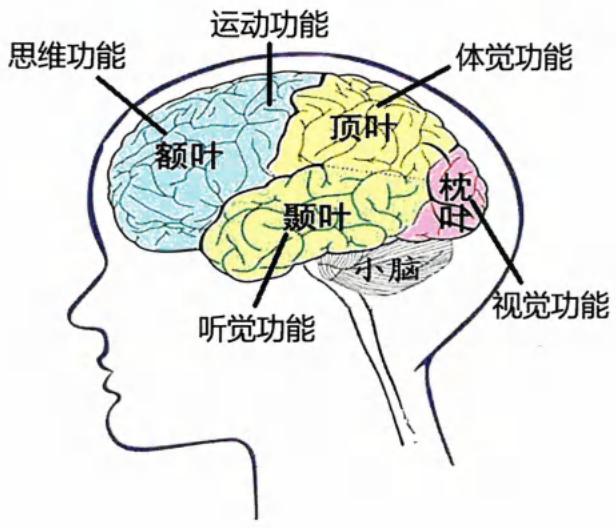
Cerebral Cortex Structure and Function Diagram
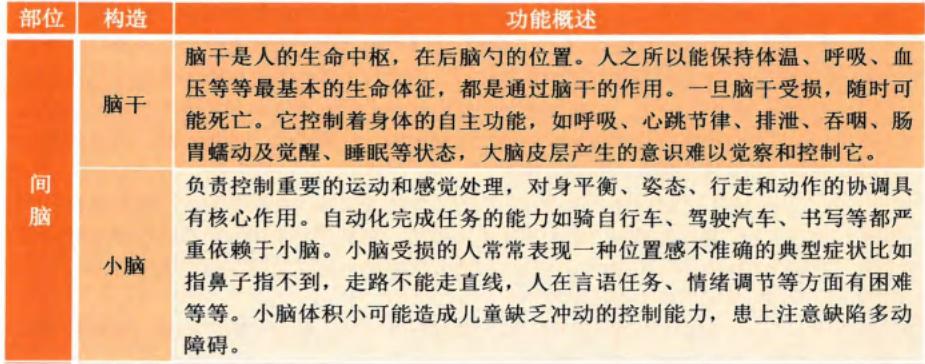
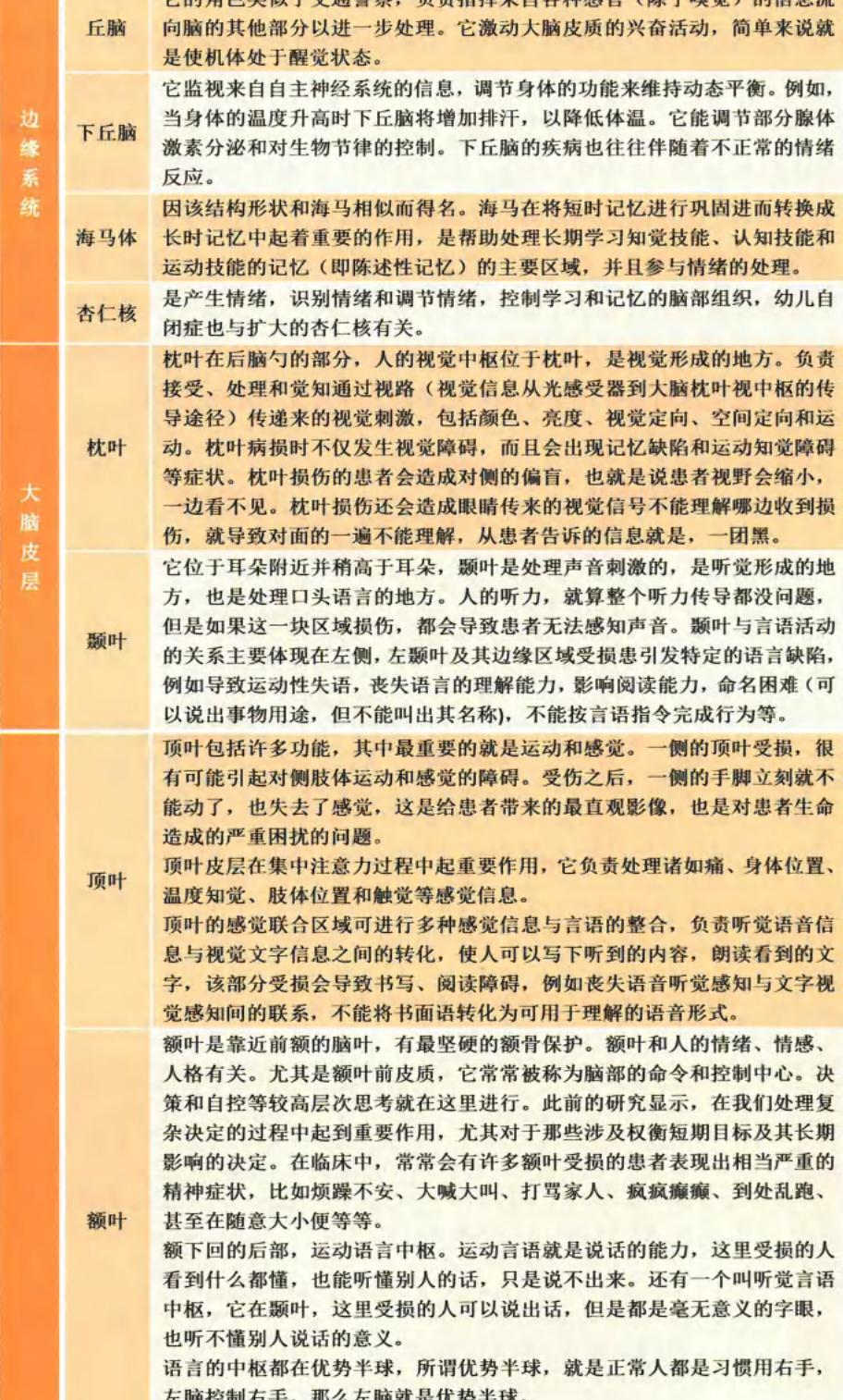
Due to the special status of the prefrontal lobe, we need to understand it a bit more. The prefrontal lobe of the cerebral cortex (the area of the cerebral cortex behind the forehead, as shown in the functional diagram of the prefrontal cortex) is unique to humans; it is the physiological characteristic that allows humans to have more complex thinking than other animals and the best-evolved part of humans. Besides this, the brains of primates, mammals, birds, reptiles, and other animals can all find corresponding structures in the human brain. The prefrontal lobe is the part that has changed the most during primate evolution; as primates evolved into humans, brain capacity doubled, and the increase is mainly reflected in the cerebral prefrontal lobe becoming larger and larger. From the perspective that matter determines function, there is some truth to the saying that people with large foreheads are smart. Memory, language, intelligence, personality, judgment, analysis, thinking, information integration, goal planning, error correction, and other functions are closely related to the prefrontal lobe, as is the role of making activities subordinate to firm intentions and motivations.
Functions of the Prefrontal Cortex
· Working memory (working memory) · Decision making (decision making) Attention regulation (attentionregulation) Abstract rules (abstractrule) Plan & strategy (plan&strategy) Problem solving (problem solving) · Social behavior (social behavior) · Behavioral inhibition (behavioral inhibition)
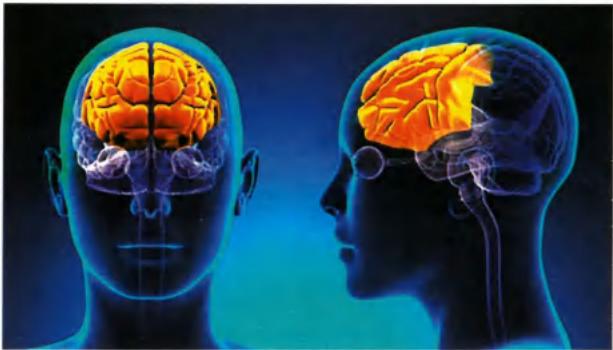
7.1.3.2 Neural Plasticity
Neural plasticity refers to the ability of the nervous system to alter its own structure in order to constantly adapt to changes in the external environment. Throughout our entire lives, neuronal cells are extending new dendrites, growing new axons, forming new synaptic connections, and modifying or pruning existing neural connections. The interaction between genes and the external environment causes our brains to change continuously with our experiences. Just as muscles are strengthened through continuous exercise, the network connections in our brains are strengthened through continuous use.
Our brains are constantly changing the connections of internal neural circuits in response to external stimuli; it is the product of the interaction between the environment and genes: our beliefs generate behaviors, and these behaviors in turn modify the structure of the brain; nature (genes) determines a certain behavior, and this behavior then turns back to change the brain. For example, reading changes the brain; the brain activation areas differ between illiterates and literates when processing textual information. Writing was an invention of 5,000 years ago, something our ancient ancestors did not possess. Some have said: the fact that humans can read is a miracle. The human brain did not evolve to read, so regardless of the writing system, approximately 6% of people cannot read (i.e., dyslexia)①. When reading, the brain basically recruits many areas originally responsible for other functions to handle text processing, just as the area originally responsible for processing faces is now responsible for identifying text. A flexible brain is like a capable chef: when cooking, if there is no ginger, use scallions instead; if there is no salt, use soy sauce instead. It is function-oriented; areas with the same function can substitute for one another. We have all had this experience: you are driving to a certain place and the main road is blocked. At first, you stay there not knowing what to do, then you find an old road, cut through farmland, bypass a broken bridge. The more often you travel the small paths, the better you become at finding shorter shortcuts to reach your destination. Similarly, the brain also finds corresponding pathways.
The brain possesses numerous neural circuits; a so-called neural circuit is the connection between neurons that work together to perform a certain task. If a certain important circuit is broken and cannot be used, the brain uses other small paths to bypass it to reach the destination. Various thoughts are produced in our brains every moment; each new thought is a new path, except that most thoughts only occupy a small amount of attention before hurriedly passing through our minds, and the new paths quickly dissipate like smoke, leaving few traces.
The formation of vision occurs in the visual center of the occipital lobe of the cerebral cortex, not in the eyes. Opening the door of neural plasticity allows us to see that it is actually the brain, not the eyes, that sees; as long as there is a method to send external information into the brain, the brain can see even without eyes.② In the period of childhood development, when the eyes are blindfolded, new channels for forming vision may be opened up, allowing one to “see” without using the eyes. However, when the eyes are opened, if the newly opened channels are not reinforced and frequently used, they will naturally “use it or lose it.” The process of forming a new habit is also a process of continuously reinforcing new paths in the neural network; its essence is a battle for attention. The more often attention flows through the new path, the more often the new path is used, the more it is reinforced, and the easier it becomes to capture attention. The old path naturally weakens until it fades from our subconscious, and the old behavior occurs less and less frequently until it no longer appears. This is somewhat like the Yellow River, which experienced countless course changes over thousands of years before forming its current flow path in 1946.
Wei Kunlin, a professor in the Department of Psychology at Peking University and a scientific judge for The Brain, wrote in the preface to The Brain That Changes Itself: “I have seen many contestants with ‘special brain functions,’ including ‘geniuses’ in the general sense, ‘experts’ developed through practice, and ‘marvels’ with physical defects and obstacles who possess special abilities beyond the reach of normal people.” “Use it or lose it” is the basic law of the brain. Even if one is naturally gifted with superior mental power, one usually still requires hundreds or thousands of times of hard practice to establish new and firm neural connections in the brain. For example, Wu Guangren, the oldest contestant in Season 2 of The Brain at 70 years old, reshaped his brain through training, thereby escaping the threat of senile dementia (this case is introduced on page 254 of this book).
The brain possesses extreme plasticity. For paths in the brain’s neural network that are frequently used, the connections between neuronal synapses are strengthened, making it faster and easier for attention to enter these paths; whereas for infrequently used paths, the connections between neuronal synapses will slowly weaken, or be replaced by connections of new paths. This explains why, through training, we can master complex skills such as playing the piano and riding a bicycle, and also explains why those infrequently used memories become increasingly blurred and slowly fade from our brains. Brain plasticity means that the more frequently used, the stronger the connection; the infrequently used are submerged by weeds. When a child learns to play the piano, the first time, he will use the strength of his whole body, such as his wrists, arms, shoulders, etc., to play every note, and even the muscles on his face will be tight. Soon, he will use only his fingertips to play. After a while longer, he develops an elegant and relaxed way to touch the keyboard, playing as freely as flowing clouds and water. This is because the child goes from using many neurons to using only the appropriate neurons to do one thing; when we become more proficient at a certain task, the efficiency of neurons also becomes higher.
We praise people for being able to multitask. You can certainly study while multitasking, but multitasking will not produce permanent changes in your neural remodeling. In many experiments, it has been found that long-lasting change effects appear only when monkeys focus intently on doing one thing. When animals perform a task automatically without focused attention, their brain maps will change, but this change will not be permanent.
Precisely because the human brain is so highly plastic, we should all the more consciously cherish and shape our own brains, establishing positively oriented neural connections and avoiding negatively oriented neural connections. It is precisely because of neural plasticity that you need to be cautious in your actions at all times, because every experience forms a connection in the brain and leaves a trace. For example, once an internet addiction is formed, it is difficult to eliminate the brain’s craving for going online.
We must also know that there is no such thing as learning in one step; it requires hard work. Every one of our experiences is changing the connections in the brain. The saying by Confucius, “Review the old to learn the new,” now has its neural mechanism visible in the brain.
7.1.3.3 Sensory Integration Dysfunction
As more and more miraculous phenomena emerged within potential development institutions and their influence grew, parents discovering special issues with their children also arrived attracted by the reputation, seeking help. These “problem children” seem to have psychological issues, yet not exactly like a mental illness; seem to have problems with brain nerves, but parents state categorically that they do not. Can potential development help such “problem children”? What exactly are the problems of these “problem children”?
Once these parents start talking, they complain that their children are always not focused when doing things, do not study seriously and love to lose their temper; educating them is a huge headache, and the result is that they cannot help but roar at the child, which serves no corrective purpose at all. Other children show lack of concentration, poor physical coordination, hyperactivity, nail-biting, love to lose temper, reading difficulties, poor language development, irritable temperaments, unsociable nature, etc. Manifested in their studies, they are often forgetful; they dawdle over homework, writing while playing; they do not pay attention to details, and lose points on questions they know how to answer due to carelessness; in class they do not listen attentively, have many small movements, and often look around or zone out; when reading, they skip words and lines, and miss questions on exams; their writing often goes out of the lines or boxes, the pen movement is not smooth, they write characters backwards (e.g., writing b as d or p, writing 阮 as 顽, writing 防 as [missing character]) etc. Whether in daily life or studies, such children require much more parental worry than their peers. This easily produces corresponding chain reactions, causing the child to lack self-confidence, become withdrawn, irritable, or struggle to integrate into a team. Most of these children have no defects in intelligence, but they often have difficulties in learning and action, and therefore may be mistaken for intellectual developmental deficiency. If a child has the above situations, they may be suffering from Sensory Integration Dysfunction (see Figure: Phenomena of Sensory Integration Dysfunction).
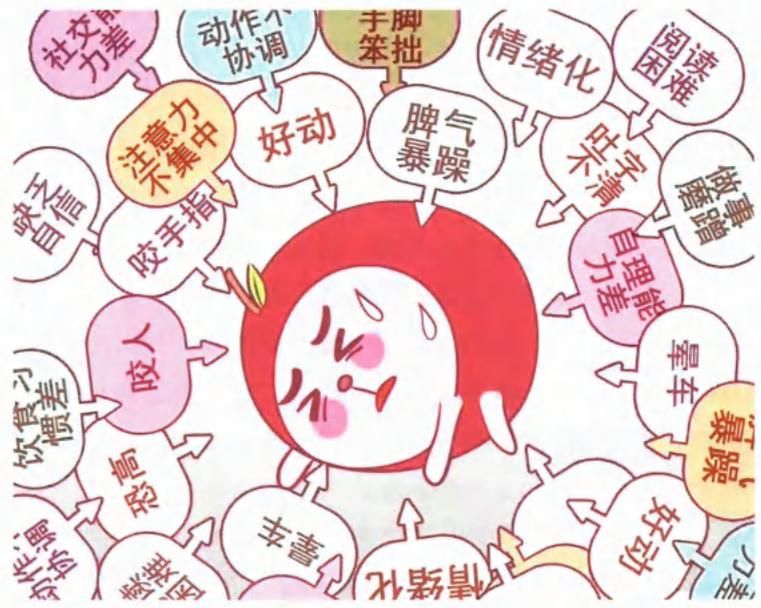
Phenomena of Sensory Integration Dysfunction
The full name for Sensory Integration Dysfunction is Sensory Integration Disorder. The full name for Sensory Integration is Sensory Integration itself. Sensory Integration is a function of the brain; Sensory Integration Dysfunction is a type of brain function disorder, also known as a learning disability. Sensory Integration is actually the ability of our body to input information from various sensory pathways—including vision, hearing, taste, smell, touch, vestibular sense, and proprioception—into the brain. Our brain then processes, handles, compares, connects, and unifies this input information, so that different parts of the nervous system can coordinate the overall work, and the body makes an adaptive response. Only through sensory integration can different parts of the nervous system coordinate their overall effect to allow the individual to make smooth contact with the environment; without sensory integration, the brain and body cannot develop coordinately. Children with Sensory Integration Dysfunction mostly have normal intelligence; it is just that the coordination between the child’s brain and various parts of the body has obstacles, preventing many excellent aspects from being manifested.
The causes of Sensory Integration Dysfunction are divided into two types: congenital causes and acquired causes. Congenital causes are mainly premature babies and children born via C-section, where the nervous system development is not perfect, and the lack of compression through the birth canal causes tactile dysfunction; also, incorrect posture or mindset during pregnancy, or medication and injections causing harm to the fetus. There are relatively more acquired causes, for example: due to family and urbanized life, the activity range of children has become smaller, and parents’ cautious parenting styles greatly restrict the child’s exploration behavior; adults overprotect young children, handling everything for them, leading to incomplete information reception by the child; parents are too busy and provide little companionship, causing insufficient sensory stimulation for the young child; after birth, the child did not go through the crawling stage and learned to walk directly, producing vestibular balance dysfunction; parents or nannies do not let children play with soil or sand, fearing dirt, thereby causing a lack of tactile stimulation for the young child; using a walker too early, causing insufficient vestibular balance and head support strength; parents’ expectations are too high, discipline is too strict, artificially causing too much pressure on the child, too little free activity time causes psychological harm, producing the frustration of “pulling up seedlings to help them grow” (dashing them ahead of schedule), etc.
According to reports, in modern urban families, the proportion of children with more or less existing Sensory Integration Dysfunction is as high as over 85%, of which about 20% are severe. When the child is young, through appropriate parenting methods, such as games, outdoor activities, sports, etc., children with mild Sensory Integration Dysfunction can achieve relatively good improvement. If the dysfunction is relatively severe, it is necessary to help the child improve through training. The methods of Sensory Integration Training are actually relatively easy to master. If parents have patience and perseverance, training the child at home can completely achieve the effects of a professional institution. It is generally believed that conducting Sensory Integration Training for toddlers before the age of 6 will have particularly obvious effects; this is the golden period for Sensory Integration Training. 6~9 years old is the remedial period for Sensory Integration Training, and 9~12 years old is the final period. After 6 years old, the child’s behavioral patterns begin to solidify. If there is not enough training time and intensity at this time, the effects will also be greatly discounted. Usually, phenomena of Sensory Integration Dysfunction are easier to correct through training before the child is 12 years old; once over 12 years old, it becomes定型 (set) and difficult to change.
The various dissatisfactions after growing into adulthood and the various situations appearing in life may be the “root cause” buried by Sensory Integration Dysfunction in childhood. For example, easily getting carsick, seasick, or airsick, feeling uncomfortable and nauseous when smelling gasoline, or even getting dizzy on escalators and elevators, is mainly related to vestibular dysfunction; easily falling off the bed, or waking up from a sleep not knowing how many times one turned on the bed, sleeping with the head and feet swapped, pillows flying everywhere, is mainly related to proprioceptive dysfunction; disliking noisy crowds, preferring solitude, being timid and unsociable, shallow interpersonal relationships, lack of self-confidence, may be related to tactile dysfunction; poor sense of direction, easily getting lost, often unable to distinguish left from right, being panicked by left/right turn commands during military training or PE class, is mainly related to spatial orientation perception within proprioceptive functions, etc.
Sensory Integration Dysfunction will not naturally disappear with the growth of age, so it is necessary to provide necessary correction as early as possible before the child is 12 years old. The related courses of potential development do not explicitly include correction training for Sensory Integration Dysfunction, but for training children before 12 years old, especially before 9 years old, the instructor only needs to do some in-depth exploration to integrate relevant training into the potential training curriculum system, which will also play a better role in potential development.
Children with mild Sensory Integration Dysfunction mostly have normal intelligence, but their intelligence levels are not fully developed, so there are obstacles in learning, sports, social adaptation, and other abilities. For children with severe Sensory Integration Dysfunction, many functional areas of the brain cannot operate normally in synergy, which may affect intellectual development. Ishaan in the Indian movie “Taare Zameen Par” (Like Stars on Earth) is a boy with severe Sensory Integration Dysfunction. He couldn’t tie shoelaces, couldn’t button buttons, threw a ball miles off target, often conflicted with classmates, and was easily distracted in class. Even more frustratingly, he could not read or write normally, and every exam score was in single digits. All teachers and even his parents lost confidence in him. Fortunately, he met an excellent teacher who conducted a series of targeted corrections on Ishaan, making him an excellent child. Such children with severe Sensory Integration Dysfunction may be a very big challenge for educators.
Child lacks concentration Beware of “Sensory Integration Dysfunction”
Sensory Integration Dysfunction is not a disease, but a symptom. It is important to note that behind it may be hidden some neurological or psychological diseases, requiring a diagnosis at a hospital. Some cannot just do Sensory Integration Training, thereby delaying formal diagnosis and treatment (see Video: Child lacks concentration Beware of “Sensory Integration Dysfunction”).
7.1.4 Meditation Reshapes the Brain
Meditation is an essential component of potential development training. It not only enables students to improve their concentration, imagination, and introspection, but also promotes better physical health and higher academic performance. Even the counselors and parents who frequently guide students through meditation training will clearly feel that their own minds have become clearer, sharper, and more relaxed than before. Meditation is not only a required course for students but also a daily practice that counselors and parents must cultivate.
Since entering the 21st century, neuroscience has conducted in-depth research on meditation, sitting meditation, and Zen practice. In laboratories, researchers have used electroencephalograms (EEG) to measure changes in brain waves and functional magnetic resonance imaging (fMRI) to measure the locations of brain activity. The final conclusion is that through meditation and meditative contemplation, not only can brain activity be altered in the short term, but it is also very likely to induce permanent changes in the brain. These experiments can be found in two books introducing neuroscientists’ research on Zen contemplation in recent years: Zen and the Brain (by J.H. Austin, translated by Zhu Naixin) and Meditation and the Brain (by Zhu Naixin). For example, in 2007, the University of Wisconsin in the United States used functional magnetic resonance imaging (fMRI) to study changes in brain function caused by meditation, with senior Buddhist practitioners as subjects. The study found that meditation can reshape the brain, enhancing compassion and joy. In the same year, scientists at Emory University also used magnetic resonance imaging to study Zen meditation. Research found that meditation can prevent brain aging, atrophy, and the decline of attention. In 2009, Danish scientists also conducted research using magnetic resonance imaging; they looked not only at the entire brain but also at the brainstem and cerebellum. Their subjects were people who practice breath-awareness meditation. The experiment found that long-term meditation can not only alter the structure of the brainstem but also improve cardiopulmonary and other nervous system functions. In summary, modern neuroscience continues to prove: “The finding that meditation is beneficial to the human body aligns with the latest research results in the field of neuroscience—through meditation, the adult brain can still undergo significant changes.” ①
Zhu Qingshi, an academician of the Chinese Academy of Sciences and former president of the University of Science and Technology of China, said in an interview with media personality Liang Dong (see video Zhu Qingshi in Dialogue with Liang Dong: Meditation Reshapes the Brain): “For people who meditate long-term, the thickness of the cerebral cortex generally increases. Regarding the functional areas (cortex) of the human brain, the deeper the sulci and the more numerous the gyri, the more intelligent the person. Meditation allows people to eliminate distracting thoughts, greatly enhance their concentration, and delay the thinning and atrophy of the cerebral cortex caused by aging. To summarize their research in one sentence: Meditation can reshape the brain.”
Zhu Qingshi in Dialogue with Liang Dong: Meditation Reshapes the Brain
In fact, what meditation reshapes is far more than just the brain. In psychology, there is a term called ideo-motor action, which refers to movement generated during the process of imagery (imagery is simply mental imagery, just a different term), also known as ideo-motor action or action-by-thought. For example, when the right arm is not bent, but the image of bending the right arm appears in the mind, the biceps of the right arm will undergo weak contraction. When a person holds one end of a thin thread with a small ball suspended from the other end, and simultaneously imagines the ball moving in a circle, the ball will actually sway slightly in a circular motion; these are ideo-motor actions. Soviet physiologist K.M. Bykov, while researching meditation, discovered that when the image of running appears in an athlete’s mind, the bioelectric currents in the quadriceps of both legs change; when the image of playing appears in a violinist’s mind, the bioelectric currents in the muscles of both hands and the motor centers of the cerebral cortex also undergo obvious changes. This indicates that the excitement of motor imagery on the “brain screen” during meditation in the cerebral cortex triggers motor impulses, which is the physiological basis for producing ideo-motor actions. It can be said that ideo-motor action is a conditioned reflexive response. The development of sports has promoted research into the mechanism of ideo-motor action, and ideo-motor action has been widely applied in athlete training. In recent years, Chinese psychologists have used motor imagery during meditation to regulate overt movements for psychological training of athletes, achieving good results.
Our cerebral cortex has ninety billion neurons. After receiving stimulation, neurons generate brain waves, which affect neurotransmitters and various hormones. These hormones can cause the body to produce various reactions and states. This series of reactions and states triggered by stimulation forms a mapping relationship and is stored in genes. Through meditation, by actively establishing mapping relationships and reinforcing desired ones—allowing neurons with positive associations to become stronger and those with negative associations to become weaker—we can improve gene expression. Gene expression can regulate all physiological states of the human body. Meditation can alter gene expression; since it can alter gene expression, it can regulate one’s own body (see video How Consciousness Affects Life).
These studies show that when we learn how to think or perform movements, our brains change through the process of neuroplasticity. Just as the skill of playing a musical instrument becomes more refined, the region controlling finger movement in the brain of a pianist grows larger day by day. Similar processes of change occur when we meditate. The surrounding environment remains unchanged, but the meditator achieves a state of inner fulfillment by adjusting their mental state. This is an experience that can influence brain function and its physical structure. Evidence collected from research indicates that meditation can rewire certain neural circuits in the brain, not only benefiting the mind and brain but also benefiting the entire body.
How Consciousness Affects Life
7.1.5 Accept All Phenomena in Potential Development Teaching
In their teaching practice, potential development coaches will encounter various magical and exciting things; they will also encounter situations where students stop making progress or cannot learn despite trying, which is confusing and frustrating; they will also encounter unexpected, jaw-dropping, ridiculous, and bewildering situations.
Many coaches have asked me the same question: “A student (who is excellent in terms of potential functions) suddenly loses all abilities. Why? What should be done?” I have actually encountered this problem myself. Some cases are due to changes in the family, some are due to discouragement from parents, teachers, or classmates, some are due to the student’s physical condition, and for some, no clear reason can be identified, so the “why” question is difficult to answer. Regarding the “what to do” question, an excellent coach must first have an accepting mindset. Accept what? Accept all that you do not accept. A student’s performance may trigger your liking, disliking, avoidance, or depression; these are actually forms of non-acceptance. Acceptance is an equanimous mind, and only through acceptance can wisdom arise. Whether a student performs well or poorly, it should not affect you, because you must continue regardless. The reason one cannot continue is often the refusal to accept the student’s current state, leading to uncertainty about how to proceed. When you can accept the student’s performance and face it with an equanimous mind, then just do what needs to be done!
The concepts of acceptance and non-acceptance above may seem convoluted. But if you calm down and slowly experience it, acceptance allows you to settle down, and only when settled can wisdom arise to solve problems. Methods told to you by others are always theirs; you might say their method is right or wrong, but actually, what others say is just their own experience. If you still do not understand this passage, you can recite the following sentence like a mantra three times, and the next day you will know what to do. This sentence is: “It is so, it is so, and this is also okay.”
Excellent coaches are those who can objectively analyze and treat all problems they face. Let us look at how the predecessors of potential development training did it:
In 1982, research institutions from nearly twenty universities nationwide conducted joint tests on special visual perception (mainly “ear reading”; blindfolded reading is more elementary than ear reading and belongs to a game level). The tests were very rigorous, proving that special visual perception objectively exists, but they also discovered many problems. These problems still exist today, not only in the field of human body science research but also frequently encountered during potential development education. Let us look at the test results from that time:
A total of 11 people participated in the test, and the results were divided into three types.
A. Unsuccessful, no cheating, 4 people, recognized characters 80, success rate zero. B. Cheating, 3 people, recognized characters 100, success rate zero. C. No cheating, 4 people, recognized characters 155, correct 73, with the lowest success rate being 60% and the highest 95%.
The experimental results indicate that the human body’s special visual function has reproducibility. However, this reproducibility is not “随时” (at any time) like physical or chemical experiments, but is conditional.
(1) Individual differences: The strength and stability of functions vary significantly among different subjects.
(2) Function decline: The functional status of some subjects has declined significantly compared to one or two years ago. This indicates that the functional status of the same subject may vary in different periods. There are also some subjects whose original functions declined significantly after developing a new function. This indicates that while those with human special visual functions are not isolated cases, those with stable functions over a long period are rare. Therefore, how to induce, stabilize, and improve subjects’ functions and prevent decline is a topic worthy of attention in research work.
(3) Fluctuation of functional state: Subjects cannot yet fully control themselves to enter the functional state at any time, nor can they sustain experiments without fatigue. Their functional state manifests as obvious fluctuations and intermittency. The causes of this phenomenon may be very complex. Factors such as physiology, psychology, energy consumption, and environment should be considered. We have not yet grasped the laws regarding this, and there is a high degree of blindness.
In this joint test, we repeatedly discovered instances of cheating by certain subjects (among the 11 subjects, 3 were found to be cheating). Their methods of cheating were very ingenious. It should be pointed out: certain subjects who were confirmed to have relatively strong special functions under strict experimental conditions were also found to have cheated. We should carefully distinguish between the true and the false. The “issue of cheating” is a problem worthy of serious attention and a very complex one, involving social, psychological, educational, and scientific aspects. It includes studying the methods, causes, and prevention of cheating, and even how to cultivate a team of subjects with comprehensive development in morality, intelligence, and physique, and how to improve the literacy and level of scientific researchers.
Long-term systematic multi-faceted observation, experimentation, and tracking should be conducted on certain key subjects. Establish archives, including detailed records of physical condition, psychological condition, weather, solar terms, time, and test environment.①
Regardless of the circumstances, coaches must treat teaching practice with an equal and objective mindset. Although the proportion of school-age children who can activate the blindfolded reading function is very high, there will still be individual children who cannot activate it or achieve ideal results due to various reasons; some children cannot even see the light ball. For some children, these functions indeed cannot be successfully displayed at certain times, while at other times it is very easy. All these require summarizing experience through accumulated practice. For example, when there are many spectators, the environment is unfamiliar, or there is mental tension, the recognition time is long and the success rate is low; when in a happy mood and mentally excited, the recognition time is short and the accuracy rate is high; some girls find it more difficult during their menstrual period, etc. No matter what situation arises, when you face it with an accepting mindset, it is easy to discover certain patterns. Coaches must not be attached (obsessive) regardless of the circumstances; they must learn to accept all phenomena in potential development teaching practice, thereby summarizing and researching them.
7.2 Seeing Through Surface Phenomena — “Peeling the Onion”
What a person says and does are merely surface phenomena; preaching aimed at surface phenomena is ineffective education. Everyone has their own inherent patterns, and these inherent patterns determine a person’s language, behavior, way of thinking, etc. Only by breaking a person’s inherent patterns can they have more possibilities. To help students grow better, counselors must find ways to make parents and students aware of their own inherent patterns. What is an inherent pattern? How can one change their inherent pattern? How can counselors discover the inherent patterns of parents and students during teaching? Let us use a story to discover the core layer by layer, like peeling an onion.
At the 20th-anniversary class reunion after graduating from university, many classmates were meeting for the first time since graduation. Although their appearances had changed significantly, they could basically still call out each other’s names. Xiaoli was the class beauty back in the day, the object of many boys’ affection, and the envy of many girls. After graduating, Xiaoli was busy with work, taking care of her family, and looking after her children, bustling with activity. Time did not treat Xiaoli kindly; the gaze of others upon her grew less and less. At this reunion, she really wanted to experience once again the feeling she had when classmates looked at her in her youth. However, the sentence she heard most at this reunion was: “How did you get so fat!”
Xiaoli held back her tears with a forced smile until the reunion ended. When she got home, she threw herself on the bed and cried her heart out. Everyone, think about it, what does she want to do most at this moment? Of course, it’s to lose weight! So, she told her husband, child, and best friend: “I’m going to lose weight!” She started making a plan: starting tomorrow, wake up at 6 AM to start running!
Everyone think about it, when we encounter a person, how do we mainly recognize and understand them? It is through the person’s language and behavior. From the story just now, we can know what determines language and behavior? Is it thoughts? Then what determines thoughts? Let’s continue watching Xiaoli’s story.
Xiaoli made her plan: wake up at 6 AM tomorrow to run, what clothes to wear, the running route, and how long to run were all planned, so she went to sleep peacefully. At 6 AM the next morning, the phone alarm rang right on time. Xiaoli usually gets up at 7:30. Suddenly, the 6 AM alarm woke her up, and she felt very uncomfortable. She felt she was too sleepy; she thought she would let herself wake up a bit more before getting up, so she set the alarm to ring again in 10 minutes. Unexpectedly, Xiaoli fell asleep again instantly. At 6:10, the alarm rang again. Xiaoli sat up with her eyes closed, feeling she still couldn’t open her eyes. After hesitating for a moment, she set the alarm for another 10 minutes and lay down to sleep again. After another 10 minutes, the alarm rang again. Xiaoli felt very agitated; this time she simply turned off the alarm. Xiaoli’s husband woke up and said to Xiaoli: “Get up, get up and go running.” Xiaoli was a bit impatient and said aggrievedly: “I’m too sleepy today, I’ll run tomorrow.” So, Xiaoli went back to sleep soundly.
From the beginning of Xiaoli’s story attending the reunion to the failure of the first day’s running plan, what determined these thoughts? Yes, they were all determined by feelings or sensations, so a person’s thoughts depend on feelings or sensations. And what controls a person’s feelings or sensations? It is a person’s emotional control system. Humans have five basic emotions: worry, sadness, anger, fear, and joy. These emotions are shared by humans and animals; they are innate and not controlled by human thought. Among these emotions, there is one most powerful, most domineering emotion; when it comes, the other emotions run away. Think about which emotion it is? It is fear. No matter what other emotional experience a person is in—whether worry, joy, anger, or sadness—once the thing or situation that makes them fearful appears, these emotions will immediately disappear, and only fear remains, right?
Fear is the boss of all emotions, why is it fear? The reason humans fear is that they have no predetermined plan for emerging things, problems, and challenges, and cannot accept or face the consequences that will be produced; it is a reaction to the unknown. As the saying goes, “The barefoot are not afraid of those wearing shoes.” The barefoot refer to those who have nothing; they have nothing to lose, so they act without reservation; “those wearing shoes” have concerns, fear losing, and cannot go all out. In psychology, the definition of emotion is: emotion is a psychological phenomenon mediated by the subject’s needs, wishes, and other tendencies. In other words, the generation of all emotions is related to human desires; satisfaction brings joy, loss brings worry, sadness, or anger, and lack of a coping plan in the subconscious brings fear. So fundamentally speaking, emotions are determined by desires.
Desire is a requirement generated by human nature to achieve a certain purpose; it is a kind of craving and satisfaction from psychology to the body. Desire has no distinction between good and evil; the key lies in how to control it. Let’s think about Xiaoli’s story. When Xiaoli attended the class reunion, one of her desires was to “experience once again the feeling she had when classmates looked at her in her youth.” We can believe that the expressions of classmates back then could bring her satisfaction and joy, which shows that her psychological experience depended on others’ opinions and evaluations of her, rather than her internal self-knowledge. When at home without the evaluation of outsiders, Xiaoli’s plan to get up early and run could justifiably be cancelled, allowing herself to sleep soundly. This is essentially determined by her values. Therefore, a person’s desires are determined by their beliefs and positions, or rather, controlled by their worldview, outlook on life, and values. Belief is a person’s principles and stance in life; belief is believing what kind of person one is. When we believe what we are, we can control this desire. I am not a beggar because I do not believe I am one; if you believe you are a beggar, you can beg. No matter how difficult a person is, sometimes so poor that they are poorer than a beggar, but they do not go begging to become a beggar, it is because they believe they are not a beggar. This is called human principles and the stance of being a person. Everyone has principles and a stance in life; this power is stronger than desire. Sometimes people do not “do whatever they want” because there is energy that can control desire. The figure below is a person’s inherent pattern diagram. We call it the “Peeling the Onion” diagram. Understanding this diagram allows one to basically understand what a person’s pattern is like.
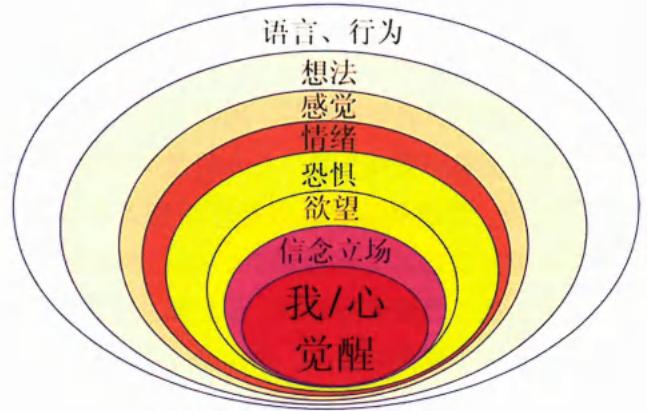
“Peeling the Onion” Diagram
When I was young, I heard a saying that when fighting, “the soft fear the hard, the hard fear the unreasonable, the unreasonable fear the reckless, and the reckless fear those who don’t value their lives.” Soft and hard are comparisons at the level of language and behavior; strength and weakness can be seen at a glance; those with a hard tone and hard fists are naturally more formidable; “unreasonable” refers to those who are unreasonable and act only according to their own feelings; people with a hard tone and hard fists will also be timid; “reckless” refers to being rash, speaking and acting without considering consequences. This kind of person doesn’t know what fear is; they will use bricks, iron bars, anything as a weapon, and no one dares to provoke them; “those who don’t value their lives” for a goal, can discard their lives, have no other desires, have firm beliefs and stances, and will not give up until the goal is reached. Such people are the most formidable. Of course, this example may not be very appropriate, but using the “Peeling the Onion” diagram to analyze a person’s behavioral pattern is effective. From the diagram, we can also know that to cultivate students, we must let them have firm beliefs and stances.
The functional development law of children developing their potential is “use it or lose it.” According to statistics, at least 80% of children will not persist in training after the age of 12. This means that the vast majority of “blindfolded reading” and other abilities once possessed will disappear. Why can’t they continue to persist in training? Some counselors say that often making children practice blindfolding and perceive makes the children bored. Why? There are many external reasons; as counselors, you can analyze and summarize them. For example, increased academic burden, the unclear relationship between training and learning, the training content’s lack of attraction to students, etc. External factors are basically influenced by the student’s internal factors. One of the more fundamental reasons is that their relevant beliefs and stances are not firm or have not been established, making them easily interfered with by external things. In 2019, there was a movie “Better Days”. The heroine experienced a series of shocking interferences in the last semester of her senior year of high school, but it did not affect her getting good grades in the college entrance examination. The reason she had a fierce energy in her heart was only because she had a firm belief: “Must get into a good university in Beijing.” It can be seen that the energy of a firm belief and stance is sufficient to control the layers wrapped around the outside of the “onion.”
Psychologists now refer to a newly discovered mental illness as “empty heart disease” (Kongxinbing), which leaves many counselors at a loss. Psychologists believe that this “empty heart disease” is caused by defects in values. A person’s beliefs and stance, values, worldview, and outlook on life may all sound rather ethereal, but these constitute the core of human thinking and behavioral patterns. So, is there anything that controls a person’s beliefs and stance? In the section “The Awakening of Life” in Chapter 6, we discussed that the human body, thoughts, and emotions are not “I”. When “I” or “Heart” manifests, a person is no longer bound by the body, emotions, or consciousness. In this state, it is relatively easy to establish a person’s beliefs and stance. This also indicates that within a person’s beliefs and stance, worldview, outlook on life, and values, there is something that can be regulated, which is “I” or “Heart”. Once the power of belief is developed, potential can be revealed; this energy is immeasurably large and very magical. This is the “awakening” of the self, nature, and heart. Only by cultivating oneself and establishing one’s destiny, while constantly looking inward, can one become a person of continuous awareness and firm belief. The significance of potential development in this regard is much stronger than ordinary educational means; the functioning of human potential relies on “I” or “Heart”, and nothing outside of this can achieve it.
A person’s inherent patterns are like an onion; peeling it back layer by layer clarifies who decides the表象 (manifestations) a person displays. For a counselor to be able to see deeper into the student’s “Heart” and help the student make their “Heart” brighter, they must first be able to discover and recognize themselves, thereby determining what kind of person they become. When a person achieves self-discovery and clear self-recognition, their life begins to awaken.
7.3 Overlapping Techniques — Hypnosis and Suggestion
7.3.1 Hypnosis and Suggestion
The functional state of potential is the result of the interaction between consciousness and the subconscious. Hypnosis is precisely a technique that deals with the human subconscious. Therefore, many of our potential development trainings seem no different to those who have studied hypnosis. If one truly understands hypnosis, it can equally be used to develop human potential. Because of this, some hypnotists even believe that potential development uses hypnotic techniques entirely.
Renowned Taiwanese hypnotist Liao Yuepeng once defined hypnosis: “Hypnosis is opening the black box of the subconscious, sweeping away negative repression, releasing negative energy, rewriting the body’s instinctive mode of operation, retrieving forgotten memories, and ascending to the higher subconscious to seek inspiration, gain insight, develop higher emotions, and even enter the realm of unity where the small self and the great self merge.” From this passage, one can perceive why hypnosis feels mysterious and miraculous to people. I believe Liao Yuepeng hadn’t focused on potential development when he wrote this, otherwise his definition of hypnosis would certainly have involved it. But regardless of how it is said, hypnosis is about mobilizing the human subconscious, and this is the consensus of all hypnotists.
We cannot perceive the subconscious, yet our every word and deed is basically influenced by it. Hypnosis is a means by which the subject surrenders part of their consciousness, allowing access to certain ideas or memories within their subconscious. After entering a hypnotic state, the subject will be guided by the hypnotist—that is, handing over control of consciousness. The subject loses some defensive capability but does not lose the ability to think. The hypnotist uses hypnotic techniques to obtain information from the subject’s subconscious to explain certain behaviors. Jacques Lacan, the famous French psychologist, philosopher, doctor, and psychoanalyst known as the “French Freud” of the 20th century, believed that the subconscious is the source of all human behavior; all our feelings, judgments, analyses, and choices stem from the subconscious.
The state of the subconscious is absolute, but its content is not. Although it is popular now to use the “Iceberg Theory” to describe the relationship between the conscious and the subconscious, that can only serve as a metaphor. Our subconscious can use consciousness to determine which content becomes conscious and which remains hidden. Consciousness is more like the cache when a computer processes files—moving what is currently needed from the warehouse to a buffer zone, without having to run to the warehouse every time, thereby speeding up the computer’s processing speed. That warehouse is like files saved on a hard drive, while memories in the subconscious are like files on the hard drive marked with the hidden attribute, which are difficult to search for directly using ordinary methods. The biggest common point between consciousness and computer cache is this: power off means clear. When consciousness is cleared, it is like amnesia; thus, amnesia is not really memory loss, but rather our cache has been cleared or partially cleaned.
Hypnosis is the result; suggestion is the means. Suggestion and hypnosis cannot be separated; suggestion is one of the ways to directly manipulate the subconscious. There are many ways and methods of suggestion; language, movements, and expressions can all be suggestive. The most common suggestion is advertising. Think about what feelings the slogan “Hometown in Dreams—Wuyuan, Jiangxi” gives you, and whether it will become your travel destination in the next season’s activities. Or perhaps you feel you must go to Wuyuan sooner or later, or you might regret it for life. If so, congratulations, you have been successfully hypnotized! In potential development advertisements, one often sees slogans like: “Sunny quality, wise life, clever learning and instant memory, benefit for a lifetime, strongest brain, develop potential, seize opportunities, win happiness, memory triggered instantly, inspirational thinking, relaxed learning, worry-free exams.” When seeing these ad lines, some parents may already start imagining these words applying to their own children. If they then see children who can read while blindfolded or use wave speed reading, their minds will likely go completely blank—this parent has been successfully hypnotized! When a teacher is lecturing, if a student is holding a pen and fidgeting, with attention not on the lesson, the teacher stops lecturing and stares at the student. The student immediately perceives the teacher’s suggestion, puts down the pen, sits up straight, and returns full attention to the class. This student’s behavior is the effect achieved through suggestion, yet he may not have thought at all about why he sat up straight. The purpose of suggestion is to be very covert. It is precisely through this type of suggestion that we can bypass some people’s psychological defense mechanisms to access parts of their subconscious.
Suggestion is a very ancient means of behavior manipulation. Almost every ancient sect—Druidism, Shamanism, Ancient Egyptian secret arts, etc.—has the shadow of suggestion. Those religious leaders or high priests, without exception, linked natural phenomena to themselves and the gods, using this to awe those they ruled. When the gods intervened, suggestion became much more powerful; it could not only influence people’s behavior for a moment but was sufficient to influence their behavior for a lifetime. Therefore, when followers of some extreme sects or cult organizations undergo repeated and constantly reinforced suggestion, they will be firmer in their faith than anyone else, more firmly believing in the supremacy of the doctrines, so they will unshakably judge sin and punishment based on their own faith, completely losing their self.
The covert and indirect nature of suggestion causes our defense mechanisms to relax. This only allows us to lift a tiny corner of the universe of the subconscious, because until now, we cannot truly open the door to the subconscious.
The subconscious can enable all functions possessed by the human body to be performed to the extreme, but when consciousness participates in judgment and analysis, various abilities are greatly discounted. Children’s ability to perceive physical information is stronger than that of adults because children believe and receive and execute instructions without judgment, ultimately allowing potential to be exerted. When there is subjective disbelief, the channel to the subconscious cannot be opened, and the exertion of potential cannot be realized. Adults have too many ideas and cannot achieve complete acceptance without thinking, so the subconscious energy cannot be exerted.
Hypnosis is the process in which the hypnotist opens a channel for dialogue with the subject’s subconscious and issues commands to the subject’s subconscious, with the subject’s thoughts and behaviors being dominated and controlled by the subconscious. Once the human subconscious receives a command, all thinking activities related to that command at the conscious level will “short-circuit.” Therefore, after a hypnotist hypnotizes you and gives you the command to forget your name or not say a certain number, after you are awakened, you simply cannot say your name or that number. When the hypnotist lets you imagine yourself as an iron plate, very hard, the subconscious executes without judgment or analysis, and you really become as hard as an iron plate. If you are bridged between two chairs, you can not only lie there straight like a bridge, very reliable and sturdy, but when someone steps on you, you will feel that person is as light as a feather. After you are hypnotized, if the hypnotist makes you think you are a musician in a venue with a grand scene, you may hold nothing in your hand, but you feel you are holding an instrument and playing beautiful music. Not only are the movements realistic, but you are also intoxicated by the music and applause from the audience that only you can hear. This is the hypnosis performance we see on TV.
One method of potential development is to open various functions through practicing Qigong; using other methods to develop potential through practicing Qigong can further improve energy and effects. In human science research, Qigong is an important component. Zhang Honglin, author of “Restoring the True Face of Qigong” and former Director of the Research Office of the China Academy of Chinese Medical Sciences, defined Qigong. Its core is that Qigong is self-suggestion or self-hypnosis. Also in practices like meditation and yoga, one cannot do without self-suggestion or self-hypnosis. This all indicates that these techniques have an intersection with hypnosis and suggestion.
7.3.2 Automatic Writing
When I first encountered the “Taoist Inspirational Learning Method,” I thought its secret was hypnosis. Later, through research, I believed that although its teaching process fully utilizes suggestion, it is not hypnosis. There is a technique in hypnosis called automatic writing. Automatic writing refers to a person writing information automatically while in an altered state of consciousness. Throughout the process, the individual is like a bystander or their mind drifts to another dimension; they are not writing based on their own thinking. When performing automatic writing, the hypnotized person generally does not know what they are writing, or only knows what they are writing on a cognitive level, unable to understand the content on an emotional level until it is written out. In clinical applications, automatic writing can reveal information hidden in the subconscious, helping them recall and express things that are inconvenient to express on a conscious level, uncover repressed pain and trauma, and even unearth latent talents. Regarding automatic writing, Liao Yuepeng has introduced it in books such as AAH Hypnosis Teaching Lectures and American NGH Hypnotist Training Teaching Lectures. Automatic writing is more like Chinese planchette writing, spirit writing, or “Pen Fairy” (Bixian). In Western libraries, it is difficult to find using “hypnosis” as an index keyword; instead, it can be found under “spiritualism,” “channeling,” or “paranormal.”
Hypnotists hope to obtain explanations from the hypnotized person regarding their own confusion, fears, paranoia, and fantasies through automatic writing to aid in psychoanalysis. Therefore, using automatic writing without the supervision of a professional can pose certain dangers: the hypnotized person may develop a schizophrenic-like reaction—a split personality—which may harm their psychological adjustment; the hypnotized person may increase their tendency to withdraw from reality; the hypnotized person may become afraid because there is no way to evaluate the authenticity of the automatic writing, and sometimes what is written is fragmented.
To perform automatic writing hypnosis, one must have a certain foundation in hypnosis; here, we will only demonstrate and analyze the core process techniques.
First, select any induction method for the subject, then deepen the hypnotic state and give the following suggestions:
In a moment, I will count from 1 to 5. When I reach 5, you will open your eyes and remain in a very deep hypnotic state. The hand you use to write now feels very strange, as if it has detached from your body and become independent… At the same time, this hand feels very at ease. I am going to place a pen in the hand you use to write. It can write by itself, as if it has its own mind, and will write automatically.
You do not need to concentrate or make any effort; it is as if some force is pushing that hand. When your hand is writing, you do not know what it is doing. The questions I will ask you to recall later are all about pleasant things. If there is any interference during your recollection, just ignore that question. Your writing hand feels as if it does not belong to you. You will find that you know the answers to the questions I give you, and later you will be able to read out those answers. I am placing a pen in your writing hand; hold that pen. When I ask you questions, you will write the answers on the paper.
You do not need to control your hand at all, nor do you need to help your hand. You just need to be like a bystander, watching your hand write by itself. Your subconscious will automatically guide your hand to write out the answers. Even answers your consciousness doesn’t know, your hand will answer. Now hold the pen tight, I am going to start asking questions…
(After asking the questions, wait a moment) Stop what you are doing, close your eyes and enter a very deep hypnotic state… Your writing hand feels like a part of your body again… Feel that everything is normal. In a moment, I will wake you up, and you will understand the meaning of what you have written. 1, 2, 3, 4, 5, open your eyes.
After waking up, compare the different reactions before hypnosis and during automatic writing. A typical reaction involves asking 4 questions. If a perfect score for all correct answers is 16 points, the score before hypnosis is roughly 4 points, while automatic writing can yield about 10 points. The questions asked are generally things that are difficult to remember, for example: What was the title or main content of the first movie you saw in a cinema? What were the surnames of your Chinese and Math teachers in the first grade of elementary school? What was the name of your desk mate in the second grade of elementary school? What was the first thing you bought on your own?
It is important to note that the questions given are generally related to pleasant matters. Of course, asking questions can also be changed to descriptive essay writing, which is somewhat like inspirational writing.
There is such a story in Liao Yuepeng’s American NGH Hypnotist Training Teaching Lectures: In the 1940s, a 32-year-old American named Karen, with no educational background in literature and having never had an interest in literature, wrote very outstanding literary works using a Ouija board and automatic writing. These articles were written in a peculiar literary style. At a very fast speed, she wrote several volumes of poetry and prose.
This story looks more like writing using the “Inspirational Learning Method.” Of course, the techniques of the “Inspirational Learning Method” are still quite different from this process; we will introduce them in detail later. Hypnotists use the method of automatic writing for some clinical therapeutic applications to explore the mysteries of treatment, research, and subconscious communication. Using methods similar to automatic writing, the hypnotized person can also perform “automatic calligraphy,” “automatic painting,” “automatic dance,” etc. Some hypnotists conduct similar potential development in society, but it is difficult to make an objective assessment of this method at present.
7.3.3 Borrowing from Hypnotic Techniques
When conducting potential development, the application of many techniques overlaps with Qigong, Yoga, meditation, hypnosis, etc. For example, many relaxation methods are evolved from hypnotic techniques, such as progressive relaxation, counting method, gazing method, deep breathing method, descending stairs method, elevator method, and so on. We use the finger-lengthening game and the game where hands stick to the head for relaxation, interaction, and warming up; mental imagery training games such as white light visualization, golden light contemplation, apple visualization, lemon visualization, etc., are items in hypnosis that test focus, imagination, suggestibility, and hypnotic susceptibility.
Some techniques in hypnosis can bring inspiration to our potential development. Below are 9 common hypnotic therapy techniques; let us see what insights we can gain for potential development:
- Simply say to the client: “Tell me more details…”
【Insight】When doing introductory training games such as light training, blindfolded color discrimination, and blindfolded reading, in order to enhance the student’s mental imagery power, imagination, and intuition, let the student describe the perceived images and other information in as much detail as possible. The instructor or parent only needs to issue simple instructions. Therefore, when guiding the student to describe information such as images presented on the mental screen, especially when the described content is similar or consistent with the actual “touched” content, try to let the student speak out more details. Of course, do not forget to give affirmation and encouragement at this time.
- If the client says: “Nothing” “I can’t see anything,” the hypnotist can say: “Just tell me what you remember?”
【Insight】Children of appropriate age in potential development occasionally also have situations of “nothing” or “can’t see anything.” The instructor or parent should not rush to find the cause, but should discover more possibilities for the student. Perhaps some children cannot perceive anything but can accurately state colors or text; some children can “make up” very interesting stories. If the student really cannot open their mental imagery, believe that when God closes a door, he will also open a window for him. Everyone must have aspects they are good at; the instructor or parent can use this opportunity to discover and accept this imperfection, and absolutely do not discourage the student. Of course, many students who fail to successfully open it have some reasons. As for what they are expecting or resisting, it is not necessarily possible to discover and resolve immediately.
- When the client recalls an event for the first time, do not interrupt him, but help him speak out more details and let more emotions surface.
【Insight】When doing introductory training games, whether the student is silent or talking non-stop, do not easily interrupt him. At this time, the student must be immersed in excitement; curiosity and a sense of wonder make him interested in this training game, so guide him to continue. Every detail the student speaks out indicates that it exists in the mental imagery. By speaking out more details, the student’s observation skills, imagination, concentration, and expression ability are exercised.
- Let the client narrate again, and more information will appear and more emotions will be released. You can let the client narrate the same event again and again until full release and full expression are achieved.
【Insight】Potential development introductory training games refer to the most basic ESP games of mental imagery and blindfolded perception. Their purpose is to enhance self-confidence, concentration, and mental imagery power to lay the foundation for ESP extrasensory perception. Light training, light ball training, and visualization training of specific objects are all mental imagery processing based on specific images. Blindfolded color discrimination and blindfolded reading are mental imagery appearing on the basis of extrasensory perception. Continuous repetition will be very helpful for consolidating and improving self-confidence, concentration, and mental imagery power.
- Sometimes the client is silent, and the hypnotist must wait patiently. Sometimes the client is silent, and the hypnotist needs to give guidance, for example, asking him: “What are you feeling now?” will lead to content.
【Insight】In the early stage of potential development training, students sometimes remain silent during light training, blindfolded color discrimination, and blindfolded reading. Silence may be because they haven’t “seen” clearly yet and need to continue “observing”; it may also be because the mental imagery scene is fascinating, leaving no time for other things; it is also possible that the mental imagery information is complex, and they are organizing language or do not know how to express it. The instructor or parent must learn to be patient. Of course, when necessary, they still need to encourage the student to speak out. You can ask: “What is there?” “What did you see?” “What did you feel?” “Just say whatever you see?” “It doesn’t matter, speak out boldly,” etc.
- When the client is narrating, answer the client simply to show understanding of what he said, for example, “Mm-hmm…” “Very good” “I understand”
【Insight】In training, the interaction between the instructor and the student should be simple and effective. Especially the response of the instructor or parent must let the student know that the teacher or parent is seriously accompanying and listening. When the student is training, too much language from the instructor or parent will cause the student’s left brain to participate more, affecting the performance of the student’s right brain. Therefore, we can learn from the hypnotist’s language, “Mm-hmm…” “Very good” “I understand…”
- Try to make questions precise, for example: “How old is he?” “How tall is he?” instead of: “What is his age?” “How many centimeters is his height?”
【Insight】During potential development training, the instructor must be clear about the purpose of the question, because the essence of the question is to guide the student to think or observe in a certain direction. Precise questions mean precise goals without ambiguous guidance. This can also make the student’s mental imagery clearer, thereby achieving a better state.
- If the client’s ability to visualize images is good, you can guide him, like operating a video recorder, to perform operations such as jumping to the next key point, rewinding, fast-forwarding, pausing, slow motion, local magnification, shrinking, brightening, darkening, adjusting focus, etc., during recall.
【Insight】This point can actually be directly used in potential development training; just replace the corresponding vocabulary with words used in potential development: If the student’s mental imagery ability is good, you can guide him, like operating a video recorder, to perform operations such as jumping to any position, rewinding, fast-forwarding, pausing, slow motion, local magnification, shrinking, brightening, darkening, adjusting focus, etc., during training. In addition to being used in mental imagery related training, it can be more used for content related to learning such as reciting texts, doing problems, reviewing class scenarios, and speed reading. It can also let students learn to develop corresponding functions like devices such as tape recorders, cameras, and calculators. When I was in elementary school, I remember the Chinese teacher often said, go home and play today’s lesson as a “movie,” and then do homework. In fact, during the process of students attending class seriously, the subconscious mind has already “recorded” the class scenario. Generally, elementary school students can achieve “playback” of the “video” after exercise.
- If the client cannot see or recall in the hypnotic state, you can use your fingers to gently tap his forehead position rhythmically, that is, the place of the third eye, to help him evoke memories.
【Insight】This method in hypnosis is called the acupoint tapping method. We can do this in potential development: While pressing the key acupoints on the head with the index finger, say: “Now you can feel my fingers gently pressing the acupoints on your head. These acupoints can help you absorb more energy to make the ‘light ball’ brighter. I will continuously press these acupoints for 10 seconds. At that time, your ‘light ball’ can be several times brighter than it is now…” The acupoint tapping method can be creative and set according to needs and actual situations. In the early stage of potential development training, the brightness of the “light ball” is very important. Some children can find the feeling of the light ball through light training, but some students cannot spontaneously generate it or the “light ball” is not bright enough. You can refer to this method and use suggestion and the instructor’s energy to make the “light ball” bright.
7.4 Winning Secret No. 1: Establish Unblocked Channels of Relationship
Master Ji Jing said: “If our relationship with nature is poor, we cannot see the beauty of the world; if our relationship with the country is poor, we cannot gain safety for our lives; if our relationship with all things is poor, we cannot gain the blessings of all things. We must improve our relationship with all things. When this relationship is improved, we will receive blessings, grace, and miracles.” ① In the universe, there is an invisible channel connecting everything. When the channel is unobstructed, the relationship between the two is established, and the subconscious energy of each can help you realize the wishes in your heart. Potential development counselors often see various kinds of miracles, but they also encounter thousands of strange problems in their work and lives. Excellent counselors must continuously elevate their energy, and their winning secret is to establish unblocked channels of various relationships. Whether it is the Zen words of the Buddha or the teachings of Jehovah, the following passage should be kept in mind at all times, because it will tell you how to clear the channel and become a winning secret.
If you love all things, all things will surely love you; this is charisma;
If you do not harm all things, all things will surely not harm you; this is safety;
If you cherish all things, all things will surely cherish you; this is longevity;
If you embrace all things in your heart, all things will surely belong to you; this is wealth;
If you bestow kindness upon all things, all things will surely bestow kindness upon you; this is happiness;
If you respect all things, all things will surely respect you; this is nobility;
If you save all things, all things will surely save you; this is turning misfortune into good fortune;
If you arrogantly rely on your own glory and treat all things as enemies, all things will surely treat you as an enemy; this is digging your own grave;
All things are inherently emotionless, but become emotional due to a sentient heart;
All things are inherently emotional, but become emotionless due to a heartless heart.
To enable counselors to learn how to establish channels with all things and to experience receiving the energy of the universe, an experiential activity titled “I Am the Earth” is sometimes conducted in counselor workshops:
Find a quiet, elegant lawn, spread our arms, and lie there quietly. We can allow ourselves to enter a state of sleep.
Now, let us imagine that the position above our heads is the center of the universe; it is the center of energy, it is the center of the world. Every one of us is like a lovely child, lying down closely surrounding this center of the world, this center of the universe. We are so safe, we are so confident.
Please look at the white clouds in the sky, look at the sky at this moment. Now let us imagine that we are a newborn infant, just having left our mother’s warm embrace to be born onto this warm earth. We brought nothing to this world, yet we suddenly possess the entire world. We have dear parents, relatives, and friends; we suddenly possess the sun, moon, and stars, and suddenly possess the mountains, rivers, and the great earth. We created nothing for this world, yet we enjoy the entire world. We have food to eat, water to drink, fresh air for us to breathe freely, tender green lawns for us to play on as we please, houses to live in, clothes to wear. We can go to college, we can read books, we have money to spend. We are so happy! We possess so, so much…
At this moment, let us empty all our troubles, all our fears, and all our loneliness, allowing the bottle of our lives to become an empty bottle. Now we are lying on the grass. Our usual work is so busy, our usual studies are so intense; we have simply forgotten that there is still a blue sky and white clouds. How long has it been since we went for a walk in nature? How long has it been since we stepped on the grass, looked at the sky, and breathed some fresh air? At this moment, lying on the earth, feeling that we are children of the earth, we discover that happiness comes so simply!
Lying on the grass, we feel that at this moment we possess the entire world. At this moment we are sleeping at the center of the universe, sleeping at the center of light, sleeping in the warm embrace of the earth. We are no longer lonely! Now let us quietly accept the light from the sun, let us quietly accept the energy from the universe. We feel our bodies growing gradually, we clearly feel that we have more and more energy! Let us take a deep breath together, inhale—exhale—deep breath—inhale—exhale. We inhale, we absorb all the energy of the universe, we feel all the energy of the universe merging into my body. We exhale, we exhale all our fears, all our unease, all our anger, all our sickness, all our low self-esteem, all our loneliness. Sickness is not what I want; I want health; loneliness is not what I want; I want fulfillment; low self-esteem is not what I want; I want confidence; fear is not what I want; I want peace…
Through the experiential activity “I Am the Earth,” many counselors feel incredibly relaxed, at ease, and energetic. Like experiential learning, this kind of experiential activity makes most people feel good during the course and in a short time, but after returning to their own circles of life and work, that feeling will slowly disappear. Regarding the reason, we can think based on the “Peeling the Onion” diagram. However, experiential activities let you know what a good relationship channel brings once it is established, and also know how to establish this kind of channel. From the experience, we can know that this channel is relaxation, letting go, and clearing, and the energy core of this relationship is “love.” The method to establish a relationship of “love” involves six steps: repentance, forgiveness, gratitude, making vows, prayer, and surrendering. Using these six steps well to establish a relationship channel of “love” can not only improve various relationships in life, meaning all problems will be easily solved, but it will also bring incredible changes. Even students’ grades will show obvious changes, and the attitudes of students’ parents will also show obvious changes. These six steps can be simplified into four sentences: I’m sorry, Please forgive me, Thank you, I love you.
The four sentences “I’m sorry, Please forgive me, Thank you, I love you” were used by us in the “Make Fingers Grow Longer” game. In the simplest “Make Fingers Grow Longer” game, with the same environment and the same guided words, different counselors guiding students achieve very different results. This is mainly because the “love” relationship channel between the counselor and the students has not been established. After learning the content of this section, counselors can practice frequently. After a period of time, they will discover that the magical power of this channel becomes greater once it is established. The “Make Fingers Grow Longer” game in the Right Brain Development Training Manual does not have these four sentences, because this energy channel in children is naturally very unobstructed; furthermore, saying these four sentences is a bit wordy, and children get annoyed as soon as they hear it. Adults, on the other hand, may need to clear mental trash and restore the mind to a state of clarity and emptiness, making the channel of “love” unobstructed, so that energy can easily arrive.
These four sentences are the “Ho’oponopono Mind Method.” This method is introduced in detail in the book New Zero Limits. When Dr. Ihaleakala Hew Len was at a hospital for the criminally insane in Hawaii, he cured all the very dangerous mental patients and also caused the stressed staff members to return to normal. What made the world feel miraculous was that in the process of treatment, he did not need injections, did not need medication, and never even met the patients. This method quickly attracted the attention of the world and is called the Hawaii Therapy. According to Dr. Hew Len, he used the traditional “Ho’oponopono” of Hawaiian indigenous shamans.
When Dr. Hew Len treats illness, he only needs four pieces of information: the patient’s name, date of birth, address, and medical record. Thirty minutes a day, like in meditation, he visualizes that he and the patient are one, and then on a pure heart, he only uses four mantras: I’m sorry, Please forgive me, Thank you, I love you. Sincerely dialogue with the virus, and after one continuous month, the virus inside his own body is gone, and the other person’s illness is also cured. The principle of “Ho’oponopono” is:
■ You must take full responsibility for your life. The words, actions, and thoughts of anyone around you are your own personal responsibility. In other words, your world is created by you.
■ All the luck and misfortune encountered in life reflect the inner world. The problem does not lie with others, but with yourself. To change others, you must first change yourself.
■ To solve any problem, you must start with loving yourself. If you want to improve your life, you must first understand how to love yourself.
The key point is that you must take full responsibility for your life, for everything you see, hear, taste, touch, or experience in any other way, simply because it happened in your life. regarding your current situation, you cannot blame anyone or anything; all you can do is take responsibility, accept it, own it, and love it. The problems you see in others are actually disturbances in your own heart. Therefore, at no time should you try to change others; instead, you must work on your own heart. All problems are projections of past bad memories in the present moment, requiring us to love, accept, and forgive, clearing the bad memories to zero. When you clean up the garbage in your own soul, others will follow suit, because we are all part of each other, and human experience is interconnected. All emotions and thoughts possess energy; when we transmit positive energy, the world transforms in a positive direction. The more you clear, the more you heal, and the closer you get to Zero Limits—a state of pure love. This concept is an expression of the Buddhist ideas of “all phenomena are consciousness-only,” “forms arise from the mind,” and “form does not differ from emptiness, emptiness does not differ from form.” The state of “Zero” repeatedly emphasized in Zero Limits is also the state of “Samadhi” (Ding) and “Emptiness” (Sunyata) in Buddhist practice.
The true beauty of “Ho’oponopono” compared to other practices lies in its simplicity. The cleansing process involves repeatedly saying to yourself: “I’m sorry, Please forgive me, Thank you, I love you.” Use these phrases to meditate, clear away garbage, and restore the mind to a state of clarity and emptiness.
“I’m sorry” means retracting outward projections and taking full responsibility for oneself. “I’m sorry” is an act of repentance, a willingness to take responsibility for one’s future. Repentance is recognizing one’s own errors①. Repentance differs from regret; regret is disliking the fact that you didn’t do well back then. One must learn to repent in life; repentance is the beginning of wisdom, the beginning of life growth, repentance can enhance awareness, and repentance leads to physical health. The opening line of The Great Gatsby reads: “Whenever you feel like criticizing any one… just remember that all the people in this world haven’t had the advantages that you’ve had.” There is a psychological term called the “projection effect,” which means when perceiving others and forming impressions, one assumes others possess similar characteristics to oneself, projecting one’s own emotions, will, and traits onto others and imposing them upon them. So when you want to criticize others, you may already be wrong. “I’m sorry” serves to wake you up, making you realize your responsibility; regardless of what you are experiencing, you must take full responsibility for it. All perceptions are what I think, or in other words, what I created, so for all unpleasantness, I can express my deep apologies. For example, “I’m sorry, I shouldn’t have quarreled with you,” “I’m sorry, I failed to make you more excellent,” “I’m sorry, I haven’t accompanied you for a long time,” “I’m sorry, I shouldn’t have tried to change you”…
“Please forgive me” means forgiving others and forgiving oneself; it is the start of cleansing. This is telling the other party that all problems do not lie with others, but with oneself. All problems have nothing to do with that person; the problem lies only in what you care about and the “garbage” you hold regarding that person. Only by placing yourself in a state of awareness and awakening can you possess the ability to receive inspiration and activate your mind. Insufficient conscious awareness of your own thought activities requires forgiveness, pardon, and cleansing. For example: “Please forgive me, I was a bit too sensitive about this matter,” “Please forgive me, I didn’t realize I was being too emotional,” “Please forgive me, I didn’t look at your homework seriously,” “Please forgive me, I cannot satisfy you,” “Please forgive me, I cannot give you more freedom,” “Please forgive me, I didn’t realize my explanation was actually making excuses for myself”…
“Thank you” means treating everything with a grateful heart. Gratitude is closest to awareness, gratitude is closest to dreams, gratitude is closest to success, gratitude is closest to wealth, and gratitude is closest to happiness. We can say: “Thank you for helping me clear my inherent patterns, allowing me to know this world better,” “Thank you for letting me see what I have attracted,” “Thank you for letting me see your excellent side,” “Thank you for always protecting and caring for me,” “Thank you for letting me grow,” “Thank you for letting me start to know myself,” “Thank you for letting me learn to appreciate and be grateful,” “Thank you for listening”…
“I love you” is a complete energy conversion, transforming negative energy into the positive energy of love. The first sentence of The Great Learning states: “The way of great learning consists in manifesting one’s illustrious virtue.” “Learning” (Xue) can be understood as enlightenment, awakening, and wisdom; “Ming Ming” means restoring brightness and restoring awareness; “De” (Virtue) is the equal heart and great love. When saying “I love you,” it indicates that I am already in the state of “illustrious virtue,” having returned to the source, like the state where all dirt outside the light bulb has been wiped away; the light is infinitely bright, possessing awareness and immense energy.
Einstein once said: “The reason why people fail to comprehend the secrets of the universe is that they are accustomed to confining themselves in the cage of ‘seeing is believing,’ not allowing themselves to imagine freely or make bold assumptions, thereby masking the light of intuition.” The Sixth Patriarch Huineng’s verse says: “How surprising that our self-nature is originally self-sufficient.” Everyone’s heart is filled with the immense energy of love and light, only the outside of the heart is wrapped in things. Put down what the brain thinks, completely break free from the brain’s control, that is, transcend the brain. Because of the brain’s random thoughts, we cannot see our inner original mind, that pure heart; let go of attachment to the brain, no longer be controlled by the brain, and at that time your consciousness will present a thorough understanding of all things. This is the state often called “enlightenment” (Kai Wu), and letting go is the prerequisite for enlightenment. The mystery of “I’m sorry, Please forgive me, Thank you, I love you” lies in cleaning oneself, allowing energy to flow within the relationship pipelines.
These four sentences, done through meditation, take only a few minutes and can be performed anywhere, anytime. Persisting in doing this can become a winning weapon for becoming an excellent counselor. Below is a self-guided version of this meditation practice, for reference only. If you experience reactions such as yawning, tearing up, or hiccuping during meditation, then congratulations, your inner relationship pipeline has been opened. Persisting in the practice for a few months will bring about major changes in your life.
Let us do the meditation practice together—“I’m sorry, Please forgive me, Thank you, I love you!”
【I’m Sorry】
Close your eyes, slowly take a few deep breaths, feel that you are with your body, face an important person in your life or a major event that once occurred, look into his or her eyes, and then silently recite in your heart along with me: I’m sorry! For everything that happened before, I am sorry. (Start slowly by lowering your head, slowly bow, bowing completely with your head down, relax your neck, emit the three words “I’m sorry” from the bottom of your heart. If emotions arise, slowly exhale deeply, breathe out the negative emotions until you feel your body is comfortable, then slowly rise, and look into the other person’s eyes again.) From now on, I will fully take the responsibility that belongs to me. Please believe me, I will do it! Please believe me, I will do it! (The tone becomes firmer and firmer, you can repeat it many times!)
【Please Forgive Me】
Close your eyes, slowly take a few deep breaths, feel that you are with your body, face an important person in your life, look into his or her eyes, and then silently recite in your heart along with me: Please forgive me, please forgive me for my differences from you. (Start slowly by lowering your head, slowly bow, bowing completely with your head down, relax your neck, emit the three words “Please forgive me” from the bottom of your heart. If emotions arise, slowly exhale deeply, breathe out the negative emotions, then slowly step backward, and while stepping backward, imagine entrusting the parts that entangle and bind you and the other person, until you feel your body is comfortable, then slowly rise, and look into the other person’s eyes again.) Out of respect for you, I will return your destiny to you, completely return it to you. From now on, I will be myself, so when I am different from you, please bless me! When I am different from you, please bless me! (You can repeat it many times, the tone becomes firmer and firmer)
【Thank You】
Close your eyes, slowly take a few deep breaths, and feel at one with your body. Face an important person in your life, look into their eyes, simply gaze peacefully, without any judgment or evaluation. If emotions arise, allow them; exhale deeply to release negative emotions until your body feels comfortable and you can gaze calmly into their eyes. Then, silently recite with me in your heart: Thank you for everything you have done and for your constant companionship. Thank you for affirming me through recognition and helping me grow through denial. Thank you for letting me see myself in you. Thank you, I am grateful and I bless you. (May be repeated multiple times)
【I Love You】
Close your eyes, slowly take a few deep breaths, and feel at one with your body. Face an important person in your life, look into their eyes, simply gaze peacefully, without any judgment or evaluation. If emotions arise, allow them; exhale deeply to release negative emotions until your body feels comfortable and you can gaze calmly into their eyes. Then, silently recite with me in your heart: I love you for who you are. I love you, without any expectations or evaluations, and I fully accept you for loving me in the way you believe is love. I love you, simply giving what I can do, and doing my best to do the part you need. I love you, in the way you believe is love. (Can be repeated multiple times, becoming increasingly firm and increasingly gentle)
7.5 Life’s Essential Course - Part 1: “Conscience”
For instructors, it may feel that their mission and goal are to ensure students learn and that their grades improve. “Learning” and “grade improvement” are actually hard to define as goals, because such descriptions are very vague. What counts as having learned? They must learn to distinguish colors while blindfolded, and also learn to recognize characters, read books, perform “light pulling,” clairvoyance, and remote sensing while blindfolded, etc. When they see others bending steel spoons or breaking matches with their minds, they feel they must learn these too and teach them to students. So, one must ask: what is your goal? Later, we will explain three goal-oriented directions: improving academic performance, developing deeper and more peculiar functions, and developing spirituality. What should students learn? How much should grades improve? After learning, then what? After grades reach the target, then what? Perhaps many instructors and parents only care about the problems right in front of them; this makes it easy to become obsessed and entangled, unable to find the goal or solve the problem.
Instructors need to broaden their horizons—further and further still—and make their perspective bigger and bigger. Only then will they not be tripped up by small, immediate problems, nor will they obsess over why this child keeps making mistakes today? Why can’t that child see colors? Why is there no “mental screen”? Why is it inconsistent? Why can’t they see the original colors yet? The purpose of potential development is not for children to gain “supernatural powers” (Shentong), but through this training, to elevate the child’s mental capabilities, ultimately possessing higher wisdom. For students, the potential development course is truly a “long road ahead”; the instructor is the organizer of the course and the guide for the students. To become an excellent instructor, one should choose to walk this path of “cultivation,” so as to achieve “cultivating oneself to help others.” But what is the distance? Where is it? It seems still confusing, so the biggest problem for instructors is: who will lead them? Who can continuously help and empower them? Where should their own cultivation head?
Based on this, I recommend a course—“Conscience” (Zhi Liangzhi). This course can not only help instructors elevate their energy, awaken themselves, and develop spirituality, but it can also be a life essential course for all Chinese people. “Conscience” was developed by Teacher Ru Ping ① 20 years ago. The course originally had a trendy name called “Nuclear Energy,” meaning the core quality energy of a person. Later renamed “Rushi · Zhongyong,” in 2019, it was reviewed by the Shandong Confucianism Development Promotion Association, and the course name was established as “Conscience.” The purpose of this course is to clarify the origin of Confucian culture, enabling the essence of Confucian culture to better serve the development of the economy, society, and humanity as a positive energy. Since the “Conscience” classroom was established, it has spread to Heilongjiang, Jilin, Liaoning, Hebei, Henan, Shandong, Hubei, Hunan, Jiangsu, Zhejiang, Guangdong, Guangxi, Sichuan, Chongqing, and other regions, receiving widespread praise and warm welcome from students across the country, Hong Kong, Macao, Taiwan, and overseas (Chinese) communities.
“Conscience” comes from Mencius · Jinxin Shang: “Mencius said: That which humans are able to do without learning is their good ability (Liangneng); that which they know without thinking is their conscience (Liangzhi).” The Great Learning has the phrase “The extension of knowledge lies in investigating things,” and “Conscience” is even more the central theme of the Mind School of Wang Shouren (Yangming) in the Ming Dynasty. Ru Ping believes that the “Zhi” (knowing) in “Conscience” is the same “Zhi” as Confucius said: “To know what you know, and to know what you do not know, is knowledge (Zhi).” This “Zhi” does not mean knowledge, but rather contemplation and awareness. The ultimate goal of learning for the ancient Chinese was to “cultivate the self, regulate the family, govern the state, and bring peace to the world.” Self-cultivation is first; the first thing self-cultivation achieves is the ability to observe oneself through learning, thereby continuously improving one’s power of awareness. When one can achieve “Zhi” (awareness), one has the ability of “Guan” (observation), the person gains “awakening,” and can then “cultivate the self, regulate the family, govern the state, and bring peace to the world.”
“Guan” (Observation) is a word we often mention during potential development. When a child’s eyes are blindfolded, the ability to “Guan” opens up, and potential is revealed. But as people grow up, the ability to “Guan” declines, so it is difficult for adult potential to manifest. If an instructor lacks the feeling of “Guan,” it is not easy to be effective in teaching. The ability of “Guan” requires a person to enter a specific state; when entering a state of selflessness and egolessness, one reaches an ultimate state of focus, a state of non-self, and this state is the essence of success. The “Conscience” course not only explains the energy principles of “Guan” in simple but profound theoretical terms, but also provides methods for practice. By simply “doing simple things repeatedly, and persisting in repetitive things,” one can learn to maintain awareness at all times, constantly observe oneself, cultivate the self and rectify the mind, and energy will be sufficient. Through “Guan,” one can cultivate stability and focus; a person’s stability and focus are not only the foundation for successful potential development but can also make emotions fuller, more stable, and autonomous, making one feel full of inner strength.
“Cultivation” (Xiuxing) is not so profound; it is all in our “Heart.” The inner world is the root of everything. “Conscience” is not a training course; it does not impart knowledge or techniques. It uses a special experiential method to stimulate the abilities we inherently possess, allowing us to thoroughly understand the essence of the world and thoroughly understand our own lives! It enables the ability to see through phenomena to the essence of things. This is a course that “leverages” the heart, transforms intentions, changes oneself, and reveals the true meaning of life.
All designs of the “Conscience” course target the “I/Heart” and the “Dao” at the center of the “peeling onion.” What is the Dao? The Dao is the “Ordinary Mind” (Pingchangxin). The three words “Ordinary Mind” are truly easy to say but hard to do. When I first learned about human potential over a decade ago, I felt as if Columbus had discovered the New World. When I achieved success through attempt after attempt, I felt as excited as if I were about to uncover the mysteries of the universe. Without an ordinary mind, it is impossible to see potential clearly; it is easy to get trapped in a dead end, the “Heart” becomes smaller, the world becomes smaller, human freedom decreases, and one becomes confused, entangled, and miserable. Therefore, possessing a bright, aware heart makes studying, working, and living obviously peaceful and comfortable. Only then can one adjust their mindset to handle various relationships in the family, career, and society, have the courage to face and take responsibility for setbacks and adversity, and enhance the ability to conduct oneself, handle affairs, and maintain physical health. “I/Heart” is contained in a person’s beliefs and positions, and as a social group, it manifests as culture.
China’s excellent traditional culture embodies the creation and wisdom of our ancestors over generations; it is the spiritual strength upon which the Chinese nation relies for survival. The restlessness of many people has caused the Socialist Core Values to be somewhat formalistic, and people have no spiritual home to serve as a lifelong belief. Culture is the DNA of a country and a nation; if traditional culture is lost, Chinese people will no longer be Chinese. To successfully pass down Huaxia civilization, the Chinese Dream of the great rejuvenation of the Chinese nation will surely be realized. “Conscience” can awaken the lost spirit and appearance of the people. Its essence lies in establishing a correct outlook on life and values, making people’s lives full of confidence and strength. Because this course deals with human core qualities, when the “I/Heart” is awakened and positive thoughts are formed, everything—whether corporate management, relationship management, parent-child communication, or child education—will be understood once one thing is understood. Therefore, this course can turn people into masters of life, transforming couples from mutual expectation and blame to individual internal reflection; causing children to establish aspirations, be grateful to parents, be independent and responsible, learn to give, and establish correct values, outlooks on life, and worldviews; allowing the elderly to understand life and death, fear neither, understand the root causes of illness, and gradually restore health. Since this is a traditional Chinese culture course, people of any age can learn it, from young children to the octogenarians, all drawing energy from the course. Because one can view people comprehensively from a cultural perspective, instructors who study this course can see through students and parents more clearly, thereby guiding them more effectively. Values, outlooks on life, and worldviews—things that make ordinary people feel illusory—can become tangible and visible in this course, making it feasible to reshape a person’s beliefs and positions.
Currently, many psychology courses in society are very popular. These courses make people feel very practical, but they also have drawbacks. Psychology or quasi-psychology courses such as NLP, Family Constellations, Satir, Home Chess (Jiaqi) technology, and counselor courses, as techniques, have their unique side. They can help people understand themselves to a certain extent and deal with various interpersonal relationship problems. The problem encountered with such courses is that you make a move and I counter it; because of this, therefore that—everything works on the surface. It is a linear way of thinking. When we see people flocking to pay attention to these courses, it indicates that the psychological problems of the public are already very serious. “Conscience” is obviously at a dimension higher than this type of course. It not only solves problems but often solves them fundamentally, not just “treating the head for a headache, treating the foot for a foot ache,” but awakening from the level of consciousness, soul, and DNA, and opening wisdom. In this way, not only psychological problems can be solved, but also physical health, interpersonal relationships, cultivation qualities, work ability, and other aspects can all be solved. Just like the “Hollow Heart Disease” we mentioned earlier, many psychological counselors are helpless against it, but in the “Conscience” course, countless teenagers have become sunny, and countless families have been saved.
“Empty Heart Disease” looks like depression, characterized by low mood, decreased interest, and a lack of vitality. If one goes to a psychiatric hospital, they will certainly be diagnosed with depression, but the problem is that all medications are ineffective. These children have a strong sense of loneliness and meaninglessness. Since childhood, they have been the best students, the most well-behaved students. They also particularly need to gain the approval of others, but most of them have strong suicidal ideation. It is not that they want to commit suicide, but they simply do not know why they should live on, or what the value and meaning of being alive is. ① The core problem of “Empty Heart Disease” is the lack of values that support their sense of meaning and existence; it is a psychological disorder caused by a defect in values. The symptoms are feeling that life is meaningless, feeling very lost about life, and not knowing what one wants. It manifests as exhaustion, loneliness, poor mood, feeling that study and life have little meaning, seeing no hope in life, repeating tasks fruitlessly all day, feeling lost in life, having no hope for the future, a lack of sense of existence, and feeling physically and mentally emptied. “Empty Heart Disease” is increasingly affecting younger ages; junior high or even upper elementary grades have already seen adolescents with “Empty Heart Disease.” Dr. Xu Kaiwen believes this is a psychological problem that the Western model cannot solve. However, countless adolescents considered to have “Empty Heart Disease” have found their own value through Zhi Liangzhi (Extending Innate Knowledge), thereby becoming positive, sunny, and upward, and the symptoms of “Empty Heart Disease” have disappeared without a trace.
For researchers and enthusiasts of potential development, Zhi Liangzhi is also a course for developing spirituality. This course is a deep, experiential traditional culture course. It not only increases wisdom, makes the body and mind healthy, and achieves a state of clarity and full energy exertion; it also makes life smoother and more comfortable, reducing sorrow and worry. Moreover, it is a process of cultivation for rectifying the mind and self, achieving “inner sagehood and outer kingliness”! Zhi Liangzhi centers on the relationship between “I” and the body, thoughts, and emotions. Through the essence of Huaxia culture and thought, it helps people find the meaning of life, elevate their energy, improve the quality of life, and allow people to connect with high-dimensional wisdom in a state of “stability” and focus, possessing spiritual experiences.
The ancients said, “Stability can generate wisdom.” Some believe that in a quiet environment, one can enter a state of peace of mind and high concentration of attention, which may stimulate potential. Actually, this is not the case. Without the proper method of cultivation, even if the environment is quiet, the mind is still hard to settle. The six sensory systems of the eyes, ears, nose, tongue, body, and mind themselves are not scattered; it is the delusional thoughts that arise when the eyes or other senses contact things that scatter us. If the mind is not settled, one cannot cultivate in the city; even if one goes to the mountains, one will still be scattered. We have found many ideas and reasons to give this delusional mind an excuse, but the only truly scattered reason is bad habits. Self-discipline and forming a good habit are a very important content of cultivation. When a person truly understands the meaning of life and has direction in life, self-discipline and the formation of habits become easy. Therefore, Zhi Liangzhi is also a course that leads people in cultivation.
Zhi Liangzhi does not cure diseases, but here virtue is cultivated and the heart is healed, and many people harvest health and happiness; this is not a mediation center for family relations, but here, many families have already rediscovered the source of happiness; this is not a place for disciplining children, but here, countless rebellious children can shout “people can turn back”; this is even more not a place for harvesting wealth, but too many entrepreneurs and business leaders have understood the secrets of accumulating wealth here.
Zhi Liangzhi is a life-required course for excellent potential development counselors, and a life-required course for all Chinese people.
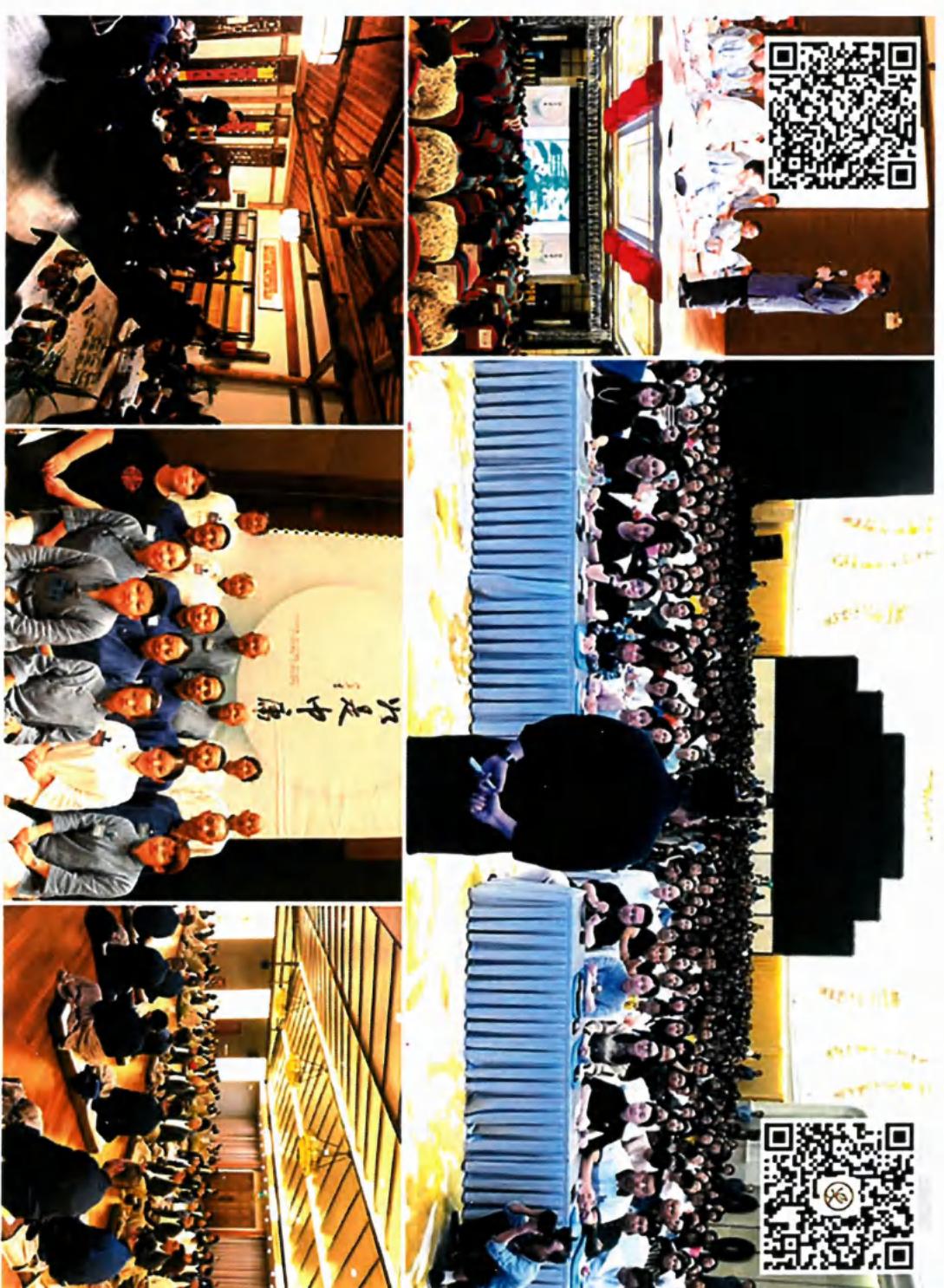
Appendix: Sharing by Professor Zuo Yan of Tongji University regarding the Zhi Liangzhi course
More than three years ago, I was fortunate to connect with the Zhi Liangzhi course. From the beginner class to the intermediate class, my state of life has since gradually changed subtly. The Zhi Liangzhi course is difficult to define; it is not a traditional Sinology course. It not only has a profound analysis of social phenomena but also possesses unique insights and interpretations of Huaxia civilization and sage wisdom, letting a sense of pride and glory as Chinese people surge in our hearts. It also imparts the excellent methods of cultivation and enlightenment from Confucianism, Buddhism, and Taoism. It not only makes us understand the principles of being human from a theoretical perspective but also guides us to practice and truly cultivate in life and work, taking due responsibility for ourselves, our families, and society. Such a good course is missing in the contemporary university education system.
Currently, young students are under great pressure and generally have various negative emotions such as anxiety, tension, irritability, and restlessness. In recent years, more and more people are suffering from mental illnesses. The root cause of these serious problems is the absence and dislocation of values. Among the students I have come into contact with, several are depression patients. They are all excellent students in the eyes of everyone and have high requirements for themselves. They struggle and work hard but are not happy, torturing themselves while also dragging their families and those who care about them into the abyss of pain. Through Teacher Ru Ping’s analysis, I realized that this is actually an extremely selfish way of avoiding reality, a sign of being weak in life.
Through comparison with ancient sages, I discovered that Chinese modern education has completely taken a Westernized path. Everyone spends their entire life constantly learning knowledge and theories from the outside to arm their brains and be recognized by society. Society also generally believes that high academic degrees are an important goal and evaluation standard for talent training, and a stepping stone to becoming a social elite. Little do they know that behind the insatiable desire for knowledge, inner emptiness and fear are at work. The more one learns, the more dissatisfied one is with oneself, and the less confident one becomes, leading to a twisted and unbalanced mindset.
The Zhi Liangzhi course is exactly the opposite. It proposes that Huaxia people are people who are satisfied with themselves, and a person who is internally complete is content and happy. The transformation from taking from the outside to giving witnesses the improvement of the quality of life and the original meaning of life. In addition, the ideas and concepts promoted in the course, such as filial piety to parents, respect for teachers, family harmony, love for the Party and the country, are very positive and have a good educational and guiding role for young college students. Just as The Great Learning says, “From the Son of Heaven down to the commoners, all must regard self-cultivation as the foundation.” As the most grounded self-cultivation course of the contemporary era, the Zhi Liangzhi course will surely become a guiding light in the life growth of young students, possessing immeasurable social significance and value.
Thank you, Teacher Ru Ping! Thank you, Rushi Academy! I look forward to the near future when more college students can participate in such courses, allowing us to learn traditional culture and be the masters of life and the strong in life!
Chapter 8: Potential Development Oriented Towards Improving Academic Performance
For more than 95% of parents, the purpose of potential development for their children is to improve academic performance, whether or not the adverbs “relaxed” or “happy” are added beforehand. The word potential refers to ability and function, not knowledge or skills. Whether academic performance can be improved through potential training depends on the situation. From the perspective of potential training content, the simplest deep breathing can improve grades because frequent deep breathing can increase the amount of oxygen in the brain, putting the brain in a better state; meditation can also improve grades, as meditation can remove impetuousness, making the heart more peaceful and learning efficiency higher; mental imagery training allows students to directly visualize textbook knowledge, imagining vivid pictures and unfolding creative thinking to strengthen understanding and memory, thereby effectively improving academic performance; many students do not do well in exams because their attention is not good enough, and academic performance can be effectively improved through attention training such as auditory and visual training; blindfolded reading can further improve grades. Reading and doing problems with eyes covered results in higher focus, rich illustrations and text in the mental image, fast memory, strong comprehension, and less carelessness; even children developed in potential can possibly improve their academic performance by using α music as background music while studying over a long period.
We generally divide whole-brain education into functional and technical categories. Blindfolded reading, blindfolded test-taking, super-senses, etc., are the main training contents of the functional category; memory methods, speed reading, mind maps, etc., are generally technical categories; there are also the seemingly miraculous photographic memory and wave speed reading, which are generally considered a fusion of the two. What is the educational strategy for improving academic performance? What is technical potential development? How should one view the relationship between these technologies and learning? And how can one apply potential development to learning? We will discuss these one by one below.
8.1 The Principles and Stance for Improving Grades
Every parent hopes to see their children achieve good academic grades. Having taught in secondary schools for 20 years, I am well aware of parents’ wishes and the standards by which society evaluates students. Zoucheng City in Shandong Province is my birthplace and where I work; the city’s calling card is “The land of Confucius and Mencius, the birthplace of culture.” The Supreme Sage Confucius and the Second Sage Mencius were both born here. People living in this land possess a unique tradition and understanding of education. As an ordinary high school teacher, I have an observation of Zoucheng’s education, as well as an understanding from the perspective of potential development.
Zoucheng is a county-level city under the jurisdiction of Jining City, with a total of four regular high schools, enrolling over 6,000 new high school students each year. For more than a decade, Zoucheng’s acceptance rate for Tier 1 universities has been unchallenged in Jining City, consistently ranking at the top, and is also among the best in the province. Every year, over 10 students are admitted to Tsinghua and Peking Universities, accounting for about 4% of the total enrollment of Tsinghua and Peking University in Shandong Province, far exceeding the provincial average acceptance rate. The national acceptance rate for Tsinghua and Peking University is about 0.03%, while in recent years, students from Zoucheng admitted to these two schools account for approximately 0.2% of the total number of candidates taking the Gaokao, and all are local first-time candidates. Zoucheng’s schools differ from some nationally famous schools; Zoucheng only recruits local students and does not engage in the practice of widely admitting excellent students to boost admission rates to prestigious universities. The teaching staff, teaching levels, professional ethics standards, and educational hardware configurations of primary and secondary schools of the same category in Zoucheng are relatively balanced with no significant differences. Parents attach great importance to their children’s development, and ultimately, based on each student’s situation, they choose the most suitable path to enter society. To this day, there are no private schools in Zoucheng engaging in unhealthy competition with public schools that disrupts the order of teaching staff, student sources, and the ecological environment of education.
Since I began researching potential development in 2008, I have shared related techniques and concepts with many friends around me. However, the situation of parents conducting potential development for their children in Zoucheng is not yet common, and there are few training institutions offering relevant courses. According to random sampling checks, among the students in Zoucheng who have historically been admitted to Tsinghua and Peking University, none have undergone potential development after entering middle school; they all became academic standouts through conventional education. This indicates that the grades of students from Zoucheng admitted to Tsinghua and Peking University have no direct relationship with potential development, but are rather the result of the joint efforts of the students, families, society, and schools.
In Zoucheng, the story of “Mencius’s Mother Moving Three Times” is known to everyone. Mencius’s mother knew the impact the environment has on a person, so she kept moving to choose a “school district house.” It is unknown whether Mencius’s mother was cultured or could teach young Mencius to read, but she was very wise and understood the way of education. The “Way” (Dao) of education places more emphasis on endowing children with life wisdom and growth energy. Mencius’s mother’s teaching includes three small stories: “Mencius’s Mother Moving Three Times,” “Buying Meat to Feed the Son,” and “Cutting the Loom to Teach the Son.” In all these, Mencius’s mother used her every word and deed, every action to inspire and educate Mencius on what moral direction to progress in, never pursuing the superficial effects of education. She knew the saying: If the direction is wrong, effort is wasted. She focused on the Way of education, the direction.
For a long time, regarding the education of children, our current parents often tend to focus on technical aspects. For example, how to make the child study well, get good grades, get into a good university, how to let the child master a skill, find a good job, earn more money, and so on. “Technique” (Shu) focuses on practicality and generally can produce results within a short period. For instance, grades have improved, or awards have been won in competitions. Therefore, many parents enjoy it with tireless enthusiasm. They are keen on making money to provide more survival and educational resources for their children, rushing to take their children to various training classes, busy asking for ways to get their children into good schools, and how to let their children obtain a good job in the future. Parents spinning their wheels at the level of “Technique” can only make their children’s perspective smaller and make it difficult to achieve great things. It is not that “Technique” is not needed; “The Way without Technique is not feasible; Technique without the Way does not last.” “Technique” must serve the goal. We must clarify the relationship between the “Way” and “Technique,” and figure out what the goal is? What is the long-term goal? What is the even longer-term goal? The path to reach the furthest goal is the “Way.” Counselors must also figure out what potential development can give students? Potential development can only be “Technique,” a tool, not the goal.
Mencius’s father passed away when Mencius was three years old. Mencius’s mother had to maintain the livelihood of the whole family and also educate Mencius; it was obviously very hard and full of bumps. Mencius’s mother successfully educated Mencius. Judging by the stories handed down, Mencius’s mother did not know as much as modern mothers do; she did not constantly teach the child how to write characters or how to do problems. In the Way of education, Mencius’s mother grasped the most labor-saving and core thing. We call this most core thing goal motivation (as shown in the Education/Learning Strategy Hierarchy Diagram), or morality, or principles and stance, or values, outlook on life, and worldview.
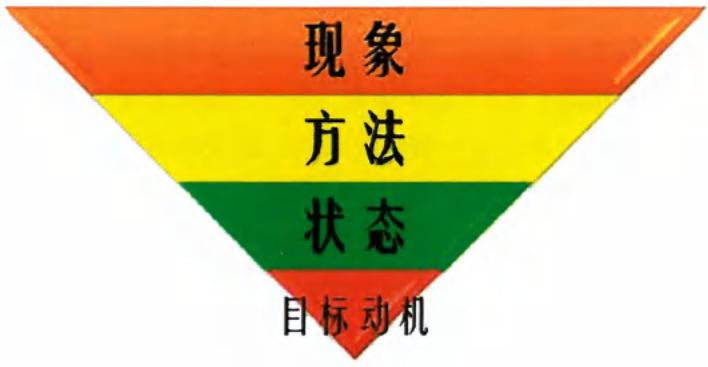
Education/Learning Strategy Hierarchy Diagram
- 现象 - Outcomes/Phenomena (observable results, grades, behaviors)
- 方法 - Methods (learning approaches, study techniques)
- 状态 - Learning State (mindset, engagement, attention)
- 目标动机 - Goals & Motivation (intrinsic drive, purpose)
We have designed the Education/Learning Strategy Hierarchy Diagram in the shape of an inverted triangle, mainly to indicate that the areas of the various factors are different. On one hand, this is based on how many things we can see; on the other hand, it is based on the different amounts of energy educators consume in education. Simply put, putting effort into the student’s learning state and goal motivation is more effortless than putting effort into how to learn and what methods to use.
People care about the results of things. If a child’s academic grades are not ideal, most parents will say: This child is too playful, doesn’t listen, is unwilling to learn, only knows how to play, doesn’t listen seriously in class, spaces out during class, is very slow and procrastinates when doing homework, only does the homework assigned by the teacher, never does what I assign, has a bad memory, is bad at Chinese, bad at math, bad at English… After listing a bunch of the child’s poor learning behaviors and problems, they often add a sentence: I can’t control it, I’m too busy, and I don’t know what to do! Just like that, they absolve themselves completely. Everyone knows that “for good grades, courses need tutoring,” so parents think that if the child doesn’t study well, they should sign up for a tutoring class, spend more time, do more exercises, and let the tutoring teacher explain it seriously again. Is this effective? I think it should be effective for some children. After all, studying at home may not be so self-disciplined; in a tutoring class, a lot more time and energy are used. “Clumsy birds fly first, use diligence to make up for clumsiness” will never be wrong. But many children have signed up for various classes, and their grades haven’t improved, and everyone feels that the child is so tired!
Students study so hard, but why are the grades of other people’s children so good? It seems they don’t see them putting in much effort either. So, when thinking that relying solely on grinding time and grinding effort doesn’t work, it turns out that “success has no shortcuts, but learning has methods.” Teachers say to increase the amount of reading; in order to save time reading, there are speed reading methods. If the child is slow at memorizing books, there are memory methods. There are methods for doing problems, and methods for thinking. In short, to learn well, one must also find methods. This is true; some methods are very effective in solving corresponding problems. With the right method, learning can indeed save a lot of effort, and learning can become a little bit easier. However, some educational institutions specifically offer courses targeting methods, such as study methods, thinking training, memory methods, speed reading, mind maps, etc. The child has learned them, but I don’t see them being used in learning? These methods, like learning, cannot be mechanically applied; one must be able to draw inferences about other cases from one instance. If you know how to drive a sedan, won’t you be able to drive an off-road vehicle? If you can swim in a swimming pool, won’t you be able to swim in the sea? “Everything must have at least three solutions.” Learning is the same; there are many methods, and you must find the one that suits you. Some parents say the child just hasn’t found the method suitable for him. Actually, this is not the fault of the method; it is all caused by personal state.
Methods are mostly created personally; most children with excellent learning use their own learning methods and rarely use others’ learning methods. Enter the state of learning, and methods will naturally arise. The great chemist Mendeleev did not know how to organize the 63 known elements at that time in a logical way. Mendeleev pondered hard but could not find a solution to the problem. Unexpectedly, he fell asleep from fatigue and had a dream. In the dream, those elements magically arranged themselves into a periodic table floating before his eyes, thereby solving the problem. Everyone dreams, but solving difficult problems in dreams—I don’t know if your child can do it? A person’s state of engagement in a matter determines the effectiveness of solving the problem. A student’s state of engagement in learning determines whether they can find a learning method suitable for them and the learning effect. Learning is a process that requires mobilizing brain energy and using attention, memory, and thinking to solve problems. Any psychological or physiological factors such as intelligence below the critical threshold, attention deficit, sensory integration dysfunction, etc., that affect the brain will affect learning. Many students with less-than-ideal grades have somewhat poor attention, and some students with reading or writing problems have more or less some sensory integration dysfunction. These problems are severe enough to require treatment, but most students are within the normal range. Attention training, potential development, meditation, inspiration learning methods, etc., are educational and teaching trainings at the state level.
Who dominates the state? Let us first look at two stories. When Mencius was a child and returned home from school, his mother was weaving cloth. She asked, “How are your studies going?” Young Mencius perfunctorily replied, “Same as before.” Seeing his indifferent attitude, Mother Meng took scissors and cut the woven cloth. Mencius was terrified, and Mother Meng seized the opportunity to explain the great principle that abandoning one’s studies is like cutting the cloth. Teacher Ru Ping, the initiator of the “Conscience” course, also has a story about educating his own son: When his son was ten years old, he became addicted to computer games, and the child’s mother could no longer control him. Ru Ping returned home and discussed his son’s feelings about computer games with him. Then he moved the computer out, handed a hammer to his son, and asked him to smash it. The son was stunned. Ru Ping said, “Smash it. Dad can do without a computer, but he cannot do without his son!” The son, with tears in his eyes, smashed the computer with his own hands. ① Both Mother Meng and Ru Ping understood that reasoning with children directly about surface phenomena, methods, or states is ineffective; instead, one must work at a deeper core level. At that moment, both young Mencius and Ru Ping’s son experienced terror and shock, and only then could they patiently listen to their parents’ reasoning. They understood the principles while situated in a context of huge emotional impact and feeling. Only when one wants to change oneself can one enter a good state. The state depends on oneself, on self-perception, not on the preaching of parents or teachers. Some children study proactively, while others refuse to study even when forced; the difference lies in their self-perception. You look at other people’s children who have tested into prestigious universities like Peking University or Tsinghua University. You hear that their families never turn on the TV, and the children never watch TV. You try to learn from them and stop watching TV from then on, but your child starts playing with mobile phones and computers, and simply refuses to study. These are all superficial efforts; it is difficult to touch the core. This core is marked in the diagram as the Goal Motivation, that is, the student’s goal and the motivation to strive for that goal. For educators, this means guiding students to determine what kind of person to be, and establishing their principles and positions, values, outlook on life, and worldview.
Once, a parent shared her experience of teaching her child: “When I first started learning potential development, I thought everything others did was good. Only when you gradually understand it step by step and train your child do you realize that it is actually not that magical. Before, I always thought it would be great if my child could be like other children and do Wave Speed Reading, or have Photographic Memory. Learning would be very easy, grades would go up, and there would be no problems with future studies or work. When you actually train them, you discover that is not the case. What is truly important for the child is not these things, but the child’s physical and mental health. As parents, the love we give our children, letting them be happy and healthy, gives them a continuous stream of energy and the internal drive to learn proactively.” Internal drive is the Goal Motivation; it is the principles and positions of being a person, values, outlook on life, and worldview.
Now, looking at this educational strategy hierarchy, doesn’t it look very much like the “Peeling the Onion” diagram in the previous chapter? Yes, when the “Peeling the Onion” diagram is used to analyze education and learning phenomena, it can be simplified to look like this; their cores are the same. Only by discovering and putting in effort at a person’s most core place can one achieve twice the result with half the effort. Departing from the essence of the “Dao” to pursue the superficial effects of education often leads to disappointing results. Whether parents or counselors, one must frequently consider: Is learning just for getting into college or having a good job? The process of learning is a process of improving a person’s thinking ability and the quality of their character; it is the excellent qualities possessed by the successful people discussed at the beginning of this book. Letting children rediscover these qualities through learning and establishing correct values, outlook on life, and worldview is the fundamental purpose of learning. With these qualities, do you still need to worry about grades not improving?
Let us use the diagram below to summarize the hierarchy of education/learning strategies again, and the things that can be done at the corresponding levels. We must know that potential development education is at the State level. The essence of potential development is that a person must enter the core states of concentration, imagination, and introspection to bring various functions into play. Counselors must be clear that the work they do in the education strategy or learning strategy is focused on adjusting the student’s state. They must keep in mind the role of potential development and be clear about the purpose of your potential development? What is the goal of every lesson? When a student has a problem, consider the relationship between this problem and the goal; has what you are done deviated from the goal?
Phenomenon Listening earnestly, spending more time, doing more exercises Methods Learning methods, thinking training, mnemonics, speed reading, mind maps State Attention training, potential development, meditation, inspiration Goal Motivation Principles and positions: Values, outlook on life, worldview
Through Chapter 6 of this book, we already know that the significance of conducting ESP games or potential development lies in finding and awakening the existence of “I,” and improving self-confidence, concentration, and imagination. These are necessary qualities for a person to move towards success, and they are the most important basic abilities for improving learning performance. However, special attention must also be paid to the fact that although self-confidence, concentration, and imagination can be improved through potential development, if the student’s goal is still not in the area of learning, then these qualities and abilities cannot play a role in learning. This is also the main reason why some potential development educators train students, and after a period of training, some students do not show improvement in grades.
Some people, after seeing the magic of potential, fantasize that children possessing these special abilities can be cultivated into geniuses. Geniuses are not cultivated; they can only be discovered. The huge achievements that geniuses in certain fields can attain are likely to be something most people can only look at and sigh for; their starting point may just be the destination ordinary people pursue throughout their lives. Many people fantasize about miracles happening to themselves or their children, excitedly shouting inside: “Let the child possess god-like power; first, let him be extraordinary in his studies!” At this time, we can only shake these people who are immersed in fantasy: “Wake up!” Do you want the function or excellent learning performance? Our potential development is just a training tool; never mistake the tool for the purpose! To improve students’ learning performance, we must firmly stand by our principles and positions:
All potential development training is a tool;
The purpose of potential development training is to improve self-confidence, concentration, and imagination (image sense).
Counselors should not let themselves become too obsessed, otherwise they will lose their direction. If you want to improve students’ learning performance, look at whether the purpose of potential development training has deviated. When these abilities are improving, you must use wisdom to guide students to strive in the direction of learning. It is also necessary to remind potential development workers that potential development can sow the seeds of curiosity in children’s hearts, but do not let children act as tools for recruitment and making money. Focus on learning, and learning performance will improve. You must remember that in potential development guided by improving learning performance, potential development training is auxiliary and a tool; subject learning is the main body and the focus.
8.2 The Mental Method for Improving Grades
All potential development training is a tool; the purpose of potential development training is to improve self-confidence, concentration, and imagination (image sense). On the basis of adhering to these two principles and positions, I have summarized four mental methods for improving students’ learning performance to recommend to everyone. Through years of practice, this will be of great help in grasping and utilizing potential development to improve learning performance.
Mindset Principle #1: Treat the Child as a Strong Person; You Are Just the Chief of Staff and Coach
In the process of growing up, a child will make choices that are most beneficial to themselves. As long as they have a goal, and all distractions that might affect their belief in that goal are removed, and you simply fulfill your roles as Chief of Staff and Coach, the child will achieve incredible results. Just like in the video “Death Crawl,” the goal does not belong to the coach; the goal must be something the athlete wants for themselves. Blindfolding the eyes is to minimize various interferences with the goal as much as possible. The coach does not point fingers or nag; they only need to know how to shout: “That’s right, just like that!” “Come on!” “Don’t give up!” “Don’t stop!” “Keep going, keep going!” That is enough. Similar to the video “Dead Poets Society” (see page 174 of this book), stimulating potential by covering the eyes seems important, but the principle is actually only one: reduce various interfering factors with the goal.
Video: Death Crawl
Think about what our parents are doing? Many parents act as the boss, the commander, the nanny, and the teacher. The word parents say most to their children is “obedient”; the child must listen to the parents, and the consequences of disobedience are severe. The goal belongs to the parents, who slowly twist the child’s goal onto their own track. When the child falls, the parents rush to pick them up and coax them, never letting the child discover what they should do to avoid falling. When the child encounters homework they don’t understand, the parents rush to explain it clearly, fearing that time will be wasted. This is all raising the child as a weak person, eventually raising them like a pet cat that gets scared away when it sees a mouse. When they grow up and enter society, the child thinks they are right about everything, yet can’t do anything. From birth to death, all things a person experiences are new; there will never be repetitive events for one to experience and face. You also cannot help your own child face all things in the future. “Zengguang Xianwen” says: “Human feelings are as thin as paper, and worldly affairs are like a game of chess with ever-new layouts.” This means that the affection between people is as thin as paper and easily torn, and no matter when it is, you have to face things. Everyone’s learning ability is very strong; all things experienced in childhood will become strategic experience for solving new problems in the future. Society is much more complex than home; how can a child see a rainbow without experiencing wind and rain? Was Brock tired when crawling in “Death Crawl”? Did his wrists hurt? What did the coach do? And how would our counselors and parents act? Let the child be the commander, and you be the chief of staff; how do you let the child grasp their own life?
Potential development can sow the seeds of curiosity in a child’s heart, help students build self-confidence, improve concentration and imagination, and also stimulate various potentials in the child. These abilities cannot be gained through preaching; they can only be obtained through students experiencing, feeling, and undergoing them. The child’s life is their own; parents must learn to be good consultants and coaches to help children clarify their goals and help them possess the excellent qualities of successful people. Improving academic performance will then be a piece of cake, and the child’s life will also achieve success.
You can watch again the short video “Have You Ever Been Desperate?” by Nick Vujicic, the Australian motivational speaker without limbs (see page 87 of this book). The vast majority of us have sound limbs and healthy bodies, but many of us lack strong will, a positive mindset, and other excellent qualities. Many people treat themselves as weaklings and entrust their fate to others. Conversely, when we look at these disabled people, we are moved, yet many people are only momentarily moved and do not awaken to truly master their own destiny. In 2019, on Jiangsu Satellite TV’s “Genius,” Gao Guangli from Jining, Shandong (see video “Genius: Gao Guangli Creates Miracles with Tongue Origami”), who has cerebral palsy and has been unable to live like a normal person since childhood, relied on strong perseverance and an unyielding spirit to master the unique skill of “tongue origami,” and even created a Guinness World Record. Bo, a PhD in Chinese Classical Literature and Culture, a professor at Nanjing Normal University, and a speaker on “Lecture Room,” could not hide his excitement. “What is a ‘Genius’ (Talent)? Only those who are unyielding in the midst of hardship and wandering are truly worthy of respect, extraordinary people, and true Geniuses—that is people like you (Gao Guangli)!” After the recording of the show, Bo’s mood could not calm down for a long time. He admitted that Gao Guangli moved him to tears. “This was an impossible task, yet he used time, humanity, and the power of life to witness a miracle. Everyone hides a self with infinite possibilities within their body.” Gao Guangli’s story brought great shock and insight to people. He told us what a strong person is: A strong person is one who can do without what others have; a strong person does not defeat others, but can defeat themselves.
Genius:
Gao Guangli Creates Miracles with Tongue Origami
We must believe that every child and every person is a strong person, everyone’s learning ability is very strong, and everyone will make the best choices for themselves,
As long as they know very clearly what they want, then they will definitely be able to achieve it.
Principle #2: Focusing on a Child’s Character is Twice as Effective as Focusing on Grades
The excellent qualities of successful people discussed in the first section of this book are intrinsic; these qualities are not necessarily reflected by surface phenomena. Counselors and parents must be able to see the essence through the phenomena and discover the intrinsic qualities in how a child handles things. By focusing on and appreciating these qualities, the child will use such qualities to learn and handle tasks.
Praising a child only for surface phenomena is of little use. Remarks like “You are so pretty,” “You are so smart,” or “You are great,” if said too often, will only increase their impetuousness and vanity. Going a bit deeper and praising the student’s state and character is much better. For example: “You’ve been very focused on your studies these past few days,” “You started doing your homework as soon as you got home, that’s very proactive,” “The teacher said you’ve been much more active in answering questions recently, and your homework is more serious too,” “I saw your positive effort,” “Perseverance is one of the best human qualities; I’ve seen your persistence during this period, and if the results were a bit better, it would be even greater,” “I saw your confidence, keep it up,” “You didn’t let this failure disrupt your goal, that’s awesome.” This begins to guide the student’s learning state and intrinsic qualities. When teachers or parents truly focus on the child’s character, the child will not only win in grades but also win in life.
Many children who have undergone potential development will possess “spirit pets” or other functions that can “help” with learning or exams. “Diamond Master” Uri Geller wrote in My Story—Uri Geller’s Autobiography: “I wasn’t a poor student, but I wasn’t a top student either. During exams, I was often stumped by the questions and didn’t know how to answer them. I would look at how other students were doing and found that most seemed to be doing well. Once during a math exam, I looked at the back of Gunther’s head; he was one of the best students in the class. Suddenly, I saw his answers projected on a screen in my mind.” How did he see them? “I have something in my mind like a TV screen, on which Gunther’s answers were projected. I could see them; these things appeared in the front part of my brain, where there is a grayish screen. If someone thinks of a picture, a number, or some words, I can see them projected on that screen in my mind. Later, I relied on this method to cope with exams. I often picked the best student in a particular subject in the class, stared at the back of his head, and his answers would appear in my mind. The only problem I encountered was: since I copied others’ answers exactly, the errors in my answers were exactly the same as those of the person I copied from.”①
Some potential development institutions externally promote “Remote Viewing” (Pulling Light) courses, which are referred to as “Out-of-Body Character Recognition” in the domestic field of special functions. This is practiced after the student’s state of blindfolded character recognition is stable; the student wears a blindfold and begins to practice recognizing characters without touching the card with hands, simply facing the character card. Once the blindfolded character recognition state is stable, achieving this result is a natural progression. Counselors gradually place the character card further away, until it is more than a dozen meters away from the student; the furthest some are placed is tens or even hundreds of meters away. At that point, the eyes can no longer clearly see the text, but the blindfolded student can still perceive the text information. Most children can practice this training, but for some children, when the character card is at a distance, perception becomes very difficult. For such children, it is necessary to consider whether it is necessary to continue intensive practice to avoid damaging the child’s psychology. When a student can blindfoldedly see distant character cards, the observers are mostly surprised and full of praise, and the student feels proud of themselves upon hearing this. For most children, this is already very successful, because the student has improved their self-confidence through this training, and their concentration has also been exercised. However, after this training is done a few times, some parents will inevitably raise objections: “What is the use of this training? Is it to let the child look at other people’s answers during exams?” Therefore, counselors must be clear about the purpose of doing this training.
Uri Geller’s functions are very powerful, yet to this day he can only be considered a magician, respected for his performances. For students who have undergone potential development, occasionally getting a good grade may not be difficult, but if one loses long-term life goals for the sake of this function, it is a great pity. Moreover, this function is not effective every time. Therefore, what is most important is that we still focus on the child’s character and long-term goals.
All successful people, when sharing their experiences, will describe their principles, positions, and character in conducting themselves; other aspects extend from this. Huang Lingcai, Chief Designer of the aviation industry’s AG600 amphibious aircraft, said in a speech on Lecture Room: “When a person links their own destiny with the destiny of the country, that is when our own value is truly reflected, and it is worth pursuing and fighting for for a lifetime! A dream is the driving force for your lifelong struggle. If you do something merely to survive, to support your family, it will never become a career. Treating it as part of your own life involves different energy投入 and achievements.” Qian Qihu said: “We must uphold the combination of individual destiny with the needs of the country, the people, and the cause.” Marx said: “There are no flat roads; only by fearing no danger, daring to challenge, and daring to innovate can one achieve success.” There is also a quote from Einstein: “If a person takes comfort and pleasure as the goal of life, that is an ideal in a pigsty. Pigs just eat well and sleep well; life should be about diligent learning.”
Do not focus too much on judging the right or wrong of a thing a child is doing at the moment; see the essence through the phenomena, discover the good qualities, and appreciate them, and everything will develop in a good direction. Referencing the “Education/Learning Strategy Hierarchy Chart,” parents and counselors should put effort into how to make students want to learn and like learning, rather than using too much energy on how students learn. The reason most students cannot improve their grades is that they do not know what they want, which is the same reason many people cannot succeed. Comparing with the “Excellent Qualities of Successful People,” focusing on the cultivation and development of these qualities in children is the most effective way to cultivate excellent children.
Method No. 3: There are no shortcuts in life, no shortcuts in learning, no shortcuts to success: The sharp edge of a sword comes from grinding, and the fragrance of plum blossoms comes from the bitter cold.
Many people regard potential development as a lifesaver for students’ learning, treating it as a shortcut to learning. I do not agree with this view. Potential development is merely a tool for human growth. There are no shortcuts in the journey of life; growth and learning have no shortcuts, and the accumulation of merit and blessings has no shortcut either. Some may not take this seriously, but let us first look at Wu Meiling’s challenge in “Mission Impossible: Go China” on CCTV in 2019 regarding her “Lightning Dual-Brain Mental Arithmetic.” Wu Meiling is one of the extremely few people with extraordinary talent in the field of abacus mental arithmetic. Since the age of 6, she has focused all her energy on learning abacus mental arithmetic. Achieving such results was obtained through long-term, arduous training. Regarding her achievement, she said, “Only through effort, only through diligence, there is no other choice.” The contestants on Jiangsu TV’s “The Brain” have also all paid long-term and tremendous efforts to possess a “super brain.”
Wu Meiling’s Lightning Dual-Brain Mental Arithmetic
Nikola Tesla is considered to be the most gifted scientist; some even think he was an alien or possessed supernatural powers. However, what goes unnoticed is that he only slept about four hours a day. The story of the “King of Invention,” Edison, has made countless children revere science, but he implemented a time-clock system for work 100 years ago, working over 90 hours a week. The hardships they paid were directly proportional to the achievements they attained.
If the most gifted athletes lack diligence and the will to fight, could they still become world champions? These world champions would have been eliminated in the initial selection without talent, but without long-term diligence and striving, it is impossible to achieve good results.
Edison clocks in for work, working over 90 hours a week
You can investigate this. Generally speaking, looking at students from top-tier universities like Tsinghua and Peking University versus students from second-tier universities, where is the study more intense? Who has more homework? Who reads more books? Who is under greater pressure? “In the West, only the poor receive ‘happy education’; the children of the wealthy are all studying hard in private schools.”
C-sections seem to alleviate the pain of the mother and allow the child to be born more smoothly, taking a “shortcut.” You can also do a survey: compared to children born via natural delivery, whose overall physical constitution is better? Which side has more instances of attention deficit?
Without experiencing the pain of the birth canal, the suffering reduced by this “shortcut” will definitely be made up for in other ways.
Some people will say that while there are no shortcuts, potential development can make learning easier for children, right? I don’t think that is necessarily the case either. You can “peel the onion” and take a look: what is this feeling of being relaxed or tired? What is it determined by?
Actually, this fatigue is often not felt by the students themselves, but perceived by the adults watching them; that is to say, the people who say the child is tired think so. Adults feel tired because their minds are filled with too many things, messy and disordered; their hearts have become smaller. Seeing their children learn a little more, they feel they cannot accept it themselves, so they feel tired. The child’s heart hasn’t been filled with too many things yet; it is basically still empty, without a judgmental mind. Whatever you put in it, he can accept. Do you remember the video “The Score the Child Gave the Mom” (page 5 of this book)? Why do moms give scores of 8, 7, and 6, while children can give their moms 10,000 points? When he is happy to accept, you can never fill him up, and he will never feel tired. As the saying goes, “Skills do not burden the body.” Knowledge and skills are not a burden; desire is the burden. Knowledge is just knowledge. If a lot of desire is attached to it, your original motivation for acquiring knowledge is not pure, and various emotions and feelings will arise. If learning knowledge is for your own desires, having more and more desires will lead to more and more burdens and worries; you will fear losing and feel tired. Students often can’t figure out why they go to school? Why study hard? If this problem is not solved well, good emotions and feelings will not be generated during the process of acquiring knowledge. What is going to college for? What is participating in various trainings after working for? Many people say it is to get a good job, to make money! Students often think: What for? My parents have jobs, and life is good right now! For some parents, getting into college has even become a part of vanity. Because of this, students study with increasing fatigue and lack of strength. If the child believes that learning is to bring glory to their ancestors, they might feel more strength and sense of responsibility. So, what you need to think about is: what kind of future do you want for your child? What are you anxious about? Are you tired? Do you want your child to learn more easily? Put down your excessive desires, and everything will become easier.
The academic pressure on students at top-tier universities seems extremely great to most people. Students working overtime to study, experiment, and research until the early hours is a common occurrence; it is not a bit more relaxed than the pace of studying in the final year of high school. Yet, every student is still full of energy, sunny, and happy. Although their studies are hard, their thoughts are free and independent, and they personally feel fulfilled, learning and living for their own pursuits. When facing others, they always show a confident and sunny side. There is never a face full of grievance, helplessness, sorrow, or resentment. There is nothing they are unwilling to face. To outsiders, these children are happy; where is the pressure? A workaholic works more than ten hours a day without feeling tired. This is worth everyone thinking about. We can change “There is a kind of cold called ‘your mom thinks you are cold’” to “There is a kind of tiredness called ‘we think he is tired’.”
A matter itself has no good or bad, right or wrong. As long as one learns to rely on oneself to face all difficulties, one will understand this truth. Experiencing some hardships is not a bad thing; this is growth. Growth cannot be compressed into a very short time. Hunan TV’s “X-Change,” which has been popular for a few years, seems to tell us that to change a person, it is enough to go deep into the mountains to experience ten days of poverty, or to be a rich second-generation kid in the city for a few days to have dreams and change one’s life. This is obviously just a script written to attract ratings; the teenagers just acted as actors once. If you investigate seriously, you will see: did these teenagers who exchanged lives really turn out as you imagined in the days that followed? Education has never been something that can be simple or fast-tracked. Poverty and suffering are not a universal reformatory, so do not expect there to be any shortcuts to take.
The old saying goes: “The sharp edge of a precious sword comes from grinding, and the fragrance of plum blossoms comes from the bitter cold.” This is a golden maxim. Please remember: There are no shortcuts in life, no shortcuts in learning, no shortcuts to success.
Principle 4: Let the child constantly find the feeling of winning in their studies
There is a story in the Gospel of Matthew: A master of a household was about to go on a journey, so before leaving, he entrusted his property to his servants. Some servants invested the money and made a fortune; others, fearing investment failure and inability to repay the master, buried the money in the ground and did not touch a single penny. When the master returned, both sides returned the property originally entrusted to them. The result was that the wealthy merchant scolded the latter and gave their money to the former group who had made a fortune. At the end of the story, Matthew spoke this famous quote, which later social and economists regarded as a golden rule: “For to everyone who has, more shall be given, and he will have an abundance; but from the one who does not have, even what he does have shall be taken away.”① In this sentence, “everyone who has” refers to the servants who believed, had faith, took action, and were loyal, because they completed their mission and received the master’s reward, hence “to everyone who has, more shall be given.” “The one who does not have” refers to those who did not believe, relied on luck without preparation, were lazy, and were good at making excuses for their mistakes. Because of their dereliction of duty, the master wanted to punish them, hence “from the one who does not have, even what he does have shall be taken away.” Therefore, Laozi said in the Tao Te Ching: “The Way of Heaven is to reduce the superfluous and supplement the insufficient; the Way of Man is to reduce the insufficient to offer to the superfluous.” The Matthew Effect is the Way of Man; it is filled with coordination and conflict with the corresponding balancing natural laws.
It is just like this; the situation of students in school is the same. Students with good grades tend to get better and better; students with poor grades become increasingly unable to learn. It is better to start focusing on learning as early as possible, allowing the child to gain the experience of winning early on. When he constantly gains the experience of winning, according to the Matthew Effect, he will increasingly possess the feeling of winning. Do tutors and parents know who the child hates the most? It is “the neighbor’s child”! Because in the mouths of adults, “the neighbor’s child” is always stronger than him, so he can only find the feeling of failure. Do not think that creating hardships for children is a good thing; in most cases, it is not. Writing was invented thousands of years ago, but it was not until less than 200 years ago that the idiom “fighting on despite repeated defeats”② was created to describe the spirit of striving unremittingly despite repeated setbacks and failures. Children cannot do this yet, so do not try to let children improve their academic performance through this method.
For children, happiness and self-confidence are the greatest energy. Let the child constantly find the feeling of winning in their studies, and only then will he be willing to work hard to welcome the next experience. This is the magic weapon for improving children’s academic performance.
If the purpose of developing students’ learning potential is simply to improve grades, then potential development education institutions should not excessively chase the development of functions. They must definitely act according to the principles and positions determined earlier, integrating the four principles into teaching and training, and they can improve students’ academic performance through potential development. It is not difficult for a potential development institution that wants to improve students’ grades; they only need to remember one point in terms of technology or course design: pay attention to the combination of potential training and school learning content, and do not make it purely potential training or functional training. For example, every time a student comes to the potential development institution to learn, 1/4 of the time is used for basic potential training, such as practicing skills, meditation, mindfulness, etc.; 3/4 of the time is used for combined training of potential and learning, such as doing homework, reciting texts, taking exams, and listening to classes while blindfolded. When learning while blindfolded or with eyes closed, useless external information can be prevented from entering the student’s brain, and it can also allow the student’s eyes to rest, improve vision, prevent myopia, and at the same time play a role in harmonizing the thinking functions of the left and right brains, laying a good foundation for functions such as photographic memory and wave speed reading, and cultivating the habit of concentrated learning attention for students. The learning effect of this method is much better than letting students learn with their eyes open throughout a class in exam-oriented education; it can be said to achieve multiple results at once. Persist in this for a long time to form habits and conditioned reflexes, and the effect will be even better.
8.3 The Brain—Technical Whole Brain Development
Whole brain development education reduces the learning burden on students. In our country, it was first applied in education through technical projects such as memory methods, speed reading, and thinking abilities. According to the education/learning strategy hierarchy, these are closest to the appearance of learning, so their impact on academic grades often directly depends on them. Practical research in this area started relatively early by scholars in our country; some had already begun in the 1960s and 1970s, and great achievements have been made so far, and these researches are now quite mature.
The Brain, which first aired in 2014, attracted a large number of young students, parents who “hope their son becomes a dragon and their daughter a phoenix,” and some science enthusiasts who like to “make science popular,” becoming one of the signature programs of Jiangsu Satellite TV. The Brain is the first large-scale scientific reality show in China, focusing on spreading brain science knowledge and mental competition, and has aired for six consecutive seasons to date. The Brain is increasingly developing towards a performance venue for top students; every project examines the contestants’ memory, observation, spatial ability, reasoning, calculation, and creativity, which mainly utilize abstract logical thinking abilities. This is different from whole brain development functional projects (i.e., potential development), which utilize intuitive power and mental imagery power more. Intuitive power and mental imagery power are the expression of image thinking ability. Facts show that with powerful image thinking ability as a foundation, abilities such as memory, observation, spatial ability, reasoning, calculation, and creativity can exert better effects. Memory is undoubtedly the core ability of learning power, and many contestants on The Brain are “World Memory Masters”①, showing how important memory is to a person’s brain.
8.3.1 Rapid Memory Method
In traditional school education, there are basically no teachers who specifically teach memory methods. Students with good academic grades do not necessarily use the same memory methods, and many students have not even summarized the issue of methodology. Scholars researching memory methods, based on their own explorations, sparked a “memory research craze” in the early 1980s in China. This was an inevitable result of people re-recognizing the value of knowledge and their desire to learn after the restoration of the college entrance examination system in China.
The most influential researcher during this period was Wang Wei, known as “China’s First Memory King.” In 1980, due to his own learning needs, Wang Wei began researching memory methods. When he first realized the magical effects of the Bizarre Association Method and the Method of Loci (Peg System), he was so excited that he couldn’t sleep all night. Subsequently, he began a long period of research and experimentation, almost “performing” for every acquaintance he met. Everyone marveled at the magic of rapid memory, but the majority did not believe that memory could be changed. Through his unremitting efforts, the first memory research society in China—the Jinzhou Memory Research Society—was established in 1984. Later, he developed some branches nationwide, sowing the seeds of memory research and memory science popularization. In October 1984, the first “Practical Memory” correspondence course in China, taught by Wang Wei, commenced. Starting from the basic Practical Memory Phases 1, 2, and 3, it expanded to over a dozen correspondence subjects, including Practical Memory: Liberal Arts Adult College Entrance Exam Coaching, Practical Memory: Science Adult College Entrance Exam Coaching, English Vocabulary Rapid Memory Tutorial, Japanese Vocabulary Rapid Memory Tutorial, Living Dictionary—Xinhua Dictionary Rapid Memory Method, Living Dictionary—Idiom Dictionary Rapid Memory Method, Higher Education Rapid Memory Coaching Tutorial, Chinese University Self-study Rapid Memory Coaching, Creativity Improvement Tutorial, Children’s Intelligence Development Series Tutorial, High School Subjects Practical Memory Coaching, Rapid Literacy Method, etc. By 1993, the cumulative number of trained students exceeded 1 million, a miracle in China’s training industry.
In 1985, Wang Wei published China’s first monograph on Practical Memory (divided into three volumes: upper, middle, and lower, totaling 635,000 words). This book played an important enlightening role in the popularization of memory science nationwide. In 1987, Wang Wei also published The Secrets of Enhancing Memory (Guangdong People’s Publishing House) and the Self-study Book Series on Practical Memory for Middle School Students (totaling 25 books; among them, 100 Practical Memory Methods for Middle School Students was later licensed by Taiwan’s Wangwen Publishing House and published in Taiwan). At the 1989 CCTV Spring Festival Gala, Wang Wei and his student Yang Shu performed the “Living Dictionary” act. They could recite a Xinhua Dictionary fluently backwards, allowing any random check, which truly astonished the world.
After entering the 21st century, the person most influential in the research, development, and promotion of rapid memory methods is Zhang Haiyang, the founder of the Memory Training Network and Shangyi Education. Zhang Haiyang graduated from the Sun Yat-sen University Zhongshan School of Medicine (formerly Sun Yat-sen University of Medical Sciences) with a major in Clinical Medicine in 1997. He entered the memory training industry in 2006 and established the “China Memory Training Network” website. Within just five years, the number of website members exceeded one million, making it an authoritative institution for memory training in China. The China Memory Training Network is also a professional and large-scale interactive platform for academic fields such as rapid memory methods, Mind Maps, Speed Reading, Rapid [Calculation/Reading], Brain Development, and Mind Maps. Relying on his personal charisma, Zhang Haiyang attracted a group of excellent talents in memory, Mind Maps, visual learning, speed reading, wave speed reading, right brain development, and other areas. The later-established Guangzhou Shangyi Education almost became an incubation base for the above training institutions; even CCTV’s memory-related programs and Jiangsu TV’s The Brain had their support behind the scenes. At the same time, their teachers and students are from the institution with the most “World Memory Masters.”
Memory is the most fundamental ability for learning. Memory is not innate, and photographic memory is not the talent of a few; everyone possesses excellent memory. As long as one undergoes training and uses the right methods and techniques, anyone can improve their memory with astonishing results. You think your memory is poor, but when you share the TV drama you watched yesterday with friends today, you are animated and eloquent; some can even recite the lines verbatim, as if the TV drama is playing in your brain. You say your child’s memory is bad, but you have already forgotten about promising to take him to the amusement park three months ago, yet he speaks with such certainty and affirmation, remembering it clearly. Therefore, everyone’s memory is about the same, or rather, quite good. The key lies in the memory method and the cultivation of interest in the content being memorized.
Rapid memory methods are also known as mnemonics. They involve transforming boring and tedious memory materials into vivid and easy-to-remember mental images, and connecting them through interesting bizarre associations to reinforce memory retention. It takes imagery as the foundation, association as the key, bizarreness as the secret, and homophones as the trick, using an interesting memory process to achieve the goal of accurate memory. Combined with scientific review methods, it achieves the goal of rapid, long-lasting, and firm memory, thereby enabling efficient memory and efficient learning. Commonly used rapid memory methods include the Number Code Method, the Peg Method (Method of Loci), the Link Method, the Chart Method, etc.
Whether it is the Memory Palace, Location Pegs, or other trained memory methods, the essence is to encode information into images for memorization, which makes memory speed fast and prevents forgetting. Memory methods have an important relationship with potential development. I have seen many cases where students initially only learned memory methods, but when they later underwent potential development, their memory skills reached a new level. The reason is that potential development is based on mental imagery training, and memory methods must be based on clear mental imagery to be fully utilized. The foundation of rapid memory methods is attention (concentration), the core is imagination, and the technique involves encoding and story-making. The key to imagination in memory methods is exaggeration, bizarreness, and visualization, because the brain does not easily forget exaggerated things; this is the memory method utilizing the Von Restorff Effect. The so-called Von Restorff Effect refers to the fact that in a series of similar or homogeneous learning items, the most unique item is most easily retained and remembered. Simply put, unique things are easily remembered. The simplest application is, for example, when reading, we mark the most important text with a highlighter (as shown in the image Von Restorff Effect), which can deepen memory.
Rapid memory methods cannot be separated from the right brain’s image memory, and for memory materials, the left brain’s logical analysis and thinking must also be applied; therefore, rapid memory methods utilize both the left and right brains. In the process of memorization, it also promotes the activity of brain nerves and reshapes more neural connections, making the brain smarter and healthier.
Von Restorff Effect
There was an old man who, at the age of 54, was left with sequelae of dementia due to a stroke, unable to care for himself and with severely declining memory. However, in order not to trouble his children and not to give up his final dignity in life, the old man began to create his own memory methods to train himself and fight against physiological decline. In February 2015, this 72-year-old man, Wu Guangren from Wenchang, Hainan, participated in The Brain and successfully challenged himself to recite 5,000 decimal places of Pi, moving and inspiring the judges and audience alike. In 2018, Wu Guangren became the oldest challenger on CCTV’s Challenge Impossible, performing “Memory of Love.”
Oldest challenger challenges “Memory of Love”
After the stroke, Wu Guangren gradually showed symptoms of senile dementia. When going out, he had to wear an address tag. He would spill food and water when eating and drinking, and on a larger scale, he would forget the way home; once, he even forgot to turn off the gas, and fortunately, his daughter returned home in time to prevent a major accident. Since then, Wu Guangren realized that he was causing great trouble to his family. Driven by strong self-esteem and the fear of forgetting his son and daughter, he began using the method of reciting the Tao Te Ching to train his memory. Knowing that his father had started reciting the Tao Te Ching, his daughter once jokingly mentioned a chapter at random. Unexpectedly, the old man recited it fluently. The family was shocked and often praised the old man. The old man regained confidence in his family’s praise. To further prove himself, the old man successively recited a series of Chinese classics, such as The Art of War, Thousand Character Classic, Three Character Classic, Disciples Regulation, and The Great Learning.
After reciting the classics of Sinology, the senior began to challenge himself with Pi. He employed a unique memorization method suited to himself. At this time, his family discovered that his memory had improved so much that he could remember who lived in every household in his childhood village and their names. Building on this foundation, using the names and addresses of people from his hometown village, the names of people from the Sinology classics he had recited, and everyday facilities around him, the senior took the first 5,000 digits of Pi, grouping them four digits at a time, and wrote a thick manuscript to begin memorizing. He used one name to memorize four numbers, using the names of 750 people. He started with names of villagers he knew, then moved on to names of classmates and friends. He first memorized the order of all the names, then linked the names sequentially with every four digits of Pi to create stories. When creating stories, he first converted the numbers into homophones. For example, 2620 corresponded to “Mountain Pig” (Shan Zhu), which was the nickname of a childhood companion. He and “San Zhu” (Third Pig) used to wander around and play together when they had nothing to do; back then there were few toys, so they played by throwing stones. The two of them wandering around represented 26, and the two of them throwing stones represented 20, so thinking of San Zhu allowed him to remember 2620.
The story of the senior, Wu Guangren, proves that the correct application of rapid memory methods can not only enhance memory but also play an important role in physical health. In this regard, it once again confirms the brain science theories① and neuroplasticity theories of Japan’s Haruyama Shigemitsu and South Korea’s Lee Seung-heon.
Memory courses are excellent for children. School teaching generally focuses on knowledge rather than methods. Many children explore their own methods for memorizing knowledge, mostly with low efficiency, so memory issues become a significant obstacle for many students. Educational training institutions for primary and secondary school students need to pay attention to the combination of memory methods and subject knowledge, as this is the application of memory methods. When using memory methods, you have your encoding, and I have mine; encoding is related to a person’s accumulated experience. The ability to flexibly apply it to new memory targets is fundamental. Some people who learn rapid memory methods learn for the sake of learning; having mastered the basic methods, without the ability to draw inferences or the ability to internalize them subconsciously, they will not apply them to their studies. For students, if memory methods cannot be applied to their learning, it indicates that the training curriculum design is inappropriate. Some memory training institutions aim to cultivate “Memory Masters,” which is inappropriate, because in the end, only a very small number of people will be able to participate in competitions. The goal should be to enable more students to have an easier time with memory and to take fewer detours in finding memory methods that suit them.
Finally, a reminder to everyone: apart from active and diligent training, there is no other way to master rapid memory.
8.3.2 Rapid Reading
When people began to widely recognize that “memory has methods,” some Chinese teachers started to figure out how to improve students’ effective reading speed to increase reading volume, thereby enhancing students’ literary literacy. Just like with memory methods, in the 1980s, people began translating works and textbooks on speed reading from Europe, America, and the Soviet Union, subsequently starting practice and research. By the 1990s, rapid reading also began to “heat up,” with the emergence of a group of influential speed reading research experts and the publication and distribution of a large number of works, textbooks, and teaching video tapes on speed reading. Among them, the most successful was Teacher Cheng Hanjie from Beijing. A 1962 graduate of Nankai University, he dedicated himself to speed reading research in his teaching and founded a high-efficiency speed reading method suitable for modern Chinese with Chinese characteristics. This achievement won the First Prize for Scientific Research Papers from the Beijing Education Society’s “Educator Cup” and the Second Prize for the First Basic Education Teaching Achievement from the Beijing Municipal Government. He successively received honorary titles such as Beijing Special-Level Teacher, Beijing Model Worker, and National Outstanding Teacher. Cheng Hanjie successively published 13 types of high-efficiency speed reading teaching and self-study books, including “How to Improve Reading Speed,” “How to Improve Reading Efficiency,” “Super Rapid Reading Method,” “High-Efficiency Speed Reading Kit,” “Middle School Chinese Textbook High-Efficiency Speed Reading Tutorial,” “Primary School Student High-Efficiency Reading — Rapid Reading,” “Practical Rapid Reading Method,” and “Super Whole Brain Speed Reading” (VCD), totaling 44 volumes.
Super Whole Brain Speed Reading
There are three core points to rapid reading training:
-
Expand the visual span. From looking at one word or character at a glance to looking at several words or a sentence at a glance, and then from one line at a glance to ten lines at a glance. If the field of vision does not expand and the eyes cannot keep up, it won’t work.
-
Silent reading. This training is very critical. Normally, when we read text, whether or not the lips or throat move, we are accustomed to forming sounds in the brain, and then understanding the meaning through those sounds—this is vocal reading. The information processing flow of vocal reading is roughly: eyes see text → transmitted via optic nerve to visual cortex (occipital lobe) → visual cortex forms vision → language center (frontal lobe) → forms sound sensation in the auditory center (temporal lobe) → language center understands via sound. To strengthen understanding, the right brain sometimes participates in the form of mental imagery. It can be seen that this process is very tortuous and complex, so the efficiency of vocal reading cannot be too high. Silent reading involves seeing text and having the right brain participate directly for visual understanding, greatly improving information processing efficiency and saving a significant amount of time.
-
The fundamental of speed reading is to ensure reading efficiency. Reading fast does not necessarily mean accurate understanding or the ability to answer questions correctly, so reading speed cannot be the sole standard for evaluating the effect of speed reading. What is important is accurate understanding; reading efficiency is the foundation of learning speed reading. Although after a short period of training it is possible to reach a reading speed of over 5000 words/minute, to maintain the optimal comprehension rate, the best reading speed that balances both is generally 1000~3000 words/minute.
The research and practice of speed reading in China has spanned over 30 years. As an applied technology for learning, its training methods and tools are already very mature. There are many such books and textbooks on the market, online and offline courses are everywhere, and there are some very practical and easy-to-use computer training software and mobile apps that can allow people to achieve good results in a short time. A reminder to everyone: like other methods and tools, mastering this skill requires diligent training to use it proficiently and effectively, before it can be transformed into a skill one truly possesses.
8.3.3 Mind Mapping
Tony Buzan of the UK is the inventor of Mind Mapping. He graduated from Columbia University in the US, holds multiple degrees in psychology, linguistics, and mathematics, and is a super expert on the brain and memory. Most importantly, he is the founder of the World Memory Championships, meaning that most “World Memory Masters” are certified through the activities he organizes. Chinese people came to know him after 2010. His works published in China, such as “Mind Mapping: The Ultimate Book,” “Buzan Memory Mastery,” “Buzan Speed Reading,” “Buzan Study Skills,” and “The Mind Mapping Usage Manual,” have been bestsellers. Many people believe he specializes in memory research, partly due to the “Buzan Yimingjingren Memory” education and training brand. This brand is headquartered in Jinan, Shandong, belongs to Shandong Buzan Culture Communication Co., Ltd., and specializes in super memory R&D, dedicated to memory R&D and teaching. This has caused people to overlook Buzan’s contributions to Mind Mapping.
One of the important reasons many students struggle with learning is the inability to create connections between past experiences and learned knowledge points, resulting in knowledge that cannot form a system and problem-solving that lacks clues. Mind Mapping fully utilizes the functions of the left and right brains, leveraging the right brain’s visual thinking characteristics to assist people in balancing development between science and art, logic and imagination, thereby finding the laws of memory, reading, and thinking, and unlocking the infinite potential of the human brain. Therefore, Mind Mapping can be a tool to help with memory and learning, as well as a tool for innovation and thinking, worthy of being called a “universal tool.” Mind Mapping was introduced to mainland China in the 1980s and has been widely researched and applied in fields such as education, enterprise, and innovative thinking, making significant progress. Mind Mapping training began to “heat up” after 2010; many primary and secondary school training institutions have achieved significant improvements in students’ academic performance simply by using this one tool solidly.
Mind Mapping is essentially an image-based thinking tool. Therefore, when starting to learn Mind Mapping, there is a process of becoming proficient and accustomed to drawing it. Once using it becomes a habit, it has excellent effects for organizing, understanding, and memorizing knowledge points. Currently, many Mind Mapping software programs can help complete Mind Maps quickly, allowing the focus to be placed on the expansion of divergent thinking or the systematic knowledge construction of information points, which can save a certain amount of drawing time (application example: “Right Brain Potential Development” drawn via Mind Mapping software on the next page).
8 Character Positioning Letter Positioning Body Positioning
22# Location Positioning
Theory
Motor Coordination Ability Theory Six Major Memory Weapons
Toddler Training 1S
Dream Thinking Abstract Thinking
#22 + Two Major Thinking Methods
Foundation…
8.3.4 A Super Brain Does Not Necessarily Mean a Genius
Speed reading, speed memorization, and mind maps are the three main projects of technical whole-brain development. The reason they can demonstrate amazing learning effects is that they must all be based on good concentration, and all require the use of imagination and the right brain’s visualization thinking. Many people report that after undergoing potential development, their ability to use memory methods, speed reading, and mind maps has greatly improved. From this, it can be seen that in the “Education/Learning Strategy Hierarchy” mentioned earlier, speed reading, speed memorization, and mind maps are located at the method layer, while potential development is located at the state layer, which is more core than they are. The purpose and significance of potential development is to improve students’ self-confidence, concentration, and imagination (mental imagery power), which can provide a solid foundation for the method layer.
Everything has two sides, positive and negative, and everything should be viewed dialectically. Take mind maps for example. Around 2014, Shandong Province and Guangdong Province provided mind map training to all high school teachers. Teachers in Guangdong use mind maps relatively frequently when teaching, while teachers in Shandong rarely use them. Influenced subtly, students in Guangdong have mostly mastered this thinking tool, while students in Shandong certainly rarely learn to use it. Although the two provinces are not comparable in terms of the Gaokao, no significant differences were found in abilities such as divergent thinking between students from the two provinces. Professor Liu Zhuoyuan of East China Normal University and his thinking visualization research team conducted fifteen years of research and practice, concluding that “mind maps” are not suitable for direct application in subject teaching because “mind maps” place too much emphasis on “image memory” and “free divergent association” rather than “comprehension memory” and “structured thinking.” For students with poor abstract thinking ability, “image memory” can indeed help students improve the efficiency of “memorizing knowledge,” but it cannot deepen students’ understanding of knowledge, belonging to a type of shallow learning; in addition, “free divergent association” has the characteristics of unconstrained imagination and uncontrolled thinking, making it more suitable for “brainstorming” creative activities and not suitable for subject knowledge teaching, because any subject knowledge has its internal logic and fixed structure, allowing no room for random thoughts. Based on the characteristics of subject knowledge, subject teaching must emphasize “comprehension memory” and “structured thinking.” As the grade level rises, knowledge becomes increasingly abstract and complex, making it even more necessary to emphasize “depth of understanding” rather than “speed of memorizing.” ① It is precisely based on these reasons that Liu Zhuoyuan’s research team grafted the advantageous characteristics of graphic methods such as concept maps (proposed by Dr. Novak of Cornell University in the US), knowledge trees, and problem trees, while simultaneously integrating ways of thinking such as structured thinking, logical thinking, dialectical thinking, and the awareness of inquiry, transforming “mind maps” into “subject mind maps” (similar in form to Buzan mind maps, but different in essence. Buzan mind maps mainly emphasize radiant thinking, while subject mind maps emphasize structured thinking).
In the “Education/Learning Strategy Hierarchy,” the closer something is to the surface layer, the more it belongs to the level of “technique.” If one always works hard at the level of “technique,” one may deviate from the “Dao,” and it will be relatively difficult to become a “successful person.” Potential development is one layer more basic than “Super Brain” training and closer to the core, so children who undergo potential development have more possibilities. An episode of “Lao Liang Views the World” on February 12, 2014, titled “A Super Brain Does Not Necessarily Mean a Genius,” well interpreted from a certain angle how people should treat speed reading, speed memorization, mind maps, and even “Super Brain.”
Lao Liang Views the World: A Super Brain Does Not Necessarily Mean a Genius
From kindergarten to high school courses, they are all strictly reviewed and designed by the Ministry of Education, and textbooks are also compiled strictly in accordance with children’s development laws. From the perspective of pedagogy, whether in terms of curriculum design or textbook compilation, the education in our country’s basic education stage can be said to be at the forefront of the world. It is all praiseworthy and requires no nitpicking. However, when we talk about students’ grades, we basically only consider cultural subject grades. Cultural subjects are divided into different disciplines because each discipline has its own complete system. In high school, students are also divided into arts and sciences streams. This is mainly a separate education system based on individual differences in people. One important point of these individual differences is the difference in thinking patterns. For example, if a person has poor spatial imagination ability, they will encounter difficulties in learning solid geometry, and they will not be suitable for work in industrial design, interior design, architectural design, landscape design, urban planning, etc. in the future. Why is the “chickens and rabbits in the same cage” problem designed in the fourth grade of elementary school? Why are many subjects added in junior high school, physics opened in the second year of junior high, and chemistry added in the third year, and when it comes to high school, the learning of all knowledge seems to suddenly increase in difficulty? The design of these courses conforms to the cognitive laws of people at different age stages. Therefore, learning is not accomplished overnight, and there cannot be a single learning method suitable for all subjects. The knowledge learned must be able to transfer, and human abilities must also be able to transform. The contestants in “Super Brain” after 2018 were almost all top students, but which of these top students became top students by using the methods of the “Super Brain” competition items? We can investigate whether the contestants of “Super Brain” were all top students in school first, and then through some opportunity participated in some training to become “Super Brains”? You can also try the “Super Brain” audition registration test. You will find that the questions inside are a comprehensive assessment of abilities, including logical ability, calculation ability, spatial ability, reasoning ability, creative ability, observation ability, etc. And these abilities must be acquired by this person in various environments from birth, and cannot be achieved through a single learning environment.
Learning is mainly a process of exercising thinking, with the purpose of establishing a set of one’s own thinking methods and forming the ability to draw inferences about other cases from one instance. For the same questions in “Super Brain,” the strategies for solving problems used by each person are not necessarily the same. Many times, solving problems depends on whose strategy is better. And most of these problem-solving abilities are gained through personal effort. Dr. Wei said: “Through ‘Super Brain,’ people not only realize the amazing potential possessed by the human brain, but also further understand the working principles of the brain. Most importantly, they know that super memory and thinking ability can be obtained through hard work.”
8.4 The Mirror of Multidimensional Spacetime—Photographic Memory
When Sa Beining, a famous CCTV host, was a guest on Shanghai Dragon TV’s “Ke Fan Listening” on October 5, 2014, he talked about the precious gift and talent bestowed upon him by heaven—the camera memory method. Utilizing the right brain’s “camera memory method,” Sa Beining is able to easily memorize the general content of a book, and even the layout of every paragraph in the book, including the location of photos in history books! His memory of books is exceptionally clear. This video is used by almost every potential development agency and fast memory training institution as a case study for promotion and explanation to parents.
Recall carefully; most people have probably had similar experiences to Sa Beining’s “camera memory” during middle school. For a certain text or knowledge point, roughly which page in the textbook, and which position on that page. Close your eyes, and the key content you need, roughly how many words, whether there are illustrations, and even the lines you drew under the text can all be vaguely reproduced before your eyes. Is this photographic memory? Obviously not; this is the result of your hard work, repeated recall, and finally being able to reproduce the remembered information in the form of mental images. Therefore, the biggest regret of the video “Sa Beining’s Camera Memory” is that Sa Beining did not make clear whether he achieved this result after taking one look or after repeated memorization.
Sa Beining’s Camera Memory
Regarding photographic memory, people naturally think of it like a camera, “click,” remembered! “Click” and remembered again! Or like the several babies in the “Super Nanny” video who quickly remembered dot cards too numerous to count. We can be a bit more lenient: one page of text, “click” for half a minute or even 1 minute. Some parents think that if used on their own children, a longer time would also be fine. In fact, if the time is a bit longer, the rapid memory method from the previous section can achieve it, and the long-term memory effect might be even better. How does the rapid memory method differ from photographic memory?
Makoto Shichida first coined the term “photographic memory”; in reality, this term is just a rename he gave to “intuitive imagery.” He said: “The right brain’s ‘photographic memory’ is sometimes also referred to as ‘intuitive imagery.’ People in the past did not know that intuitive imagery is right brain memory, so there was a separate name called ‘intuitive imagery.‘” “So-called intuitive imagery is a phenomenon where past classics are not simply ‘recalled,’ but are clearly reproduced from a sensory perspective and appear in a certain position before the eyes according to their literal meaning.” ① Makoto Shichida believes that intuitive imagery is a right brain ability, most commonly appearing in the right brains of children aged 0-6, it is easier to appear between ages 6-12, and becomes increasingly difficult after age 12. Therefore, for adults, this type of image memory seems truly magical.
We know that the rapid memory method also utilizes fragmented images for memory. Whether it is the memory palace or location pegs, or any other memory method, its essence is to encode information into images before memorizing. This makes memory speed fast and prevents forgetting; the key is that using it is not restricted by age. People with super memories basically have their own proficient memory methods. So, are there any geniuses with photographic memory among adults? Extremely few. Unfortunately, one of them is autistic. He hovered over London in a helicopter for more than 20 minutes and was able to draw an extremely detailed and complete bird’s-eye view of the city from memory. This Briton, Stephen Wiltshire, is known as the human camera! (See video “Human Camera! Man Draws London Panorama from Memory”
Human Camera! Man Draws London Panorama from Memory
Why do some autistic patients have super strong abilities in certain areas? One important reason is that autistic patients often have a relatively singular interest in external objects and are not easily distracted by other factors. Since children’s image thinking, dominated by the right brain, is dominant, training children in photographic memory is very much about relaxation and focus. The principle of photography is to capture an object as a portrait in an instant; memory can be the same. Photographic memory refers to past experiences forming clear images that reappear before the eyes, rather than being vaguely remembered. This type of memory allows things seen only once to be imprinted in the brain like a photo. No matter when, as long as it is needed, it can be reproduced.
So how do we conduct photographic memory game training for children?
Photographic Memory Game Training Method
-
You can first have the child perform eye muscle training for 2 or 3 minutes.
-
Randomly scatter about 10 matches on a table and cover them with a slightly larger piece of cardstock. The student stands beside the table, ready to look carefully under the cardstock.
-
Guide the student: Take a few deep breaths, relax your body. From now on, you are a camera, and your eyes are the lens. When you hear “take a photo,” you will capture what you see as a “photo” and place it in your brain.
-
Remove the cardstock, count 5, 4, 3, 2, 1, take a photo, and then place the cardstock back over the matches.
-
Have the child keep their eyes closed or open, present the “photo” just taken, make the image become clearer and clearer, and then count how many matches there are in total.
During the game, you can replace the matches with flower petals, coins, chess pieces, building blocks, number dot flashcards, etc.; the quantity, color, and difficulty can be gradually increased based on the student’s performance; the duration of each training session should not be too long; generally, 15 minutes is appropriate, and it should be determined based on the individual student’s situation to avoid causing “game fatigue”; the time for “taking a photo” can be adjusted at any time according to the student’s condition and the difficulty of the target object. From this game training, we can see that the relaxation, focus, and mental imagery of ESP games are all the foundation of photographic memory. Therefore, if some children cannot achieve good results in photographic memory training, we should still consider whether to strengthen the training of blindfolded ESP games.
To establish a link between photographic memory and numbers and text symbols, the target objects can gradually be changed to numbers and text. For example, print some Schulte Grids with 4, 9, 16, and 25 cells on A4 paper, and fill the grids with irregular numbers or Chinese characters. During practice, start slowly with fewer items and gradually increase. When students do the game training, prepare a blank grid and let them fill in the answers according to the corresponding positions in the “photo” (as shown in the Schulte Grid example for photographic memory training).
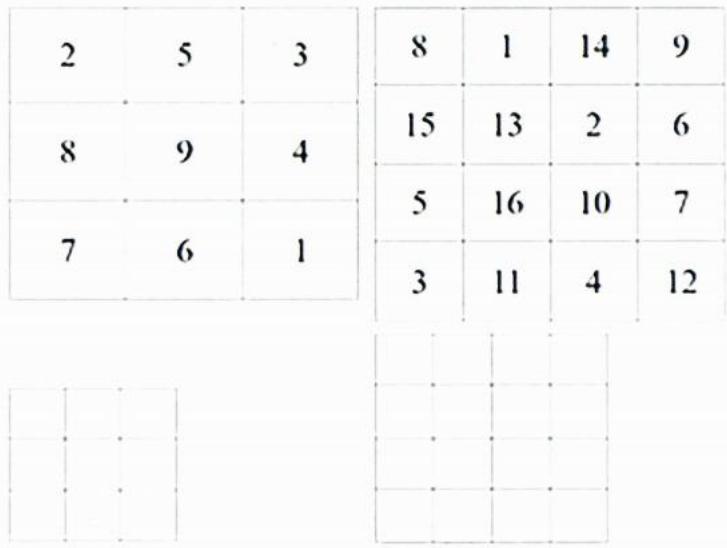
Schulte Grid example for photographic memory training
When using number dot flashcards (as shown below) and other items as targets for the game, we will discover some interesting phenomena. When the number of dots increases to a certain amount, for example, 58 dots, and you let the child look for 5 or 10 seconds. You will find that if there is no number behind the flashcard, these dots in irregular positions are simply impossible to count completely within the specified time. You ask the child how they did it? Some will say they just intuitively knew it was like that; some will say a number appeared; some will say a “light ball” told them… When dealing with some complex patterns or text, some students can see this content appear clearly on their forehead. Since this phenomenon cannot yet be explained clearly scientifically, some people say that photographic memory is actually students “peeking.” This kind of peeking is hard for us to understand; it is probably peeking from a “multi-dimensional space-time mirror” (for an understanding of multi-dimensional space-time, please refer to the introduction to high-dimensional space-time on page 277 of this book).

Number dot flashcard
This photographic memory ability is most effectively developed during childhood when the right brain is dominant. Photographic memory ability is often manifested between the ages of 0 and 6, is relatively easy to manifest between 6 and 12, and becomes more difficult after the age of 12. For children under the age of 12, this is just an instinct; it is simply a matter of awakening and using the ability of this instinct. Of course, for some children, abstract logical thinking has completely suppressed imaginative thinking ability, so the difficulty for such children may increase significantly. In addition, the exertion of this ability has a great relationship with health, mood, environment, etc. It is not easy to perform stably through training like the rapid memory method. In 2015, the 11-year-old contestant Li Junhui on Jiangsu Satellite TV’s “The Brain Season 2” used photographic memory at the time, but regrettably, due to nervousness, stage pressure, and other factors, the challenge was not successful. In his final summary, Dr. Wei’s statement that “image memory is fast to remember but also fast to forget” is actually a characteristic of photographic memory, not of the rapid memory method. The rapid memory method is also primarily image memory, converting the content to be remembered into vivid stories or animations for memory, and the stories we remember are not easily forgotten. In critical situations, the probability of successfully challenging using ESP (extrasensory perception) or photographic memory methods is inevitably relatively low.
The Brain - Li Junhui
Although photographic memory is not a psychological term, we can still find the following terms related to photographic memory ①:
Sensory aftereffect: After the stimulation of the receptor stops, the sensory impression does not disappear immediately but can remain for a brief period. This phenomenon of temporarily retaining sensation after the stimulation stops is called sensory aftereffect.
Afterimage: Sensory aftereffect is particularly obvious in vision, becoming afterimage, which is divided into positive afterimage and negative afterimage.
Positive afterimage: First look at a strong light stimulation for a minute or two, then close your eyes. At this time, you will see an image in front of you that is about the same as the strong light stimulation. Because the afterimage and the strong light stimulation are both bright, that is, the quality is the same, it is called a positive afterimage.
Negative afterimage: After the positive afterimage appears, if the eyes turn to a white wall at this time, you will see an image darker than the wall. Because the afterimage and the strong light stimulation are opposite in quality, it is called a negative afterimage.
Photographic memory has a “law of ability decrement,” which means: the closer to the birth period, the greater the possibility that a certain human ability can be manifested; the further from the birth period, the smaller this possibility. Shichida Makoto’s research subjects were mainly infants aged 0 to 6 in the more than 200 early childhood education institutions he guided in Japan, and the rate of this ability appearing could reach 100%. As age increases, the amount of information humans take in increases greatly, abstract logical thinking comes to dominate, and the ability of image-based memory is inevitably suppressed. The memory ability of the right brain is super strong. When the child is young, their potential must be developed so that when they grow up, they can combine the advantages of the left and right brains to form the strongest brain. Therefore, children’s image memory ability should still be cultivated as much as possible from a young age.
The amount of information in a child’s brain is not yet large, and most importantly, children’s thinking is relatively simple, without the need to consider parallel processing of many other types of problems. The photographic memory we speak of is relatively easy to achieve for children, and everyone can see the performance of several toddlers in the “Magical Baby Nurse” video. However, as age increases, especially after entering puberty, with the increase in learning content, changes in thinking patterns, and integration into social roles, this image-based memory ability of photographic memory will inevitably decline. If one insists on maintaining this ability through intensive training, even with huge efforts, the student may not necessarily achieve ideal results in the end.
So does photographic memory have no meaning at all? No. The essence of photographic memory is image memory, and the rapid memory method must fully utilize image memory to be more effective. Therefore, the best method is the combination of photographic memory and memory techniques, which can truly enable students to master and create memory methods suitable for themselves and keep this ability for a long time. Shichida Makoto’s “Super Right Brain Photographic Memory Method” actually does this. For students who want to learn photographic memory, younger ones can use the “Photographic Memory Game Training Method” introduced earlier to train the child directly. For older students, or those with a poor foundation in ESP games, training can be conducted through the following training outline.
Photographic Memory Training Outline
I. Goals of Photographic Memory Training
-
Quickly form image-based memory of the target to be memorized
-
Be able to clearly reproduce the content of the image memory
-
Be able to analyze and process the memorized image
II. Photographic Memory Training Content
- Attention Training
Objective: Improve attention span and focus state, cultivate abilities of concentration, distribution, and control of attention.
Content: Visual attention training, discrimination ability training.
Example: Schulte Grid Training
-
For each grid, quickly find all characters in numerical order. An average time of 1 second per number is considered excellent, i.e., 9 seconds for a 9-grid, 16 seconds for a 16-grid, and 25 seconds for a 25-grid.
-
At the beginning of practice, it is very normal not to meet the standard; do not be impatient. You should start practicing with the 9-grid. Only after feeling proficient or reaching the requirements with relative ease should you gradually increase the difficulty. Never let your enthusiasm for learning be dampened by eagerness for quick success.
-
When looking at the Schulte Grid, place your gaze naturally at the center of the grid. On the premise that all numbers are clearly visible, focus your sightline on the center of the grid, use your peripheral vision to cover the entire grid, keep your eyeballs still, and find all numbers from 1 to 9 in sequence within no more than 9 seconds. Be careful not to “attend to one thing and lose sight of another”; do not ignore other numbers while searching for one.
-
After finishing each grid, rest your eyes briefly, either by closing them or doing eye exercises, to avoid excessive fatigue.
-
You can also download Schulte Grids from mobile apps for practice. In the early stages of practice, do not consider memory factors; viewing 8 grids a day is sufficient. The longer you practice, the shorter the time required to view the grids will become.
- Visual Training
Objective: Expand visual span, improve eye function.
Content: Gaze training, eye muscle training, field of view expansion training, 3D image training.
Description: Such images can be purchased as relevant training cards, searched for and printed from the internet. There are also many related dynamic videos on the internet that can be used directly for training with computer screens or projectors, mobile app training games, etc. You can even train directly by tracing the four edges of a wall clockwise or counter-clockwise.
Example: Left-Right Visual Point Movement Training
-
Look at the image, starting from the top-left point, and move from left to right, repeating according to the lines.
-
Move the visual points left and right as fast as possible, striving to move across all points once within 2 seconds.
-
Move the visual point back and forth along the training chart; one training session takes about 1 minute.
Left-Right Visual Point Movement Training Chart
- Color Memory Training
Objective: Through encoding and retention, be able to clearly reproduce or recognize relatively simple color graphics.
Content: Mandala cards, color graphics cards, color text training.
Description: Such images can be purchased as relevant training cards, searched for and printed from the internet (when printing, generally one side is a color-filled Mandala pattern, and the other side is a blank outline Mandala pattern). You can also train using a computer screen or projector; there are also mobile app games regarding Mandala memory. For students who excel in blindfolded training, they can also train by perceiving and memorizing Mandala cards while blindfolded.
Example: Color Text Training
-
Look at the text in the image; regardless of the color of the characters, just read the pronunciation of the Chinese characters.
-
Look at the text in the image; regardless of what the Chinese character is, read out the color of the character loudly.
-
Require reading quickly; do not pause or think.
Black Pink Green Black Blue Black Red Orange
Blue White Yellow Green Blue Yellow Purple Red
White Red Pink Orange White Purple Green Purple
Color Text Training Chart
- Image Memory Reproduction and Analysis Training
Objective: Through encoding and retention, be able to clearly reproduce relatively complex images, be able to analyze memorized images, and reduce encoding time to less than 1 second.
Content: Flashcard training, “spot the difference” training.
Description: You can use Doman flashcards such as dot cards, picture cards, flag cards, etc. Besides using the Doman flashcard method, you can also flash cards and then ask students to describe the details of the flashcard content. For “spot the difference” training, flash two images simultaneously and find the differences based on memory, or flash one image and find the differences on another image.
Example: Image Spot the Difference Training
The image below shows the flags of Australia and New Zealand. After flashing for 1~5 seconds, ask students to state the similarities and differences between the two countries’ flags based on their memory.

Image Spot the Difference Training
- Imagination and Memory Training
Objective: Exercise students’ imagination, create tight links between images and information, and lay the foundation for transforming abstract content into imagery memory.
Content: Object imagination, divided attention (doing two things at once), letting imagination run wild, 3D unfolded diagrams, 1000 images, etc.
Description: For specific training methods, please refer to Chapter 11 “Expansion Training” in the Right Brain Development Training Manual.
- Photographic Memory Text Training
Objective: Through encoding and retention, be able to clearly reproduce text. The number of words increases continuously, encoding time reduces to less than 1 second, and one is able to recite or write from memory in any order.
Content: Unrelated 4-character cards, 9-character cards, 16-character cards, ancient poems, articles.
Description: Before this training, you can perform the Schulte Grid used for photographic memory training from the Photographic Memory Game Training Method. Refer to the image below for text cards.
- Rapid Memory Method and Photographic Memory Combination Training
Objective: Extract information from image memory, use memory methods to process and re-memorize the content, maintain long-term memory, and delay forgetting.
Content: Rapid memory method training, combination training of photographic memory and memory methods.
The above photographic memory training methods are only a reference outline; training progress should vary from person to person. Ultimately, combining photographic memory with rapid memory methods is a better choice for students. The most important suggestion photographic memory gives students is this: Right now, you are a camera.
8.5 Can Also Be a “Versatile Transformer”
Most children aged 6 to 12 can also act like a tape recorder, video recorder, calculator, etc., similar to the “Photographic Memory Game Training Method.” Of course, these “Versatile Transformer” abilities are best still based on ESP game training. We vividly analogize the process of memorizing things to information storage devices like cameras, tape recorders, and video recorders, thereby awakening human memory potential in this way. Zhang Xuexin is undoubtedly a leader in potential education nationwide. He has actively explored right-brain image memory and achieved excellent results. He calls this curriculum “photographic memory” and “reciting upon hearing.” In 2010, he presented a demonstration of four contents to experts from research institutions under the Ministry of Education in Beijing:
-
Learning an ancient poem (e.g., “Spring View,” “Flower Shadows”), the student reads it 1~3 times, enabling them to present clear images, sounds, and subtitles in their brain, just like self-directing a “TV series” of the poem in their brain. They should be able to play it forward and backward, thereby reciting it aloud forwards and backwards word for word.
-
Learning a modern poem (e.g., “Song of Youth”), the student reads it 1~3 times, enabling them to present clear images, sounds, and subtitles in their brain, just like self-directing a “TV series” of the poem in their brain. They should be able to play it forward and backward, thereby reciting it aloud forwards and backwards word for word.
-
Reading an article of over 500 words (e.g., “Dandelion”) 1~3 times, converting the article in the brain into a colorful “TV series” with images, text, and sound, capable of playing forward and backward, and achieving long-term memory.
-
Watching a TV series segment 1~3 times (e.g., a 3-minute segment from “Home with Kids” with over 700 characters in subtitles), allowing the student to record the images, text, and sound in the show completely like a video recorder, and replay them at any time. They should be able to recite the characters’ lines forwards and backwards and achieve long-term memory. ①
As early as the 1990s, Liang Guangxiang, who was the first to apply potential development to education, conducted practice and achieved very good results. In July 1994, Liang Guangxiang led students who had trained for 6 days to hold a demonstration in Shijiazhuang. Ye Dan, Lu Ning, and three others performed extraordinary memory feats. With their eyes closed, the teacher asked people off-stage to randomly write down 10 or 8-digit numbers, read them twice to the students, and then asked them to recite them forwards and backwards. Regardless of whether it was 10 or 8 digits, or forwards or backwards, all three children could recite them without a single error. 12-year-old girl Ye Dan recited a 12-digit number backwards, drawing waves of applause from the audience. When asked how they could remember so many numbers, they answered that the numbers read by the teacher could be imprinted on the screen on their forehead; when the teacher finished reading, they just read them out following the screen forwards or backwards. Liang Guangxiang explained that the screen the children feel in front of their forehead is the “Bright Mirror” of the Bright Mirror Skill. The Bright Mirror can also see through the human body and magnify. The author saw that every child receiving instruction had a registration form, which, in addition to name, age, and address, also recorded their daily practice in developing their own potential. The registration form of 9-year-old girl Yang Jingru showed: no feeling in the first three days; on the 4th day, saw a white pill the size of a walnut, could introspect any part of her body, and was transparent throughout. She could also magnify blood vessels and see the teacher’s image with closed eyes. 14-year-old girl Gao Ying said she saw the blood flowing in her blood vessels. ②
Liang Guangxiang was the first educator to train children in blindfolded character recognition, and he has always been committed to the research and practice of using potential development to improve children’s intelligence. Our current development of children’s potential is actually moving forward based on the profound practical accumulation of our predecessors. For students with a higher level of ESP game training, some learning related to memory and quick calculation can often form automatically. If you ask a student to become a camera, they won’t know how they changed, but they can directly remember things. The training methods for audio and video recording can directly borrow from the “Photographic Memory Game Training Method.” When using these training methods, note that the training must proceed from easy to difficult; do not strike the student’s confidence in the pursuit of speed.
Zhang Xuexin summarized concepts such as the eye-brain system, ear-brain system, mouth-brain system, and hand-brain system, along with corresponding training. He believes that the human ear-brain system has evolved over hundreds of millions of years and possesses magical thinking abilities for recording, playing, and creating sounds. Let students relax their body and mind, listen to a sound, then close their eyes and play it in their brain. After a period of training, students can replay clear and complete sounds. Letting students listen to low-volume sounds and double-speed sounds to train their hearing not only improves students’ listening and lays the foundation for the development of the “reciting upon hearing” thinking function but is also an effective means of developing students’ right brains and prompting them to enter whole-brain thinking. At the same time, it cultivates good habits of focusing attention in class. Because the brain has thinking functions for recording and playing audio and video like a video recorder, through “recording and playing audio and video,” the quality and efficiency of the brain’s recording and playing are gradually improved, which means improving the brain’s memory ability. In his teaching, Zhang Xuexin calls the brain’s audio-visual thinking function a “Small Color TV” (i.e., what we call the brain screen), requiring students to be able to direct the content of the “Small Color TV” according to their personal situation.
Example: Let students record images, subtitles, and sounds completely in their brains like a video recorder, and then replay them seriously.
Please students, sit up straight in a beautiful posture. Good, train your eyesight a bit. Good, come and appreciate the song XXX with the teacher. Pay attention to eyesight! Hearing! Sing along softly with your mouth, and record the images, melody, and lyrics in our small color TV. Good, get ready, start.
Good, slowly close your eyes, take a deep breath, watch the image in your small color TV, listen to the sound in your small color TV, and sing the lyrics in the small color TV softly. ①
The same method can be used to record and play videos of poetry, articles, texts, micro-lessons, etc., requiring students to watch seriously, reminding them to record images, subtitles, and sounds completely in their brains like a video recorder, and then replay them seriously. Students can eventually replay at any time, not only replaying forwards but also backwards, and achieve forward recitation, backward recitation, and long-term memory of subtitles. Therefore, some whole-brain education institutions promote that students can recite a 1,000-word original text within 15 minutes, achieve photographic memory, reciting upon hearing, backward recitation and spot recitation, and even recite punctuation marks; this is not impossible to achieve.
After students’ potential is well opened, the quick calculation function is sometimes automatically opened as well. In the “Right Brain Development Training Manual,” there is a case of student Tianyi:
When classmate Tianyi was performing some mathematical multiplication calculations while blindfolded, whenever the answer appeared, it was always like a funny cartoon story, with numbers vividly singing and dancing, and even accompanied by music, appearing on the “screen” on the forehead. ①
Classmate Tianyi was not instructed to become a calculator; his function was spontaneously generated. This calculation is in an unconscious state of calculation, which means the child does not know what the calculation process is like, only sees the result, and the process is automatically completed by the subconscious mind. Professor Zhu Nianlin of Yunnan University uses a slightly more complex but more effective method when training students.
To improve students’ academic performance, we can also induce training for the brain to have an “electronic calculator function.” The method is as follows:
First, everyone holds an electronic calculator in their hand, learning to use the keys to produce various digital answers until they are proficient. Then, without touching it, use the mind to press the ON key, and the display shows “NO”. Then, practice with a distance of about 1 meter apart, slowly pulling away sequentially to practice. Use the mind to press single-digit to three-digit numbers. After mastering this, start training simple arithmetic problems. Each training session does not exceed 45 minutes. Successful ones can see the answer on the calculator. After a period of time, put the calculator in a schoolbag and place it in front of the desk. Similarly, use the mind to press the keys. After verification, secretly take away the calculator in the schoolbag. Under the condition that there is no electronic calculator on site, there is only an empty schoolbag in front of the desk. The student thinks the calculator is still in the schoolbag. According to the above induction training from simple to complex, from easy to difficult, gradually enable students to master various special application methods of the electronic calculator. After training, the answers of students will appear in the mind “calculator” in front of their forehead, and answers to unlearned knowledge will also appear. ②
We need to note that learning is not only the mobilization of memory and subconscious calculation but also a process of reconstructing thinking and knowledge. Many parents are willing to take their children to接触 more new things and read more books, which is a very good practice. Doing so is the process of letting children accumulate knowledge elements. The more things they接触, the easier it is to form elements of realistic image perception from text, which is not only conducive to memory but also conducive to the understanding of new knowledge.
In the process of student learning, we must pay attention not only to the accumulation of memory skills but also to the combination with subject knowledge. Some instructors think that such instructional design is relatively difficult. Zhang Xuexin’s exploration in this area is very deep and has achieved good results. Below is the instructional design of Zhang Xuexin’s “Wordless Heavenly Book” public class, for your reference only.
*Instructional Design for the “Wordless Heavenly Book” Public Class *
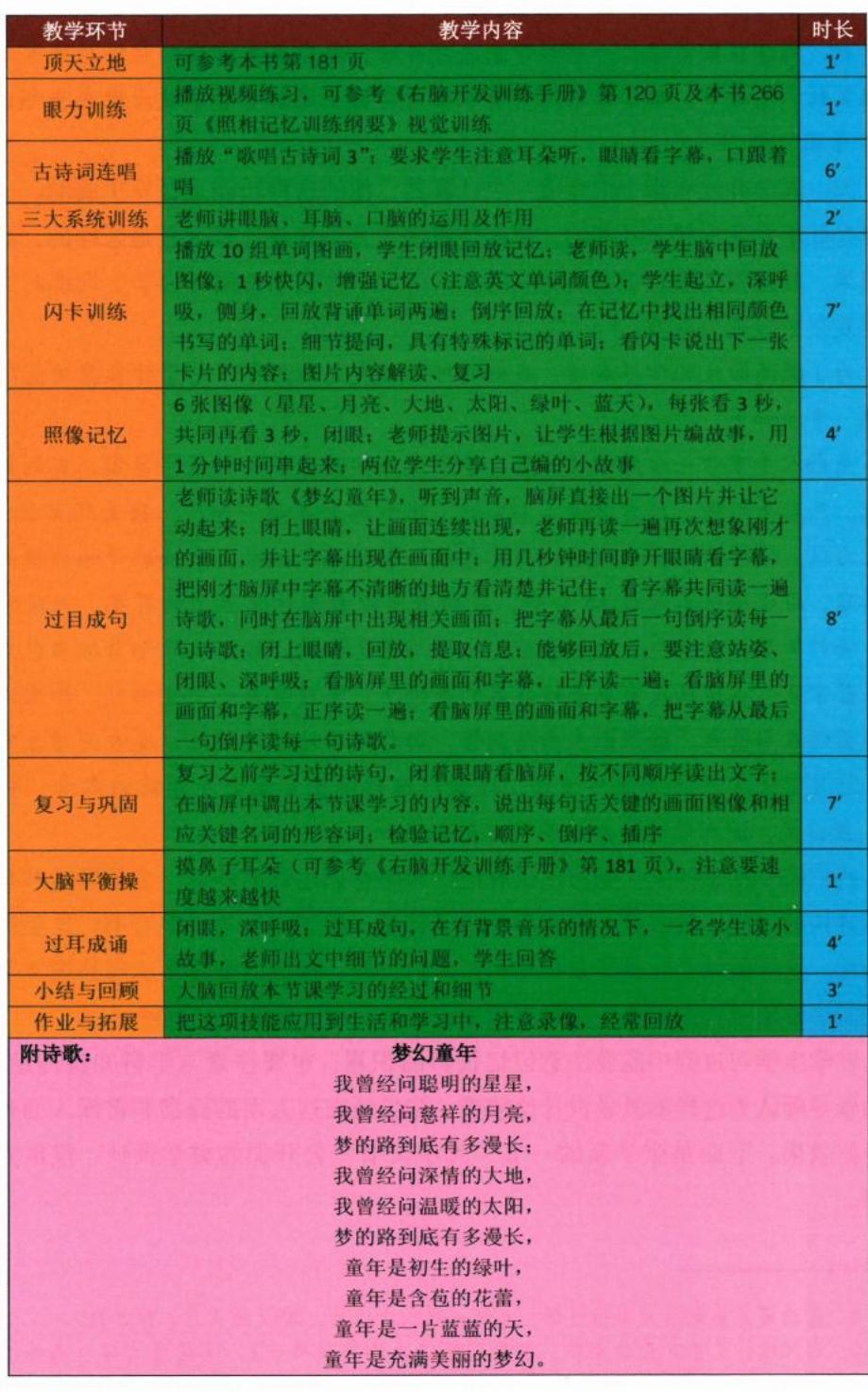
8.6 Information from the Heavens in a Book: Wave Speed Reading
Let’s start with a test:
Pick up a book, focus entirely on the author and the synopsis, and perhaps flip through the table of contents to establish a mental connection with the book.
Please take a few deep breaths, completely relax yourself, make yourself absolutely quiet, empty your mind, and concentrate on this “emptiness.” You may gently close your eyes.
Rapidly flip through the book (flip the book quickly, like watching a flipbook animation), over and over again. After a while, some information will appear in your mind—it might be images, it might be sounds. Or it might be nothing at all, just a feeling, but this feeling will let you know some information.
About one-third of people will receive information related to the content of the book. This method of obtaining information “out of thin air,” where it is achieved in a single thought, comprehending the whole book through intent, and allowing consciousness to cover the entire book, is what we call Wave Speed Reading, Cloud Brain Speed Reading, Quantum Speed Reading, High Score Speed Reading, etc. In the early research of Human Body Science in our country, this phenomenon was referred to as “Designated Character Recognition,” “Closed Book Character Recognition,” “Non-contact Character Recognition,” etc., which provides more precise information than “Wave Speed Reading.”
In the early 1980s, two Mongolian girls named Siqin and Gaowa were most adept at this. Once, researchers sealed a book of over 300 pages in a kraft paper envelope and glued it shut. They asked Siqin to identify the characters on the first line of page 106. Siqin was seen gently feeling up and down the outside of the envelope with her hand. After a short while, she wrote on paper: “Carbon compounds, through a series of complex reactions, cycle repeatedly, producing CO and.” When the book was opened for inspection, sure enough, not a single word was wrong, not even the punctuation marks. Siqin said that to recognize characters on a designated page, one only needs to calm down, and after “seeing” the bright light on the forehead, think of the page to be recognized in one’s mind. At this time, the pages that don’t need to be recognized quickly “flip” by, and when it “flips” to the page that needs to be recognized, I let it stop, and then the characters to be recognized jump out one by one. ①
Hua Zhongyi, the president of Fudan University, mentioned in a speech on May 17, 1989, at the inaugural meeting of the Shanghai Society of Human Body Science: “He went to Professor Tan Jiazhen’s house and saw two children arrive. Professor Tan randomly took a book from the cabinet and placed it on the table without opening it, stating a specific page, line, and character position, asking the child to say what the character was. The result was correct both times. Professor Tan did not know beforehand that he was going to take a book, nor did he know which one. Even if it were a book he wrote himself, he wouldn’t know what characters were on which page or line. It was completely random and impossible to cheat.” This situation is called “Freezing” or “Locking” in Wave Speed Reading. “Freezing” is considered an advanced stage of Wave Speed Reading in the field of whole-brain potential development; in fact, this is no longer ordinary whole-brain development but belongs to the field of Human Body Science research.
Why can humans obtain information in this way? What is the principle behind it? Legend has it that Huineng, the Sixth Patriarch of the Zen Buddhist school, was illiterate. After his enlightenment, he often cited scriptures and classics when teaching his disciples, reciting various Buddhist sutras effortlessly, which was regarded by others as a supernatural power. Setting aside the debate on whether Master Huineng was truly illiterate, let us look at how Buddhism understands Buddhist principles through the Buddhist cognitive system. Huineng was able to discern Buddhist truths through “wisdom of detachment from appearances” (the specific technical term for this wisdom should be “Prajna”). “Appearance” (Lakshana) refers to the six types of perceptions generated through the six sensory functions: seeing with the eyes, hearing with the ears, smelling with the nose, tasting with the tongue, touching with the body, and thinking with the mind, forming memories called “Six Consciousnesses.” “Consciousness” (Vijnana) constitutes the obstacle to liberation, meaning one should not rely on the realms of “knowledge, common sense, cognition, consciousness, or karmic consciousness” to establish any viewpoints. “Detachment from appearances” is the state of completely breaking through dualistic oppositions and shattering all cognitions, viewpoints, and positions. In this state, appropriate information can also be obtained; the principle of Wave Speed Reading obtaining information is identical to this.
Why is it called Wave Speed Reading? This name was coined by the Japanese right-brain educator Makoto Shichida. “The source of all things is waves, and all things are connected by waves. This wave is not an electromagnetic wave, but an energy wave of the unknown universe. Humans possess left-brain and right-brain consciousness. Right-brain consciousness resonates with the cosmic waves of this universe energy, allowing them to be visualized, thereby seeing images, and even turning them into sound.” “So-called Wave Speed Reading is a speed reading method where you flip through the book rustlingly, and the book’s information enters the brain at super high speed like light waves during the flipping process.” ① Makoto Shichida believed that Wave Speed Reading is a function of the right brain. The left brain’s working rhythm is very slow, while the right brain’s rhythm is the speed of light, capable of processing information entering the brain at super high speed with autonomy. The method of using the right brain to read is to first quickly scan the book with the eyes, thus obtaining an overall impression, and parts can also be compared and contrasted at a glance. The right brain can grasp the whole in an instant, allowing intuition to modify erroneous parts and correctly organize the information. Visualization is an important function of the right brain; the right brain can convert and translate received information into information such as images. The right brain has an imagination mechanism that can rapidly convert received information. “The right brain can turn language into images; not only that, the right brain can also turn numbers into images, sounds into images, and smells into images.” “The right brain visualizes and remembers everything seen, heard, and thought of.” “In Wave Speed Reading, the text and images in the book are first received by the brain at wave speed, and the right brain processes this information visually, then converts it into images one by one, which are taken into the brain and freeze there. If Wave Speed Reading becomes possible, it means your right brain function has been activated. In other words, we can regard developing the ability of Wave Speed Reading as a key to unlocking various mysterious abilities hidden in the right brain one by one.” ① Makoto Shichida believed that the basic purpose of the Wave Speed Reading method is to cultivate the ability to obtain information at wave speed and turn this information into imagination.
In the second half of 2019, the term “Quantum Wave Speed Reading” was pushed to the forefront of public opinion by the media and social platforms. The State Council even stepped in to investigate and penalize some institutions without school-running permits for conducting training for primary and secondary school students under the guise of “Quantum Wave Speed Reading” and “Whole Brain Training.” The Office of the State Council Education Supervision Committee issued the “Circular of the Office of the State Council Education Supervision Committee on the Investigation and Handling of Several Off-Campus Training Institutions for Conducting Training in Violation of Regulations.” ② In November, Jiang Wan, a philosophy professor at Shenzhen University, published an article titled “Wave Speed Reading: It’s Not Easy to Love You” on a WeChat official account to help people correctly interpret “Wave Speed Reading.” A netizen wrote an article on the Q&A platform “Zhihu” titled “How to evaluate Shenzhen University philosophy teacher Jiang Wan’s support for the existence of ‘Wave Speed Reading’?” ③ The views exceeded one million within two days, entering the top three of Zhihu’s hot search at the time. Human Body Science has conducted experimental research on “Closed Book Character Recognition,” “Non-contact Character Recognition,” and “Designated Character Recognition” for over 30 years, and Wave Speed Reading has been in China for over ten years. Why did society stop buying it just because “Quantum” was added to the front? Of course, this is due to training institutions exaggerating their propaganda and failing to keep promises, as well as unreasonable situations where “fees range from 6,000 yuan for half a year to 260,000 yuan for a ‘lifetime membership’.” ④ So it is not the name that was at fault, but the trouble caused by making money.
The term “Quantum Wave Speed Reading” was originally created by Yumiko Tobitani, a student of Makoto Shichida. This was introduced in the section “The Development of Brain Potential Development” in this book (page 135 of this book). In 2006, Yumiko Tobitani published a book titled “Quantum Speed Reading: Awakening Your Child’s Mind” (the book was not published in China) in the United States, thereby opening up the foreign education and training market. However, the book did not mention anything about quantum content; quantum research studies the microscopic field of atomic-level matter. “Wave Reading” is a realm completely transcending traditional “speed reading methods.” So she added the word “Quantum” probably just to increase the “tech feel” of the term “Wave Speed Reading.”
Of course, we can also give a science-fiction style explanation for Wave Speed Reading. Zhang Kaiji, a Taiwanese spiritual researcher, believes: “The most basic phenomenon of the spiritual world is not communication through language, but completely through thought transmission.” Language and text are low-level communication tools; after human potential is developed, high-level communication can be achieved. Closing
(Above) Resting state brain topography during speed reading. Brain topography taken August of 2000.
Medica University by DrKim Kawano. We can see that the waves are being emitted from the central frontal area when concentrating and doing QR. This type of brain wave is appropriate for study and it appears in the frontal and central area of the head, about the middle of the space between the crown and forehead, continuously.
(Left) The Asahi newspaper excerpt from May 23, 2003. As noted by our young student K, alongside Sene magazine, there are many kinds of brain holes.
Screenshot from the book “Quantum Speed Reading, Awaken Your Child’s Mind” by Yumiko Tobitani
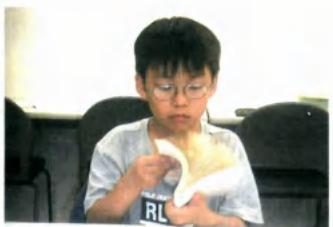
By flipping through the pages of an English book, this student can understand the contents through Japanese and the imagery which it “emits.”
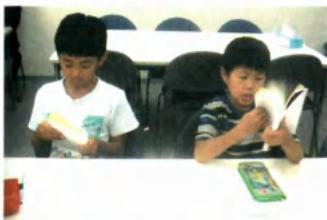
Students see colors, light, and imagery as well as perceive smells and sounds from the books.
Why is it possible to see the words inside a closed book? After successfully developing their potential, when people enter this state, it is as if they have entered a high-dimensional space-time. In a high-dimensional space-time, one can see things that cannot be seen in the three-dimensional space-time. For example, in three-dimensional space-time, we cannot see the inside of an inflated basketball without destroying it, whereas in a high-dimensional space-time, one can see things in any three-dimensional space at any time segment. This seems difficult to understand, but a video can help us understand the passage just mentioned. The 2014 sci-fi movie “Interstellar” features a segment where the pilot Cooper enters a black hole and can see his daughter in three-dimensional space at any point in time. In a high-dimensional space, three-dimensional spaces are like individual drawers, allowing one to see every scene.
“Interstellar” movie clip
We will not delve deeper into science fiction topics; instead, let’s look at how to train in Wave Speed Reading. Let’s first look at how pioneers in human body science conducted “closed-book character recognition” and “off-body character recognition” with children:
Building on “ear recognition” and “palm recognition,” we teach “closed-book recognition.” The method is: hold a book, do not open or look inside, only touch the cover with the hand, and require seeing the characters on a specified page and line. At first, we only recognize characters on a single page because characters on a double page appear reversed at first glance and are hard to recognize; it takes prolonged practice to adjust, so we leave double-page characters for later training. When looking, just as before, students are required to send an intention, thinking: “What characters are on page X, line Y? Tell me quickly.” Students often can see the content of pictures in the book clearly, and the answers are very accurate. After practicing for a while, some students can even see the specified content in the book without their hands touching the book. At this point, we can raise the level to train “off-body character recognition.”
“Off-body character recognition” means neither the hand nor the body can touch the book or the note slip; viewing is done at a distance, moving from near to far. First, place it 50 cm away to view, then slowly pull it further away, then view through a wall, and finally view from upstairs or downstairs. At this stage, teach students to practice anytime, anywhere in daily life. For example: How many cigarettes are left in Dad’s pocket? How many matches? How many little birds are standing on the utility pole? How many small flowers have bloomed on this flower? Send an intention, ask the question, and after seeing the answer, verify it. ①
“Ear recognition,” “palm recognition,” “closed-book recognition,” and “off-body character recognition” are actually no longer just ESP games but genuine ESP functions of human body science. Therefore, most of us believe that Wave Speed Reading falls into the category of ESP superpowers. Of course, this function can be gradually achieved by starting with blindfolded ESP games as a foundation and progressively increasing the difficulty.
The methods we use to increase the difficulty of recognition include:
-
Limit completion time: Our fastest recorded speed is recognizing 15 medium-difficulty samples correctly in 40 minutes.
-
Semi-off-body (container isolation) recognition: Place the sample in a glass bottle, plastic bottle, or paper box, and hold the container to identify. Sealing the opening with tape is optional. Our current highest record is correctly recognizing a sample with 58 Chinese characters in 20 minutes.
-
Off-body recognition: Identify without any contact with the sample. The hardest sample we have on record being identified was a short text of 80 characters. The furthest distance was three meters. Successes have been achieved at distances of several dozen meters as well, but due to lack of strictness, they can only serve as references.
The recognition time for semi-off-body or off-body methods increases significantly, so it should only be carried out after the speed of “palm recognition” is sufficiently fast.
- Touch-book character recognition: Let a child touch an unfamiliar book, specify any page number and line number, and ask them to identify. Students who can perform “off-body character recognition” are mostly able to complete this. After training, they can often recognize a whole page, or even recognize a whole page off-body.
When students possess the ability to recognize long strings of text samples, we started experiments on applying this function to learning. Our first experiment was whether the function could be used to find typos or errors in answers to math calculation problems. The method was to deliberately include typos in a printed short text, or write several numerical calculation problems that are hard to calculate mentally, and deliberately get a few digits wrong in the answers. Students were asked to use the function to find the errors and mark them with a pen. Students were able to mark them correctly. Even second-grade students could correctly mark errors in idioms learned in fourth grade, and primary school students could correctly point out errors in text descriptions from university biology majors. When asked how they knew, some said that in the “screen,” there was a red circle or a red line drawn there, others said there was a triangle symbol. Others said a voice told them. If further required to correct the error at that spot, students who already possessed the relevant knowledge base would be fast and have a high accuracy rate. Those who did not possess it were slow but still had a not-low accuracy rate. ①
Currently, most whole-brain development training institutions or potential development education institutions do not have the concepts and foundation of human body science research. Most parents also pursue short-term application in learning. “Ear recognition,” “palm recognition,” “closed-book recognition,” and “off-body character recognition” are also not what many parents truly pursue, and Makoto Shichida did not conduct in-depth research and exploration in this area either. Many people learn Wave Speed Reading to read faster, thereby increasing reading volume. With so many conflicting psychological factors mixed together, designing a Wave Speed Reading training course may not be easy. Shichida’s “Super Right Brain Wave Speed Reading Method” essentially borrows fully from the “Speed Reading Method” combined with his right brain theory for practice. This indeed has a good effect on brain development. Drawing on Shichida’s “Super Right Brain Wave Speed Reading Method,” for older students or those with a poor foundation in ESP games, training can be conducted through the following training outline. There are also some Wave Speed Reading training cards on the market, which can be used for training through these professional tools.
Wave Speed Reading Training Outline
I. Goals of Wave Speed Reading Training
-
Perceive book content in the form of flipping (rapidly flipping the book, like looking at a flipbook) and correctly retell parts of the plot.
-
Perceive book content and accurately understand parts of the content.
-
Accurately perceive specific details in the book.
-
Be able to perform learning activities while in the Wave Speed Reading state.
II. Wave Speed Reading Training Content
- Relaxation and Meditation Training
· Breathing training
· Body relaxation training
· Mental relaxation training
· Imagination training
For the above, please refer to Chapter 5 “Relaxation and Breathing Training,” Chapter 6 “Image Training,” and Chapter 7 “Imagination Training” in the “Right Brain Development Training Manual.”
- Attention Training
Psychological application research regarding attention training is already quite mature, and the related training systems are relatively complete. It is recommended to use relevant specialized tutorials for training. Even if one does not undergo Wave Speed Reading training, this training is very important. Students who undergo systematic attention training will show improvements in areas such as restlessness, carelessness in problem-solving, and poor observation skills, thereby improving their academic performance.
- Visual Training
· Concentration Training
【Training Goal】Through training, enable the mind to concentrate naturally. When looking at text and objects, it should produce the effect of the characters appearing larger than they actually are and the field of vision becoming clearer, while simultaneously training endurance of focus.
【Training Process】
-
Maintain abdominal breathing.
-
Open the eyes naturally; do not stare or squint. Place the eyeballs naturally in the center of both eyes; do not go cross-eyed (do not let both eyes converge toward the nose).
-
Look at the concentration training chart. Do not blink. Stare at the black dot in the center. The gray shadow will gradually decrease. Always look only at the black dot until the shadow surrounding the black dot is seen entirely as white.
-
Try to maintain the state of seeing a single black dot. The duration for one training session is approximately 2 minutes.
Concentration Training Chart
· One-Point Gazing Training · Viewpoint Movement Training
· Viewpoint Circle Mark Training
· Visual Span Expansion Training
· Visual Span Range Training
· Rhythm Training (It is recommended to use speed reading rhythm training software for training)
· 3D Image Training
For the above, refer to the relevant content on visual training in the Photographic Memory Training Outline and Right Brain Development Training Manual, Chapter 8.
- ESP Training
Through a series of trainings, achieve the ability to see various color cards, where the original colors of the cards appear when eyes are closed or when looking at a white wall, and mental images can be created and changed at will.
· Complementary Color Card Training
· Solid Color Card Training
· Shape Card Training
· Mandala Training
· Mental Image Enhancement Training
- “Wave Reading” Training
III. Special Notes
■ The above training process is relatively suitable for adolescents aged 9 to 18. Children under 9 who lack sufficient literacy and reading accumulation are not suitable for this training. The duration of each training segment must be determined based on the individual student’s situation. Some adolescents can acquire basic Wave Speed Reading abilities and enter the corresponding state within two days.
■ Establish a life information link with the book and the author; be full of respect and sincerity towards the book and the author, and let this book become a part of your own life. On this basis, Wave Speed Reading can achieve better results.
■ When students initially cannot find the information from the book, you can first let the student establish an information link with the book by browsing the table of contents. After the student confirms the link, proceed with flipping the book.
■ Students who have reached a high level of ESP training can have relevant information from the book appear on their “brain screen” by touching the book with their hands. This can be used as a sign that they are ready to start Wave Speed Reading.
□ There are generally two types of feelings students experience during Wave Speed Reading: one is where the brain screen directly presents relevant information from the book while flipping the book; the other is a sensation where the information from the book floats or is sucked into the brain. The first situation is more common.
■ Wave Speed Reading is closely related to ESP (Extra Sensory Perception). In the best state, one can directly perceive information at specific locations in the book without opening it. This can be regarded as an advanced stage of ESP training, which some institutions call “Fixating.”
■ When starting Wave Speed Reading, one should select books for lower elementary grades. The reading material should feature continuous stories, simple and clear characters and plots, and may include illustrations. Once the student’s state is stable, the requirements for the reading material can be gradually increased.
■ For children who have already undergone ESP game initiation training and possess good ESP abilities, they can directly enter Wave Speed Reading training.
8.7 A True Look at Wave Speed Reading
In recent years, I have found that the teaching methods and curriculum settings used by various educational training institutions differ significantly from their lineages. There is currently no unified industry standard for potential development. Each institution obtains technology through different channels, and the extent to which they can master, absorb, and apply what they learn varies. The methods I introduce here are certainly not the best for everyone, because only after transforming them into your own can they truly suit you. Unless one devotes themselves to deep research and accumulates experience over many years, it is difficult to form a truly practical teaching system. Furthermore, the results of painstaking research by genuine educational institutions are difficult to use effectively outside of their institutions, because the students, teachers, school culture, management, and environment are all different. New teachers in regular schools learn to teach by listening to veteran teachers in every class. Initially, their lesson plans refer to those of veteran teachers. Even with the same lesson plans and the same courseware, the classes taught by new teachers often differ vastly from those taught by excellent veteran teachers. New teachers in schools find it difficult to truly and thoroughly understand the curriculum standards in a short time. When the teaching research department organizes excellent course selections, there is often a requirement that new teachers with less than three years of teaching experience are not allowed to participate. Excellent teachers can take any topic, prepare briefly, and deliver a wonderful lesson. They can teach very well even without courseware, and students still love learning. Some new teachers do not know how to teach without courseware, do not know how to design instruction without reference materials, and dare not go onto the podium without multimedia. This is truly worrying.
Another cause for concern and confusion is the promotion by whole-brain potential educational institutions. There are promotional soft articles that claim: “Accuracy can reach 90% after flipping through once, 95-98% after a second flip, and 100% after three flips. Three stages, with the highest stage being reciting the original text. For Wave Speed Reading a book, the highest stage can also be reciting the original text.” I believe that since Wave Speed Reading entered China, there have indeed been many breakthroughs in development technology. However, most institutions still contain more elements of boasting. Two problems exist here. One is how accuracy is defined: reciting the original text? Or just the general idea? If reciting the original text, does it apply to all content of the book? What kind of books? Can books beyond the student’s age and cognitive level be used? If it is the general idea, it cannot be represented by data like 70% or 90%. Second, with Wave Speed Reading or Photographic Reading, how much of the student’s understanding rate of the text can be achieved? We do not exclude the fact that every institution has very excellent individual cases, but what must be done is not to infinitely promote individual cases, but to cultivate more students to be excellent. Because the essence of Wave Speed Reading is ESP, which fully utilizes imagination. When children flip through books, it is very easy for information they have recently focused on—such as books, stories, animations, TV shows they have watched recently—to appear and mix with the content of the book being flipped, and be described by the child. Therefore, a lot of subjective information unconsciously appears. This situation is also relatively common, and ways should be found to avoid subjective participation. Combining “Speed Reading” with Wave Speed Reading training to display objective information as comprehensively as possible is a better method.
I do not oppose Wave Speed Reading or Photographic Memory, but one must clarify that Wave Speed Reading and Photographic Memory are still just tools, like other ESP games. Do not mythologize this tool excessively. Rather, the focus should be on how to make good use of this tool to improve students’ learning abilities. Many educational training institutions, such as Shenyang Whole Brain Huiyi Training School, Sichuan Mingjue Growth Academy, and Chengdu Wenrude Learning Ability Training Center, have combined Wave Speed Reading very well with subject learning. They do not pursue the function itself, but enable students to learn in a Wave Speed Reading state, and the results in grade improvement are very good.
When I was an undergraduate, my philosophy history teacher gave excellent lectures. He never recited from the book, and the students all loved listening to his class. However, there were also many who skipped class. This teacher’s exam questions were always very strange; it was very difficult to find the correct answers directly in the textbook, so it was hard to cheat on his exams. This relied on how the teacher, during lectures, connected content from different chapters to form a network for solving new problems. Current exam questions increasingly value the comprehensiveness of knowledge and test students’ thinking abilities more. The student’s entire basic education stage is basically about improving human thinking ability and the ability to apply knowledge points. If you simply rely on the skills of Wave Speed Reading and Photographic Memory, it is relatively difficult to display a higher level of thinking ability. If you do not pay attention to solid knowledge accumulation and thinking training, it is impossible to stand out in the college entrance examination.
“Marxism-Leninism holds that the characteristics of the two stages in the process of cognition are, at the lower stage, cognition manifests as perceptual, and at the higher stage, cognition manifests as rational (logical). However, any stage is a stage in the unified process of cognition. Perception and reason are different in nature, but they are not separated from each other; they are unified on the basis of practice. Our practice proves that: what we feel, we cannot immediately understand; only what we understand can we feel more deeply. Perception only solves the problem of appearance; theory alone solves the problem of essence.” ① Whether it is Photographic Memory or Wave Speed Reading, the intake of information is perceptual, while examinations basically rely on abstract logical thinking. From the right brain to the left brain and then to the whole brain, from perceptual intuitive thinking to image thinking and then to abstract logical thinking, there must be a process of understanding in between. Parents hope their children become prodigies; this feeling is understandable. Potential development can be an effective tool for children’s growth, but it is definitely not a life-saving straw.
Chapter 9: Potential Development Oriented Towards Functional Research
Many people’s first interest in potential development began with these incredible functions humans can possess. Parents send their children to training institutions hoping they will stand out and possess various magical abilities. If blindfolded reading is merely considered an entry-level warm-up “game,” many may still hope their children can acquire abilities like snapping matches with their mind. The development of various latent functions may slowly unveil an unpredictable unknown world…
Due to human curiosity, since the dawn of civilization, individuals with “supernatural powers” or extraordinary abilities have particularly attracted attention. Once discovered, such people attract crowds eager to follow them, almost worshipping them as deities. Throughout history and across the world, there has been no shortage of such individuals, known as wizards, psychics, magicians, eccentrics, superhumans, functional humans, or mutants. Science cannot yet give us a definitive answer on whether such abilities are special functions or magic. Here, we give them an entertaining name: “King Kong Experts.”
Some parents believe that if their child can become a “King Kong Expert,” their life will be relaxed, smooth, happy, and joyful. If this is the case, they often place great importance on the functions their child develops during potential development. When this pressure shifts to the instructors at the potential development training institutions, the instructors also hope to guide students in that direction. Therefore, this chapter will provide a comprehensive overview of content related to extraordinary human functions. However, a reminder is necessary: if you have any ideas about attempting to guide students to become functional humans, be sure to consult experienced practitioners or human science researchers beforehand to avoid unforeseeable consequences.
9.1 Selected Examples of “King Kong Experts”
9.1.1 The “Superpower” CEO—Zheng Xiangling①
In the 2018 Hurun Richest Women in China list, a pharmaceutical industry entrepreneur ranked tenth. She is Zheng Xiangling, current President of Chia Tai Pharmaceutical Group, Chairwoman of Beijing Tide Pharmaceutical Co., Ltd., and President of the Shaanxi Chamber of Commerce. Additionally, she controls over twenty pharmaceutical enterprises, including China Biopharmaceutical Co., Ltd., Chia Tai Century Group Co., Ltd., 999 Pharma, Freda, and Tianqing.
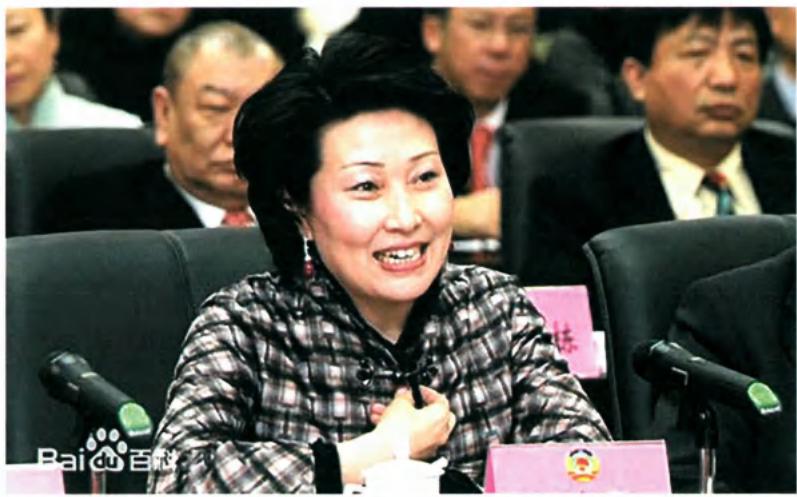
Zheng Xiangling at the CPPCC National Committee meeting
Zheng Xiangling was born in 1964 in Houzhengjiagou Village, Jizhen Town, Suide County, Yulin City, Shaanxi Province. Her grandfather, Zheng Weiye, was known as a “Living Immortal” while alive, reputedly able to see through to the illnesses inside others’ bodies. Zheng Xiangling’s father, named Zheng Dezhi, had six children; she was the second daughter, and her younger brother, Zheng Doudou, is also a King Kong Expert.
Perhaps due to heredity, Zheng Xiangling possessed clairvoyant functions from a young age. At the age of 4, once night fell, she would often see the colorful internal organs of her relatives in the darkness; her parents appeared as skeletons in her eyes. She cried loudly, and when her father hugged her to comfort her, she was so frightened she thrashed about, scratching bloody tracks on her father’s face, which left permanent scars.
When Zheng Xiangling was six years old, she was living at her aunt’s house in Xi’an. Once, when an aunt came to visit, Zheng Xiangling seemed able to see a little brother in the visitor’s belly and told her aunt. Sure enough, a few months later, that aunt gave birth to a boy.
Once in class, because she couldn’t recite the text and was momentarily at a loss, she inadvertently placed her hand on the closed textbook. Immediately, rows of inverted characters appeared in her mind. She focused and saw it was the text content, so she read it out all at once, and the teacher even praised her afterwards. By junior high school, the news that Zheng Xiangling possessed “special functions” had spread.
In 1978, the Xi’an Evening News conducted a special test on Zheng Xiangling. During the test, she used her hands to identify different colored yarns wrapped in paper balls by a reporter, and also used her ears to “hear and identify” many Chinese characters and drawings.
In September 1979, Zheng Xiangling was exceptionally admitted to Xi’an Medical College as a special talent, becoming the youngest college student in her class. When taking human anatomy classes, Zheng Xiangling used her clairvoyant function to directly gain useful knowledge from living bodies, without needing to rely on cadaver dissection. The following October, after strict investigation by the Lanzhou Military Region, she was specially approved to join the army, beginning a decade of military life. In 1984, she graduated from the Lanzhou Military Region Medical School, worked in the Healthcare Office of the General Staff Department in Beijing, and later went to the Beijing University of Chinese Medicine to serve as the Deputy Secretary-General of the World Medical Qigong Society.
In October 1980, relevant experts from Xi’an Medical College conducted a test on Zheng Xiangling. She sat alone on a chair with a pot of white chrysanthemums placed one meter directly in front of her, with a red ribbon tied to a flower branch as a marker. After concentrating her mind for about 40 minutes, she saw a colorful halo appear around the red thread, and the white chrysanthemum actually slowly bent and fell over at the point where the thread was tied! Professor Fan Yulin and over 40 others witnessed the entire process.
One day in March 1981, Zheng Xiangling was invited to the home of Department Head Li from the Logistics and Health Department of the Lanzhou Military Region. She saw 6 small goldfish in a fishbowl on the table and thought they were cute, so she happily watched the fish swimming. About 10 minutes later, 3 of the fish in the bowl actually flipped over, floating belly-up on the surface, dead. When a live fish was put into a small bowl, Zheng Xiangling watched it for another 10 minutes or so, and that fish died too.
In October 1983, Zheng Xiangling underwent scientific testing from experts in the Soviet Union, the United States, Germany, and other countries in Beijing. The test samples were randomly selected by a computer and possessed characteristics such as “uniqueness, irreversibility, and opacity,” and neither the examiners nor the subject knew the content of the samples. The examiner handed Zheng Xiangling a paper ball sealed in tin sheeting, and she identified the 8 characters written inside—“千古绝迹,以目待睹” (A unique sight unseen in ages, waiting to be seen by the eyes)—in just a few minutes. The examiner then placed different paper balls inside Zheng Xiangling’s hair, neck, soles of feet, and other parts, and she identified them all without error. She also discovered that a German scientist present had emphysema and kidney stones; on-the-spot medical equipment examination confirmed her diagnosis was completely correct.
In March 1989, Zheng Xiangling performed a special clairvoyant examination in Beijing for a certain foreign political figure visiting China. She refused to reveal the results of the examination—presumably for confidentiality. But one thing can be said: this political figure formally invited Zheng Xiangling to visit their country.
In 1990, Zheng Xiangling was transferred to the Beijing University of Chinese Medicine, serving as the Deputy Secretary-General of the World Medical Qigong Society and Director of the International Medical Qigong Exchange Center. She was also selected as a Standing Committee Member of the Shaanxi CPPCC. Later, she served as the Chairman’s Assistant at the Charoen Pokphand Group (CP Group) in Thailand, where she met Xie Bing, the third-generation head of the Chearavanont family (Thailand’s richest family). She married Xie Bing in 1992 and settled in Hong Kong after marriage. In 2013, she became a member of the 12th National Committee of the CPPCC.
Nowadays, King Kong Experts are not rare. However, tracing back from Zheng Xiangling and her brother to their uncle Zheng Dehai and their grandfather Zheng Weiye, the phenomenon of a family having superpowers for three consecutive generations is extremely rare worldwide.
9.1.2 The Xinjiang Wonder—Emil Imiti①
Emil Imiti, the Xinjiang wonder and current Executive Vice Chairman of the China Love Working Committee, has performed on numerous domestic and international television stations, including CCTV-4’s “Happy China,” Hunan Satellite TV, Beijing Satellite TV, and Korean television. His performances mainly include:
- Biting off and eating a handful of pins, and bending and snapping pins with his mind.
- Remotely shredding and restoring a shredded ribbon with his mind.
- Remotely igniting a towel with his mind.
- Palm-chopping, hand-tearing, and biting off large pebbles.
- Remotely untying dead knots on silk scarves with his mind, and mentally transferring hair into the silk scarf.
Regarding Emil’s performances, Dr. He Hong, who pleases neither the human body science community nor the “anti-pseudoscience fighters,” wrote on his blog: “I have seen many swindlers, but this time I definitely did not misjudge. Whether you believe it or not, I believe it anyway.” It is evident that the credibility of Emil’s abilities is quite high. What kind of person is Emil?
Emil Imiti was born on June 10, 1965, in a herdsman’s family in Hebei Village, Qiaoyibake Township, Korla City, Xinjiang. He ranks fifth among ten brothers, and his other nine brothers do not possess these “unique skills” of his.
Emil’s “unique skills” were not acquired through postnatal cultivation. At the age of 7, he discovered he was different from his brothers. He said: “I could see through other people’s clothes and split stones with my bare hands. When I first told my father about these things, he scolded me for being a fool.” As a child, after seeing a master perform swallowing iron nails in a movie with his fellow villagers, he went home and imitated the scene from the movie. Unexpectedly, with a “crunch,” the iron nail was actually bitten off by him and swallowed into his stomach.
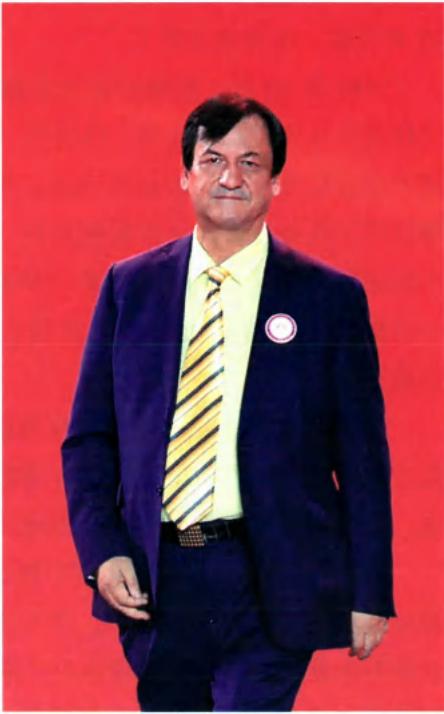
On November 2, 2019, Emil Imiti attended the 14th Global City Image Ambassador and Miss Global City World Cup Finals as an award presenter.
In his hometown of Korla, Xinjiang, there is a beautiful Peacock River, and playing in the water is the happiest thing for children here. On July 21, 1975, while several children were skipping stones by the river, suddenly one of the 11-year-old children felt that every stone he touched was as soft as pinching a ball of cotton. He found a pebble and pulled hard, and it actually snapped; he was Emil. At the age of twelve, the mischievous Emil often skipped class to go out and play. Once, after being discovered by an elder who tried to discipline him with an iron rod, an incredible thing happened when the iron rod struck down: the iron rod bent, but Emil was completely unharmed. Once, he scratched his arm and went to the hospital to have it bandaged, but when the doctor touched his arm, he was repelled several steps away as if electrocuted. As an adult, Emil is 1.8 meters tall, with deep-set eyes and a high nose. Like ordinary people, he likes to eat pasta and often drinks and eats meat with friends.
At the age of 20, he gathered a few good friends and toured Xinjiang. Soon, his strange deeds and wonders spread widely throughout Xinjiang. In 1995, the CCTV program “Oriental Horizon” conducted an exclusive interview with him, making him famous overnight. Domestic media, the entertainment industry, and even celebrities vied to invite him to perform or treat illnesses.
However, during performances, he often put a dozen pins into his mouth, shook his head, made a few “crunch, crunch” sounds, and chewed the iron nails as if they were candy. Then, he took a bite of a cucumber and swallowed it all mixed with the iron nails. Just when everyone had not yet recovered from their shock, Emil brought over a pile of extremely hard and highly rigid granite rocks. Seeing Emil hold the stone in his hand with his eyes slightly closed, ten seconds later, the stone was actually pulled apart! According to him, even if two cars were used, it would be difficult to pull this stone apart. Then, he picked up another stone, put it in his mouth, and with a slight exertion, the stone was bitten into pieces.
Emil’s unique skills do not stop there; he can also effortlessly “point” and snap pins in half with his mind at the waist, and even see through poker cards. A reporter brought him a pack of unopened cards. After shuffling, the reporter randomly drew three cards, and he was able to accurately state the bottom cards.
He is not only a “tough guy” but can also perform very “delicate” “feats.” Reporters from the CCTV program “Rural Date” and the people present cut a red rope into shreds together, then wrapped it in paper. Emil pointed in the air, connecting the soft red strips together, and it was seamless. Once, a girl had very long braids, two of them. He held scissors and cut off one of them, and the girl cried sadly. Emil said to the girl: “Don’t cry, watch.” He covered it with both hands, and in a short while, it returned to its original state. Just think, how many hair strands are in that braid! He actually connected them all.
Emil has a happy and warm family, with a beautiful wife and two pretty, lovely daughters. The family of four is full of joy. Emil said that his supernatural powers are indeed a good tool for making money. But he said: “Someone was willing to give me 500,000 to thank me for checking Feng Shui for him, but I cannot take it. These unique skills were given to me by God, and using them to help others is enough.” Emil often skipped class and was unwilling to go to school when he was young, which he deeply regretted when he grew up. To make current children study hard, Emil took a portion of the appearance fees from his invited stage performances to fund impoverished students in his hometown. In 2004, he donated 100,000 RMB to a primary school in Changji City at once, and Emil was also hired as an honorary principal by this primary school.
In 2013, Emil Imiti was appointed Executive Vice Chairman of the China Love Working Committee. He said: “We Chinese people are the most enthusiastic and kind, and various ethnic groups are very united. Wherever there is difficulty, there are people reaching out a helping hand. Being able to make a contribution to the Chinese people is my greatest wish.”
Emil’s performance on Hunan Satellite TV’s “Who Is the Hero” in June 2005
CCTV-4, 2003, “Happy China: Xinjiang Wonder Emil”
9.1.3 The Pioneer of Potential Development—Liang Guangxiang①
While the powerful abilities of most “Vajra Adepts” like Zheng Xiangling and Emil Iminiti are innate, among the well-known “Vajra Adepts,” there are also those who attained their status through cultivation. “Huixue” (Wisdom Learning) master and inheritor of the Huilian Gong (Wisdom Lotus Skill), Chen Linfeng (born in 1962 in Nantong, Jiangsu), and the previously mentioned inheritor of the Mingjing Gong (Bright Mirror Skill), Teacher Liang Guangxiang, are both outstanding figures who became “Vajra Adepts” through cultivation.
Because Chen Linfeng had a significant influence during the “Qigong Fever” of the late 20th century, he was the protagonist of Episodes 21 “The Master of Prediction” and 22 “The Blue Sky as Witness” in Ke Yunlu’s documentary Exploration of Life Science. Some criticized his predictive abilities as pseudoscience②, and he gradually faded from public view. Unlike Teacher Chen Linfeng, Liang Guangxiang has always kept a low profile in his cultivation and is little known to the world; the fact that he is a “Vajra Adept” is even less known.
In March 2007, Liang Guangxiang posted an article titled “Seeking the Truth in the Taoist Innate Golden Elixir Way—Two Iron Indicators of the Elixir Way from the Perspective of Human Body Special Functions” on his blog, stating: “Are we correct about the medicine, the mystic pass, and the firing process of the Elixir Way? This one Qi is the root of Yin and Yang, the source of creation, and the door of life and death; obtain this one, and everything is accomplished. It is the direct manifestation of the Tao. Supernatural powers (speaking on a smaller scale, special functions) and longevity are both manifestations of the Innate True One Qi. Supernatural powers and liberation from the cycle of life and death are the two iron indicators of the Elixir Way. Without them, it is not the Golden Elixir Way.” “I am merely a practitioner and beneficiary of the Elixir Way. I only dare to practice silently. Even when I was leading the ‘Selection of Special Function Talents’ work for the Central Human Body Working Group, I never mentioned the words ‘Elixir Way.’ Abilities are not spoken of, they are demonstrated through action. If our training takes a year or six months, I believe no scientist would cooperate with you. If you can only theorize about the Elixir Way and cannot produce immediate results, I believe you have no hope of participating in cooperation with scientists. Seeing that scholars of the Elixir Way are currently rampant, misleading themselves and others, I have offered these few words of justice. Whether I am understood or blamed, let others laugh or scold.”① From this text, friends can judge for themselves whether Liang Guangxiang can be called a “Vajra Adept,” and one who attained it through postnatal cultivation.
Among “Vajra Adepts,” there are few who are committed to applying potential development to the intellectual development of children and the restoration of sight for blind children. Liang Guangxiang was the earliest educator to conduct applications in this area. Liang Guangxiang is not only an accomplished Qigong master but was also a core figure in relevant topics for the Central Human Body Science Working Group. He was the first person to teach students to “read with blindfolds.” Current potential development techniques such as whole-brain development, midbrain development, and right-brain development mostly trace their origins back to him.
Episode 21 “The Master of Prediction”
Liang Guangxiang was born in 1968. At the age of 14, he encountered by chance a mentor from the Shangqing Sect of the Taoist Golden Lotus Sect and began cultivating the Taoist Mingjing Shangdao (Bright Mirror High Way). After cultivating for four years, at 18, he was admitted to the Department of Education at Guizhou Normal University. During his time at university, he not only persisted in practicing the Mingjing Gong but also received the true transmission of the Wudang Kongling Gate (Void Spirit Gate), and continues to practice meditation and boxing to this day.
After graduating from university in 1990, Liang Guangxiang voluntarily chose to teach at the National Normal School of Zhenning Buyei and Miao Autonomous County in remote and backward Guizhou (now Anshun City National Normal School). Using his spare time, he began experimenting with potential development, using the Mingjing Gong to unlock the treasury of human potential. He discovered that this method could enable over 80% of children under the age of 14, after instruction ranging from as little as one hour to as many as ten hours, to acquire varying degrees of human body transparency (clairvoyance), magnified or extraordinary memory, and even restore sight to some blind children. That year, Mr. Liang trained three neighbor children for three hours a day for a total of 22 days. As a result, all three children acquired multiple potentials, such as seeing through human bodies, reading or watching TV while blindfolded, seeing through buried objects underground, remote viewing, telepathy, breaking matches or bending metal wires with intention, picking locks with intention, psychic writing, apportation, starting fires with intention, and shaking pills out of bottles (breaking through spatial barriers).
In 1993, Liang Guangxiang came to Beijing to teach the Chinese Mingjing Gong. The excellent effects of his method in developing potential immediately attracted widespread attention from all sectors of society. In early 1994, Episode 17 “Developing Children’s Potential” and Episode 18 “Opening the Third Eye” (see page 134 of this book for these two episodes) of Ke Yunlu’s large-scale TV series Exploration of Life Science were specifically dedicated to recording his development of extraordinary functions in teenagers. In November 1994, at the invitation of the Central People’s Broadcasting Station, he conducted a bold attempt on a national broadcast. He led the audience in special function experiments on the radio. As a result, the hotline rang constantly, and letters flew in like snowflakes. Many listeners developed special functions and, unable to contain their excitement, reported their successes one after another.
In early 1995, the famous Japanese psychic Ayako Ichipoo visited China. Ms. Ichipoo herself possessed strong special functions and had exchanged research with special function institutions in Australia, India, the United States, the United Kingdom, the Soviet Union, and other places; she was a well-known figure in the international special function research community. She conducted on-site inspections of the potentials of several of Liang Guangxiang’s students. These students were not only able to read while blindfolded but could also, while in three separate sealed rooms, draw the图形 that Ayako Ichipoo was drawing in another room. This exchange activity was filmed into a television program by Tokyo Television Station in Japan and broadcast in Japan in March of the same year, titled Liang Guangxiang’s Classroom.
In 1996 and 1997, at the invitation of Li Shoutian, the Deputy Mayor of Xiaoyi City, Shanxi Province, Liang Guangxiang held three training sessions in Xiaoyi City with a total of 122 participants. The number of people able to see through human bodies reached 114, accounting for 93% of the total trainees. During the summer vacation of 1997, Liang Guangxiang held an “Advanced Class” for 50 teenagers in Xiaoyi City who had previously participated in training. After 6 days of training for 2 to 3 hours a day, the students developed various special functions. 47 people could break matches sealed in bottles or bend metal wires just by looking; 22 people could open spring locks inside glass bottles with intention; and 11 people could apport distant matchsticks, fresh flowers, business cards, etc., into strictly checked, covered glass bottles.
Liang Guangxiang said: “Special functions are not special at all. Theoretically speaking, special functions are a human potential that everyone can develop.” He himself is a “Vajra Adept,” but he never says he has special functions.
Mr. Wen from Shijiazhuang is a Qigong enthusiast and has known Liang Guangxiang for a long time. In July 1994, his old ailment from his time in the military—lumbago—flared up again. It happened that Liang Guangxiang was in Shijiazhuang. Old Wen had his wife and child help him onto his bicycle and rode to Liang Guangxiang’s residence. Upon entering, before he could speak, Liang Guangxiang said: “Your back pain has flared up.” He then led him through 20 minutes of Mingjing Gong, said “It’s healed,” and told him to move around a bit or practice boxing. Old Wen said that in the past when the disease flared up, he needed help just to turn over in bed. He didn’t expect this chronic ailment to be healed immediately. He performed a set of Tai Chi on the spot and rode his bicycle home, feeling as if he were bathing in a spring breeze.
Liang Guangxiang does not claim to have special functions and tries to avoid disputes with people of different views, having his own joking method. Once, at home, he said to a famous psychologist he knew well: “Let’s play a magic trick.” Saying this, he took two 5-fen coins, tossed them up from under a round table, and without any cracks or marks on the large wooden round table, the coins quietly appeared on the tabletop. After watching the performance intently again, the psychologist exclaimed: “This is not magic, it is a special function.” For Liang Guangxiang, this was just a small function of breaking through spatial barriers. This small joke moved the psychologist, and later the psychologist’s son and daughter both studied potential development with Liang Guangxiang.
Liang Guangxiang established a family in Beijing in 1994. His wife, Lin Jing, is a doctor of neuropsychology, and the two exchange ideas and complement each other in the field of neuropsychology. Liang Guangxiang’s greatest joy is reading, and he especially likes browsing bookstores to buy books with his wife.
Liang Guangxiang’s greatest wish in life is to help as many people as possible, especially children, develop their own potential. He said that this is not only beneficial for curing diseases, strengthening the body, increasing wisdom, and generating spiritual insight, but if they engage in medical or scientific careers in the future, it will be like a tiger with wings (give them a massive advantage), allowing them to benefit humanity even more. His other wish is to hang the “Bright Mirror” high on the foreheads of blind children to let them see the light again. He also said that regardless of whether others believe it or not, he only focuses on practice. If he can make contributions in these two areas, his life’s value will be reflected.
Since 2014, Liang Guangxiang began investing in the stock market to prove to the world the efficacy of cultivation in increasing wisdom and generating insight. This is actually a practice of the essence of traditional Chinese culture and a roaming of the ocean of wisdom of ancient philosophers, which he has verified by persisting for five consecutive years. By the end of 2019, the cumulative return rate over 5 years was as high as 2200%, and the annual compound return reached 85.56%. This achievement is not comparable to that of ordinary people. Liang Guangxiang’s behavior appears secular on the surface, but he is not bound by his body; in reality, he lives in great freedom.
The special abilities of “Psychic Masters” fall into two categories: one is “Extraordinary Perception” (ESP), which involves obtaining information without relying on the conventional five senses, such as “Eyeless Vision,” “Remote Viewing,” and “Clairvoyance” that transcend space, “Retrocognition” and “Precognition” that transcend time, and “Telepathy” (mind reading) that directly reads the information in others’ minds; the other is “Psychokinesis” (PK), which relies on the spirit or mind to directly cause changes in the energy or nature of material objects or environments, such as “Needle Breaking by Mind,” “Spoon Bending by Mind,” “Lock Picking by Mind,” and “Withered Leaves Turning Green,” as well as phenomena that make macroscopic objects move, appear, or disappear, such as “Mind Transport,” “Snatching Medicine from Air,” and “Shaking Pills,” which are so-called phenomena of “breaking through spatial barriers.”
As we mentioned earlier, potential is “the result of the interaction between consciousness and the subconscious.” The state when unleashing potential is one of concentration, imagination, and introspection, where one is omnipotent. So, how are the miraculous feats of “Psychic Masters” achieved?
Among the “Psychic Masters,” those born in 1940 with a college education who can accurately describe their feelings during the functional state are rare. Wang Youcheng, formerly a fine art designer at the Jilin City Museum, Deputy Director of the Jilin City Cultural Bureau, and Vice President and Special Advisor of the Chinese Academy of Somatic Science, is a leader in this “circle.”
When discussing his state during “Psychic Master” performances, Wang Youcheng believes that “Entering Stillness” (Rujing) is key. When “Entering Stillness,” everything around turns into void, as if it no longer exists, while the natural space becomes a tangible entity. Sometimes, he can feel his soul stepping out of his body and blending with nature. Once this state is entered, various special effects can be produced. ①
Wang Youcheng loves playing the piano and painting, which helps to a certain extent in enhancing the state of “Entering Stillness.” So, what does it feel like when “Entering Stillness”? Wang Youcheng describes it this way:
Sometimes someone asks you the name of an acquaintance, and for a moment, you suddenly can’t recall that person’s name. You try to remember, but your mind goes blank. Stillness is probably just that taste. Or, you strike a piano key heavily, and the sound floats very, very far, until your ears can no longer hear it, and you only feel it traveling infinitely far, breaking through the room, breaking through the earth, floating into the distant space. The feeling travels very, very far, but in reality, it is going deep into our consciousness. That momentary experience is also the experience of “Stillness.” When you enter stillness to a certain degree, you can also feel a mysterious relationship between man and the universe, man and eternity, and man and the infinite, experiencing an unfathomable impulse of consciousness from chaos and a fresh, infinite light that transcends time and space. With your eyes closed, you can feel that the outside is clear, and at the same time see your own internal organs. The flow of the hands when playing the piano is also the flow of the heart. The melody, rhythm, tone, harmony, intensity, and other major elements of music mix together to create a harmony close to life. One is music, the other is nature; I like these two things the most. They helped me develop special abilities.
When practicing Qigong to induce potential, one must pay attention to the cultivation of intuitive ability. Non-rational intuitive thinking plays a decisive role in inducing human potential. In a sense, the strength or weakness of potential is the strength or weakness of intuitive ability. ①
9.1.4 The “Diamond Master” Queen — Sun Chulin
Sun Chulin relies entirely on congenital energy when performing clairvoyance on others, and feels particularly tired after “seeing” one person. Professor Shen Jinchuan told her she must practice Qigong, saying it would be beneficial for improving her abilities. After a period of practice, Sun Chulin’s abilities improved significantly. When talking about her practice experience, she said: “When I devote myself to practice and enter a certain functional state, I feel as if I have entered another time and space, and I will hear a voice in the void, and various vivid images appear. Only when entering that hazy state of subconsciousness can special abilities appear, and performances or experiments succeed.” ② Whether domestic or foreign, “Psychic Masters” must enter a certain state to demonstrate their abilities.
The Tengxun Net “Tree Brain Science” column once published an article titled “Interpretation: The Secret Behind Psychic Master ‘Wolf Messing’” ③, which interpreted the state of Messing’s super-perception abilities:
Albert was the first person to discover Messing’s brain had extraordinary abilities and tested him for mind-reading. Messing could enter a state of catalepsy, a state where he was conscious but had no physical reaction. He found that in this state, he could predict the future.
Interpretation: Messing’s prophetic ability comes from a special mental state—catalepsy. This is a method of “channeling.” The subject’s subjective consciousness becomes blurred, the brain’s reality perception function decreases, and the “subconscious” becomes abnormally clear (the brain’s external reality perception function is inhibited, entering a “subconscious” state). The information for accurately predicting the future comes from “High Spirits.” When human consciousness completely detaches from the real world (real conscious perception is blurred), and the mind completely enters another world (the mind fully believes the High Spirit world is real), it resonates with High Spirits and obtains information from them.
Albert also trained him to learn how to “turn off” the sensation of physical pain. Messing allowed people to prick his chest and neck with nails in front of an audience without any expression of pain.
Interpretation: Messing can turn off the body’s “perception” ability. The human brain has two functions: one is to generate conscious thoughts, and the other is to generate sensory perceptions. For ordinary people, conscious and perceptual functions are interconnected and coexist. The trained Messing can turn off the body’s “perception” function and enter a pure “consciousness” realm, such as a conscious state without emotional feeling. The perceptual function makes people more attached to the reality of the real world (the essence of why people feel the real world exists is produced by human perception ability), thereby shielding the channel connecting with the High Spirit world. When the perceptual function is turned off, consciousness is more likely to establish a connection with the High Spirit world (when turning off perception, people are more likely to enter the “subconscious” state and easily accept the existence of the High Spirit world, so they can establish contact with High Spirits).
How are the performances of “Psychic Masters” achieved? I have selected the operational procedures of some classic items from various public materials to satisfy everyone’s curiosity and desire for knowledge.
9.2 How Did They Do It?
9.2.1 Telepathy
Xiao Xu and Xiao Xiong sat on chairs respectively, one meter apart, sitting back-to-back. Teacher Dong Zhenqun drew a card from a deck and showed it to Xiao Xu, then returned the card to its place, asking Xiao Xu to silently think about the suit and number of the card in her mind. After 40 seconds, Xiao Xiong knew: “The card Xiao Xu saw is ‘Heart 6’.”
The above was a one-way telepathy experiment, where one party purely sent information and the other purely received information. Subsequently, they conducted a two-way telepathy experiment, where both parties sent information to each other and received information from each other.
Teachers Dong Zhenqun and Song Niantang from Wuhan University placed two playing cards face down on Xiao Xu and Xiao Xiong’s tables respectively, requiring them to first identify their own cards, and then receive the information identified by the other party. This time they were 4 meters apart. After 30 seconds, both Xiao Xu and Xiao Xiong indicated they had recognized their own cards. The teacher then took the cards away. Another 7 minutes passed, and both said they had a feeling. They were asked to write the results on paper separately. Xiao Xu wrote: “Mine is Club J, hers is Spade J.” Xiao Xiong wrote: “Mine is Spade J, hers is Club J.” Completely correct.
Similar experiments were conducted dozens of times. Besides poker cards, literacy cards or pictures were sometimes used. Xiao Xu said that when Xiao Xiong received her signal, she would have a feeling. Once, the teacher gave Xiao Xu the character “Shen” (God) and Xiao Xiong the character “You” (Have) for the experiment. After 3 minutes, Xiao Xiong said it looked like the character “Sheng” (Victory) or the character “Sheng” (Sound). When asked if she heard a sound or received the character shape, she replied: “First there was a buzzing sound in my ears, and then the character shape appeared.” After a while, she said it looked like the character “Shen” (God), but it was messy, with some horizontal strokes, vertical strokes, and left-falling strokes, but they just couldn’t be pieced together.
Telepathy is also one of the human potentials. Everyone has it. After induction, sixty to seventy percent of children can produce it. Practicing Qigong is also an effective way to induce this function. Those who possess this ability say that as soon as they think about it, the thing to be tested will appear on their forehead. Abroad, telepathy is called thought transference. ①
Telepathy: When Wolf Messing explained this ability of his, he said: “Others transmit thoughts to me like images, and I received the visual images entirely relying on natural laws.” ②
9.2.2 Sticking Coins
This method of sticking coins is different from the coin and spoon sticking found in ESP games; instead, it involves sticking a coin to the forehead or other parts of the body, and then stacking another coin on top of the first one.
Wang Youcheng can cover the coin on his forehead with a piece of paper, stick another coin on the outside of the paper, and then pull the paper out from the gap between the two coins, yet the coins remain stuck to his forehead, one attached to the other. Wang Youcheng can even place a coin on his chest through his clothing and move it up, down, left, and right at will.
Wang Youcheng described this experience as follows: “You must find a ‘hot spot’ and be quiet (still). Just be quiet, find the hot spot, and the hot spot will drive it—use this stillness to experience this movement. As soon as there is movement, a hot spot follows; it is burning hot, just like the sensation of eating chili peppers.” “The reason the coin doesn’t fall is not that I am sucking it, but (I feel) an unknown force from the outside pressing it against me. At first, I feel a hot spot appear at the Mingmen point (Life Gate) near the second lumbar vertebra. Then, a kind of infinite joy spreads throughout the body; when the hot spot moves, the coin moves with it… Only through stillness can one experience the kinetic energy of life and feel a kind of void surrounding you, hazy and indistinct. At this moment, you feel that it is you, yet it isn’t you; you are wanting something, yet haven’t gained anything, feeling only a hazy blankness. At this time, there is absolutely no reasoning in the heart, nor any worry or pain…” ③
After seeing Wang Youcheng stick coins, Sun Chulin also conducted such experiments. She could even pick up non-magnetic substances; she could stick aluminum coins to the Tianmu point (Third Eye) without them falling off, and at most, she could stick a stack of ten aluminum coins on the Tianmu point on her forehead at once. This is how Sun Chulin did it:
“First, take a coin and stick it on… As soon as it sticks, I feel a pressure from the outside, and the Tianmu point has a sensation of suction. At this moment, if I let go, the coin is sucked on. Sometimes a coin will fall off because there is sweat or oil on the head, so it won’t stick. Therefore, you can also do two at a time; there will be suction between the individual coins. Align the two coins, press slightly to expel the air from the middle. Stabilize the coin, find that feeling, that pressure, that suction. Once you feel the suction, let go, and it goes up. The main technique for sticking the third coin is alignment. After pressing, relax. Once you feel the suction, let go. Once you feel the suction, let go; if you don’t feel it, absolutely do not let go, or it will fall. Doing anything requires practice; you cannot be impatient. When I first started sticking coins, I practiced for three hours, until my wrists hurt.” ①
9.2.3 Acupoint Magnetic Effect Experiments
The human body possesses a magnetic field and can release relatively strong magnetism through acupoints to produce magnetic field effects, but this is very difficult for ordinary people to achieve. Sun Chulin once mixed magnetic powder with yellow loam sand, and then used her hand to suck the magnetic powder out. By placing a children’s magnetic writing board over someone else’s Laogong point or Baihui point, Sun Chulin could guide the other person to cause the magnetic writing board to display regular magnetic field patterns.
She would first guide the other person to relax and enter a state of quiet (stillness). After he entered the state, she would place the magnetic writing board on his head. The other person had to visualize: “There is a bright spot (or bright light) in my Dantian, slowly rising up along a column. Do not visualize the Qi in the Dantian as large; the more concentrated and smaller the Qi, the better. If you visualize it as large, slowly make it smaller until it forms a pagoda shape, and then the whole Qi exits from the tip of the pagoda and becomes very dense.” After he enters the state, the magnetic writing board is placed on his head, allowing the magnetic field produced by the Baihui point to manifest. If the Qi on top of his head is scattered, it means the magnetic writing board cannot sense the magnetic field of the Baihui point, and thus cannot display a pattern. ②
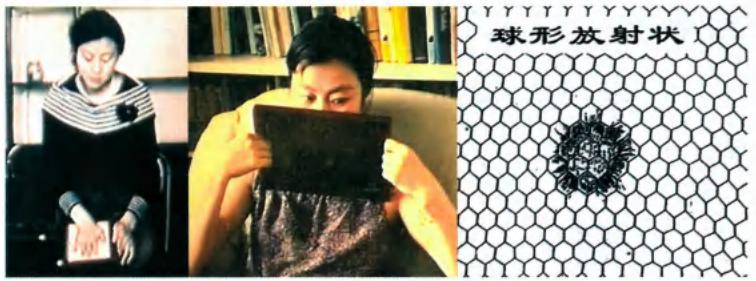
Sun Chulin places the Laogong point of her palm on a magnetic writing board, using her intention to generate a black magnetized area (spots).
9.2.4 Intention Photography
Professor Shen Jinchuan of the Institute of Human Science at the China University of Geosciences and Sun Chulin conducted extensive research on RS (Human Body Field) photography from the late 1980s to the early 1990s, using X-ray film, electron microscope film, ordinary film, and dental film. Both sides of dental film contain photosensitive material and are sealed in the factory using high-temperature heat sealing in plastic sleeves, making it convenient for experiments. Sun Chulin could use her intention to write different characters on the front and back of the same film without any interference. At her best, she could staple three films together and write different characters on each of the three films. How did Sun Chulin do this? She said:
“First, I see a piece of film on my brain screen, and then I bring out a fine, bright spot, just like the feeling of using a laser pointer, and then I use the laser pointer to write on the film. At this time, the film is directly visible on the brain screen, without the plastic sleeve.” ①
Besides being able to write on film, she could also cause images to appear on the film. Sun: “As soon as I enter the functional state, light spots appear on the screen. Then, just like watching a movie, I see a patch of water coming out, a bridge coming out, and there are mountains behind the bridge, a row of green trees beside the bridge, and a beach. I stabilize the image on the Tianmu (Third Eye) screen, and then project it onto the film.” ②
Professor Shen and Sun Chulin also successfully produced hundreds of intention photography photos. For intention photography, they would place rectangular Polaroid photo paper into a camera that had no lens; the side facing outward for exposure was blocked by a steel plate. During the experiment, Sun Chulin would press her palm against the steel plate and directly project the image from her brain screen onto the topmost sheet of Polaroid paper in the camera. After completion, the photo paper was removed, and after waiting one minute for development, the protective sleeve was torn open, and the image appeared on the paper. Some of these were photos of “Laozi” (Lao Tzu). According to Ms. Sun, she would call out “Laozi” in her heart, and images would appear on her brain screen. They were not very clear, but she could vaguely see an old man with a beard and thin hair, either standing or sitting, or practicing boxing or meditating, in various postures. She selected a meditating posture and projected it onto the Polaroid paper. ①
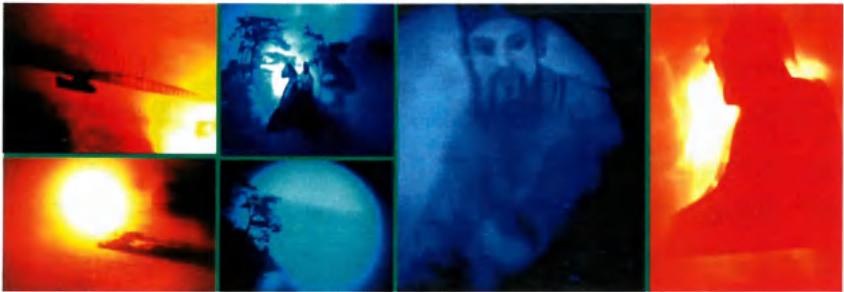
Since 1999, Sun Chulin has successfully obtained a series of color intention photography photos.
9.2.5 Healing and Curing Diseases
In the previous Chapter 6, we introduced the process of Qigong master Shen Chang using imagination to heal and cure patients (page 190 of this book). When Mr. Liang Guangxiang develops potential in children, he often opens the ability of inner vision (neishi). The children diagnose their own diseases through inner vision and perform self-healing on the affected areas using light spheres. In the documentary “Life Science Exploration” by Ke Yunlu, the 18th episode “Opening the Third Eye” (page 134 of this book), there is a relevant interview. The documentary introduces that when a child is sick, he can discover that the diseased part of the body is turbid and particularly black, while the healthy parts are transparent. Transferring the ball of light to the diseased area, illuminating it, and rotating it makes it better.
9.2.6 Bending Metal with the Mind
In Shanghai, there are a pair of young brothers named Xiaojie and Xiaolei, whose minds can bend straight steel wires inside test tubes. Inside several glass test tubes with a diameter of 1.5 cm and a length of 5 cm, a copper wire 3 cm long and 0.5 mm in diameter was placed in each tube, and the tube mouth was plugged with a rubber stopper. Xiaojie and Xiaolei held the test tubes in their hands, and after a period of time, they could cause the copper wires to bend into U-shapes, V-shapes, O-shapes, L-shapes, etc. Whatever shape they were willing to bend them into, the copper wires inside would become that shape. Once, Xiaojie even caused the copper wire to curl up spirally. Another time, he caused two copper wires to twist together like a rope. Xiaojie said that sometimes he didn’t even know it himself; as soon as he thought of the copper wire in his mind, the result was that he looked at it and it was bent. But his younger brother Xiaolei said: he has to use his intention, that is, thinking in his heart about making it into a certain shape, to succeed. They can not only bend copper wires, but likewise, cause lead wires, soft lead wires, and metal wires of various hardnesses to bend into various shapes.②
Officials from the Department of Public Health in Cáceres Province, Spain, used an electroencephalograph (EEG) to record measurements of Mónica, who also possesses the ability to bend metal forks, spoons, or rods. They found: the more relaxed she was, the easier it was to bend those metal rods. Mónica said: “When I want to bend something, I focus my attention and stare at it, and visualize in my mind the shape I hope it becomes
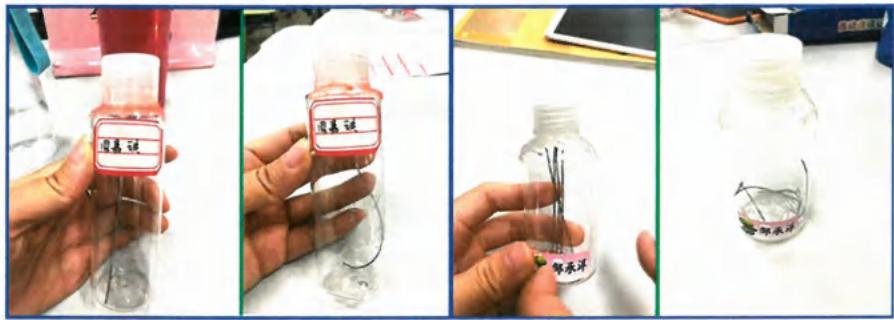
Photos before and after an experiment on mentally bending 0.8 mm welding wire inside a wax-sealed plastic bottle by students of the Shenzhen Brain Equation.”①
Bending spoons and keys is Uri Geller’s most classic performance item. He once led others in bending keys together, and some people bent them using their minds. He guided them in this way: “Let a belief emerge in our minds: that we can use the power of thought to achieve things we never felt we could do. Let us pick up a table knife, a key, or a spoon, or something like that, choose any one, then concentrate your thoughts, focus with all your heart, and let your mind firmly believe that what you hope to happen will definitely unfold before your eyes. Gently hold the knife, fork, or key in your hand, and start silently chanting in your heart: ‘Bend, bend, bend!’ Gently stroke the surface of the metal with your hand while silently chanting in your heart: ‘Bend, bend, bend!’ If the object bends, then be joyful and hope it continues to bend. You have become part of a strange effect; this strange ability is deeply buried in many of us. If nothing happens, please do not be disappointed, because not everyone has this special function; it is also possible that the time is not right or the mood is off. Even I am not infallible; it doesn’t work every time.”② The most critical part of this operation is to firmly believe that you have the ability to make the key bend; this is extremely important.
9.2.7 Unlocking with the Mind
In early 1981, Zhu Yiyi, Zhu Runlong, and others from Shanghai Jiao Tong University found Xiaodong, Xiaoqing, Xiaobai, and Xiaojun in Shanghai to conduct mind-unlocking experiments. The teachers found several small ink boxes, placed a locked lock inside the ink box, and then inserted the key into the keyhole. The length of the lock plus the length of the key remaining outside the lock was basically equal to the length of the ink box, and the width and thickness of the lock were also basically equal to the size of the box, then the lid was sealed. Xiaojun placed the box under his armpit, Xiaobai held the box with both hands, Xiaoqing held the box with one hand, while Xiaodong placed the box on the table without touching it. At 18 minutes, Xiaojun said “It’s open,” and almost at the same time, Xiaodong, Xiaobai, and Xiaoqing also claimed “It’s open.” The teachers asked them to place the boxes on the table, and then checked the sealing. After confirming that the sealing was intact, they opened the ink box lids. The locks in Xiaojun’s and Xiaodong’s boxes were completely opened, and the lock shank and lock base had rotated 120°; the lock in Xiaobai’s box was also opened, but the lock shank and lock base had only rotated about 45°; while the lock in Xiaoqing’s box was just opened, with no rotation angle between the lock shank and the lock base.
The second test involved placing a locked lock and the key to open it (the key was not inserted into the keyhole) inside the box, and sealing it. The length of the lock plus the length of the entire key exceeded the diameter of the small ink box, which was impossible to complete under normal circumstances. At 22 minutes after the start of the experiment, Xiaobai was the first to raise his hand saying it was completed, and after another 3~5 minutes, the other three teenagers also raised their hands indicating the lock was opened. After the teachers removed the sealing and opened the box lids, they saw that the keys were inserted into the keyholes of the locks inside the boxes, and the locks were opened.
Xiaodong described the unlocking process: I first “see” that lock in my brain like recognizing a character, and then I have to “see” that key, while using my mind to insert the key into the keyhole, and turn the key, and the lock opens. I wasn’t reassured whether the lock was really opened, so I turned the lock shank over, so that I could clearly know the lock was opened.①
9.2.8 Punching Holes in Coins
Sun Chulin has also successfully performed punching holes in coins from a distance many times. While cooperating with Professor Li Sichen, Sun Chulin also conducted experiments on mind-punching holes. The professor provided a 10-yuan Taiwanese coin, and Sun Chulin punched a hole with a diameter of 1.1 mm in the coin in less than 10 minutes. Her description of the process of punching a hole in the coin with her mind is as follows:
First, one must enter a state of emptiness and quiet, feeling as if in a state of another time and space. At this time, a screen appears in front, and on the screen is a fist holding a coin, then the fist disappears, and the coin appears. Initially, the image is not stable; wait for it to slowly become clear, then concentrate the mind to punch the hole. When the intention to punch is concentrated to a certain degree, a transparent hexagonal rod, like crystal with pointed ends on both sides, appears on the screen, and it feels very hard. As the intention to punch persists and strengthens, a round tip suddenly pops out from one end of the hexagonal rod, and it punches a hole in the coin with a “tung” sound in a pulsed manner. When punching the hole, the brain feels a shock, as if the screen is about to be shattered. At this time, open the palm, and a hole has been punched in the coin.②
9.2.9 Retrieving Medicine from the Air
Chen Qiushi, a member of the Communist Party of China, holding a bachelor’s degree, ancestral home in Zibo City, Shandong Province, was born on July 22, 1985, in an ordinary worker’s family in Fushun City, Liaoning Province. He was born with some “Vajra Master” abilities, but he did not know he was different from others. Around the age of 27, he remembered his abilities from childhood, and as a result, many functions succeeded upon trying, and he quickly became a “Vajra Master” with powerful functions and comprehensive items.
Chen Qiushi’s small “unique skill”: Mind-controlling paper figures
One of Chen Qiushi’s adept “unique skills” is retrieving medicine from the air. On November 19, 2018, he performed retrieving medicine from the void for Guo Decai, a retired senior engineer from Factory 5434 of China North Industries Group Corporation. He was seen extending his two arms upward and forward, then looking up and gazing back and forth everywhere. After a few minutes, he was seen clapping his palms together and rubbing them back and forth with his palms, and very quickly a black-brown pill slightly smaller than a soybean appeared in his hand. According to Chen Qiushi’s description: using both eyes or a single eye to look up and gaze everywhere is to search for a ball of light the size of a mung bean; as long as the ball of light can be seen and grabbed in the hand and rubbed back and forth, it can turn into one or several pills. The next day, Chen Qiushi used the same method to retrieve another, larger pill for Guo Decai.①
9.2.10 Teleportation (Breaking Through Spatial Barriers)
One winter, Sun Chulin was visiting Professor Shen’s home and suddenly wanted to teleport the winter sweet flowers outside into Professor Shen’s home. Professor Shen was very happy to hear this and immediately went to get a cup, asking Sun Chulin to teleport two branches of winter sweet flowers into the cup. After speaking, Professor Shen covered the cup with the lid and placed the cup on the table beside the TV. Sun Chulin described the experimental process as follows:
As soon as I entered the functional state, I felt I had arrived under a tree full of winter sweet flowers. She saw a tree full of winter sweet flowers on the screen and smelled the very fragrant floral scent. At this time, the tree was gone, and only two small branches of winter sweet flowers remained on the screen. So, I thought: “Teleport these two branches of winter sweet flowers to Professor Shen’s home.” I also added an intention: “Teleport into the cup.” At this time, I looked at the screen again, and the two branches of winter sweet flowers were gone. The result was that there was one branch of winter sweet in the cup, and there was another branch of winter sweet in the small room.②
9.2.11 Psychokinesis Through Walls (Shaking Pills)
Many “Qigong Masters” know how to shake pills out of bottles. It is said that Sun Chulin’s skill in shaking pills was taught to her by a master in her dreams. Her master asked her to close her eyes and hold a glass medicine bottle. She felt the glass become soft. After it became soft, she felt it was like a plastic bag, giving the sensation that it was about to break. When she felt the glass had become particularly thin, she would shake it hard, and with one shake, the pills inside would come out.
Sun Chulin would actually hold the bottle and enter a functional state. When she experienced that sensation, she would shake it hard, scattering pills all over the floor! She heard the sound, and also saw the pills scattered all over the floor on her “Third Eye” screen. ①
Once, Professor Shen Jinchuan and Sun Chulin conducted an experiment on psychokinetic penetration through walls without contact. Professor Shen placed more than 60 coins, red beans, mung beans, etc., into an empty instant coffee bottle, numbering them one by one. He pressed one end of a wire under the bottle cap, screwed it tight, and hung the bottle from the ceiling. Sun Chulin sat 3 meters away from the bottle, using her intention to make the objects inside fall out. Just like the method of shaking pills, she felt the bottle become soft, and then felt a hole open in the bottle. As a result, the objects inside came rattling out through the hole, and the speed at which they fell was extremely fast, like an explosion, scattering down—forty or fifty of them fell with a swish.
Zhang Baosheng’s Psychokinesis Through Walls and Experimental Explanation (Excerpt from the documentary Rainbow of the East)
Although there have been many successful experiments involving pills or crystals penetrating glass bottle walls, and even live elm leaf beetles penetrating walls and surviving for several days, these successful experiments share a common condition: the container must have a seam, a small hole, or a lid. Target objects cannot be removed from a completely sealed, seamless container.
On April 2, 1989, Zheng Xiangling and Lin Zhengqun, a veteran comrade from the Electronic Station of the Information Center of the Guangdong Provincial Planning Commission, performed “Fetching Medicine Through a Bottle” (also known as “Pills Penetrating a Bottle”) at the auditorium of the Guangdong Science Hall. She spent 26 minutes removing the medicine from an unopened plastic bottle of “Persantin Capsules,” causing the pills to penetrate the bottle. Zheng Xiangling said that after she initiated the function and entered the state, she would feel the tiny round holes on the bottle wall magnify before her eyes. With a push of her Qi (intention), the pills would drill out through the round holes. In that instant, the bottle wall seemed to cease to exist, and she only saw the pills. ②
9.2.12 Earthquake Prediction
Tao Zhangyuan, from the Human Science Research Office at the China University of Geosciences, was born in 1965 in Dongning County, Heilongjiang Province. He started practicing martial arts at the age of 6. By age 15, he had reached a certain level in Qigong practice, and by age 20, he was able to emit Qi to treat illnesses. During the process of continuous practice, his Gongli (cultivation power) grew increasingly deep. By the end of 1986, he was able to perform clairvoyance, remote viewing, predict the evolution of events, and trace information. Later, he also discovered some abilities to predict earthquake disasters. At 10 PM on January 23, 1988, while Tao Zhangyuan was practicing Qigong in Benxi City, facing south, he projected his intention into the ground and felt his body rotating with the earth. Suddenly, he felt a strong heat current cushioning and turning him. A green light screen instantly appeared before his eyes, displaying a string of numbers: 88713249267. It also displayed the Chinese characters for Haicheng and Yingkou. After finishing the practice, he did not understand what this reaction meant. At the end of April, during another practice session, a similar numerical display appeared again, along with the intention that an earthquake was imminent: specifically, a magnitude 6.7 earthquake would occur in Haicheng between July 13–24 and in Yingkou on September 2, 1988. From July 13 to 24, 1988, a swarm of earthquakes with Ms 2.7–3.2 occurred continuously in Haicheng. At 4:55 AM on September 3, 1988, an earthquake of Ms 4.9–5.3 occurred in Qijia Kou, Yingkou. ①
Li Li, a teacher at No. 39 Middle School in Benxi City, Liaoning Province, constantly explored and researched her body’s special state before major earthquakes. Through smells, sounds, and brain screen imaging, she gradually summarized her unique method for disaster prediction. Upon entering a special state, she could see maps of China and the world appear instantly through brain imaging, showing the epicenter point and numerical displays of the magnitude. The earthquakes generally occurred within about 3 days. She issued forecasts for major global disasters, and was particularly sensitive to Taiwan and Japan, issuing short-term imminent forecasts within a few days that were consistently disastrous. ②
Li Li’s anomalous perception is obtained through her body’s special感应 (sensation) regarding certain events. This information is always premature. Regarding earthquakes, due to the movement of ground pressure, information about underground activity is transmitted to the brain in advance. First, 3 days before a major earthquake of magnitude 5 or above, strong odors appear (sulfur, coal gas, flower fragrance, herbal medicine, ammonia, etc.), which others cannot smell. Subsequently, the brain screen appears, displaying information in the form of text, numbers, coordinates, language, maps, and perception, succinctly presenting the three essential elements of earthquake prediction. Finally, macroscopic observations of the形态 and light intensity changes of the sun, moon, stars, and clouds further confirm the occurrence of the earthquake, forming a complete earthquake prediction process. ③
It is important to remind readers that these phenomena cannot yet be explained scientifically; they can only be researched or treated as a game. One must not disseminate prediction results without approval from relevant authorities, otherwise legal liability must be borne.
9.2.13 Bean Sprouting and Reversion Sprouting
After 1992, Shen Jinchuan and Sun Chulin conducted a series of experiments involving rapid biological germination, accelerated growth, reversion, or the reversal of life processes, which they termed “Consciousness Bioengineering.” Their idea for these types of experiments came from Plants’ Special Functions ① and a Russian video titled Nine Years with Functional Humans. In 1994, the Institute of Human Science at the China University of Geosciences, together with the Institute of Biological Information Technology at Capital Normal University and the Research Center for Human Science at Beihang University, established the National Education Commission Human Science Research Center in Beijing. Sun Chulin came here and performed the first experiment on sprouting boiled beans (reversion sprouting). Later, she also performed experiments on reverting boiled quail eggs. Shen Jinchuan and Sun Chulin took their experiments to an incredible degree. They used peas that were fried, boiled, microwaved, or from cans. In other words, they took peas that were already dead, where the majority of cells had no vitality, and returned them to a fresh state, and then made them accelerate their growth and sprout. The experiments progressed gradually from simple to complex. For example, from adding water to no water, from contact to non-contact, from experimenting with a single bean to a batch of beans, and finally making five hundred beans sprout simultaneously. The earliest experiment Sun Chulin did was to make fresh green beans sprout:
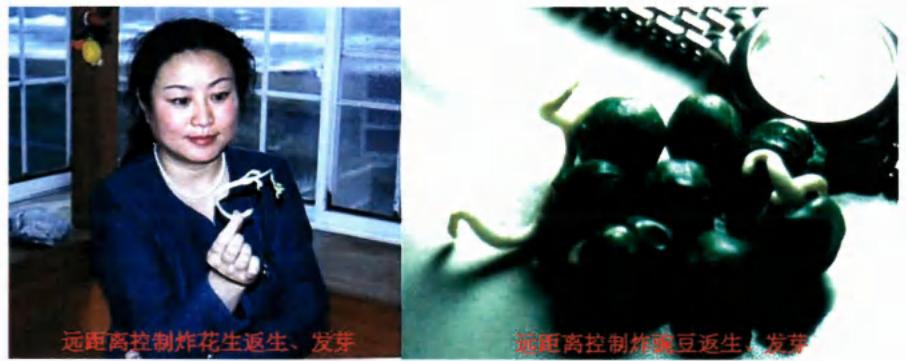
Sun Chulin’s reversion sprouting experiment in 1998
“I would tune the green bean onto the Third Eye screen, and then communicate with it. At the beginning, I held the green bean, feeling very protective of it, thinking and saying: ‘Green bean, why are you so beautiful, why are you so cute!’ I praised it. I then asked the green bean: ‘Can you communicate with me?’ At this moment, the brain screen would make a ‘beep’ sound, a signal appeared, and many images emerged (this was the sign of successful communication with the green bean). Later, I saw the nutrients inside the green bean continuously gathering, gathering, and ‘pop’ a sprout burst out. During this process, there were both sounds and images. The sounds were gibberish, creaking and groaning; I didn’t know what they were saying, I couldn’t understand. I saw things rotating inside.” ①
9.2.14 Green Apples Turning Red
After Sun Chulin watched a “Vajra Master” from the Henan Armed Police Force perform the feat of turning green four-season fruit (the fruit of an ornamental plant) red at a conference in Tianjin in 1990, she also successfully succeeded in turning green apples red and red fruit green. This operation is basically the same as the method for making beans sprout:
First, you must have the confidence to turn it red, to make it ripe. Bring the green fruit onto the Third Eye screen, enter the functional state, and operate while looking at the green fruit on the screen. I say to the green fruit: “You are so young, so green, can you become a bit more mature? Turn into a bright red, a particularly beautiful red, a particularly lovely red.” Anyway, just say whatever comes to mind. If it responds to my request, it will move a little, and then start to change. I can see the process of its change on the Third Eye screen, but sometimes I don’t look at it at all, nor do I manage it; I just let it change. Once the fruit on the screen has turned red, the screen disappears, and the fruit I am holding in my hand follows suit and turns red. Sometimes, problems also arise. For example, if the fruit is unwilling to change, it will tell me: “I don’t want to change today.” I ask it: “Why don’t you want to change?” It says: “I want to take a nap right now.” This is very interesting. ②
Sun Chulin wrote in “Dialogue from the Depths of the Soul—Life Experiences of Communicating with Plants,” published in the September 1998 issue of China Qigong Science: “Initially, it was turning ripe four-season fruit and holly fruit from bright red and dark red back to green or white. I also tried turning red apples into green apples. Later, I further conducted many experiments on restoring vitality to deep-fried, boiled peanuts, peas, or other beans, and even quail eggs boiled for 40 minutes under the action of my consciousness information field. These experiments involve the ‘rejuvenation’ of various cells, or even ‘bringing the dead back to life.’ It is a process opposite to normal growth, as if time can flow backward and the process can be reversed. In the process of completing such experiments, the scenes I saw on the forehead screen were very different from the images seen in experiments accelerating seed growth. After entering the functional state and realizing communication with it, the process of returning to life and restoring vitality is a spiral change from the outside in; we can call this process ‘reverse spiral change,’ accompanied by colorful, flickering, fast and slow changing light points that constantly change color and switch. Generally, after spinning continuously for more than ten turns, the ripe fruit or boiled, deep-fried peas and peanuts would gradually return to their raw state. In the process of the experiment, there were many strange images and sensations, a strange sensation of oneself merging with the experimental object. For example, when deep-fried peanuts were returning to their raw state, I also suddenly felt particularly relaxed, as if I were becoming younger and younger. Another time, when I urged a flower bud to bloom, I felt that I had drilled into the heart of the flower, slowly communicating and merging with her, gradually becoming a part of the flower bud, becoming a whole, opening together with her; the flower is me, and I am the flower. In other experiments I have done, such as moving buttons and coins without contact, I also had the experience of becoming one with the target object; it is truly indescribable!”
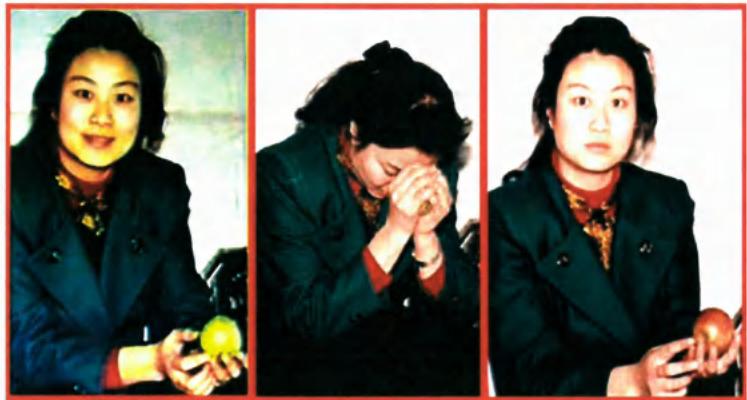
Sun Chulin turning a green apple red
9.2.15 Prospecting for Minerals and Oil
If one were to say that a person can accurately determine whether there is oil thousands of meters deep under the sea surface just by looking at a piece of white paper with coastlines and longitude and latitude lines from thousands of miles away, people would certainly think it is a fantasy, yet this is real. During the winter vacation of 1989, Shen Zhang ① led Wang Bin and Wang Qiang to the Nanhai East Oil Company, a subsidiary of the China National Offshore Oil Corporation, to conduct experiments on finding oil by looking at maps. Engineers from the oil company first explained the basic knowledge of undersea oil to the sisters in the simplest, most popular language, and let them feel oil samples, then asked them to sense the difference between already drilled oil wells and dry wells marked on the geological map.
After Wang Bin entered the state, she was quickly able to accurately distinguish between oil wells and dry wells. She said herself that she first stared at the oil well point on the map, and a bright spot appeared in her brain, then looked at other points on the map, comparing other points with the known oil well point. If other points could also form a bright spot in her brain, she believed there was oil; those with no sensation were dry wells.
They first tested on maps with geological markers. Geological personnel covered the markers indicating whether the well points on the map had oil with colored opaque tape. Wang Bin’s accuracy in judging well points on such maps was over 90%. Wang Qiang also learned quickly, with an accuracy of around 80%. At this point, there was a possibility that they could see the markers under the tape through their clairvoyance function. So, further experiments were conducted, providing ordinary maps without any geological markers. Some points were circled with a pencil on the map, and then they were asked to judge whether these points had oil or not, thereby ruling out the possibility of seeing the markers through clairvoyance. These points included already drilled wells and undrilled unknown well points. Their accuracy in judging already drilled wells did not decline. Later, both sisters could make judgments on designated points on white paper that had only coastlines and very sparse longitude and latitude lines, with no other geological information. Shen Zhang believes that the accuracy of finding oil by looking at maps has little to do with experience, but mainly with the strength of the function. ①
9.2.16 Several Key Points
All operations can only manifest when entering the “functional state.” One can enter the performance state of a “Vajra Master” with eyes open or closed. Generally, when entering this state, one feels as if they have entered another time and space, and at such times, keeping eyes open seems to be ineffective. The key does not lie in opening or closing the eyes, but in whether one has entered that state. However, generally, entering the state with eyes closed is faster and more comfortable.
The unique skills of the “Vajra Masters” are a technique of brain movement. As long as you understand a certain technique, you will be able to use a certain function, and the more you practice, the more proficient you become. It is just like learning to play the piano and paint; there are some techniques involved. But if you do not know the trick to that technique, you simply cannot do it.
Every operation requires waiting with great patience; some may take tens of minutes or even several hours to complete, and it is also possible that success cannot be achieved even after several hours.
Most “Vajra Masters” enhance their power and recuperate through certain cultivation methods (meditation, practicing Qigong, etc.). Otherwise, performing too much will also drain the essence and energy, reducing the function.
It is necessary to explicitly oppose practitioners without rich experience or scientific human body researchers from attempting the above or other experiments. Whole-brain potential development institutions are very likely to discover talents with very high aptitude to become “Vajra Masters” during teaching and training. If there are any, they can be confirmed through methods such as finger reading. If parents and children very much hope to develop in the field of human body science and make contributions to scientific research, it is suggested that parents take students to “Lvjiang Chunpeng University New Scientific Research Alliance” and professional research institutions such as Sichuan’s Mao Youguang and Mao Yuanjun to conduct on-site detection and systematic, effective development of the students’ potential.
9.3 Starting with Finger Reading and “Brain Screen” Imaging
9.3.1 Finger Reading is Not Blindfolded Reading
The purpose of blindfold games is to cultivate students’ self-confidence, concentration, imagination, etc., so special rigor may not be required in training and design. People often refer to blindfolded reading games as “High Sensitivity” (Gao Gan). The meaning of High Sensitivity is the same as ESP (Extrasensory Perception); their training and experiments should be very rigorous and conform to psychological double-blind procedures. This falls under the category of human science and parapsychology research. The potential development ESP game courses offered by our tutoring institutions lean more towards the category of educational research.
A few years ago, in order to get skeptics to believe, I tried every method possible, and using swim goggles stuffed with black cloth was just one of them. So we need to clarify this matter now: why carry out potential development? Is it to make people believe, or to improve certain abilities of children? To make people believe, one could say that no matter how rigorous the experiment is, those who don’t believe still won’t believe. Blindfold training can only be called an ESP game, which is different from true ESP. Parapsychology also considers blindfolded reading to be something children play with, which can only be called a game.
Earlier, it was mentioned that the initiator of blindfolded reading training was Liang Guangxiang, but as early as 1979, Chen Shouliang, a professor in the Department of Biology at Peking University, conducted the earliest experiments on children hearing characters with their ears and reading with their fingers. What exactly is the difference in their training content? ESP belongs to the phenomenon of special functions studied in human science. The most basic introductory method of ESP is finger reading. I believe everyone is familiar with the term “finger reading”; anyone who knows NTU President Lee Szu-chin is definitely familiar with this term. However, some people mistake finger reading for blindfolded touching of word cards, which is incorrect. In the 1980s and 1990s, when human science was just emerging and flourishing, the characters identified by research subjects with ESP abilities were invisible to everyone present with the naked eye. Unlike ESP games where the person wearing the blindfold cannot see but everyone else can.
So-called “finger reading” may actually not be the “finger” seeing; the finger is just a medium. Once the ability is induced, it works without touching with the finger. After children succeed in finger reading, the difficulty is gradually increased by putting the paper strip into a box. Sure enough, after repeated practice, they succeeded. Although it is known that it has nothing to do with touch, the actual mechanism of action is still inconclusive. However, it is fine to start finger reading from blindfold training.
Universality of Special Recognition Reading and Zero-Sum Testing (Documentary “Rainbow of the East” excerpt)
There is an article online titled “Chinese Scientists Successfully Crack the Evolutionary Code of Human Superpowers,” signed by Qin Xin Wu Yan, which states:
The blindfold training method allows children’s functions to develop from shallow to deep in an orderly manner, becoming a recognizable, monitorable, and controllable process: when children are trained to have basic functions, such as being able to read relatively smoothly while blindfolded, further training can allow them to wear stricter competition blindfolds or special swim goggles for training. At this time, their abilities will improve rapidly due to the increased training difficulty. Finally, they can identify text or patterns on sealed samples through perspective.
When such laws in blindfold training were discovered by scientists from the “Lvjiang Chunpeng” University New Science Research Alliance, it actually meant that Chinese scientists had fully mastered the key to comprehensively unlocking the treasure trove of children’s superpowers. Human scientists realized that the blindfold training method is the simplest and easiest method found so far for inducing potential in children. Using this training method, the potential of almost 100% of school-age children can be induced. The discovery and certification of this method cleared the final technical hurdle from an ordinary child to a person with superpowers!
Lee Szu-chin’s view on finger reading is as follows:
Since ancient times, Taoist cultivation has had the so-called “Xuan Guan Yi Qiao” (Mysterious Pass), and we often say “Kai Qiao” (Opening the Orifice) or “Yi Qiao Bu Tong” (Not getting through at all). If the Third Eye is that “orifice” connecting two worlds, then the simplest method known to open it is to practice finger reading. As long as the ability of finger reading is practiced, the Third Eye is opened.
The ability of finger reading or ear hearing characters actually exists universally in children, but if not developed and trained, the ability will slowly disappear as they grow older.
Some parents ask me, what is the use of learning finger reading? Finger reading is actually a kind of art skill, just like learning to play the piano, violin, drawing, or writing. It is adding a skill that can enrich life and obtain knowledge and abilities beyond ordinary people. Ordinary people always think that special functions are abilities that come when called, but this is not the case. The physical condition, mood, and proficiency of practice of the functioner will all affect the operation of the function. Based on my ten years of research experience, even great functioners like Zhang Baosheng and Sun Chulin cannot complete high-difficulty experiments every time they take the stage. The finger reading function is the same; it will fluctuate due to various conditions. Therefore, every time an experiment is conducted, one must warm up first. If the child has practiced for a few days before coming to the laboratory, the warm-up time will be shorter. If the way the sample is wrapped is suddenly changed, a period of adaptation time is required, just like suddenly changing the racket in a ping pong game. It takes time to adapt to get back the feeling of hitting the ball. This also shows that finger reading is a skill of the brain, similar to other artistic and sports abilities, requiring learning and training. ①
As early as the late 1970s, researchers designed several experimental methods and discovered many new phenomena. The earliest discovery was that a paper ball placed in the ear could be recognized. Later, it was found that without using the ear, one could also recognize the characters on the paper ball using other parts of the body such as hands, nose, armpits, feet, and buttocks. To prevent cheating, the paper strip with characters was sealed in an envelope, a dark box, or a ping pong ball, and it could still be recognized; not only could characters be recognized, but also pictures; not only characters written in ordinary ink, but also different colors could be distinguished, and even characters written in invisible ink could be recognized; no matter how the paper strip was crumpled, it could be recognized, and even incomplete characters with a corner cut off could be recognized. Some people can even recognize the characters originally placed from an empty ink box that once held the character strip, but if the ink box is dried in the sun, it cannot be recognized. The verification of special recognition reading phenomena made people realize: it is not an extension of the range of human eye sensation; it is different from radar searching for targets; the human body can emit some kind of unknown radiation different from electromagnetic waves; during the character recognition process, a screen similar to a TV appears in the forehead of the brain, and characters or pictures are displayed on the screen. Finger reading is probably a term made more widely known by Lee Szu-chin. Below, let’s look at how finger reading is trained.
9.3.2 Training from Finger Reading (ESP) to Psychokinesis (PK)
For finger reading ESP without blindfolding, the notes are generally prepared before training. Several notes can be made by printing different colors and texts on A4 paper using a color printer, then folded for standby use. The “Transcendental Space-Time Superpower School” introduced the “paper strip peeking method” ① of predecessors like Yao Hongjun, Luo Xin, and Zhu Nianlin from Yunnan on their blog. This training method can simply and effectively open the brain screen and finger reading function for school-age children:
-
Prepare some blank paper strips about 2×1cm. Write two or three characters or draw simple shapes on the strips. Then fold each strip twice or crumple it into a paper ball.
-
Let each student take one, hold it in their palm, or put it in their ear canal, etc.
-
Let the students look at a wall or a monochromatic object surface. But do not stare fixedly at one place; instead, rest your gaze lightly on the space between the eyes and the wall. Just like zoning out, empty the brain.
-
Then sense the small paper strip in your hand or ear and start silently chanting, for example: Little paper strip! Tell me quickly what is written on you! And so on. This sounds seemingly silly. But you must sincerely request the little paper strip. Keep silently chanting and requesting over and over again. Like praying.
-
After a while, some images or characters will flash before your eyes. Generally speaking, the things that appear at the beginning may be projections of random information in the brain. At this time, absolutely do not engage in a dialogue with them, nor guess. The correct approach is to continue looking like a fool, looking like you are zoning out. Let these things flash before your eyes. As long as you ignore them, they will pass and not come back. Slowly the brain becomes quiet, and at this time, the information on your strip will flash before your eyes. When you discover that some characters or images are always flashing before your eyes, that is likely the character or image on the strip. If you see it correctly, your screen is considered open.
Participating in this training requires patience; do not expect to succeed in three or five minutes. At the beginning, it is very normal not to see anything for half an hour.
- Although the screen is open, it cannot be counted as success yet; afterwards, it may close again. This requires unremitting daily training. Just like sports, after a series of training sessions, it will stabilize.
The “Transcendental Space-Time Superpower School” also recorded the training insights of several students on the paper strip peeking method.
Xu Mei’s training insights:
When the paper strip sample is placed in the hand, attention must be concentrated on the hand. Think with all your might about what is written on the strip. After 1~2 minutes, there will be a tingling sensation in the palm, and this numb swelling sensation will travel up along the hand—arm—shoulder—head. Immediately, a “white screen” appears in the mind, and the content of the sample appears on the white screen. Patterns, numbers, and colors do not follow a fixed order; they often appear randomly. For example, when recognizing a big character, it may be a stroke (pie) first, then a stroke (na), then a horizontal line, and finally combined into the big character in the brain. At this time, often nothing else around can be seen, only the big character on the white screen. Occasionally, characters can also be recognized incorrectly. The reasons for wrong recognition may include the following situations:
- Eager to express before the character combination process has completely stabilized.
- Unfamiliar characters were combined wrongly without knowing it.
- Lost strokes during the combination process.
If the paper strip is folded too tightly, it displays unclearly. However, most of these errors occur when the function is not strong or when fatigued. The state of the screen person also has a great relationship with physical condition, thoughts and emotions, and the surrounding environment.
Zhang Zhen’s training insights:
I put the paper strip sample in my palm and concentrated my energy to sense it. There would be a feeling like ants crawling in my palm. Then I imagined it as a little ant crawling up along the inside of my arm. It crawled along the arm—armpit—heart area—behind the ear—all the way up to reach the brain side and then entered the brain. Then I imagined there was an apple in the brain, and this little ant would crawl towards that apple. As soon as it touched that apple, the character in my hand appeared in the middle of my brain. Recognizing a character generally takes only about a minute.
Wang Chu, Chen Shouliang, and He Muyan’s insights on children’s training class development:
Most of the trained children responded that after receiving the sample, they subjectively felt a color image gradually appearing in the brain, with the image changing from blurred and unstable to gradually becoming clear and stable. This clear and stable image is often the correct response to the sample. The process is roughly as follows: After the subject receives the sample, reality in the brain appears with dots or chaotic images of horizontal and vertical lines. A period of time must pass; most subjects feel a large bright spot appearing in the brain, and some feel several small spots appearing in the brain. Next, if the sample is a color picture, the background color of the image appears quickly. If the sample is text on white paper, the color of the text appears. After that, a blurred image gradually appears. This image often flashes constantly. And it becomes a clear image part by part. When the image is not only clear but also flashes less or does not flash, the trainee considers this to be the image of the sample.
What the trainees see at the beginning are all fragmented pieces of information that seem unrelated, but after this chaotic state ends, these seemingly random fragments will organically converge into a clear whole.
In practice, it seems there is a processing process for the information from the sample by the trainee. For example, a child trainee named Xiao Pei complained: When looking at the character “在” (zài), what appeared first was a ”+”, then a vertical line appeared to the left of the +, and a horizontal line at the bottom. Then a slanted stroke and a horizontal line at the top, forming the character “在”.
A child’s self-account:
Last night, mom put a small paper ball into my ear. I immediately closed my eyes. At this time, my brain was blooming. At the beginning, it was messy; there were horizontals and verticals. There were blue ones and white ones. After a while, there was a patch of black in the brain, and then a few silver stars slowly appeared in the brain; these silver stars slowly diffused. After a while, there was another patch of black in the brain. Subsequently, I saw a blue “方” (fāng) character flashing in my brain. After a while, the dot on the head of that “方” character turned into a vertical line. The “方” character became the “才” (cái) character. I waited patiently for a while, and that “才” character was as if nailed in my brain, fixed in my brain. At this time, I told mom, “It is the blue ‘才’ character.” Mom nodded and said it was correct.
The training from ear hearing characters to off-body character recognition is written in great detail in the article “Experimental Research on Developing Brain Potential and Improving Thinking Ability” signed by He Fengchui in the 2012 Spring issue of Yisheng Culture (pages 109–112). An excerpt follows:
The ability of ears to recognize characters is a potential inherent in the human body; it is just that people do not pay attention to developing it. Generally, using the “thinking” method, most children can be made to recognize characters with their ears, recognizing colors and pictures as well. Besides ear hearing characters, some children can also recognize characters on many parts of the human body, such as: palms, soles of feet, armpits, chest, and back. After training for a period of time, “closed book character recognition”, “off-body recognition”, and “through-wall recognition” can also be trained, slowly developing many advanced potentials of the human body such as “clairvoyance function”, “thought sensing function”, and “remote sensing and telemetry”.
Any method must master a principle: the content must go from shallow to deep, from easy to difficult, from simple to complex, step by step. At the same time, education in thought and character must always be threaded through, so that people understand the principles of conducting themselves, and persist in practice every day. First, choose a venue that allows students to feel relaxed and happy; they cannot be allowed to have mental pressure or tension. Organizing seven or eight people together is best.
Prepare the paper strips well; the thickness and size of the paper used should be appropriate. About 3~4 cm in length and width is good; if it is too small, it will fall into the ear and cause trouble. You can use pens in five colors: red, yellow, blue, black, and green to write characters and draw pictures.
At the beginning, we only write the ten Arabic numerals “0~9”. Write the characters the same size as in textbooks for easy recognition. You must tell the students the range; everything is hard at the beginning. Crumple the written strip into a ball and put it into the student’s ear canal, and “ear character recognition” can begin. Students are required to keep their eyes open and not close them; closing eyes easily produces hallucinations.
How to “see”? First, teach students to use their mind to command the brain, focusing intently and concentrating on silently repeating: “Ears, ears, let me see what is on the note”? After a while, the ears will have various reactions, such as hearing a buzzing sound, or feeling heat, cold, numbness, swelling, or itching; these are all normal. At this moment, guide the students to draw the sensation upwards, leading it from the ears along the temples to the space between the eyebrows on the forehead, and use the consciousness to command: “Let me see on the forehead”! After silently repeating this for a period of time, suddenly, it is as if a TV switch has been turned on, and a screen appears between the eyebrows. The screen is a white bright light, and within this bright light, the content of the note inside the ear is presented, and the colors appear as well. It is true seeing, not guessing. At the beginning, the image is unstable, it moves around and is unclear. We use our mind to command the brain: “Steady! Don’t run, let me see clearly.” Slowly, the image stabilizes and becomes clear, and “ear reading” is considered successful. (Linguistic suggestion produces a magical effect; the principle of chanting in Buddhism and Taoism also lies here.) Later, practice more and gradually increase the difficulty. The power of intention will become stronger and stronger, the speed of seeing will become faster and faster, and the accuracy will become higher and higher. Professor Zhu Nianlin of Yunnan University once tested this using a bio-field Y-ray instrument. Students just starting training only had a very faint, thin ray of light; after practicing for a long time, this ray of light would become wider and brighter, indicating that brain power is gradually increasing. Students starting training should pay attention to getting more rest; the duration cannot be too much or too long, and the brain must not be overworked; one must “proceed step-by-step”.
When training “ear reading”, some students react very sensitively and can immediately use their palms to read. Go with the flow and teach them to lead the sensation along their arms, up through their shoulders and necks to the space between the eyebrows on the forehead to see. Encourage them to try recognizing with other parts of their body. We also adopt various methods to increase students’ interest in identification. For example: What is the content of the turned-over playing card? What is drawn on the animal card inside the envelope? They are only allowed to touch with their hands. At the same time, send out an intention, think! The answer will come out.
In the “One-Year Summary of ESP Function Training” written by Professor Zhu Nianlin of Yunnan University on October 5, 2011, he summarized several points of experience regarding ESP function training, which serve as an important reference for function-oriented potential development ①.
-
Leaving room for guessing has extremely negative effects. Whether conducting function induction or function enhancement training, it is best not to say anything about the test sample, so that the original habitual mode of thinking cannot be used at all, allowing the trainee to fumble their way into the special function state on their own. Once they know the scope of the sample—for example, that it is a two-digit number, two letters or Chinese characters, or a playing card—quite a few people will adopt a guessing method, and the success rate will become quite low. Even students with originally high accuracy rates will make mistakes repeatedly.
-
Identifying colors is easier than identifying shapes. In practice, it has also been found that most people will “see” the colors clearly first, and then see the shapes clearly. During student training, some who could correctly identify colors but could not completely identify the characters correctly is also proof of this. Therefore, when making experimental test samples, it is best to use single-color, two-color, or three-color mixtures. As long as they report that they have identified the colors, although they have not yet succeeded, we already know that they have entered the special function state and are not far from success. And they know early on that seeing color means finding the feeling, so their confidence immediately increases; then, with a little more effort, they succeed.
-
Another difference between special vision and ordinary vision is that for different test samples—such as written notes, playing cards, character recognition cards, or even physical objects—special vision requires an adaptation process. It is common not to be able to recognize the first time encountering a type of test sample one has never touched before, so there is no need to be surprised. Let them come into contact with different kinds of test samples more often; this is beneficial for the comprehensive development of the function.
-
Increasing interest is an effective incentive mechanism. Training methods are limited; simply and constantly repeating for one or two months easily makes people feel bored and creates a feeling of weariness. During training, this manifests as a lack of concentration, constantly failing to produce results, and even making up excuses to put off the teacher. Therefore, during training, one must find ways to constantly change the pattern, or encourage competition, or give appropriate rewards, or replace practice with games, or tell relevant stories, or simply take them to visit or play once… so that they maintain their interest. If the interest is maintained, the training effect will be very obvious. When a slump appears, it is even more necessary to look for causes in the training method and come up with a trick to increase interest; the problem may be solved quickly.
-
Continuous low-difficulty, low-intensity training is of great help for stabilizing the function. Whether completing a simple function like “palm reading” or completing a function with a certain level of difficulty like long-distance psychokinesis, for the function person, the first half of both is the same: it is entering the special function state from the normal state, or opening the “screen” or “opening the heavenly eye,” or simply finding the feeling. Only then does one enter the next stage, in the special function state, to complete some operations, simple or complex, as required. If the first half is not completed, there will be no second half. For quite a few functions, the operational difficulty of the second half isn’t very high; once the first half is completed, doing the second half is easily accomplished. Therefore, whether one can stably switch between function states is the key to whether the function is stable. This can only be achieved by letting the function person practice function state switching frequently; naturally, they will master the skill of switching states through repeated practice. It is impossible to achieve this by relying on only a few training sessions a month.
As mentioned above, to complete any kind of special function, one must first complete this stage. Therefore, using “palm” reading and other such easiest-to-complete functions for training can also achieve the goal. Once a day, or once every other day, each time spending only a few minutes, utilizing fragmented time such as going to school, coming home from school, or after homework, it can be completed without any adverse effect on the child’s normal life. As long as parents or family tutors can cooperate, it is very easy to do. If one persists for a few months, the child will naturally be able to enter the function state easily at any time.
In the “One-Year Summary of Psychokinesis (PK) Function Training” on September 15, 2011 ①, Professor Zhu Nianlin summarized the PK function training, which is valuable experience for function-oriented potential development. Here is an excerpt of the summary on function induction for zero-start children:
- Lay a good foundation from ESP. Based on many years of practical experience, we conduct “visualization” operations for the induction and improvement of PK functions only when the “heavenly eye” or “screen” is opened. This not only has a high success rate but also follows certain patterns.
This method first requires the appearance of a “screen,” and the most effective known method for developing the “screen” is “ear” or “finger” reading; performing actuation operations within the “screen” requires operation time, otherwise it cannot be completed. Therefore, during ESP training, one can gradually increase the complexity of the test samples to extend the recognition time, thereby extending the “screen” opening time; usually, once the function person can proficiently recognize seven or eight unrelated Chinese characters, psychokinesis function induction can be carried out.
If full-contactless psychokinesis is required, also start with full-contactless ESP reading to train the function person’s ability to find and lock onto the target.
- Induction by teachers without PK function. At the beginning, it is often teachers without functions who teach students based on their own imagination. First, require the student to open the “screen,” find the test sample in the “screen,” then see their own two hands in the “screen,” and let the two hands grab the test sample and forcefully act upon it. During this process, various problems we did not expect will appear, such as not finding the hands or finding only one hand; finding the hands but the object disappears; as soon as the hand grabs the object, it runs away; the folded paper springs back as soon as the hand is released; or even problems we cannot imagine or answer appear, such as “The test sample says it doesn’t want to do it today.” Yet these are questions that have to be answered, so one has to make things up blindly. We became truly blind commanders. Fortunately, after persisting for a while, there are mostly good results. This indicates that the general direction is still right.
9.3.3 Character Recognition by “Diamond Masters”
- Demonstration by function persons. Once a person with psychokinesis function has been cultivated, the situation is completely different. Students who had made no progress using the original method only need to watch someone else complete psychokinesis once, and without the teacher saying anything, they immediately know how. This greatly accelerates the training speed, and the teacher is also much more relaxed.
A student who had only participated in half a month of ESP development training saw a classmate performing psychokinesis and was very curious. He took the initiative to ask to try. We did not explain any essentials, and he succeeded on his first attempt. Later, a student who had just joined the training for four days (for the third time) also asked to try. He also “watched” someone else do it once first, then did it himself, and succeeded on the first attempt.
To us, the phenomenon of psychokinesis is still unfathomable today, but to them, it is a small trick that is learned at one “glance”! It is just like an ordinary child seeing another child fiddling with matches and pieces of paper; he learns it immediately. This shows that they can “see” a complete “material” interaction process and can immediately learn to operate the same process. Therefore, the reason it is mysterious is simply because we cannot see this process at all, yet we stubbornly believe that there cannot be a process that we cannot “see” but that children can see.
·The Tangram in the Mind
Beijing’s Wang Qiang (born December 27, 1966, in Beijing; graduated from the Music Department of Beijing Teachers College in 1989) and Wang Bin (born July 14, 1968, in Beijing; graduated from Beijing Medical Assistant School in 1989) are a pair of “King Kong Experts” sisters with innate abilities such as extrasensory perception (ESP) for reading characters. In January 1980, Luo Dongsu from an institute affiliated with an Air Force medical college tested the sisters. He gave each of them a kraft paper bag and asked them to identify the characters inside; they placed the bags under their armpits. After only one minute, Wang Bin exclaimed: “Uncle, you are so bad! Inside are all scraps of paper.” Wang Qiang said: “No, there are characters on the scraps!” Luo Dongsu told them to compete to see who could identify them first. Seven or eight minutes later, Wang Bin figured it out; inside were three characters written in blue ink: “Take the train” (乘火车). However, these three characters had been cut into pieces, cut randomly, with each piece having an irregular shape. At this moment, Wang Qiang also recognized them; there were two characters: “Bright Moon” (明月). Black, cut into a total of 5 pieces. She even drew out the shape of each of the 5 scraps one by one. The researchers cut open the paper bags and pieced these scraps together. It took Wang Bin 14 minutes to assemble her 8 scraps into their original state, while Wang Qiang took 11 minutes to assemble the 5 scraps in her pocket. This means that the time they took to splice and identify the characters on these scraps using their special abilities was faster than doing so by using the naked eye and hands.
They said this splicing was completed in their minds. When the first fragment appeared in their mind, as the second fragment appeared, it would automatically find the position matching it along the jagged edge of the remnant. The third piece would then find its corresponding position along the irregular edges of the first two, until all fragments were in their proper places. According to the Wang sisters, when identifying characters, a small screen similar to a television usually appears in the forehead area of the brain, displaying the characters or graphics on this screen. ①
·Ear and Hand Identifying Characters Together
On April 2, 1989, Zheng Xiangling performed “Ear Hearing Characters” and “Palm Reading” at the auditorium of the Guangdong Science Hall. Huang Xinwu, a professional writer from the Guangdong Dramatists Association, wrote the two characters “Feng Cai” (Elegance/Style), Zhang Jin, an editor from Shenzhen Fengcai magazine, drew the pattern ”※” impromptu, and more than ten other people also wrote things, folded them into small paper balls, and handed them to Zheng Xiangling. Zheng Xiangling randomly picked two paper balls, stuffed one into her ear, and held the other in her palm. She asked the audience members who wrote the characters to silently recite what they wrote in their minds. 16 minutes later, she successfully identified the characters “Feng Cai” and the pattern inside the paper balls.
Zhang Jin afterwards asked Zheng Xiangling how she recognized the characters. Zheng Xiangling said: “At first, I felt the paper folded into a ball suddenly open layer by layer in front of my forehead, then I saw the characters inside. The characters were upside down, flickering. Once I saw clearly, as soon as I opened my mouth to say them, the characters disappeared. Everything followed nature; which one was recognized first was not intentionally controlled. Before the character is recognized, I vaguely feel a red line transmitting from the body part holding the sample (hand or ear) to the brain, and the paper starts to open layer by layer before my eyes.” ②
·Identifying Characters with Lights Off
Zhang Naiming, author of “Child Found in Dazu County Capable of Reading Characters with Ears” published in the Sichuan Daily on March 11, 1979, conducted rigorous tests on Tang Yu for two consecutive days before writing this report. During the test on the second day, all electric lights in the room were turned off, so that the room was only dimly lit by moonlight, making it absolutely impossible to see the words on a letter or a newspaper clearly. Under these conditions, Tang Yu still identified all the characters on more than a dozen notes placed in people’s ears one after another. He also told everyone what color the characters were written in, and whether they were written with a brush, fountain pen, or pencil…
Tang Yu also introduced that his hand felt like it had electricity; when he took out the paper ball with characters, reflections of the handwriting began to appear in his brain; when the paper ball was placed in his ear, his mind acted like a screen revealing the strokes one by one; if he was in a happy mood and there was no noise interference, the characters appearing in his mind were very clear. No wonder Tang Yu could not only write out characters he had learned, but also draw Chinese characters or English he had not learned, exactly as they were. ①
·“King Kong Experts” ESP Character Reading Also Has Unsuccessful Times
Kaifeng Hui ethnic girl Ma Weiqing (born in 1967) was once a famous figure among the “King Kong Experts.” She had magical “powers”: she could accelerate the growth of tree leaves, reconnect broken branches, fetch medicine from inside a bottle, write with special power, move watch hands with intent, and transport objects through the air. Although Ma Weiqing was called a “Superwoman,” she also had times when things did not go smoothly.
On November 11, 1988, 8 scientific PhDs from Hong Kong conducted scientific experiments on Ma Weiqing. Two film cameras and six video cameras were all aimed at her, creating a somewhat tense atmosphere. Ma Weiqing said: “If everyone stares at me with a scrutinizing gaze, I feel pressure and get very annoyed, and it is hard for my ability to manifest. If everyone cheers me on like friends, my ability comes out easily.”
In the first test, Ma Weiqing easily identified a paper folded several times in just 5 minutes.
During the second test, the venue was deathly silent. Ma Weiqing seemed to sense a hostility from this silence, and she spoke up: “It’s too tense. You guys talk. The cameras keep pointing at me, and I’m sweating. Wait until my ability is about to come out, then point them at me.” For this test, the sample had its four corners glued shut by the PhDs. After 42 minutes, Ma Weiqing only recognized one of the three characters.
In the third test, the characters for the sample were written on a rectangular cloth strip, rolled into a ball, and tied with rubber bands for nearly twenty loops. It took 30 minutes before Ma Weiqing gradually recognized the characters inside.
After returning to Hong Kong, the PhDs completely denied Ma Weiqing’s special character reading ability, believing she succeeded by “peeking.” The accompanying writers, however, affirmed the success of this verification of special character reading. Thus, both sides stuck to their own arguments, and there was an endless and lively debate in Hong Kong newspapers at the time.
Ma Weiqing settled in Shenzhen at the end of the 20th century and gradually went into seclusion, no longer performing “King Kong Expert” acts thereafter.
9.3.4 “Mental Screen” Imaging is Key
The mental screen is quite important in ESP game training; most people use the mental screen for blindfolded color discrimination and character recognition. Many people do not pay attention to whether there is a screen at the beginning; perhaps later they will notice it themselves, or perhaps under the prompt of a teacher or parent, they will see a frame, a screen. This screen is also called a “window” by some; the things on the screen are two-dimensional, while what is seen through the window is three-dimensional—that is, what is seen is not a flat object. In short, when looking at things with the Celestial Eye, the feeling is as if one is personally on the scene. Therefore, whether it is called “mental imagery,” “brain screen,” “screen,” or “window,” there is no need to be dogmatic, and the feeling of seeing varies from person to person. In ESP games, some people may never have a mental screen, yet are able to perceive colors and text while blindfolded, but to become a “Vajra Master,” the mental screen is essential.
Sun Chulin once explicitly stated: Regardless of what experiment she does, the object to be manipulated must first appear on the screen. If the object to be psychokinetically moved or manipulated is not seen on the mental screen, it indicates that the object is not connected with the brain’s consciousness. Therefore, the appearance of the object to be manipulated on the mental screen is the most critical and the first necessary condition.
How Extraordinary Character Recognition is Achieved
(Excerpt from the documentary “Rainbow of the East”)
Li Sici also believes that after the brain’s consciousness and the object merge into one, when the mind receives information, it becomes a function similar to finger-reading; when the mind sends information out, it becomes psychokinesis (PK). Now we have gradually understood the macroscopic mechanism within this, but the microscopic mechanism—for example, exactly how the brain’s consciousness and the object connect—is still unclear. However, it is certain that: first, the brain’s consciousness and the object must connect. Once the object can be tuned onto the mental screen, it is half the success, because that indicates consciousness has penetrated the body’s barriers and is interacting with the object. ①
In fact, as early as the 1980s, Chinese researchers discovered the mystery within. The following are selected excerpts from papers and articles regarding the “mental screen.”
Sheng Zujia from the Institute of Genetics at Fudan University mentioned in the article “Extraordinary Functions and Human Body Science”: In extraordinary function character recognition experiments, a “screen” was discovered appearing in the forehead during the recognition process, with the character to be recognized appearing on the screen. This “screen” effect is not limited to character recognition; this “screen” effect exists in the realization processes of extraordinary functions such as telepathy, psychokinesis, and extraordinary writing. However, while visual information can be transmitted, some extraordinary function practitioners cannot transmit auditory and taste information.
The training of extraordinary functions is very simple in form, mainly consisting of silent recitation. Taking non-visual character recognition as an example, a “screen” appears in the forehead through silent recitation, and the character to be recognized appears on the “screen.” Some people developed a “screen” during long-term silent sitting and recitation. The images appearing on the “screen” were mistaken for attaining immortality and the Dao. Extraordinary functions also have a certain relationship with internal Qigong, as both are results of introspection. ②
Shao Laisheng and others from the Department of Electronic Engineering at Fudan University mentioned in the article “Experimental Study on Telepathy”: Extraordinary function practitioners reported that during their process of extraordinary perception or psychokinesis, a “screen” would flash out in front of their forehead, and the content of perception or the object of action could be obtained on the “screen,” termed the “screen phenomenon.” Generally, there is a brief state of entering stillness before the “screen” appears. In telepathy experiments, both the information sender and the receiver must have a “screen” flash out in front of their foreheads for the transmission of information to be realized. When transmitting dozens of characters, the information is transmitted without error. For an ordinary person, looking at the sent sample and immediately memorizing it silently without a single error is not an easy task. The sender and receiver may neither understand nor recognize the information on the sample, such as sending Russian or Korean text, yet it can still be transmitted telepathically, and the appearance is very realistic.
The essence of telepathy is the transmission of images flashing out in front of the foreheads of the sender and the receiver. Sounds, smells, etc., can also be transmitted telepathically, but this can only be achieved after the sender converts this information into “text” or “images.” ①
Shao Laisheng and others from Fudan University stated in the article “A Preliminary Study on the Mechanism of ‘Telepathy’”: Whether in Extra Sensory Perception (ESP) or Psychokinesis (PK) experiments, a “screen” must flash out in front of the subject’s forehead, and “extraordinary radiation” is emitted. This may be a universal phenomenon in extraordinary functions. After each extraordinary function experiment, subjects often complain of feeling physically fatigued, and sometimes feel headaches and brain swelling. When identifying characters extraordinarily, the pulse pattern changes, spontaneously becoming slippery and rapid, similar to the pulse changes when an athlete enters heavy exercise. When identifying characters extraordinarily, when the “screen” occurs, cerebral blood flow must increase, energy supply increases, and energy is released in a pulsed manner. When the subject feels physically unwell or fatigued, especially female subjects during menstruation, the success rate of the experiment becomes very low. At this time, they often complain: “The screen did not appear,” “The screen is dim,” “The screen image is blurry,” etc. If they are in a happy mood and full of energy during the experiment, the experiment is often done relatively quickly, and the success rate is high; at this time, they often say: “The screen is very bright and clear.” This may be related to the energy storage situation. Therefore, we hypothesize that when an extraordinary function practitioner enters the extraordinary static state, they begin to store energy. Once the energy threshold is reached, it triggers the “screen to flash out” and releases “extraordinary radiation.” ②
Weng Taimeng, Wu Maojun, and others from Fudan University introduced in the article “Similarities, Differences, and Mechanism Exploration between Extraordinary Psychokinesis and Conventional Psychokinesis”: It is very easy for an extraordinary function practitioner to extraordinarily bend a lead wire. We took a lead wire about 40 mm long and 1.0 mm in diameter, placed it in a plastic dark box, and coated the surface of the lead wire with red ink pad. We emphasized to subject Xiao Ji that he must use extraordinary functions to simulate holding both ends of the lead wire with his thumbs and index fingers as usual, and forcefully bend the lead wire into a “V” shape. Xiao Ji succeeded in one go. However, Xiao Ji’s thumbs and index fingers on both hands were stained with traces of the red ink pad from the lead wire. Regarding this experiment, we can only see the result as such; the action process is invisible.
This process may be the thinking movement of the extraordinary function practitioner. Through the brain’s synthesis and speculation, conceptual knowledge is formed, and through brain thinking, the world is actively and reciprocally transformed. Normal functions and extraordinary functions are both functions of the interaction between humans and the real world; the former is limited to conventional space-time, while the latter involves high-dimensional space-time. Humans can only know and transform the world through the brain, so both functions are actually functions inherent to the human brain. However, people often only habitually use normal functions, while extraordinary functions are often resisted. ①
Shao Laisheng, Zhang Linchen, Zhang Ming, and Zhou Yingqi from the Shanghai Universities Human Science Joint Research Group stated in the article “Optical Phenomena of Human Body Extraordinary Functions and Their Exploration”: To date, human body extraordinary function phenomena cannot be explained by modern scientific knowledge. However, by using modern scientific experimental methods to accumulate a large amount of experimental data, we will definitely be able to gradually approach and reveal the true face of this unknown field. Aluminum foil can play a good role in blocking or attenuating the energy of the ESP information carrier.
When using “mind intent” to identify a character sample, the character form does not flash out completely in front of the forehead all at once, but rather stroke by stroke or partially repeatedly and successively, finally feeling the display of the complete image. ②
Shao Laisheng from Fudan University and Zhu Yiyi from Shanghai Jiao Tong University stated in the article “Signs of the Human Body Extraordinary Function State: The Screen Effect” ③: Most subjects reported that they saw the content of the sample and the process of action on the “screen” appearing in the forehead. To experience the feeling of this special state when extraordinary functions appear, the author conducted self-induced training and indeed experienced the process of the “screen” appearing. At the same time, it was discovered that before the “screen” appears in the forehead, there must be a brief state of high-level stillness.
Xu Mei is a young girl with relatively strong clairvoyance functions. She described: When a poker card is placed on the palm, at this moment, one must concentrate attention on the hand, thinking with full strength about what the poker card is. Immediately, a white curtain appears in the mind, and on the white curtain, the outline of a poker card reduced to about 3/4 of the actual object appears, followed by the pattern on the poker card as well as Arabic numerals and colors. ④
Wang ××, a young teacher at Shanghai Fisheries University who is a beginner in learning extraordinary functions, felt: What I see is just the reflection in front of my eyes of the graphics identified in my brain. Recently, I tried twice to look with my “brain,” that is, letting the forebrain first concentrate on the sample, and then thinking of nothing. As a result, the graphic of the sample jumped out in my brain, and both times were successful. ③
Chen ×, a student at Shanghai Second Medical University who is a beginner in learning extraordinary functions, initially only felt something flashing in front of the forehead, like looking at a kaleidoscope spinning very fast, and then it was gone. Very quickly, a bright patch (with words on it, but the strokes of the words and the shades of color varied) flashed. When I wanted to look carefully, it had already passed by. Afterwards, it appeared repeatedly several times, but due to the suddenness of its appearance and fast departure, it was very difficult to see clearly. ①
The world-famous extraordinary function practitioner Uri Geller described in his book: There is something in my brain like a television screen, on which Gunther’s answer is projected, just as my mother’s thoughts were often projected on it after she came home from playing cards. I can never feel these things, but I can see them. These things are projected in the front part of my brain, where there is a grayish screen, and on it, I can see these things. If someone thinks of a picture, a number, or some words, I can see them projected on that screen in my brain. ②
Shao Laisheng from Fudan University and Zhu Yiyi from Shanghai Jiao Tong University published their investigation into the extraordinary experiences of 8 young men and women aged 20 to 27 with special functions in the article “Signs of the Human Special Function State — The Screen Effect”.
- Precursors before the occurrence of the screen phenomenon — sensations upon entering a highly specific meditative state:
(1) External sounds seem to be blocked out. (2) Eyes can still see surrounding things. (3) The brain feels groggy, with thoughts focused only on the goal to be accomplished. (4) The body seems to be floating in the air. (5) There is an indescribable feeling of discomfort, which disappears after the screen flashes out.
- When the screen flashes before the forehead, it seems as if one sees inside the brain:
(1) The screen is rectangular, white or bright, about the size of a comic book (1/64 format); (2) The screen mostly flashes from left to right, occasionally from right to left; (3) The numbers seen in the screen flash out one by one, but sometimes they flash out all together.
- Other sensations
(1) Every time before the screen flashes, there is always the aforementioned meditative state sensation.
(2) After each experiment ends, the body feels fatigued, sometimes with a headache and a swollen feeling in the head.
In addition to being able to “see” images or text on the brain screen, some people also “hear” certain sounds. Gong Zhebing, a professor at Wuhan University, wrote an article titled “Ear Reading is Real, Possibly a Right Brain Function”, which introduced the training situation of several children: Zhao Kai’ai used her palm to recognize the character “Hai” (Sea) on a piece of paper folded three times. She told us: The shape of the character “Hai” appeared on the small screen on her forehead, and she also heard the sound of ocean waves. Ma Yueyuan trained to recognize characters on small paper slips inside medicine bottles. Initially, the medicine bottle was placed on a table one meter away, and she misidentified a few characters. Later, when she held the bottle in her hand, she recognized them with a high accuracy rate. At that time, I wrote the two characters “Guanyin” (Bodhisattva) for her to identify. She recognized them in 3 minutes and wrote the characters “Guangyin” (Light Sound) in her notebook; one was correct and one was wrong. I discovered that “Guang” and “Guan” are homophones, so I asked her how she recognized it. She said: The shape of the character was on the small screen, but it wasn’t very clear; I heard the pronunciation and wrote it down based on the sound. Teacher Zhang Wenhua said: There was a child who was basically illiterate. When asked to use his ear to identify the character “Hai” (Sea), he heard the sound of ocean waves, and the scene of ocean waves was displayed on the screen on his forehead, so he answered that the character was “Hai”, which was correct. The same child used his ear to identify the character “Jun” (Army). A shining five-pointed star cap badge appeared in his mind, and he answered “Jun”, which was correct.①
The essence of special functions is the reception and release of information. The most important aspect is the ability to clearly “see” images and artificially alter them (for example, healing via special functions). Imagination is a channel leading to a higher-dimensional space; in this high-dimensional space, altering the seen images can manifest them in the three-dimensional world.
9.4 How to View the “Vajra Master” Phenomenon
9.4.1 “Vajra Experts” Cannot Change the World
Throughout history, “Vajra Experts” have never been absent; their abilities include those innate from birth and those acquired through later cultivation. Some people believe that a significant part of religious practice and cultivation involves developing supernatural powers, becoming “Vajra Experts,” but this is merely a byproduct. In China, at the very least, the two most influential schools, Buddhism and Taoism, both oppose the cultivation of supernatural powers, believing that such powers cannot change the world or alter one’s destiny; only the Dharma and the Tao should be the truths that people seek.
Why can’t supernatural powers change the world and destiny? We can look at the story of “Maudgalyayana Rescues His Mother” in the Buddhist Ullambana Sutra. Maudgalyayana, full name Mahamaudgalyayana, was one of the ten principal disciples of Shakyamuni Buddha, renowned as the foremost in supernatural powers and filial piety. Because his mother was stingy and greedy during her lifetime, enjoyed slaughtering livestock, and feasted extravagantly, after death she was cast into the underworld and subjected to torture. Maudgalyayana’s supernatural powers were formidable; he smashed open the Gates of Hell to rescue his mother. When he saw her, however, all the food he gave her turned into charcoal fire before it could enter her mouth. He tried every trick he knew but could not get her to eat a single bite of food. Maudgalyayana sought help from the Buddha, who shook his head and told him: “Supernatural powers are no match for karma!”
After the Buddha passed into Parinirvana, Maudgalyayana continued to uphold his master’s command and spread Buddhism. While preaching at the foot of a mountain, he was ambushed by opponents and crushed to death by a massive boulder rolling down the mountain. Maudgalyayana, the “foremost in supernatural powers,” could not foresee his own impending doom, nor could he use his powers to escape this calamity. In this light, what use are “supernatural powers”? Therefore, Buddhists say: “It is true that Buddhas and Bodhisattvas possess supernatural powers, but supernatural powers cannot defeat karma. The Buddha is omniscient, not omnipotent. There are three things the Buddha cannot do: he cannot save those without affinity, he cannot eliminate disasters on behalf of sentient beings, and he cannot save all sentient beings.”
These Buddhist myths are merely intended to teach people certain principles. Everyone has karma; finding supernatural powers cannot change the laws of the universe, nor can supernatural powers have an impact on a macro level. Therefore, Buddhism is generally opposed to practicing and using supernatural powers. When the Buddha was alive, he was very worried that some bhikkhus might display “supernatural powers,” causing people to lose faith in the True Dharma and instead worship individuals and bow down to “miracles.” Consequently, there was a strict prohibition against bhikkhus displaying “supernatural powers,” with violation resulting in “expulsion.”
Later, Mahayana Buddhism considered “supernatural powers” to often be low-level byproducts of cultivation, unrelated to Buddha-nature. The Zen school is extremely vigilant, and even排斥, regarding “supernatural powers.” Attachment to “supernatural powers” hinders the discovery of one’s own Buddha-nature and blocks the attainment of the Prajna realm; showing off and promoting “supernatural powers” in front of the public would “mislead the masses,” which is a grave sin.
The Zen classic The Record of the Five Lamps (Wudeng Huiyuan) records several stories about “Vajra Experts.” The story of the 37th Buddhist Patriarch, Master Huangbo Xiyun, encountering a person with “supernatural powers” provides an intuitive understanding of the Zen school’s attitude toward “supernatural powers.”
Before Huangbo Xiyun attained the Dao in his early years, he traveled to Mount Tiantai and met a monk with an extraordinary demeanor; they talked and found they had a great rapport. As they walked together, they encountered a mountain stream where the water had risen, making it difficult to cross. That monk wanted to take Master Xiyun across the water with him, but Master Xiyun indicated: “Each crosses their own way.” Crossing water is like saving people; here, it implies the meaning of saving oneself. At this point, the monk revealed a bit of “supernatural power”: he lifted his robes and trod on the waves as if walking on flat ground. Lifting his clothes, he stepped on the waves to cross, simply like the “treading snow without traces and floating on water” seen in martial arts novels. Once the monk had crossed, he beckoned Master Xiyun to cross. If this were a standard novel trope, how could one let a master slip away when met? The protagonist should be infinitely admiring and hurry to bow as a disciple to learn a few moves. But the development of the story was contrary to our expectations. The subsequent narration in The Record of the Five Lamps contains the profound meaning of Zen. Master Xiyun scolded that monk for revealing “supernatural powers,” and was quite sharp-tongued: “You self-liberated rascal! If I had known you were like this, I should have cut off your legs!”
The Record of the Five Lamps also records a story of Zen Master Yinfeng of Mount Wutai. He attained enlightenment under Mazu and became a high monk of his generation; by seniority, he should be Huangbo Xiyun’s grand-uncle. He was humorous and uninhibited by nature, and also possessed a set of byproducts of cultivation—supernatural powers. Once, while passing through Huaixi, he encountered government troops fighting with rebel warlords, with neither side able to win. Out of compassion, Zen Master Yinfeng decided to use “supernatural powers” to quell the battle. He threw his khakkhara (staff) into the air and flew over it himself, leaving the soldiers dumbfounded. It is unknown whether Zen Master Yinfeng had used “supernatural powers” to infiltrate the soldiers’ dreams beforehand or had tampered with their memories, but the soldiers actually felt that the scene before them was exactly the same as a scene they had dreamed of previously. Everyone was astonished and could only stare in salute, instantly losing the will to fight, and a military disaster dissolved into nothingness.
Following the routine, the story should end happily here, but The Record of the Five Lamps takes a sharp turn at this point in the narrative, creating a major reversal. This reversal reveals the Zen school’s attitude toward displaying “supernatural powers.” Zen Master Yinfeng had used supernatural powers, but he worried that using such “supernatural powers” would “mislead the masses,” so he returned to Mount Wutai and passed away (entered Parinirvana) in front of the Vajra Cave. As Zen Master Yinfeng was about to pass away, his humorous side revealed itself again. He decided to use “supernatural powers” one last time—to pass away while standing on his head. His corpse remained standing upside down on the ground, as if it had taken root; no matter how hard the crowd tried, they could not move it. His younger sister, also a nun, happened to be there. She stepped forward and said, “You didn’t follow the rules when you were alive, why are you bewitching the crowd after you’re dead?” After saying this, she gave him a push, and only then did Zen Master Yinfeng’s corpse fall over.
Using “supernatural powers” in front of the public is, in the Zen view, a very serious sin. In their words, it “misleads the masses.” “Misleading the masses” can be understood as disrupting secular order and breaking the subtle balance between religion and the secular world. There is another layer of meaning here: Zen hopes that people will understand and experience Buddhism from the normative perspective of “realizing the mind and seeing the nature” and pursuing wisdom, rather than for the purpose of pursuing “supernatural powers.” When a Zen master displays “supernatural powers” in front of the public, it disturbs the people’s “right faith,” making the purpose of approaching Buddhism impure. Zen Master Yinfeng used “supernatural powers” out of compassion, yet he still could not escape the suspicion of “misleading the masses,” which shows the strict attitude of Zen toward this issue.
9.4.2 Possessing Powers Cannot Change Fate
What is the highest realm of Taoist cultivation? We can understand this through the number one Taoist expert of the Song Dynasty, the Ancestor Chen Tuan, who lived in seclusion on Mount Hua. Chen Tuan (871–989), style name Xiyi, was a native of Puzhou, Sichuan (present-day Anyue, Sichuan), and a Taoist thinker during the Five Dynasties and the early Song Dynasty. As everyone knows, Ancestor Chen Tuan was not only proficient in Taoist internal arts but also good at the arts of physiognomy (face reading). He authored The Treatise on the Heart and Appearance (Xinxiang Pian), which explains that the heart is the cause and appearance is the effect; when the heart turns, the appearance follows suit, and cultivating the heart is the foundation of changing destiny. There is a story in Compilation of Anecdotes of Song People (Zhou Xunchu, Shanghai Ancient Books Publishing House, June 2015):
Emperor Taizong of Song admired Chen Tuan greatly, so he arranged for Prime Minister Song Qi to speak with him. Song Qi curiously asked Chen Tuan: “Sir, can you tell me what the highest realm of Taoist cultivation is, and by the way, teach me a bit of Taoist breathing and energy cultivation for prolonging life?”
Chen Tuan smiled and replied: “I do not know any methods of nourishing life through breathing and energy cultivation at all. Furthermore, even if I knew the art of immortality and could ascend in broad daylight, what benefit would that be to our country?” Chen Tuan looked at Song Qi, who seemed a bit disbelieving, and continued: “The current Emperor is well-versed in the past and present, learned and knowledgeable, and deeply understands the reasons for the rise and fall of nations; he is a wise ruler who possesses the Way. Now is the time for you, Prime Minister, to assist His Majesty in governing diligently and benefiting the people. The highest realm of Taoist cultivation is nothing more than this!”
After hearing this, Song Qi felt deeply admiring, because what Chen Tuan said was indeed very reasonable.
No matter how high the cultivation of a Taoist expert, it is nothing more than ascending in broad daylight, which brings no benefit to the people or the country. Only when the ruler is wise and the ministers are virtuous, and they work together with all their might to benefit the people of the Great Song, and build a prosperous and peaceful nation with a strong country and rich people as soon as possible, can everyone in the world live a good life. Taoism also says: “The Right Way never allows saving people through supernatural powers; cultivation does not take supernatural powers as merit; the Master does not pass on supernatural powers; the Tao does not use supernatural powers as a strategy.”
Therefore, human problems can only be solved by humans themselves; relying on gods, Buddhas, Bodhisattvas, God, or aliens cannot solve them. Since humans learned to think and have had history, there has never been any redemption from gods, Buddhas, Bodhisattvas, God, or aliens.
9.4.3 From the Debate on Authenticity to Re-emergence in the World
It was not that there were no “Ear Reading Masters” before the Tang Yu incident in 1979, nor was there a lack of such “sensational” reports; it was a matter of timing and opportunity. At this time, the spring of China’s scientific development had arrived, and there was an accumulation of science, which allowed the Tang Yu incident to become the fuse for a “scientific revolution.” Liu Huajie②, who has specifically studied this period of history and stepped out of the debate between the opposing sides to analyze the phenomenon of EHF from the perspective of “parascience,” said: “How important was the Tang Yu incident? It started an era that lasted for a full 20 years.”
Before the report on Tang Yu’s ear recognition of characters, various levels of investigation teams—including the Party committee of the commune (now township) where Tang Yu lived, the County Science and Technology Commission, the County Culture and Education Bureau, the Regional Science and Technology Commission, the Provincial Science and Technology Commission, and the Red Scarf magazine—conducted numerous investigations and verifications of him. Throughout the process, even the Provincial Party Secretary and the Regional Party Secretary personally participated in testing Tang Yu, and all confirmed the situation to be true. On March 11, 1979, the article “A Child Who Can Recognize Characters with His Ears Discovered in Dazu County” was published in the Sichuan Daily. As soon as it appeared, various kinds of criticism, controversy, and verification began. If Tang Yu’s ability was real, then this would be an earth-shattering event, because it would modify much of our knowledge and theories, including philosophy, physics, physiology, medicine, etc. Therefore, was the phenomenon demonstrated by Tang Yu the truth or a facade? Is it something that current science can explore? Various questions and emotions were interwoven. Scientists, politicians, the military, and the literary and art circles immediately reacted, immediately began to act according to the directions they focused on, and formed two opposing camps.
Tang Yu reading characters with his ears in the TV documentary Rainbow of the East
Three days after the report on Tang Yu was published, Sichuan Medical College conducted 25 tests on Tang Yu over 8 days and wrote their investigation report on April 3. The conclusion was: Tang Yu basically adopted magic methods; aside from 6 failed attempts to peek, the other 19 times were all cheating, and 8 cheating methods were listed.
At the same time, following the report on Tang Yu, more and more people with similar functions were discovered across the country. “Now, besides Tang Yu in Sichuan, 17 so-called teenagers capable of ‘recognizing characters’ with ears, noses, hands, feet, and stomachs have been successively recommended in Beijing, Hunan, Hubei, Sichuan, Anhui, Hebei, Liaoning, and other provinces and cities. Most of these were formally reported by letters from regional or county science and technology commissions or unit Party committees.”①
On April 19, the Institute of Psychology of the Chinese Academy of Sciences tested 8-year-old girl Jiang Yan, a second-grade student at Moshi Primary School in Shijingshan District, Beijing, who was also capable of special character recognition. The conclusion of the test was: “The so-called Jiang Yan ‘recognizing characters with ears’ is entirely fake.” Jiang Yan was therefore psychologically frustrated and lost the ability of special character recognition for a long time, until later Chen Shouliang, a professor and Vice Dean of Academic Affairs at Peking University, re-induced and restarted it for her.
The ear recognition incident eventually alarmed high-level central leaders. On April 24, Comrade Hu Yaobang, then head of the Publicity Department of the Central Committee, wrote a comment on the letters and visits briefing of the State Science and Technology Commission and the Chinese Academy of Sciences: “None of the children who have performed this ugly farce are guilty. That a local county Party committee actually believed it so lightly, that a Party newspaper actually published it, that in the midst of the charge toward the Four Modernizations such an absurd joke actually appeared, and to infer from this that there must inevitably exist things on all fronts comparable to this joke—how we must be on guard! How we must work hard to link with reality and solve some problems!”① On November 8 of the same year, Hu Yaobang again wrote instructions: “As for this kind of matter, let scientific workers do what they want to do. But it cannot be publicly publicized. Publicizing this kind of matter is of no use or benefit whatsoever to the Four Modernizations. China is still a backward country; publicizing such things can only increase people’s superstition and ideological confusion.”②
At that time, the Science and Education Department of the People’s Daily discussed phenomena such as “ear recognition of characters.” Based on basic human physiological knowledge, everyone unanimously agreed that “ear recognition of characters” violates science. On May 5, the People’s Daily published a critical article by Chen Zujia③ titled “From ‘Sniffing Text with the Nose’ to ‘Recognizing Characters with Ears’.” He said: “The reason why things like ‘sniffing text with the nose’ are absurd and unfounded is that they violate common sense and are completely anti-scientific.” On May 18, Ye Shengtao④ published a commentary in the People’s Daily. His view was: “That ears can hear characters—people with even a little scientific common sense and a materialist viewpoint would never believe this. Such absurd news is hardly worth refuting. However, this news has caused extremely bad influence and cannot but be given sufficient attention.” On June 2, the People’s Daily published an article pointing out that the report signed by the Sichuan Medical College investigation team stated that the so-called primary school student in Dazu County being able to recognize characters with ears was purely fraudulent. At the same time, the People’s Daily situation briefing also pointed out that comrades from Beijing Second Medical College, Xinhua News Agency, Guangming Daily, Tianjin Daily, and Hebei Daily respectively tested some children, proving that the so-called ear recognition and such were “entirely fraudulent.”③ Yu Guangyuan, an authority on the dialectics of nature, an economist at the Chinese Academy of Social Sciences, and then Deputy Director of the State Science and Technology Commission and President of the Chinese Academy of Social Sciences, firmly opposed the existence of EHF. Under his influence, a certain central department specially issued a document defining the research on EHF by the China Meteorological Administration as a revival of feudal superstition that violated science. Newspapers such as the Sichuan Daily made self-criticisms, and Yang Chao, the Secretary of the Sichuan Provincial Party Committee who had supported the reporting and research, was forced to make a self-criticism.③
Although the People’s Daily believed that “EHF” was anti-scientific, at the time those who believed gained a certain advantage. The scientific community was almost overwhelmingly fanatical, while the opposing camp was at a disadvantage in the debate. Supporters of “EHF” accused the opponents of “posing like medieval inquisitors to lecture others.” At this time, the official media, caught in the middle, felt very stifled and depressed, while supporters of “EHF” did not have much right to speak in newspapers and periodicals either.
On June 18, the Hong Kong Ming Pao published an article signed by Li Xuelian titled “Recognizing Characters with Ears Is Not Necessarily Absurd,” “hoping that the official attitude of the mainland would be more scientific, and that regarding things not yet understood, it might as well hold a skeptical attitude and not be too arbitrary. Whether ‘recognizing characters with ears’ is true or false is in itself a small matter, but in the attitude of the Chinese official handling, it reflects that the scientific knowledge of certain leaders is probably not modern enough, and the attitude seems not too scientific.”① In September 1979, Shanghai’s scientific journal Ziran Magazine published an “investigation report” on “ear recognition of characters.” This matter received the attention and support of Zhang Zhenhuan②, then Director of the Science and Technology Commission of the National Defense Science and Technology Commission, and Qian Xuesen, the Deputy Director. Based on this article, Hong Kong’s Wen Wei Po reported on the research situation of “non-visual organ image recognition” in the mainland on October 23.
From 1979 to 1980, in addition to the continuous discovery of new people with various non-visual character recognition abilities, people with various kinds of functions were also discovered. Peking University, Harbin Institute of Technology, and Zhejiang University also conducted large-scale induction of EHF in children, discovering that EHF has a certain degree of “universality.”
The universality of special character recognition and the understanding of some scientists (Documentary Rainbow of the East clip)
What truly reversed the trend was the “Scientific Symposium on Human Body Special Functions” held in Shanghai from February 4 to 10, 1980. This scientific meeting announced the true arrival of the EHF craze on the land of China. Regarding this meeting, Shanghai’s Wen Wei Po, Jiefang Daily, China News, Guangming Daily, PLA Daily, Workers Daily, and others all gave positive reports. Research on “EHF” began to enter a period of spring blossoms; however, the “Qian-Yu Great Debate”③ had just begun to unfold.
In 1981, Qian Xuesen published a paper in Ziran Magazine, discussing systems science, noetic science, and human body science. After “ear recognition of characters” and others encountered criticism, they were renamed “human body EHF,” and Qian Xuesen further evolved it into “human body science”①. According to the paper, “human body science” includes three components: human body EHF, Qigong, and Traditional Chinese Medicine, and Qigong is the core of Traditional Chinese Medicine. In May 1981, the Second Scientific Symposium on Human Body Special Functions was held in Chongqing. At the meeting, Qian Xuesen submitted the paper “Carrying Out Basic Research on Human Body Science.” The meeting proposed preparing for the Research Society of Human Body Science. Qian Xuesen also published monographs several times, the most complete being On Human Body Science and Modern Science and Technology published by Shanghai Jiao Tong University Press in 1998, with a word count of 1.08 million.
Facing the counter-criticism from “EHF” supporters, Yu Guangyuan, who had served as Deputy Director of the State Science and Technology Commission, on one hand organized personnel to continue investigations, and on the other hand conducted his own research and wrote articles to criticize. He published a serialized article “A Critique of the Publicity of ‘Ear Recognition of Characters’ over the Past Two Years” in the magazine Knowledge Is Power. The article pointed out that so-called “ear recognition of characters” and other “EHF” have existed since ancient times, and abroad it is just called “parapsychology.” Mr. Lu Xun also exposed this early in his essays②. He reminded people that they should engage in rational thinking as guided by Engels’ article “Natural Science in the Spirit World.” Yu Guangyuan wrote dozens of critical articles from 1982 to 1984, which were compiled and published by Knowledge Press in 1986 as A Critique of the So-Called “Human Body Special Functions”. The situation in those years was “affirmation, negation, negation of negation, the struggle continued incessantly; contending, criticism, and counter-criticism were interwoven continuously.”③
Believers will always believe, and non-believers will always not believe. Faced with the fierce war of words between the two sides, on April 20, 1982, the Publicity Department of the CPC Central Committee issued a notice to all propaganda systems across the country, stating: “For a period of time, some newspapers and periodicals have continuously carried out propaganda for things like ‘ear reading’. At the same time, some newspapers and periodicals have publicly published articles criticizing this kind of propaganda. Recently, several leading comrades of the Central Committee believe that things like ‘ear reading’ are not our scientific research direction; they should not be introduced or publicized in newspapers and periodicals, nor should articles or news criticizing them be published.” This is the so-called “Three No’s” policy regarding “special functions”—“do not publicize, do not introduce, do not criticize.” Because of the three words “do not criticize,” although some propaganda for “special functions” was restricted, articles criticizing “special functions” were also curbed; even the articles by Yu Guangyuan that were being serialized in Knowledge is Power were cut short. ④
At the Third Plenary Session of the Preparatory Committee for Human Body Science held in October 1982, Qian Xuesen gave a report titled “Does This Herald a New Scientific Revolution?” At the end of the report, he claimed: “I think what truly attracts us to explore along this tortuous and dangerous path is that this may lead to a new scientific revolution in the 21st century, perhaps a scientific revolution even greater than quantum mechanics and relativity at the beginning of the 20th century. Who among us will be the enlightener of this future scientific revolution?” In May 1983, with the approval of relevant departments, the journal Research on Human Body Special Functions was launched in Shanghai. This journal replaced the newspaper Human Body Special Functions Newsletter, which was launched on October 15, 1980. Qian Xuesen’s speech was placed in the first position. Journal of Nature continued to publish a large number of articles on “research” into “human body special functions.” From then on, research on “human body science” became popular all over the country. Shen Zhang published a book titled Heavenly Confusion: Exploring the Secrets of Special Functions and Qigong. He admitted that the main supporters of human body science were Qian Xuesen and Zhang Zhenhuan. “Under the strict criticism of an authoritative figure like Yu Guangyuan, if it were not for Qian Xuesen and others daring to confront this criticism and daring to hold up the banner of support, I am afraid research on special functions would have long been aborted in China.” ①
In 1987, the Chinese Society of Human Body Science was established, and the society determined that special function research was the core content of human body science research. The term “special function research” gradually transitioned to “human body science research.” In 1990, the journal Chinese Human Body Science was founded by Shanghai Jiao Tong University and the Chinese Society of Human Body Science.
In that era, media and communication were far from comparable to today. Research on “special functions” within “human body science” was only conducted in universities and research institutions and did not have much application-oriented promotion. However, Qigong was different. The most basic function of Qigong is to strengthen the body, eliminate disease, and prolong life. Since the conditions for square dancing did not exist at that time, Qigong was very attractive to the masses. In the 1980s and 1990s, a large number of Qigong masters emerged nationwide. Through the form of “lectures emitting Qigong,” they let the masses witness miracles on the spot, thereby causing the masses to form worship of the masters and blind faith in the cultivation methods, gradually setting off a Qigong fever.
Qigong is a form of static meditation with the primary purpose of self-cultivation after stripping away the religious core. It communicates the conscious and subconscious through breathing or meditation, and can sometimes produce unique physiological effects. However, the purpose of Qigong cultivation is to strengthen the body and cultivate the mind. Regarding the functions produced by practicing Qigong, there is a clear requirement to “possess wisdom but not use it.” ② In the past, traditional Qigong in China required practitioners to achieve the “five passes” realm of “Qi circulation, heat circulation, front circulation, back circulation, and body circulation,” emphasizing that one should “guide Qi with intention” when practicing Qigong. If the practice does not go well and the Qi is not guided by the intention, one will “deviate,” and must be regulated in time to avoid “zouhuo rumo” (qigong deviation/fire intrusion). In scientific terms, this means preventing the induction of mental illness. In the Qigong fever of the 1990s, some Qigong masters promoted the functions that could be achieved, leading to a pursuit of “the heavenly eye, heavenly mouth, heavenly ear…”, believing that reaching these would allow one to transcend the mundane and enter sainthood. Some people practiced until they were involuntary and danced with their hands and feet, while those practitioners who screamed wildly thought they were not suffering from deviation but had reached a “high Qigong state.” However, with the pursuit of this “high Qigong state,” no transcendent sages appeared; instead, incidents of jumping from buildings, jumping into rivers, lying on railway tracks, and hunger strikes increased. Due to incorrect Qigong cultivation, the number of patients with “visual hallucinations,” “auditory hallucinations,” and “symptoms” accepted by mental hospitals also increased day by day, triggering many social instability events. ①
In fact, various Qigong methods only differ slightly in their introductory approaches, but they all enter an unusual psychological and physiological state where the conscious mind is inhibited, thereby unleashing the mechanism of self-regulation of body and mind. Due to differences in physical and cultural qualities, the effects of practicing Qigong vary greatly from person to person; the results can be good or bad. The good side is that the body and mind are relaxed and rested, producing a feeling of joy and refreshment; the bad side is the appearance of terrifying hallucinations leading to fear and panic, trapping one in psychological obstacles unable to extricate oneself. Both Qigong and religion may produce these two results, but religion often reduces its negative effects through ethical and moral preaching, and through reliance on the metaphysical “God”; whereas Qigong, lacking a cultural foundation, often produces illusions and triggers beliefs in witchcraft and ghosts and gods, easily leading to hysteria and deviation. Therefore, if Qigong cannot be made scientific in time, it will inevitably gradually become witchcraft. This is precisely why, in the last 20 years of the 20th century, simple Qigong developed step by step from general fitness exercises to witchcraft exercises, gang-style exercises, and then the cult Falun Gong appeared. Because the initiator
On May 27, 2019, the “Green River Spring Roc University New Science Research Alliance” and the “527” Laboratory were established, aiming to reveal new achievements in human body science through the development of adolescent potential. Their initiators were primarily Professors Luo Xin, Zhu Nianlin, and Zhang Yifang from the Department of Physics at Yunnan University in Spring City; Professor Gong Zhebing from the School of Philosophy at Wuhan University in River City and his assistant, Teacher Tian Ye; Professor Guo Ping from Zhengzhou University in Green City; and Associate Professor Jiang Wan from the College of Social Sciences at Shenzhen University in Roc City. The Green River Spring Roc University New Science Research Alliance is undoubtedly the most outstanding institution for current human body science research and the development of adolescent special functions. the document “Child Potential Development (Professor Version)” circulating online showcases their core concepts and achievements.
Function-oriented potential development aims primarily to cultivate experimental “functioning individuals.” Only when talents like “Vajra Masters” reach a sufficient quantity will it truly be possible to systematically establish human body science. Through the joint efforts of these university research institutions and society, it is said that some key universities at home and abroad have begun to specially recruit “Vajra Masters,” which is undoubtedly good news for researchers in human body science as well as for the students and parents engaged in potential development.
9.4.4 Believers Will Always Believe, Non-Believers Will Never Believe
Whether domestically or internationally, research into paranormal phenomena is basically regarded by the mainstream scientific community as mostly fake, magic, pseudoscience, or anti-science. Regardless of whether it is true or false, neither side can easily convince the other at this moment. Perhaps science and human civilization need to advance further; the truth can likely only be revealed at the moment the box is opened, just like “Schrödinger’s cat.”
In the first 20 years, researchers in human body science were always in an environment of “affirmation, negation, negation of negation, with continuous struggle; contention, criticism, counter-criticism, interwoven with each other.” After entering the 21st century, with the general environment of the struggle against pseudoscience and cults, fewer and fewer people believe in paranormal functions. In the minds of “scientific youth,” anything that cannot be explained by current science is pseudoscience and fraud; anyone who claims or is claimed to have special powers is a master of divine arts and a liar. It can only be said that we humans understand ourselves too little.
On March 27, 2007, facing netizens’ doubts about the authenticity of paranormal functions, Liang Guangxiang published an article titled “The Truth about the Verification of the Existence of Paranormal Functions (A Disguised Ring Challenge)—A Response to Sina Netizens” on his blog ①:
Ordinary people find it difficult to know the truth about the authenticity of paranormal functions because media reports are one-sided.
My students and I do not refrain from doing “demonstrations,” but rather the “demonstrations” we do are simply ones you cannot see (of course, there are also public ones, such as the two TV specials on paranormal function development and notarization that I filmed, Exploration of Life Science, and those filmed in Japan, called Liang Guangxiang’s Classroom, etc.). Because some of our work is confidential, we cannot disclose experimental details to the media or society. For example, the “Verification of the Existence of Paranormal Functions” was an experiment jointly designed and participated in by three parties: the opposition (certain scientists and academicians opposed to paranormal functions), the proponent side (certain scientists and academicians who believe in paranormal functions), and the neutral side (certain scientists and academicians who neither believe nor oppose, holding a neutral attitude). This was the strictest, most difficult, and highest-level verification of the existence of paranormal functions in the history of Chinese human body science, personally organized by the Central Human Body Working Group. To say nothing else, the experimental rules formulated by the three parties alone made up a thick book. At that time, I was the leader and deputy head of the “Paranormal Function Talent Selection Group of the Central Human Body Working Group.”
I am not at liberty to disclose the details, but what I can tell everyone is this. In the first “ring challenge,” we were not only very successful, but even the representative sent by the opposition (a certain professor from the Institute of Psychology) became a strong supporter of the proponent side at the subsequent summary meeting. The second round of the “ring challenge” was also a major victory. Relevant central leaders gave instructions that whether paranormal functions exist or not is not something for certain individuals to decide; it should be answered by scientists through experiments. This was precisely the antecedent for this “Verification of the Existence of Paranormal Functions.”
However, even when we achieved such great success, Sima Nan and Lan Di continued to ignore central policies and clamor in society, and the people remained unaware of our work and efforts.
Furthermore, it is not that we do not respond to Sima Nan and Lan Di; it is because they are simply putting on a show. Therefore, when we challenge them, they either procrastinate or hide, having no intention of engaging with us at all.
Since 1979, and even now, voices regarding paranormal functions or certain human potentials as pseudoscience, magic, or deception have been unceasing. Overall, the reasons for this situation include the following aspects:
-
The functions or experiments that “Vajra Experts” can achieve or perform are only a few dozen in number; they lack universality and have not resulted in significant social applications.
-
There are only phenomena and no theory; without the support of scientific theory, the research direction is not yet clear. Paranormal functions are not for performing to please an audience, but are a serious topic in human body science research. Any paranormal function must undergo scientific and systematic rigorous supervision. All related experiments should avoid using methods similar to magic or tricks as much as possible; any item that can produce the same effect through magic or tricks should be avoided or presented in other ways, otherwise it is difficult to be convincing.
-
When scientific cognition is not yet clear, aggressively and high-profile promoting “Vajra Expert” phenomena disturbs people’s minds and easily causes social instability. Facts have also proven that some “Vajra Experts” engage in personality cults and play politics, which is a terrible thing.
-
It is suspected of challenging Marxist materialism and shaking people’s worldviews and values.
-
“Vajra Experts” are a mix of real and fake; even the real ones cannot guarantee success in every experiment, and there is a lack of rigorous applied research.
Let us first talk about why people do not believe. With blindfolded reading, some ordinary people might first think of scratch cards; with thought prediction, some think of lotteries and stocks. The experiments that can be presented cannot satisfy human greed and desire, so how can they be expected to accept them?
And why can some experts and scholars not believe either? As experts on the opposing side, none of them conduct experiments; most are engaged in theoretical, management, or public opinion work, and they conclude whether to believe based on intuition and theory. From the verification of blindfolded reading to finger reading, actually finding a few school-age children to try is all it takes to know; why is so much talk needed? Once, a chief physician of Traditional Chinese Medicine came to learn potential development from me. After finishing the learning, he asked me for the courseware, saying how he could explain it to children without courseware. I said this class is not for children to listen to, nor is it for the teacher to lecture; it is done like learning to swim or playing games. He went back and found a few children, and it worked as soon as they did it. Why do great scholars like Qian Xuesen and Yu Guangyuan also adhere to “believers will always believe, non-believers will never believe”? This shows this is no longer a scientific issue. However, experiments conducted by “Vajra Experts” among believers are more likely to succeed, while experiments conducted for non-believers are hard to succeed. It seems this problem is very simple—it lies between belief and non-belief; everything depends on what you believe. Therefore, what one believes is very important. Two people with different “belief systems” find it very difficult to convince the other. Therefore, even if you perform many experiments for the other side to see, they may not truly see, and ultimately it is difficult to make the other side truly believe.
Let us discuss the issues regarding theory. In China, since the discovery of paranormal functions, apart from experimental exploration, there has been no fundamental theoretical breakthrough. “Vajra Expert” Wang Youcheng discussed the paranormal function research he experienced:
I used to do a demonstration of a coin penetrating a wooden board. Scientists suggested that I had better use my mind to move the coin into the wooden board and then stop, so they could study how this “transportation” process works. This is simply impossible. Paranormal function demonstrations generally only have results, no process.
I once did a performance where I casually placed an iron ring on my body, and the iron ring started moving. A professor spent a year and a half writing a paper on this phenomenon, discussing the theory of “electromagnetic waves forming an electromagnetic field.” Two years later, at a human body science academic symposium, after the professor read the paper, the audience burst into thunderous applause. But later I did another performance: potato slices and foam slices placed on the body also spun. The professor saw the performance and said, “It’s all over, my paper is totally wasted. I forgot to ask you one thing at the time: would other things also spin if placed on the body?”
How difficult it is to use lifeless things to study living things. Simply using scientific instruments to detect and conduct experiments can only find superficial things. Paranormal functions fear reasoning; it is a mysterious thing, an experience that emphasizes experience, not description, not deliberation. ①
Sun Chulin participated in paranormal function experiments at the China University of Geosciences in Beijing for about thirty years. Summarizing these thirty years, although there were achievements, they were not significant. The experiments seemed only to prove the existence of paranormal functions; for Sun Chulin, existence is self-evident. Various experiments were done, but so what? Philosophers explain from a philosophical perspective, physicists have a physics explanation, psychologists have another set of explanations; none can affirm nor deny. She cooperated with Shen Jinchuan at the China University of Geosciences for nearly thirty years and with Li Sicen at Taiwan University for five years, but there was no major theoretical breakthrough.
Paranormal functions are not very stable in anyone’s body and are easily influenced by the emotions of the observers and one’s own emotions. They easily fail when leaders are present and also easily fail when non-believers are present. People with paranormal functions also have some issues; some who have functions lack confidence when leaders come to inspect, resort to fraud, and end up embarrassing themselves.
In 1980, Tian Jishun, a professor at Zhejiang University, conducted a large-scale experiment on inducing special functions among 1,222 students in primary and secondary schools near Hangzhou. He discovered that 14 years old is a threshold; for students over 14, fewer than 1% could be successfully induced. The rate was highest for 9-year-olds, at approximately 20%. Kindergarten children found it difficult to sit quietly for long periods, making experiments difficult to conduct. Around the same period, Professors Chen Shouliang and others from Peking University conducted universal testing on children around 10 years old in a primary school. After some training, about 60% of them possessed abilities similar to “ear reading.” This research result was published in the Journal of Nature. Some scientific researchers in Shanghai conducted induction function experiments on primary school students in districts and counties such as Nanshi, Hongkou, Zhabei, Xuhui, Changning, and Jiading. Approximately 30% succeeded in a single induction; some, after multiple training sessions, achieved a success rate of up to 90%. Of course, this was just when China had begun exploration and research in this area, and presumably because the induction techniques were not yet mature, the success rates were far lower than later. However, the manifestation at age 14 remains a watershed even today for professional research institutions like the “Lvjiang Chunpeng University New Science Research Alliance” that specialize in this type of research. Due to physiological and psychological changes in children compared to 40 years ago, this age threshold may even be slightly lower.
Professor Lee Si-chen, former president of National Taiwan University, believes that children are easily induced to have special functions, which may be related to brain plasticity. From a physiological perspective, the age of 10 is when a person has the most neural synapses in their lifetime. This indicates that plasticity is very good at this stage because when the brain receives a signal, there are many possible paths it can take. For children around 10 years old, with just a little training to direct their neural signals to a specific channel or connection, latent special functions can be activated. Age 10 is the peak period for brain neural plasticity; at this time, children absorb whatever is given to them. However, as age increases and more knowledge is acquired, some neural pathways or connections may become blocked, thus reducing brain plasticity and making it increasingly difficult to bring out potential. Nevertheless, this does not mean that induction is impossible after the age of 14, only that the training time required is longer. For example, children aged 9 to 10 can be induced with just 1 to 10 hours, while children over 14 may need to spend 1 to 10 months, or even longer, unless they are exceptionally gifted.
There are many neural synapses in the brain, and when signals are transmitted, they are essentially seeking pathways through these synapses. If a child’s potential abilities are not activated while the brain stores excessive knowledge, once the neural pathways are blocked, the available neural pathways decrease. The pathways in early childhood are far more numerous than those in adulthood. There might originally be a hundred pathways, but if only ten are used, many pathways go unused and slowly become obsolete. If all one hundred pathways are frequently traversed, then all one hundred remain open.
350 years ago, the modern science master Descartes believed that potential abilities are controlled by the pineal gland. The pineal gland has a characteristic: it undergoes calcification as age increases. If the operating center of potential is truly in the pineal gland, then it is only active during childhood; after a person grows up, it calcifies and loses its function. It is also possible that if potential is developed during childhood, keeping the pineal gland constantly stimulated and preventing it from calcifying, then the potential will be retained in adulthood. Of course, this is just a hypothesis regarding “use it or lose it.”
Wen Xiaogang, an ethnic Chinese scientist at MIT, an internationally renowned theoretical physicist, and academician of the US National Academy of Sciences, said: “Quantum mechanics has brought about a conceptual change. If one truly believes in quantum mechanics, one must believe that matter and information are two reflections of the same thing.” More than 100 years ago, people began studying the microscopic world and discovered that its behavior is completely different from the macroscopic world familiar to people. Newton stated that matter exists in particle form, and Einstein discovered the existence of wave form; quantum mechanics unifies these two forms of matter. Existence is neither particle nor wave, yet it is both particle and wave. This incredible, illogical thing truly exists in our world. What is frequency? Frequency is change. Frequency is associated with information. The change of anything is frequency. Frequency has no relation to matter; as long as there is change, there is frequency. Quantum mechanics tells us that frequency is directly related to energy, and energy is directly related to mass; therefore, frequency is energy, is mass, and information is matter. Quantum mechanics tells us that information and matter have a very essential and profound connection. “The real world we live in is actually an information world. The so-called physical world is a virtual world built upon the information world. This is the essence of the unification of information and matter. Actually, there is no matter; information is the root. The real material world is virtual, and the so-called virtual information world is actually real.” ① Based on this, Lee Si-chen proposed that our current three-dimensional material world and the imaginary world accessible through special functions together form a complex spacetime. This theoretical hypothesis is likely basically accepted by most researchers at present, but it can currently only be discussed at a philosophical level and cannot be verified using existing scientific methods.
Lee Si-chen Lecture “Traversing Complex Spacetime”
The Amazing Person from Inner Mongolia — Tangguda·Wuergen
In retrospect, the fundamental issue is the issue of application. Like any scientific and technological research, only when special functions are truly applied in production and daily life can academic research become meaningful and truly change our daily lives.
Sun Chulin has repeatedly stated publicly: “I believe that future research must be combined with product development. We should no longer explore whether special functions exist, but rather use special functions to create products to serve society and the public. While serving, products enter the market, meet social needs, and generate value. Only such research is meaningful.”
Tangguda·Wuergen, the Diamond Master from Inner Mongolia, has also said many times: Do not be ambiguous about existing experimental results; observation and thinking must not be attached to current theories and technologies. The direction of human body science research should be placed on academic research and application.
For many years, not only in China but also globally, some universities and industrial laboratories have been quietly conducting applied research. Bell Labs in the US and the GTE Corporation’s Contel Technology Center both researched whether certain electronic circuits and conventional components would be affected by special functions. Hong Kong’s South China Morning Post published the following passage on December 10, 1995:
Sony, the giant company that once brought revolution to the fields of audio-visual and electronic technology, admits that it is researching alternative medicine, spoon bending by mind power, thought sensing, and various other types of extrasensory perception.
Encouraged by the company founder, the Intelligence Research Institute was established in 1989. The company has already obtained evidence of the existence of extrasensory perception and is stepping up the development of diagnostic equipment based on Eastern medical theories…
The Extrasensory Perception Excitation Research (ESPER) group under the institute has studied over 100 people with extrasensory perception. In one test, subjects faced two black plastic containers, one containing platinum and the other an empty box. The Diamond Master could “see” the platinum 7 out of 10 times.
Yoichiro Sako, the artificial intelligence expert in charge of this 4-person group, believes the research has commercial value.
NEC Chairman Kosaki Masashiro once said: “Research on the sixth sense and thought sensing will surely lay the foundation for future communication modes.”
In terms of education, it is currently estimated that at least 60,000 people nationwide are engaged in work related to the shallow-level development of children’s potential to help students learn. However, in this area, cooperation among educators, psychologists, and human body science researchers is still needed to find more theories and methods with educational significance. Similarly, in other aspects of human body science research, scientists are also conducting intensive practice and research. It is believed that in the near future, a wave of application of new science will be set off.
9.5 Related Research Abroad
While people are still hesitating over whether “King Kong Masters” is magic, it is difficult to pay attention to foreign research on these miraculous phenomena. In fact, such research began very early abroad. In 1882, 13 scholars who believed in psychic phenomena and 6 who did not founded the Society for Psychical Research in London, UK. It is the world’s earliest and most influential organization for the study of paranormal functions, and by 1981, its membership exceeded 1,000. Its membership has included 11 Nobel Prize winners; 8 have served as presidents of the British Association for the Advancement of Science; and it included the famous psychologists G.G. Jung and Freud. It was not until 100 years later that China established the Chinese Society of Human Science under the leadership of Qian Xuesen. To understand foreign-related research, let us first look at the video “KGB Paranormal Phenomena Research Files”. Although I believe the viewpoints within are generally alarmist, the figures and events are real, providing an intuitive and simple understanding.
The history of foreign research on superpowers is much longer, and the situation is more complex than in China. Below, we will briefly discuss foreign research on ESP (Extra Sensory Perception), which will give us a glimpse into foreign superpower research.
KGB Paranormal Phenomena Research Files
The special functions we know of are roughly divided into two categories. One is called Extrasensory Perception or Special Perception, known in English as ExtraSensoryPerception, abbreviated as ESP. Examples such as remote sensing, thought transmission, clairvoyance, perceiving residual information, telepathy, and precognition all belong to this category; the other type of special function is Psychokinesis, abbreviated as PK in English. This part includes breaking through spatial obstacles, mind-induced movement, and conscious bio-engineering.
Remote sensing (telepathy) implies “mind reading” or “thought sensing” and was coined by British scholar Frederick Myers, one of the founders of the London Society for Psychical Research, in 1882. We often have the feeling that we know what the other person is thinking when calling or writing to each other. When this feeling is extremely strong and we are sure there is no information from the five senses, and what is felt is confirmed, this is telepathy or thought sensing.
In the early 20th century, the Japanese scientific community also debated the issue of clairvoyant eyes (X-ray vision) for several decades. The focus of the debate was also “true” or “fake”. On one hand, it was considered “heresy”; on the other hand, Kenjiro Yamakawa, an authoritative figure in the Japanese scientific community, used a metaphor to express his conclusive opinion on the issue of clairvoyant eyes: “If everyone in the world were blind and had no vision, relying on touch to feel the shape of external objects. If a sighted person with perfect vision said that eggs are oval and tofu is square, the blind people would rise up and attack him, calling him a fraud! The issue of clairvoyant eyes is roughly similar to this metaphor.” ①
Upton Sinclair’s “Mental Radio” is worth commenting on, as the book is the most well-known and profoundly vivid account of clairvoyance in psychic literature in recent years. The book was published in 1930, and Einstein wrote an introduction for the German edition (Einstein once explained that he wrote the introduction only out of friendship with the author, not out of belief or support for this phenomenon).
Dr. Joseph Banks Rhine of Duke University published his first experimental report in 1934, titled “Extrasensory Perception,” followed by “New Frontiers of the Mind” in 1937; in 1940 he published “Sixty Years of Extrasensory Perception” co-written with others; and in 1947 he published “The Reach of the Mind”. Since 1937, he has served as the editor of the “Journal of Parapsychology,” which is probably the most important magazine in the history of scientific psychic research. Rhine believed that the term “extrasensory perception,” which includes telepathy and clairvoyance, has been confirmed by millions of tests using ESP cards designed to test extrasensory perception, and is beyond doubt.
Later, Rhine turned his attention to another type of Psi phenomenon. The “Psi” term used by Rhine comes from Psychic, and he called this phenomenon PK, an abbreviation for Psychokinesis. Psychokinesis is the ability of the mind to control matter. Rhine believed that psychic levitation, faith healing, and haunted houses were all examples. Because psychic phenomena are free from the limitations of space and time, they cannot be explained by any known physical theory, which leads to the conclusion that the mind is at least partially detached from the material world. Rhine believed that the most subtle influences interfere with the use of psychic ability. Extrasensory perception is an extremely elusive thing, possessing “fickle,” “half-hearted,” and “capricious” qualities.
From the late 1920s until 1965, Rhine and his colleagues conducted ESP card tests. Rhine used special playing cards with five suits: square, circle, wavy line, five-pointed star, and triangle, with five cards of each suit, totaling 25 cards per deck. After the cards were thoroughly shuffled, one was drawn at random, and then its image was mentally transmitted to a person far away. Statistical analysis was then performed on the number of correct guesses to determine whether the card-guessing results were probabilistic events. ESP card experiments yielded increasingly affirmative results regarding special functions. These experiments were originally intended to study thought transmission, but people soon realized that the observed effects could also be explained by “non-visual vision.” The information in ESP cards did not necessarily need to be sent by a specific person; the receiver might also see the pattern through “non-visual vision” or “remote viewing.”
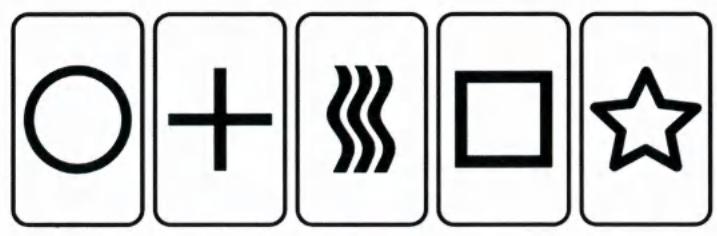
ESP Cards (Zener Cards)
What we call finger reading and non-visual vision was also deeply researched in Europe and the United States, mainly in the Soviet Union, France, and the United States, during the 1950s and 1960s. In the city of Tagil in the Ural region of the Soviet Union, a young woman in her early twenties named Rosa Kuleshova discovered that she could see colors, newspapers, magazines, and books with her fingers. Her hands looked exactly like ordinary people’s, but her performance suggested that she had a second pair of eyes growing on her fingertips. This phenomenon quickly attracted the attention of neuropathologists and psychologists and was called “The Mystery of Tagil” and “The Miracle of Tagil.” Her ability was astonishingly referred to as the “Rosa Kuleshova Phenomenon.” This phenomenon was also discovered in other regions of Europe and America; in France, it was called “supervision capability,” and in the United States, it was called “clairvoyance” or “dermal vision.” This sparked a wave of enthusiasm for clairvoyance in the Soviet Union. During this wave, Rosa performed excessively, and she also could not withstand the pressure of too many people questioning her about cheating. Her behavior and mental state gradually deteriorated, her weight dropped, she felt physically unwell, and she lost her clairvoyance (Soviet and American researchers found that emotional disorders and diseases often caused dermal vision to disappear). Finally, she had to undergo psychiatric treatment.
The Soviet Union also conducted training on more groups of people, including the blind. Scientists would suggest that people first learn to feel two different colors in different combinations—for example, the sticky sensation of red and the smooth sensation of pale blue. Once dermal vision appeared, they could further try to distinguish black and white Western checkers, or categorize cards into red and black groups. Some trainers, if they persisted in training, could reach the level of recognizing pictures with their fingers, reading numbers, and even reading letters under glass plates (some domestic institutions also use similar methods of direct finger perception to train children in blindfolded color distinguishing games). Some parents claimed that with just a few waves of their hands, children could see pictures under carpets, things their fathers hid specifically for them under mattresses, and even things inside safes!
By the mid-1960s, it was said that there were already a considerable number of Soviets with mature dermal vision. At a scientific meeting held in Perm in 1965 by the Ural Branch of the Soviet Psychological Association, S.N. Dobronravov from Sverdlovsk reported that 72% of children had dermal vision potential. “This situation is particularly prominent among children aged 7 to 12.” The scientists attending this meeting unanimously believed that the atmosphere of “fanatical excitement” surrounding clairvoyance was harmful to both the subjects and the research work. They also found that cultivating dermal vision in adult blind people was more difficult than in blind children. Perhaps adults believe that hands simply cannot distinguish objects. Secondly, their long-formed contact sensitivity, and their mental habit of always trying to “figure out” skin texture, hindered the emergence of their dermal vision sensation.
The Soviet Union also conducted a series of experiments and research on children who had had their eyes and optic nerves removed, allowing blind children to distinguish different brightness levels by wearing a lens on their forehead. Scientists also found that some trainees could recognize colors using the skin of their tongue, nose, shoulders, elbows, and stomach. Later, the Soviet Union referred to clairvoyance as “bio-introspection” and speculated that it was an electromagnetic field phenomenon. ①
Scientific research into remote sensing and remote viewing is certainly different from the playful training like “blindfolded reading” found in potential development institutions. Over 100 years after Frederick Myers, who coined the term “remote sensing” in 1882, published picture perception test experiments, the United States conducted a series of studies on remote viewing. Starting from the early 1970s, from the Stanford Research Institute (SRI) at Stanford University to the later Science Applications International Corporation (SAIC), research was conducted for US defense agencies such as the Central Intelligence Agency, Defense Intelligence Agency, Army, Navy, and NASA, until the project stopped in 1994. SRI used 16 years to conduct 154 experiments and 26,000 tests to convince the US government of the existence of remote viewing; the purpose of SAIC’s experiments was not the existence of the phenomenon, but to study how extrasensory perception works ②.
Using remote viewing to obtain intelligence requires little money and involves no risk, especially since some information is simply impossible for spies to acquire, so the US military and intelligence departments are quite interested in it. Sometimes the information perceived through remote viewing is exceptionally accurate, far exceeding general laboratory results. SRI’s laboratory once published a case where they asked a remote viewer to observe “a technical installation within the United States”; the target was a high-energy microwave generator in the Southwest. The remote viewer, who was completely unaware of this target, drew a diagram based on what he saw through remote viewing that closely resembled the microwave generator; he not only described its function and approximate size, and how it was placed in the room, but even correctly noted that it had a 30-degree divergence angle.
An example from the late 1970s is very interesting. A remote viewer was given the latitude and longitude, and he accurately depicted this top-secret facility. He not only accurately stated the internal structure of the facility but even accurately found the password on a document locked in a safe. A very skeptical official heard about this and decided to get to the bottom of it personally. He followed the coordinates on the map, found the location, but only saw “a hillside, a few flocks of sheep, and a lot of sheep dung,” without even a building. Later, he learned the truth: the secret was that deep underground the hillside where the sheep were grazing, there was a military facility.
Regarding remote viewing, The Divine Matrix (by Gregg Braden) provides a detailed introduction to the theoretical assumptions and training methods:
The “Coordinate Project,” abbreviated as SCANATE, is one of the predecessors of the famous remote viewing research at the Stanford Research Center.
Remote viewing seems a bit far-fetched, but it actually has a solid foundation in quantum principles. The success of remote viewing can be attributed to an idea in quantum physics: although things appear solid and far away from us, they exist connected to each other in the form of a unified energy field. For example, when we hold a beautiful seashell in our hands, from a quantum perspective, its energy is omnipresent. Because the seashell does not exist only in this specific position in our hands, it is said to be “non-local.” Experimental evidence has led more and more scientists to accept the view that the universe, planets, and even our bodies are non-local; we have always existed everywhere. Although we appear physically separated from others, we are still able to communicate instantly, which is the principle behind remote viewing.
Remote viewers allow their consciousness to focus freely on a specific coordinate while in the remote viewing state. This coordinate may be in another room of the same building, or on the other side of the world. Experts, when describing the connectivity of the universe in the quantum realm, say: “Describing what happens across the street is just as difficult as describing what happens in the Soviet Union.”
Trainees must undergo up to three years of training before they can carry out secret missions. Details of the US military’s remote viewing projects have only recently been disclosed to the public, describing at least two training methods. The first is called Coordinate Remote Viewing (CRV), where the remote viewer needs to describe details at specific geographic coordinates of latitude and longitude. The second is called Extended Remote Viewing (ERV), which is achieved based on a series of relaxation and meditation techniques.
Although the details of these two methods differ, usually at the beginning, the remote viewer is required to enter a peaceful, relaxed state. In this state, they are more open to receiving sensory impressions of distant targets. During this process, usually another person participates in the role of a monitor, prompting the remote viewer or guiding him to see specific details. Through a series of protocols, the remote viewer can distinguish which impressions are more important for the specific task and then provide further in-depth details. This controlled form of remote viewing, prompted by a monitor, is different from natural dreaming during sleep.
Information obtained via remote viewing had a major impact on the collection of classified information and opened a new era of intelligence, reducing the risk for agents, but remote viewing was terminated in the mid-1990s. These projects had some mysterious code names, such as Project Stargate, and the last project did not officially end until 1995. Although these were designated as “fringe” science and were considered not fully credible by military skeptics, the success of some remote viewing missions was confirmed to be no coincidence. There were even several remote viewing missions that saved many lives.
During the 1991 Gulf War, remote viewers were instructed to search for the locations of enemy missiles hidden in the western desert of Iraq. The remote viewing project successfully located specific missile sites and ruled out the possibility of other locations. The benefits of this psychical research are obvious. By reducing the number of potential weapon hiding sites, vast amounts of time, fuel, and funds were saved, and more importantly, the number of troop casualties was reduced. Remote viewing searches for lethal missiles reduced the risk for soldiers searching for missiles on the ground.
The reason I mention these projects and techniques again is that they successfully demonstrated two keys to help us understand the Divine Matrix. First, these projects indirectly confirmed the existence of the Divine Matrix; when we help people sit on their own sofas yet see real details of distant situations, it shows that something allows our consciousness to travel freely through time and space. Second, the nature of this energy that makes remote viewing possible shows that holographic connectivity seems to be part of us.
In addition to the aforementioned Project Stargate, other psychic projects declassified in the US in the 1990s included “Grill Flame,” “Bluebird,” and “Artichoke.” For example, in September 1979, a military remote viewer was asked to “look at” a building somewhere in the northern Soviet Union. The remote viewer described that a huge, strange submarine seemed to be under intense construction inside this building. The US National Security Council received the report of the results and believed it must be a mistake, because it is impossible to build a submarine inside a building on land more than 100 meters away from water. A few months later, when US spy satellites showed a gigantic submarine never seen before driving from the building through a blasted open channel towards the water, this was the Typhoon-class submarine.
These legendary scientific studies are real, but what needs to be considered is why US psychic research could not be recognized by the mainstream scientific community, and why Project Stargate was terminated in 1995.
Foreign research on psychic abilities is impressive in terms of both time span and the breadth of project content. Their rigorous and open scientific attitude also commands respect. The video Foreign Research on Psychokinesis hopes to bring everyone some reference and inspiration.
Chapter 10 Spiritual High-Dimensional Wisdom Orientation in Potential Development
When primary and secondary school teachers talk with parents, they often say that the child is very smart, but often following this sentence is a “but,” mentioning some of the student’s shortcomings. If a teacher tells the parents that the child has spirituality or a spiritual nature, it indicates that this student is truly valued by the teacher and is really not just smart. What is spirit (Ling)? It is aura, spirituality, inspiration, and wisdom; it is high-dimensional information, the advanced level of life, and an energy form that is difficult to describe. In recent years, “spiritual cultivation” courses in society have quietly become popular. Among them, there is a course that is恰恰 suitable for adolescents and fits well with school knowledge learning: the “Inspiration Learning Method,” which was popular all over China for a time. Its essence is leading students to enlighten their inspiration and connect to high-dimensional wisdom.
10.1 Spirituality and Higher-Dimensional Wisdom
Liu Feng, author of the book Activate Your Higher-Dimensional Wisdom, believes that if one can use every moment of the present to shift their thoughts and elevate themselves, they are living in a state of life that is wholly joyful, entirely residing within the connection to higher-dimensional wisdom. The past and future are purely three-dimensional perceptions; only in the state of the “present” can one connect to higher dimensions. The joy produced by connecting to higher dimensions cannot be replaced by any joy in the material world. In Buddhism, this state of joy is referred to as “Zen Joy” (Chan Yue), “Dharma Joy” (Fa Xi), or “Samadhi Bliss” (San Mei Le), and it has an inevitable relationship with energy.
The external manifestation of a person with high energy is a high degree of freedom and the capacity for tolerance. You feel comfortable when with someone who has high energy because that person’s vibrational frequency can encompass your vibrational frequency. Freedom comes from the elevation of dimensions. Liu Feng says, “The fundamental significance of life lies in elevating the freedom degree of conscious energy, which is the elevation of dimensions.” “One dimension is a projection of two dimensions, two dimensions is a projection of three dimensions, and three dimensions is a projection of four dimensions” (see video Liu Feng on the Dimensions of Life). Therefore, with each additional dimension, the ways we have to solve problems multiply countless times. We live in three-dimensional space-time. Because time is a constant in our space-time, we only have a three-dimensional world where length, width, and height are variables. The three-dimensional world is extremely limited. If time becomes a variable as the fourth dimension, then space-time possesses infinitely many three-dimensional instances. The dimension of an energy wave is far more important than the wave’s own intensity or frequency. Once connected to higher dimensions, information from higher dimensions can be directly downloaded; those who can directly download information are spiritual people. Many successful people say that the basis of their most successful life decisions was not analysis or reasoning, but intuition. “Intuition is information from higher dimensions. All human scientific inventions come from inspiration. In-spiration is information from higher dimensions.”
Liu Feng on the Dimensions of Life
Throughout history, the undoubtedly most spiritual inventor was Nikola Tesla (see video Scientific “Superman” Nikola Tesla). It is well known that very few of Tesla’s design drawings were preserved. This is because he possessed “visualization abilities” and could directly download information from higher dimensions. Tesla said: “I perhaps have to thank my visualization ability for all my inventions. The events of my life and my inventions were presented realistically before my eyes, and every event or invention project was visible. When I was young, I was terrified because I didn’t know what this was. But later, I learned to use this ability as a special talent and gift. I cultivated this ability and guarded it very carefully. I also corrected most of my inventions through this ‘visualization ability’ and completed them in this way. Through ‘visualization ability,’ I can solve complex mathematical formulas in my mind. For this gift I possess, I should be certified as a high lama.”①
Downloading information from higher dimensions often yields only the result, not the process. Just as many children who have undergone potential development can sometimes write answers directly during exams, the child might be able to see the answer directly on a “mental screen,” or perhaps their “spiritual pet” can tell them the answer. Tesla’s greatness lies in the fact that the higher-dimensional information obtained through his “visualization abilities” was all verified through practice. This is because, in addition to the abilities he possessed, it was also related to his interest and persistent pursuit of the highest achievements. The interaction between his consciousness and subconscious (here we can also understand this as higher-dimensional information) enabled him to invent technology that transcended what was being used in his era.
Consciousness arises from our brains, but wisdom exists in a place that is relatively more multi-dimensional than our bodies. We think that bees and spiders have no consciousness, yet bees not only know where flowers are blooming kilometers away but can also build honeycombs with perfect mathematical structures, and spiders can build spider webs that could induce a mathematical revolution. We are now learning to use our own thinking and consciousness to interpret these mathematical models constructed by insects. In the presence of these creatures, we seem rather foolish. Our instincts seem to be limited to eating, sleeping, and reproducing; can we find anything higher than that of animals? Are we really just lower life forms? How can higher-dimensional wisdom be obtained?
We often hear Buddhists chant “Namo Amituofo.” What does this mean? It is a prayer, meaning to download information from higher dimensions. “Namo” is a modern metaphor for downloading from the internet. “A” is ancient Sanskrit, meaning “nothingness” or “without.” “Mituo” means “measure” or “quantity.” “Fo” (Buddha) means “enlightenment.” So “Namo Amituofo” means downloading from the Buddha’s “website” the immeasurable enlightenment, immeasurable light, immeasurable wisdom, immeasurable beauty, immeasurable life, immeasurable fortune, immeasurable joy, and immeasurable happiness!①
This concept of experiencing the divine through spiritual cultivation is universally present in various religions. Jewish mystics use methods like meditation and breath control to pursue a state of selflessness, expecting to enter a realm of union with the divine; Greek Orthodox mystics also believe that those with pure hearts and inner peace can achieve a state of union with the divine; the mystical sect of Islam—Sufism—also advocates achieving spiritual alignment with the Prophet Muhammad through meditation to approach the realm of God; the emphasis of Eastern Buddhism and Taoism on cultivating the mind and nature is even more well-known.
People often say, “In the agricultural age, men were strength, and livestock was wealth. In the industrial age, knowledge was strength, and technology was wealth. In the post-industrial age, information was strength, and connections were wealth. In the information age, information is strength, and vision is wealth. In the current era, belief is strength, and wisdom is wealth. In the future era, state of being is strength, and enlightenment is wealth.” The current situation is that Master’s and Ph.D. students learn the most knowledge, but upon graduation, they do not necessarily possess strength. Many of them are filled with fear of the future, not knowing where they will survive or find a foothold. Facts prove that today, knowledge is not necessarily power. Knowledge is specialized, while wisdom is universal. In the coming era, we should enter spirituality and the spiritual world.
Liu Lianghua, a Ph.D. and professor at the Institute of Educational Science, East China Normal University, believes: In the past, to promote the comprehensive development of people, we always emphasized the “simultaneous development of five domains” (comprehensive development of “morality, intelligence, physical fitness, aesthetics, and labor”). Times are changing, and educational philosophy is also developing. Promoting the healthy development of students’ “soul education” has entered the vision of many education experts. “Soul education,” according to modern educational theory, should belong to the category of psychological education. It aims to coordinate the relationship between students’ physical behavior and their souls, promoting the maximum development of individual potential. The educational effect of the “five domains” manifests externally as “movement,” while the effect of “soul education” manifests as the “tranquility” of the student’s soul. Using “six domains” to guide students’ physical and mental development means to cultivate excellent students who possess “stillness within movement.” The protagonist 1900 in the movie The Legend of 1900 never saw his biological parents and was raised on a steamship. He never set foot on land. During his days drifting at sea, the piano was his only hobby. Although he did not undergo systematic piano study, his entire wisdom was focused on the piano, making his playing technique “miraculous” and allowing us to appreciate the “mysteries” of “soul education.” For the protagonist 1900, the ship was a lonely island, and the coast represented the secular world. On this lonely island, he had no attachments, was not disturbed by secular things in the slightest, had no restlessness at all, and possessed only a slice of inner peace. He entrusted his entire body and mind to the “piano,” and the piano also allowed him to “shine brilliantly.” Turning “five domains” into “six domains” and developing students’ “soul education” does not mean turning students into “bookworms,” but rather liberating them from complex lives so they can truly see their “inner hearts” and walk a learning path suitable for themselves.①
In recent years, “spiritual cultivation” or “body, mind, and spirit” courses have quietly become popular in society, especially among high-level white-collar workers, managers, and others who engage in heavy mental labor. They hope to gain energy and open high-dimensional channels through these courses to obtain inner peace and wisdom. So, where exactly are the higher dimensions?
According to Teacher Liu Feng’s theory, “The exterior is all projection, so what we see is all three-dimensional things; we cannot see things that transcend three dimensions. Only by entering the interior can we internally observe things that transcend three dimensions.” Seeing is using the eyes; observing (Guan) is internal observation, entering our source of projection. In the source of projection, you can see the essence of all images, which we cannot discern from the images themselves. It is like using a light to cast the shadow of our hand on a wall; modifying the image of the hand on the wall is meaningless. Once the hand changes, the image changes. Each of us is inherently complete within, but most people do not ask their internal questions, instead looking for answers in knowledge. When we do not seek answers from within ourselves but from knowledge, we waste many, many opportunities in life to connect with our interior. Every time we connect with our interior, we are connecting with the higher dimensions within. Therefore, those who do not open their internal higher dimensions will become pets and slaves of high technology in the future!
Let’s continue discussing spirituality and spiritual intelligence. Once a person possesses spiritual intelligence, when playing table tennis, the ball flying towards them appears to move very slowly. It is not that the ball has actually slowed down, but rather that the person’s focus, inner peace, and simplicity make it seem slower. In real life, if a scholar is too socially adept, their scholarship is bound to be lacking. It is because they are not adept at social interaction, appearing silly and like a bookworm, that they are able to maintain peace and excel in their scholarship. Conversely, because they are learned but not good at dealing with people, the entire group may live a rather depressed life, so one must grasp this balance and direction. Once a person has too many entanglements, their body loses its spiritual intelligence.
The common characteristic of exceptionally intelligent people like The Legend of 1900 and Rain Man is that they do not have many desires; they are very closed off, even resembling autistic patients. Some autistic children appear unable to do anything, but once an autistic child is smart, it is a level of intelligence that no normal person can match. Why? Because they are peaceful. Only when a person is peaceful can their body possess spirituality and their brain possess spirituality; all spirit comes from the heart. The Legend of 1900 had no name, being called 1900; he had no parents, and though he had a foster father, this foster father eventually passed away. He never went ashore, always drifting at sea; the ship was a lonely island, and the shore represented secular life. He certainly would not be tainted by secular things. All of this allowed 1900 to maintain his spirituality, becoming a prodigy, a pure heart, and an elf, completely free of worldly entanglements.
The Inspiration Learning Method is a curriculum that aligns well with school knowledge learning and can effectively cultivate the spirituality of teenagers.
10.2 Tao Yongdi and the Inspiration Learning Method
In the 1990s, during the Qigong fever era, there was a Qigong method called Ruyi Fitness Qigong, which was practiced by over one hundred thousand people nationwide. In the late 1990s, Ruyi Fitness Qigong was blended with dance, making it more suitable for public practice and fitness, forming the precursor to the square dancing seen in some places today. Ruyi Fitness Qigong, Ruyi Fitness Dance, and Ruyi Wisdom Opening Method (the predecessor of the Tao Learning Method and Inspiration Learning Method) together constituted Ruyi Fitness Science, which was created by Tao Yongdi and took shape in 1996.
Tao Yongdi’s hometown is Shijiayan, located on the southwestern outskirts of Shanghai. This area actually includes three natural villages: Shijiayan, Taogenglang, and Chuanbanglang. The area is inhabited exclusively by the Tao clan family, which has a tradition of practicing martial arts. Tao Yongdi has five siblings; he is the third child, and each of them has their own unique style of Kung Fu.
Tao Yongdi was born on the sixth day of the sixth lunar month in 1952, the Year of the Dragon. After Tao’s mother gave birth to him, she had no breast milk, so he had to be nursed by mothers in the village who had infants to sustain his fragile life. These mothers always had a special fondness for this little life, and everyone said: “This child was raised on the milk of a hundred families.” When he grew to four or five years old and could understand things, a series of extraordinary phenomena appeared on him; he could see things and scenes that others could not, and people called Tao Yongdi “Clairvoyant.” As he grew older, Tao Yongdi’s personality became even more prominent. Many adults and children were willing to be with him, saying: “He seems to have a cohesive force about him, and being with him feels like a feeling never experienced before.” Therefore, in the surrounding villages and schools, Tao Yongdi was already a child who attracted attention.
At the age of 18, Tao Yongdi enlisted in the Chinese People’s Liberation Army, where he was also an outstanding soldier. He participated in military competitions and received seven awards from the army. After returning to civilian life, he entered Shanghai Maritime University as a high-quality student cadre. He later worked in government agencies for a long time, where he was also an excellent national public servant. In June 1996, he resolutely gave up his position to enter the public sphere, engaging in research on human life work and the dissemination of Ruyi Science. Through Ruyi Fitness Science, Tao Yongdi relieved diseases for a vast number of people, and through the Ruyi Wisdom Opening Method, he solved health problems and learning difficulties for countless teenagers and children. The situation at the time is introduced in great detail in the book Ruyi Fitness Science (Urumqi: Xinjiang Juvenile Publishing House, 1999) written by Wang Longcai.
In January 1998, Xu Ziliang, a professor at the Institute of Microelectronic Technology and Quantum Medicine Research Center of Shanghai Jiao Tong University, conducted on-site inspections and tests using technologies and instruments such as a quantum resonance detector on a children’s intelligence development class held by Tao Yongdi in the Shanghai Nanshi area (one wisdom-opening session per afternoon, totaling three sessions). A total of 45 children were tested for changes in IQ and physical condition before and after the wisdom opening. The conclusion of Xu Ziliang’s “Experimental Test Report on Wisdom Opening and Intelligence Increasing of Ruyi Fitness Qigong” shows that after the wisdom opening, the detection and comparison of eight IQ-related indicators such as reading, memory, and pituitary gland in 45 cases of children all showed improvement. The statistical data from the quantum resonance detector indicated that “Ruyi Fitness Science’s method for developing children’s intelligence is scientific, has obvious effects, and no side effects have been observed.” At the same time, the test data also indicated that “this wisdom opening and intelligence increasing method also has a positive effect on improving the physical fitness of children.” This scientific test report further strengthened Tao Yongdi’s belief in his Ruyi Fitness Science, so that even after Qigong dissemination activities were restricted by the general environment, he was able to persist in the potential development of teenagers and children until today.
After the Qigong fever of the late 20th century cooled down drastically, Tao Yongdi devoted himself entirely to the application research and practice of the Ruyi Wisdom Opening Method. Through more than ten years of concentrated study, he enriched and perfected the Ruyi Wisdom Opening Method and Learning Method, which originally only had wisdom opening and writing components, into a systematic course composed of several links: experience, wisdom opening, basic training, brainstorming, entering single subjects, Zen sleep, enhancement training, and cultivation of individual strengths. The aim is to apply “making inspiration routine” to all aspects of learning, work, and life, allowing teenage students not only to have healthy bodies and minds but also to know how to learn and possess spirituality, thereby making greater contributions to social progress.
In October 2013, Liu Minghao, a professional manager engaged in capital operation management, stood out among many business people interested in cooperating with Tao Yongdi. Liu Minghao led his team to establish an education company under the Tao brand with Tao Yongdi in Wuxi, Jiangsu. The Tao Inspiration Learning Method brand was thus determined, and began recruiting franchisees nationwide in March 2014. The Tao franchise promotion meetings can be said to have been booming at every session; of course, what attracted people was the incredible effectiveness of the students’ learning. Some people felt it was simply “Manjusri Bodhisattva and the God of Literature manifesting,” not only the rapid progress in students’ grades but also the highly spiritual progress and achievements of students in writing, foreign languages, music, speech, calligraphy, and other aspects (see video: Sharing by Tao student Mao Shihua and parent). Therefore, the earliest franchisees were not businessmen looking for business opportunities, but parents of these students who had made huge progress. Although the franchise fee was not something ordinary people could afford, with the lowest county-level franchise costing 380,000 RMB.
The Tao Inspiration Learning Method brand instantly ignited into a blaze, lighting up the folk education and training industry. People who smelled business opportunities and dreamed of changing the status quo of their children’s education swarmed to Wuxi Tao. By the end of 2014, nearly 200 institutions nationwide had become Tao franchisees, and the tutors for the Inspiration Learning Method at Tao headquarters exceeded one hundred. During the commercial promotion process, Tao Yongdi quickly discovered that although commercial operation could rapidly increase popularity, the rapidly trained tutors had low energy and could not resonate with Tao Yongdi himself, or even distorted his theories and training methods. Promoters even exaggerated publicity and promises for economic gain, indiscriminately recruiting students and franchisees, leading to a significant lowering of standards during student training, which failed to achieve the expected results. Finally, in the second half of 2015, Tao Yongdi completely broke with Liu Minghao’s commercial operation team. The commercial operation team led the crash-course tutors to set up their own stove, establishing a company under the Three Quotients Education brand. The Three Quotients are IQ (Intelligence Quotient), EQ (Emotional Quotient), and SQ (Spiritual Quotient). However, Wuxi Three Quotients Education collapsed in less than a year. Meanwhile, the tutors trained by franchisees through crash courses mostly either quit or failed to produce training results, and franchisees closed one after another, with very few remaining in the end.
In 2016, Tao Yongdi returned to his own teaching practice, starting another batch of children’s “making inspiration routine” training, allowing more children to improve their bodies, learning, and spirituality.
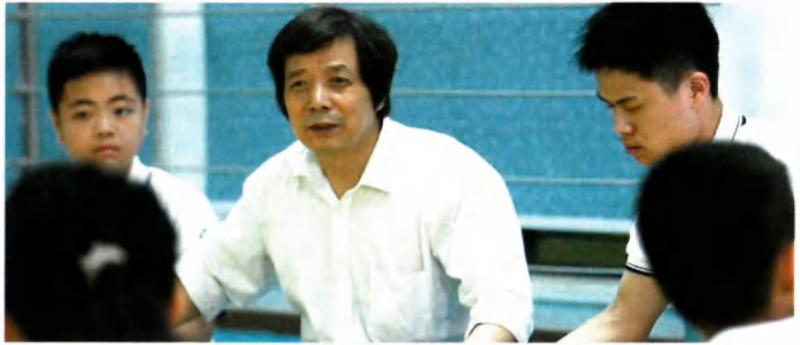
Tao Yongdi (center) boosting energy for students
10.3 Success Stories of the Tao’s Inspirational Learning Method
Since its official promotion in 1996, countless teenagers and children have benefited from the Tao’s Inspirational Learning Method. Below is a selection of cases from which one can understand the training methods, learning effects, and the students’ feelings regarding this method. Among these cases, the first six students participated in the learning program in 1998, and the following reflections were written by their parents or the students themselves after the training①. The later cases are selected from the personal accounts of four students who participated in the training between 2014 and 2016, subsequently published in their own Collections of Poetry and Prose.
Zhang Jing, female, 16 years old, a first-year high school student at Penglai in Shanghai. Before the age of 15, she won the national youth swimming championship multiple times and was a famous young swimming athlete in China. Later, she suffered from severe antral gastritis and gastric ulcers, forcing her to give up swimming with tears. Previously, her academic performance was average, ranking below tenth in the class. After participating in the intelligence development class, her grades improved significantly; she could complete 10 math problems in just 10 minutes. Her speed in reciting Chinese and English texts, as well as doing homework, nearly doubled; test scores for all subjects were above 95, and her class ranking rose to third. But the biggest gain was: her original severe gastric ulcers and antral gastritis, which used to flare up daily with severe pain requiring medication control, had been seen by many famous doctors and treated in many hospitals but were hard to cure, still requiring daily medication. Now, the gastric ulcers and antral gastritis have healed, and she no longer needs to take medicine.
Zheng Junhua, born November 20, 1990. More than two months after birth, due to a high fever, he was taken to the hospital where it was discovered that the infant had hepatitis and required hospitalization. After more than two months of treatment, the illness was cured, but due to the side effects of the medication, his brain was damaged, and he became a mentally disabled child. The liveliness of a naive child calling out to mom and dad and being affectionate with adults was rare; his language expression ability was far behind his peers. His brain reaction was slow, showing signs of dementia. Upon reaching school age, he couldn’t even count 1, 2, 3, 4 clearly. He was rejected by schools as having low intelligence, and his parents couldn’t think of any miracle cure for Zheng Junhua’s difficult condition. The misfortune of life shrouded this family. At a moment of utter helplessness, through the introduction of Lu Bingnan, a colleague of the parents, they signed up Zheng Junhua for the Scientific Intelligence Development and Wisdom Enhancement Class held on January 21, 1998, at No. 166 Donggongyin Street, Nanshi District, with a wait-and-see attitude. After participating in the class, Zheng Junhua became much more lively, his language expression accuracy improved, and he would politely greet guests when they visited the home, completely changing his previous demented appearance. What was even more pleasing was that when his mother called from the factory, he answered every question correctly. His mother asked him on the phone what he had for lunch? After understanding, he answered chicken wings. She asked how many he ate? He answered two. Were there any left in the bowl? There were two more (verified as correct afterwards). What excited the family and relatives even more was: Zheng Junhua started talking to his mom and dad more and even actively asked his parents to talk to him more. Now he can count to 20-something or 30-something. From a child who couldn’t count 1, 2, 3, 4, he has become clever and sensible after the intelligence development, lifting the heavy burden off his parents’ hearts.
Lu Zhifeng, 12 years old, lives at Room 502, No. 26, Tonghe Fourth Village, Baoshan District. Previously, his grades were third from the bottom in the class, which worried his parents and teachers. He couldn’t hold his head up in the class and felt very pessimistic at such a young age. After participating in the intelligence development program, his academic grades have improved significantly, and his reaction speed is faster. Previously, he couldn’t start writing an essay; a composition was at most 200 words, full of typos, and difficult to read through. Now, he improves every time; he can write over 400 words, there are no typos, and it reads smoothly. In this final exam, he achieved good scores of 86 in Chinese and 98 in Math, jumping to third place in the class overall. Moreover, his hyperactivity was also cured; it is simply a miracle! The teacher running the class for intelligence development can even cure diseases; it is truly killing two birds with one stone.
Qian Ying, born in 1986, lives at Room 603, No. 28, Yangguang Third Village, Pudong New Area. My daughter, since starting first grade, had average academic performance due to hyperactivity and lack of concentration. Seeing her daughter’s situation, the parents felt terrible. They led their daughter to seek medical help, hoping to change the bad habit of hyperactivity and improve her grades. Hearing that the founder of Ruyi Fitness Qigong—Teacher Tao Yongdi—was giving a lecture with energy at the Shanghai Gong Stage, combined with scientific intelligence development, which could change bad habits in children, make them smarter, and improve their grades, I took my daughter to the Gong Stage to attend the Scientific Wisdom Enhancement Method lecture with skepticism. Through this session of accepting Teacher Tao’s personal intelligence development on stage, where the teacher input “smart information” into the brains of the children on stage to be stored, and high-speed rotation to activate brain cells, my daughter improved greatly after returning. She does homework much faster than before, and reciting texts and dictating characters are better than in the past. Her grades have improved; at the end of last year, exam scores for all subjects were above 95.
Sun Xia, female, 16 years old, second year of middle school at Douzhuang Middle School, Dongxian Town, Danyang City, Jiangsu. Personally, I felt my reaction was average and my memory was relatively poor; doing homework was very difficult. For school-assigned text recitation, I had to spend a long time. Although I tried my best and worked hard, the content I recited well would be forgotten shortly after. Students are divided into good, medium, and poor; I belonged to the medium-poor category and could only resign myself to fate. Later, I accidentally heard propaganda that there is a scientific intelligence development method in Ruyi Fitness Learning that can develop brain cells and increase wisdom, which is very magical. So, I couldn’t wait to participate in the intelligence development activity personally hosted by Teacher Tao Yongdi. Teacher Tao placed his hand over my head from a distance, turned it gently a few times, and in just that moment, I felt my brain turning inside, and I felt like I was floating. Like other children in the development class, my body swayed back and forth. Following the teacher’s mental guidance: “Heaven and man are one, the mind makes oneself rise to the sky, go into the universe, the brain heats up and rotates, make oneself smart, and grades go up…”, my brain really felt floating, very hot, and rotated faster and faster. I also smelled a very cool mint scent. With just one development session, I can now successfully complete the text recitation tasks assigned by the teacher in just half an hour or even 15 minutes (previously it took over an hour), very fluently and without errors. Doing homework is also much faster than before.
Hua Feijiang, male, 18 years old, a student at Xishan Industrial School. My grades in the class were in the lower middle range, between 60 and 70 points for all subjects; I had never scored above 80. No matter how hard I studied, my grades just wouldn’t go up, which made me very distressed. My dad heard people say that the Scientific Intelligence Development and Wisdom Enhancement Method created and invented by Mr. Tao, the founder of Shanghai Ruyi Fitness Learning, had good results. Moreover, the children in the Wuxi area who participated in the classes saw their grades and IQ go up, becoming smarter than before, and it was being spread everywhere miraculously. Therefore, my dad took me to find the place where the class was held to participate in the intelligence development. After the development, my grades suddenly jumped to the 80-90 range. I was extremely happy. In the past, when I was in class and didn’t understand something, no matter how much I thought about it, it was hard to figure out. Now, I just need to think a little bit to understand it all. My brain’s memory has strengthened, my thinking ability has increased, and the scientific intelligence development has brought out the inspiration in my brain. It has truly benefited me greatly.
My name is Ding Qiqiang, from Zishi Middle School (Grade 7) in Haian County, Nantong City, Jiangsu Province. My previous grades were very poor. Who would have thought that after only a period of training here, my grades slowly improved from the bottom. My family and I never imagined there was such a magical method in the world; this method has helped me a lot.
I remember that previously it took me at least three or four days to memorize a text. I became a thorn in the teacher’s side; I couldn’t recite, made many mistakes, and naturally had many corrections, staying up very late every day. My family was worried sick about this. Added to my love for playing, my family had almost given up hope on me. But since I started using the Tao’s Learning Method, my grades have gotten higher each time. If my previous teachers knew about me now, they would surely find it incredible. I am now using this method to preview the next semester’s curriculum, and my memory has obviously improved a lot. I am so excited.
August 23, 2014
I am a student in the second year of middle school at Taizhou Bilingual School in Zhejiang Province. My name is Huang Sheng, and I am fourteen years old this year. When I came to Tao’s, I was still in the first year of middle school. I originally thought the burden of the tutoring class would be heavy and boring, but after arriving at Tao’s, I was clearly overthinking it. My first experience with the Tao’s Inspirational Learning Method left a deep impression on me. Later, I actively wanted to come to Tao’s to learn, which surprised me. Going to the Wuxi headquarters for intensive training in August this year shocked me even more. Now, I have only studied for five months but achieved extraordinary results. Now, when I get a composition topic, I can write it effortlessly. Learning ancient poetry has become very simple. The Tao’s Inspirational Learning Method has completely conquered me.
I used to be most afraid of memorizing books, but now it’s different; my speed has increased multiple times, and my memory is more profound. I have made progress in every subject this semester, and my class ranking improved by 11 places in the midterm exam.
January 5, 2016
10.4 Basic Principles of the Inspirational Learning Method
China’s greatest scientist, Qian Xuesen, said: “Inspiration is the subconscious; when incubation is mature, it suddenly connects, emerging into consciousness and becoming inspiration.” “This type of thinking often manifests as the sudden flash of inspiration or ideas, or the emergence of insight.” It is “the product of intellectual labor, possessing the distinct characteristics of suddenness, leap, and transience.”
Generally, inspiration is considered a sudden, creative idea that arises during activities in literature, art, science, and technology. It is the state of “sudden enlightenment” that people pursue. Its emergence is random, accidental, and creative, and it is fleeting. However, Tao Yongdi believes that the emergence of inspiration is not accidental, but that a “pipeline” can be established so that, like tap water, it flows continuously as soon as the tap is turned on; this is “the normalization of inspiration.” The establishment of this “pipeline” connecting the source of inspiration is closely related to a person’s energy, virtue, willpower, karma, and the accumulation of information (knowledge). After this “pipeline” is established and unobstructed, a person will not only possess spirituality and wisdom, but their physical health, moral character, and other aspects will also be significantly improved.
Inspiration is a psychological phenomenon in magical innovative activities; it is a function of the human brain and a reflection of objective reality. In 2000, British psychologists Danah Zohar and Ian Marshall proposed the concept and theory of “Spiritual Intelligence Quotient” (SQ)①, which is the best interpretation of Tao Yongdi’s philosophy by Western science.
Spiritual Intelligence Quotient (SQ) is spiritual intelligence, namely Inspirational Intelligence Quotient, which is the ability of inspiration, insight, and intuitive thinking regarding the essence of things. Humans are not as strong as oxen, cannot run as fast as deer, are not as agile as cats, and do not have the sense of smell of dogs, yet relying on their developed brains, they have become the “spirit of all things” dominating the earth. SQ, this mental capital of “the heart’s function is to think,” is an inspirational intelligence based on the principle of innate telepathy. Inspirational intelligence is not the patent of great scientists, great artists, or great inventors; ordinary people have it as long as their brains are normal, it just doesn’t play as large a role as these “experts.” Usually, when someone is said to be very “sharp” or “bright” (lingguang), it refers to inspirational thinking,即 insight. Why can people often come up with quick-witted ideas, remain confident, and adapt to changing situations in emergencies? Why can some people remember everything at a glance and recite it after seeing it once, possessing amazing memory? Eastern sages have long had the famous maxim “See the true nature, attain enlightenment and become a Buddha,” which refers to the role of “SQ.”
What is mainly related to SQ is the right brain. The human brain is composed of two parts: the left brain and the right brain. The left brain mainly governs analysis, abstraction, calculation, language, etc., focusing on the expression pattern of abstract thinking, and is known as the “scientific brain”; the right brain mainly governs imagination, fiction, feeling, creation, etc., focusing on the intuitive image thinking pattern, and is known as the “artistic brain.” Right brain thinking far surpasses left brain thinking in cognitive aspects such as intuitive thinking ability, insight thinking ability, image recognition ability, spatial judgment ability, understanding of complex relationships, and emotional expression ability. This is precisely the argument point for establishing the rich connotation contained in the concept of “SQ.” Those who remain calm, resourceful, and adaptable in emergencies obviously possess higher SQ. There is a proverb: “Reading ten thousand books is not as good as traveling ten thousand miles; traveling ten thousand miles is not as good as observing countless people; observing countless people is not as good as being enlightened by a famous teacher; being enlightened by a famous teacher is not as good as enlightening oneself.” There is also a famous saying in the management world: “Intelligence is more important than knowledge; quality is more important than intelligence; awareness (consciousness) is more important than quality.” Therefore, while strengthening IQ and EQ, we must stand on the high ground of SQ and exercise a high degree of awareness to promote success.①
The main significance of improving “SQ” lies in: First, using the spark of insight from inspirational thinking to propose and solve brand-new topics of significant meaning and innovative value; Second, using the spark of a flash of thought from inspirational thinking to expand image creative planning and predictive research for scientific discovery; Third, using the mental spark of developing right brain potential to complete instant recognition, judgment, and comprehensive evaluation functions that robots cannot replace. This will provide the golden key to open the library of life intelligence for the birth of neurocomputers, the development of immune diagnosis and treatment for neurological diseases, and the establishment of a completely new science of learning and memory.
In fact, SQ refers to a type of intellectual potential, belonging to the category of subconscious energy. Therefore, inspirational thinking often manifests as a subconscious process. Because the thinking process and conceptual movement are neither continuous nor consistent, to a large extent, one can only let it take its course. It is difficult for people to control and guide it, or to find out the ins and outs of the object of thought. However, many scientists, inventors, and artists believe that inspiration appears in a state of temporary relaxation following long-term intense work and contemplation.
Most subconscious activities are scattered, turbulent, multi-causal, and multi-directional. Therefore, if the content of inspiration completed in the subconscious is not seized and firmly grasped by consciousness in time, it may be destroyed or drowned by other activities in the subconscious, never to appear again. To turn the possibility of realizing the content of inspiration in consciousness into a necessity, one needs to improve one’s “SQ.” World potential master Brian Tracy said: “The power of the subconscious is 30,000 times greater than that of the conscious mind.” So some say the ratio of the energy of inspiration, insight, and intuitive thinking to the energy of abstract logical thinking is 100:1. This indicates that the ability to generate creative thinking depends on the stimulation and emergence of inspiration, insight, and intuition. Even philosophers with highly abstract thinking need to combine inspiration with logical language to achieve breakthroughs in their field. Einstein once said: “When I think, I don’t think in language, but in active, leaping images. After this thinking is completed, I have to make a great effort to convert them into language.” Thus, it can be seen that the right brain’s leaping image thinking mode is the source of our innovation ability.①
The working characteristics of the subconscious are: working through images; not distinguishing between true and false; not accepting negative language; reacting quickly to emotions; believing repetition to be true; automatically choosing to seek advantage and avoid harm; generally presenting results directly without a process; easily influenced by stories and metaphors; and having enormous energy. Subconscious thinking is the ultra-high-speed visualization thinking inside the human brain; the speed of subconscious thinking is an instant, operating unknowingly. The subconscious likes to receive commands, not requests. When doing self-suggestion, do not always use vocabulary of request, but use powerful vocabulary to command and affirm.
Through the above discussion, you understand why the Inspirational Learning Method must pass through the right brain’s intuitive image thinking and mental image training, involving a large amount of practice converting images into text-based poetry and articles. From a neuropsychological perspective, its essence is the process of opening up many new neural circuits and reshaping the brain’s nerves through the interaction between the subconscious and consciousness, thereby shaping the spiritual brain neural circuits like those of Qian Xuesen, Einstein, and Nikola Tesla. Regarding its neuropsychological principles, Tao produced an educational film “Inspiration and Potential” in 2015, which is quite scientifically sound.
Tao Educational Documentary: Inspiration and Potential
The training of Tao’s Inspirational Learning Method is essentially the same as other potential development. It involves relaxing and entering a static state to achieve focus, imagination, and internal awakening. In this state, one can let go of excessive left brain thinking. Through the guidance of a tutor, the student knows what they want, has clear goals, and strong desires. In this state, “the whole universe will help him,” which can present various incredible miracles. It is precisely for this reason that many students, after later leaving Tao’s teaching environment, due to various requirements and desires from parents and the environment, seriously disturb the child’s state of “normalized inspiration,” causing the child’s subconscious to return to a scattered and turbulent state, resulting in unstable academic performance until the ability of the Inspirational Learning Method seems to disappear. Therefore, the fundamental reason for the failure of the Inspirational Learning Method or other potential development is basically the desires, greed, and obsession of parents or the individual, which suppress the display of potential. Whenever these are truly let go, the potential can be awakened again.
The Inspirational Learning Method shares much in common with potential development. In Chapter 12, “Linking with School Education,” of the “Right Brain Development Training Manual,” I introduced the Inspirational Learning Method (pages 231~232). The training for the Inspirational Learning Method is not based on ESP (Extra Sensory Perception) such as blindfolded reading, nor does it use crossing. However, children who have experienced potential development such as blindfolded reading find it easier to enter the state and achieve better results. Of course, within the suitable age range, children who are good at the Inspirational Learning Method often find it easier to achieve results when developing other potentials. The Inspirational Learning Method is generally suitable for teenagers and children aged 10 to 18. If the age is too small, the accumulation of literacy, writing, and reading volume is insufficient, and willpower is relatively weak, so it is not suitable for training. The Inspirational Learning Method also has no shortage of people who try it and succeed every time for older people, even the elderly. The simplest requirement is the “Eight-Character Motto”: Simple, Believe, Listen, Do. If you can achieve these eight characters, the learning of the Inspirational Learning Method is 80% successful.
10.5 Basic Training Process and Content of the Inspiration Learning Method
Due to individual differences, it is difficult to standardize the teaching and training of the Inspiration Learning Method. Because the energy gap between instructors and Tao Yongdi is too large, this book only introduces some of the key links and provides detailed guidance and explanations to readers. As mentioned earlier, among the more than 200 franchisees of the Tao Group, it is estimated that only 3% to 5% of students achieve learning results comparable to those of the Tao Group Headquarters. The reason for this is not solely because Tao Yongdi participates in teaching directly, but is more due to reasons of belief and energy. If this method is understood thoroughly and combined with other potential development techniques, and flexibly applied to writing and learning, it will surely benefit students immensely; this is not difficult for potential development instructors.
Tao Education Group Roadshow Video
The entire Inspiration Learning Method course system is very flexible. An overall intuitive understanding and reference regarding its teaching process and the application of various stages can be obtained through the “Tao Education Group Roadshow Video”. In summary, the entire teaching system is very profound and requires readers to comprehend it earnestly.
10.5.1 Opening Wisdom
We arrived above the blue sky and white clouds; the blue sky set off the white clouds, and we saw clusters of clouds floating in the sky. Not far away, a white cloud shaped like a lotus floated towards us. We slowly sat down on it, settled in, and began our journey today. Flying forward, we arrived at a five-star grand hotel. Two stone lions stood at the entrance, appearing particularly majestic. There were also a doorman and a welcome lady at the door. Let’s look at what color clothes the welcome lady is wearing. We slowly stepped into the hotel and, following the waiter’s guidance, arrived at the hotel lobby. Looking at the crystal chandelier on the ceiling, it was crystal clear. Seeing that the lobby was decorated very luxuriously, it was resplendent in gold and jade. Now let’s go to the restaurant and find any empty seat. We sit down. Now we call the waiter to order dishes. Let’s order to our hearts’ content, ordering whatever we want to eat. Order all the things we like, whether we’ve eaten them before or not, filling the whole table. Order sour, sweet, bitter, and spicy dishes. Let’s taste the sour ones first. Is it sour like a lemon? Then taste the sweet ones. Is it sweet like sugar? Then taste the bitter ones. Is it like traditional Chinese medicine, so bitter that we can’t open our mouths? Finally, let’s taste the spicy ones. Like Sichuan hot pot, it’s numbing and spicy, so spicy that our throats are about to smoke. Let’s eat to our hearts’ content. While eating, we vaguely felt a piece of music playing in our ears. It sounded like a wedding march. Turning our heads to look, sure enough, a couple was holding a wedding. The woman was wearing a white wedding dress, looking particularly beautiful. The man was wearing a white suit, looking particularly handsome and energetic. Hey, they seem to be walking towards us. They might have mistaken us for invited guests. Okay, let’s politely raise our wine glasses, accept the blessings of the couple, and also send our blessings to them, wishing the newlyweds a happy marriage and a lifetime together. Okay, that’s done, let’s continue eating. Looking at the table next to us, two men are playing finger-guessing games—two fives, four sixes, and so on. It’s so noisy, particularly clamorous. The atmosphere feels increasingly wrong. I estimate they will be quarreling soon. Hey! Sure enough, they really started fighting. One person threw a punch, and the other picked up a wine bottle and smashed it on the other person, hitting that person on the head. The head was covered in blood, fresh blood flowing profusely. It was all over the face and clothes, bright red. We hurriedly finished eating, called the waiter to pay the bill, and asked how much we consumed. Ask him if he can give a discount. We will pay cash and not use a card. After paying the bill, we walked out of the hotel and continued flying forward. The speed got faster and faster. Soon we arrived at a KTV. This KTV is different from ordinary KTVs; it accommodates tens of thousands of audience members. There is a huge stage in the center of the venue, and many celebrities have held solo concerts here. We slowly walked in. Wow! The audience was extremely enthusiastic, with shouting and cheering, and the noise was deafening. The lights were shining brilliantly, full of colors. We slowly walked onto the stage and walked to the center of the stage. It turns out today is our solo concert. After we walked onto the stage, we greeted and said hello to our fans and the audience. They held glow sticks and shouted our names. We sang a song for them, singing a song we have never sung before…
At this time, a large group of young people walked up from the side of the stage. They were holding flowers and walking towards us to present flowers to us. There were also young people holding our posters asking for autographs, and some even holding T-shirts for us to sign. After we took the flowers and signed our famous names, we gave them a hug to thank them for their support. Okay, let’s continue singing, singing to our hearts’ content, singing with abandon… Due to time constraints, we said goodbye to our fans and audience. After saying goodbye, we walked off the stage, left the concert venue, and continued flying forward.
We came to the paradise again, found the excellent poet from just now, and asked him to help write another ancient poem. The title of the poem is “Cold Plum” (Han Mei). Ask the poet to present the scene. Look clearly at the image: in the deep winter month, white snow is fluttering, and a few plum blossoms are blooming. What color are they? What can be smelled from afar? We ask the poet to infinitely magnify the scene and look carefully. Ask the poet to conceive quickly and write this poem down on paper. We look carefully, seeing every word clearly!… While looking at the scene, let the poet write for you… After writing the first sentence, write the second sentence. Ask the poet to speed up. Ask the poet to speed up. Okay, in a moment, silently count to three in our hearts with the teacher, then we open our eyes, clap our hands, and write down this poem. 1, 2, 3 (Clap). Okay, we pick up the paper and pen and write down the poem from just now.
Generally, for the first “Wisdom Opening” session, including the two segments plus interactions and games, it takes about two hours or more. One to two essays, or a dozen poems, are written. Whether the Wisdom Opening is successful is generally not determined by the quality of the ancient poems or essays. Instead, success is defined by having at least one of the following during the games and writing process: sound, text, or images. If sound, images, and text are all present, it indicates a comprehensive success in Wisdom Opening.
Among the students undergoing Wisdom Opening for the first time, a very small number may not be able to open it immediately. This is very normal. For those who haven’t opened it yet, if the student themselves wishes to continue or we persuade and mobilize them to try once or twice more, they can usually succeed. If we hope for them to continue with Wisdom Opening, the best method is to let such students participate in the writing and poetry sessions of students who have already successfully opened their wisdom, or even play with them. This way, seeing the remarkable growth in writing and poetry of the successful students, the unsuccessful students will naturally believe or even envy them after a few days. Eventually, they will change their previous concepts that hindered the opening and will actively request to undergo the opening. At this time, performing the opening for them becomes very easy.
For students who have successfully opened their wisdom for the first time, the tutor must frequently ask the students during the essay or poetry writing process: Are there sounds? Are there images? Is there text?
If all three are present, it is the optimal state of Wisdom Opening. If one of the three is missing—for example, there is no sound and no text, but the images are particularly clear—that is also excellent. As long as such students persist, one day they will break through to 300~500 poems, and images, sounds, and text will all appear.
Our tutors must especially remember that after the student’s first Wisdom Opening, during the writing or poetry process, if there are no images, sounds, or text, or if they are unclear, timely guidance is needed to convey positive energy and confidence to make the text and images clearer. We must try every means to let the student write while listening to the sound or looking at the images.
10.5.2 Poetry Training and Writing
Writing poetry or essays ultimately aims to enable high-dimensional wisdom (subconscious mind, right brain) to operate automatically, allowing students to write excellent poetry and articles without relying on the conscious mind. Poetry training and writing are the foundational content of the Inspiration Learning Method, also referred to as Initial Training. Generally, it requires 7~15 days of continuous full-time training.
The foundational training segment of the Inspiration Learning Method involves writing a large volume of poems, lyrics, and essays. Through a transition from quantitative to qualitative change, students will reach a state where inspiration flows continuously the moment they see a topic or touch upon a specific scene. This is a necessary step to achieve the “normalization of inspiration.” Children who have undergone right brain potential development generally possess stronger mental imagery capabilities than those who have not, allowing them to quickly grasp the feeling, and even learn to write using Tao’s methods through simple guidance. In the book Right Brain Development Training Manual, the application techniques of using the Inspiration Learning Method to guide students in writing are mentioned repeatedly. Among them, the two exercises in “Writing Essays with the Right Brain: No More Worries About Writing” (pages 226–230) serve as guided scripts that many Tao’s Learning Method instructors enjoy using to guide students in essay writing during experiential sessions. “Exercise 1: Meditation Guidance for Essay Writing” is a classic guide for students learning to write poetry or essays for the first time. Its key points are: first, to further strengthen the student’s mental imagery ability on the basis of having opened their wisdom; second, to let go of the logic, analysis, and judgment of conscious thinking; third, to hand over writing completely to high-dimensional wisdom (or the subconscious mind, right brain, spirit, universe teacher, poet, writer, etc.); and fourth, to be able to clearly see the images, text, and sounds displayed by high-dimensional wisdom, and be able to remember and transcribe them accurately.
In fact, when using Tao’s Inspiration Learning Method, once a student can break through to writing 300~500 poems a day, the teacher only needs to provide some model essays and rules. The student can then automatically write various types of texts, including lyrics, classical Chinese, modern poetry, narrative essays, prose, argumentative essays, novels, etc. When the writing of poetry and essays becomes effortless, with only appropriate guidance, students can then apply Tao’s Learning Method to learn various knowledge and skills.
Sharing of Results
Why use poetry and lyrics to improve students after they have successfully opened their wisdom? After wisdom opening, some children will initially use subjective images, sounds, and text to help with writing essays and poetry. Because the inspiration of these children is still in a primary stage immediately following wisdom opening, in order to gradually clarify and normalize this inspiration, continuous practice and reinforcement are needed to naturally convert subjective images, subjective sounds, and subjective text into intuitive images, intuitive sounds, and intuitive text. Tao Yongdi summarized through practical research: starting with poetry, which belongs to the literary category, is the fastest, most convenient, intuitive, and effective method. He believes there are three main reasons for this:
First, choosing poetry for improvement is because a single line in poetry represents a meaning and a plot. A poem is a short essay, a story. Writing a poem takes only a few minutes, whereas writing an essay takes at least twenty-some minutes. Students improve a little bit with every poem they write. If writing essays, improving a little bit per essay, then how long would two or three essays take? In countless successful cases, we have found that starting with poetry is indeed much better, faster, and more effortless than starting with essays. Even if they start by writing doggerel or nursery rhymes, it doesn’t matter. In our practice, we found that even students who were originally very poor in liberal arts can still succeed as long as they persist with this method (we have not found a single unsuccessful case to date, though the time required is longer than for other children).
Secondly, in the classroom or on-site, the instructor only needs to spend a very short time reading a student’s poem, or even just a line from a poem, to understand whether the student has improved and the extent of that improvement. This allows for timely corresponding guidance and adjustments.
Thirdly, looking back at Chinese history, imperial examinations all tested liberal arts, which are the foundation of all learning. Now, our country is placing increasing importance on liberal arts scoring in the college entrance examination. From an educational perspective, it has also been found that proficiency in liberal arts can drive improvement in other subjects.
The specific course details, procedures, and techniques for the Initial Training of Tao’s Inspiration Learning Method mainly include:
- When writing essays and poetry, frequently ask and understand if students are perceiving sounds, images, or text. If so, require the student to write based on these images, sounds, and text. Initially, it may be intermittent, but it will get better and faster. If there are no sounds, images, or text, the teacher must guide them immediately, transmitting positive energy until there are images, sounds, or text. If that doesn’t work, wisdom opening must be repeated. There are individual cases where there are never sounds, images, or text, but as long as they have inspiration and write very fast and well, it is also considered a successful wisdom opening.
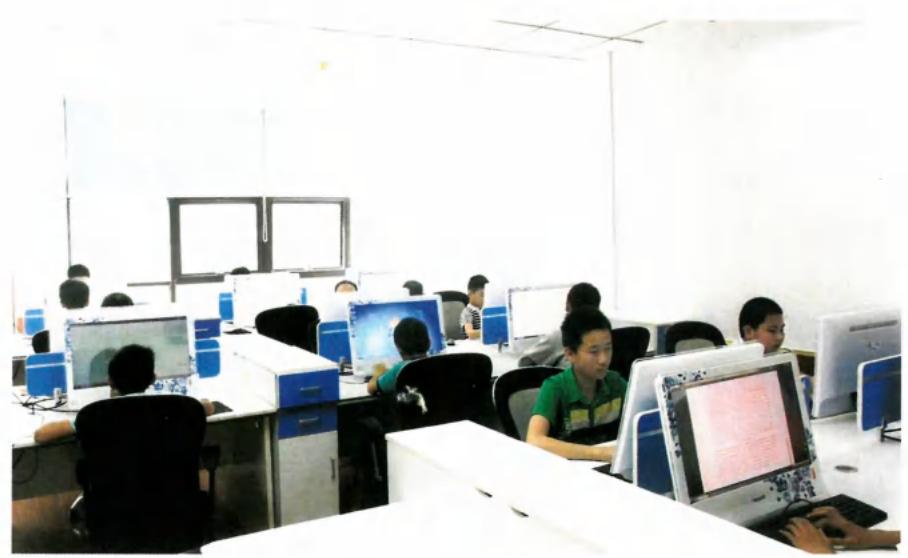
Tao students undergoing poetry training
10.5.3 Brainstorming and Energy Enhancement
-
Have students participate in brainstorming twice a day to transmit energy, improving their ability and quality in writing poetry and essays. The number of poems a student can write daily will undergo a process where quantity increases from few to many and quality improves from low to high. They will also experience the “plateau phenomenon” during the process of change (i.e., reaching a certain stage and stagnating). The quality of poetry generally goes through a developmental process of: nursery rhymes (basically making sentences around the topic), doggerel (basically forming sentences that are relevant to the topic but lack poetic flavor), borrowing poems (poems that plagiarize lines used by predecessors), patchwork poems (it can be seen that the vocabulary used has improved compared to previous stages, and the breadth of thinking is elevating), and imagery poems (reaching a certain depth in both wording and rhyme, capable of divergent thinking based on a topic, reaching another height of poetry).
-
Daily monitoring of the progress and quality of students’ poetry writing is required to discover their improvements, even if they are minute. Frequently encourage and praise them. Since every child is in a different grade, has a different original foundation, different comprehension abilities, and different levels of trust in this learning method, there will be significant differences between children. Therefore, teachers must use different methods and language for each child and cannot adopt a “one size fits all” approach.
-
Assign different amounts of poetry daily based on the progress of different children. Once assigned, the teacher must supervise the student to complete them as much as possible (note that the teacher’s encouragement and companionship are very important at this stage).
-
Only after the student can write 500 or more poems should they proceed to textbooks. Tao’s method has lessons and experience in this regard; doing it based on a timeline of days would lead to serious technical errors. Letting poetry reach a certain quality and quantity before entering textbook lessons is the correct method and the only method. Once poetry reaches a certain volume, the pathway for learning textbook lessons is completely opened up.
10.5.4 Tao’s Inspiration Learning Method Improvement Strategies
- Language Encouragement Enhancement Method
Educational experts and psychological experts all share a common viewpoint: every child needs praise and needs encouragement. The saying “good children are coaxed out (with praise)” is a summary of experience in educating children and encouraging them towards success, and it has long been recognized by everyone. Therefore, when tutors or parents see even the slightest bit of progress in a child—whether in studies or attitude—they must praise them, using phrases such as “You are awesome,” “You have improved,” “You are different now that you’ve learned the Inspiration Learning Method,” “I like this kind of student,” “I like you,” and so on.
Also, for the occasional child who, even after several days, has not yet been able to write poetry or essays, and where no progress in learning is visible, one must still not forget to praise them. Frequently use language such as “Hmm, since coming here to learn the Inspiration Learning Method, what you write has improved, and you have also become more sensible,” “We need to do better, set an example for everyone to see,” etc.
Practice proves that this method of verbal praise and encouragement is very effective and can be used repeatedly.
- Goal Setting Enhancement Method
Teachers must set a target every day based on each student’s writing (prose, classical Chinese, poetry, etc.) ability and progress. This means issuing a task so that students have a direction, a goal, and a small amount of pressure in their studies; pressure is motivation.
The task target must be recorded daily in the “Student Training Daily Summary Form”. The daily summary form includes: the day’s task; completion volume; pass rate; planned volume for tomorrow; and signatures from the student themselves and the teacher.
Upon completion, the specific types and quantities are to be confirmed by the signatures of the student and the tutor.
- Positive Energy Transmission Enhancement Method
Enhancing students’ positive thoughts, positive hearts, positive actions, and positive energy is an extremely effective method for students’ poetry, classical Chinese, prose, composition, mathematics, and physics. It is the essence of Tao’s Education and the core, so the requirements for the tutor’s energy are extremely high.
Transmission method: First, both teacher and student simultaneously enter the state of “Unity of Heaven and Humanity” (Tian Ren He Yi), eyes slightly closed, whole body relaxed. Then, the teacher transmits positive energy to enhance the student’s various abilities by placing hands on the student’s shoulders or shaking hands. Using this method requires both teacher and student to enter the state of Unity of Heaven and Humanity simultaneously; it is especially crucial for the student to enter the state. The requirement for the teacher is that their positive thoughts, positive heart, positive actions, and positive energy—i.e., their human physical bio-energy field—must reach above 1000 (this physical bio-energy field is a technical standard researched by Tao Yongdi).
When shaking hands or placing hands on shoulders, the teacher thinks of transmitting positive energy to the student, and the student must think of receiving positive energy. During the entire process, the student may experience slight headaches, head distention, or dizziness; all of this is a good phenomenon, indicating it is effective. Using “handshake and shoulder-touch to transmit positive energy” is a good method to enhance student abilities.
- Brainstorming Enhancement Method
At Tao’s Headquarters, we almost organize student brainstorming sessions every day at noon, afternoon, or evening, usually for no more than twenty minutes. When students are seated in a circle, the teacher states: relax, relax, empty, empty, rise up. Below, you can connect with the teacher, or connect with Teacher Tao. Regardless of which teacher it is, it serves as a necessary psychological suggestion for the student, making the student feel that there is a tangible teacher, allowing the student in this state to directly ask the teacher for positive energy and for knowledge in subjects like Chinese, Mathematics, Geography, etc.
It is best to have a set time, a set place (preferably in the Wisdom Opening Room), and a designated teacher to conduct the brainstorming. Practice has proven that the “Brainstorming Enhancement Method” has excellent results for improving students.
- Sitting Meditation Method
Whether at school or at home, students use the sitting meditation method to consolidate and enhance the results of wisdom opening.
Before sleep every day (if at home, parents are required to accompany), spend about 7 minutes in bed to mentally review the subjects taught by the teacher that day, such as Chinese, Mathematics, Physics, Chemistry, Geography, etc. Read English vocabulary twice and recite texts twice.
The next morning after waking up (do the same), repeat the review process from the night before to master the learned knowledge again.
On Saturdays and Sundays, use the mornings and evenings to review the week’s learned courses in the brain according to the previous requirements. Practice proves this method is very helpful for students.
- Copying Enhancement Method
The source for “copying” should be selected from excellent students who use the Inspiration Learning Method. They should not only write modern poetry and classical Chinese well but also write modern compositions well; their performance in Mathematics, English, Chinese, Geography, Science, and other subjects should also be outstanding. At the same time, exam results must confirm that their grades are indeed very good.
When students “copy”: whether it is the student receiving the “copy” or the “copying” source, both must enter the state of Unity of Heaven and Humanity, relax the whole body, rise into the universe, and perform “copying.” Whatever the other person needs, “copy” that to them. For example, if they need Mathematics or Chinese, then you “copy” Mathematics or Chinese to them.
Taking “copying” a foreign language as an example: the original “copying” student must package the pronunciation, phonetics, language sense, grammar, translation, etc., needed by the receiving student into a “file package” and “copy” it over. The receiving student then copies the entire knowledge inside the “file package.” After doing this continuously several times or for a few days, significant results will be seen. The effect is even better and faster for copied poetry, classical Chinese, and literature.
- Order Download Enhancement Method
For students who can already write more than 500 poems a day, after entering the state of Unity of Heaven and Humanity, they link with the teacher and place an “order” with the teacher for subjects such as Mathematics, Composition, Poetry, Classical Chinese, Foreign Languages, History, etc. After silently chanting thank you, gratitude, I love you, they begin to download (using praise language, from a psychological perspective, can establish a very good mindset). Generally, download twice to three times in one go. For the download requirement, think it over thoroughly in the brain several times, and you will definitely receive good results.
- Special Training Zen Meditation and Zen Sleep Enhancement Method
Zen is the best state and highest realm of entering meditation (Ding), but truly remaining motionless for hours after entering Zen meditation is something only a few people can do. However, sleep is something everyone can do. Tao’s Zen Sleep requires entering a state of sleep for days or even ten-odd days while in the state of Unity of Heaven and Humanity and in the form of Zen.
When students undergo Zen Sleep special training, they make their mood particularly joyful and silently chant gratitude words: I am grateful to you, I thank you, I love you (using praise language, from a psychological perspective, can establish a very good mindset). They place an “order”—this “order” is the subjects desired, i.e., Chinese, Mathematics, English, Physics, Chemistry, etc.—and merge them with their own brain. Then, they think about and review each subject item by item. Repeating this process of placing “orders” repeatedly will make the effect even better. Zen Sleep will make people feel physically weak and the head somewhat groggy; this is a good phenomenon, indicating that various knowledge and abilities are effectively and continuously entering our head and whole body. Persisting like this for several days or even nearly ten days will yield great results.
The Zen Meditation and Zen Sleep Enhancement Method can be said to be the most effective method among numerous enhancement methods.
- Textbook Knowledge Input Method
The Textbook Knowledge Input Method is also something we discovered from practice, and it is more intuitive.
First, relax the whole body, close eyes slightly, and enter the state of Unity of Heaven and Humanity. Then sit on the bed or on the floor, holding books for subjects such as Chinese, Mathematics, English, Physics, Chemistry, etc., to meditate. Then silently think in your heart words of praise such as I love you, I am grateful to you, I like you (using praise language, from a psychological perspective, can establish a very good mindset). Then make the book glow, and finally “input” each subject item from the books into your own brain. Input once, flip through the book once, understand once. You need to “input” and flip through several times until you fully understand it. Practice proves this method is also a very good method.
- Top Student Implantation Method
The Top Student Implantation Method is also a good method discovered by our Tao’s practice to enhance students’ learning abilities and grades.
Method: Relax the whole body, close eyes slightly, enter the state of Unity of Heaven and Humanity, then sit on the bed, floor, or chair. Primary school students think of the student with the best grades in their own school. During meditation, use I am grateful to you, I thank you, I like you (using praise language, from a psychological perspective, can establish a very good mindset). Then visualize all their subjects and knowledge being “implanted” into your own brain (when “implanting,” you will generally feel a “knowledge package” coming to the brain; during “implantation,” you will feel head distention, dizziness, head numbness, etc.). After “implantation” is complete, it will stop automatically. This can be repeated several times. After “implantation,” you need to decompress the top student’s “knowledge package,” then merge subjects such as Chinese, Mathematics, English, Physics, Chemistry, etc., with your own brain, and think about and review each subject item by item. Repeating this several times yields excellent results.
- Method for Normalizing the Application of Inspiration
After students have studied the Taoist Inspiration Learning Method for over ten days, although there will be many astonishing results, these results are not yet very stable, like a toddler learning to speak or stumbling while learning to walk; they still need to be continuously strengthened, exercised, and consolidated.
The most effective method is to conduct retraining and improvement training at the school every Saturday and Sunday within six months. Within six months, they should write five poems or an article of several hundred words at home every day, and it must be written in a state of “Unity of Heaven and Humanity.” Practice has proven that this is an effective method that allows students to maintain a normalized state of inspiration, and it is also an effective method for improving academic performance (the poems students write every night should be sent to the school daily so that the school can supervise them).
- The Book Publishing Encouragement Method
When students’ articles are published into books, the tutors must give this great importance. In the mind of every student, publishing a book is a sacred, proud, and honorable matter; it is a display of their own achievements. In the past, publishing books was the domain of literati, writers, and celebrities; it was their exclusive preserve. But today, they have published a book themselves and have entered the ranks of writers.
There are several major benefits for students publishing books:
① It can greatly stimulate their writing ability and enhance their enthusiasm, interest, and self-consciousness.
② It can consciously change students’ various bad behaviors and habits. They feel that they are writers, and they will strictly demand of themselves in every aspect of their behavior and conduct.
③ It will greatly stimulate their interest in other subjects and play a positive role in promoting the learning and improvement of other subjects.
④ It is a report of results to parents and society, and it can further gain parents’ recognition of our training school.
Taoist Library has tens of thousands of collections of poetry and prose written by students
10.6 Reflections on the Taoist Inspiration Learning Method
The purpose of the Inspiration Learning Method is to enable people to possess the ability of “normalized inspiration” and to learn in a state of inspiration. This method exactly corresponds to the “Spiritual Education” (Ling Yu) within the “Six Educations” proposed by Dr. Liu Lianghua. Spiritual education requires students to learn “tranquility,” thereby combining it with current educational activities which involve much “brain work.” Only then can children return to their true nature and possess spirituality, spiritual intelligence, and inspiration. Obviously, spirituality, spiritual intelligence, and inspiration are different from things at the level of knowledge and skills, and seemingly do not belong to the literacy aspects of ability, emotional attitude, or values. Below, I will share a few scattered thoughts on the Inspiration Learning Method (Taoist Learning Method), hoping to be helpful to friends interested in this learning method.
- Enrollment Restrictions for the Taoist Inspiration Learning Method
In order to protect the Taoist reputation and guarantee teaching quality, after 2016, the Taoist Headquarters began to strictly restrict the enrollment of students. Clear instructions were given regarding conditions not accepted for trial experiences: those below fourth grade (except those who are extremely smart) are not accepted for trials; those with ADHD or who do not want to learn are not accepted for trials; those with intellectual disabilities are not accepted for trials; those in the bottom three of the class are not accepted for trials; those who do not believe are not accepted for trials.
Previously, when recruiting students, as long as the parents were willing to learn, Taoist did not refuse. In the earliest era of the Ruyi Kai Zhi Method (Ruyi Wisdom Opening Method), the teaching teachers were generally taught personally by Tao Yongdi or by excellent Ruyi Qigong masters. According to Tao Yongdi’s requirements for energy, these Qigong masters all possessed relatively high energy. Most importantly, people’s thoughts were relatively ignorant and simple at that time, without the high activity and collision of thoughts in today’s era of information explosion. The expectations and importance placed on children’s academic performance were also far from being the only pursuit of parents as they are today. Due to the mindset of parents at that time, it was easy to see children’s progress and changes in certain areas, thus making it easier to be content. In that period, some children with intellectual problems, and even children with cerebral palsy, saw great improvement under Tao Yongdi’s care, and parents often felt a sense of gratitude from the bottom of their hearts.
The situation often seen today is that some children can go from failing to passing, and from passing to 70 or 80 points through the Inspiration Learning Method. When the student does not advance beyond 90 points, the parents become seriously dissatisfied. Even if the grades satisfy the parents, some parents will still find things they are not satisfied with. In fact, not only is the Inspiration Learning Method like this, but many educational institutions, even schools in compulsory education, also have this situation. the unremitting efforts of educators can never satisfy the constantly and rapidly increasing desires of parents.
From Taoist’s perspective, this shift began after Tao Yongdi and the operations team formed a company. The Taoist Inspiration Learning Method, Taoist Learning Method, Yuanhang Education, Quantum Learning Method, etc., are essentially the same thing. The constantly changing names are just to make parents feel that what their children are learning is very high-tech and very high-end. The core goal of the operations team must be the maximization of profit. Driven by profit, it is unknown whether Tao Yongdi’s educational philosophy still has the ability to influence employees.
Turning education into an exchange of interests between the educator and the parent makes it very difficult for the relationship to be equal. Because the object of education is people, and people are not simple objects. Academic performance is just an external representation; without establishing a core outlook on life, worldview, and values, one cannot only work on the representation. The establishment of principles and stances in being a person is extremely susceptible to the influence of parents and the environment. How do people and money exchange? No matter who it is, it is difficult to balance this transaction. Taoist can only continuously narrow the entrance of its student source to cater to the needs of society.
- Guarantees for the Success of Inspiration Learning Method Training
In the successful cases of the Taoist Inspiration Learning Method, many students describe that they participated in the experience with emotions and doubts before they believed. Disbelief is the biggest obstacle to the Inspiration Learning Method. Judgment is left-brain thinking and is thinking at the conscious level. If the result of the left brain’s judgment is “do not accept,” then all the teacher’s guidance will only spin in the neural circuits of the conscious level. Information can never enter the subconscious mind. If the subconscious mind is not mobilized, one cannot enter a state of inspiration, and the Inspiration Learning Method cannot be truly mastered. Some people question but are willing to understand and explore, which opens the “door of belief” by half. As long as the information can begin to mobilize the subconscious mind, the Inspiration Learning Method can be used skillfully after hard training. Therefore, the first barrier to whether the training of the Inspiration Learning Method can succeed is “belief.”
The quality of poems written by students in the Inspiration Learning Method poetry training has stage changes (generally experiencing five stages: Baby Poems, Doggerel, Borrowed Poems, Patchwork Poems, and Imagery Poems). Even at the highest stage, after the poetry training is completed, although ordinary people feel that the students’ poems already have good imagery and charm, if “experts” look at them, they will still be full of holes and unbearable for review. The reason is simple: few tutors of the Inspiration Learning Method truly understand the strict rules of ancient poetry, and they generally do not pay too much attention to norms during teaching. If “experts” use appropriate methods to give students encouragement and guidance, after training, students can quickly adjust to a standardized poetry style. If “experts” give harsh criticism to the students’ work, the students’ application of the Inspiration Learning Method will often be hit. If students are frequently judged, the application of the Inspiration Learning Method may gradually fail, which is related to the subconscious mind not accepting negative language. Therefore, if there is too much judgment in the students’ learning and living environment, the training of the Inspiration Learning Method may fail.
Whether students possess the willful quality of persistence is the key to being able to use the Inspiration Learning Method well for a long time. Most students can happily complete the basic training stage, but after mastering the basic method, they need a few minutes every day to use and consolidate it to form a habit. As well as trying to undergo a longer period of retraining every semester to further improve and consolidate. For most students for whom the Inspiration Learning Method eventually fails, the problem often lies in the inability to persist and form habits. Therefore, persistence is a person’s most excellent quality and an essential quality for success.
Whether the training of the Inspiration Learning Method fails is also related to whether the student’s beliefs are firm. In today’s information society, there are too many信息和 temptations. Electronic media such as TV, mobile phones, and computers are more attractive than introspection and self-reflection, easily “controlling” people with wavering beliefs, making it difficult to extricate themselves. Over time, the training of the Inspiration Learning Method may result in “complete loss of martial arts.” Also, most parents and teachers today focus their thoughts entirely on scores. This situation determines that many people are in a very low dimension of thought and do not give children sufficient space for free thinking. The children educated in this way find it difficult to think and apply in a high-dimensional state. Therefore, what kind of worldview, outlook on life, and values the student forms, and what kind of person they become, is crucial and is the core of education.
The Northern Song Dynasty poet Wang Anshi had a prose piece “The Lament for Zhongyong” (Shang Zhongyong), which tells of Fang Zhongyong being able to write poems on any designated topic at the age of five. When he grew up, this talent disappeared and he was no different from ordinary people. The reason was the parents’ greed and short-sightedness for fame and fortune. This is where the values and worldview of the adults interfered with the child, causing the child to lose the opportunity to study and grow in accordance with the trend, and killing the development of natural talent. To let children make good use of the Inspiration Learning Method, parents must not educate with self-righteousness, but must have wisdom, right thoughts, and learn and grow. This is the top priority for keeping children’s inspiration always present.
- Where Does the Information Come From?
Fang Zhongyong, from the story “The Pitfalls of Being a Prodigy” (Shang Zhongyong), was born into a peasant family. When Zhongyong was five years old, he did not recognize the brush, ink, paper, or inkstone. One day, suddenly, Zhongyong cried and asked for these things. His father was surprised and borrowed them from a neighbor to give to him. Zhongyong immediately wrote a four-line poem with the theme of caring for parents and uniting the clan, and signed his name. Fang Zhongyong had never attended school, so how could he write characters and compose poetry? This ability he possessed in his childhood makes us all feel incredible. Some Tao’s students, after an hour or two of learning, go from not knowing how to write poetry to being able to write excellent rhyming verse, and from hating writing essays to falling in love with writing; after a period of learning, they can suddenly use a brush to write calligraphy with outstanding personality, and sing like a professional singer using their voice with ease. Is this a case of being possessed by a mysterious force? Or is there really a “Teacher of the Universe” instructing them?
The previous section, “Basic Principles of Latent Sensation Learning,” introduced Tao’s understanding. Through cognition that is widely accepted today, this is understood as mobilizing the human subconscious; all information is the result of subconscious operation. Students write poems and articles; some are titled “Jiangnan,” but the students have never been to Jiangnan; they write “Winter Sweet,” but the students have never seen winter sweet flowers. How did they write them? Text contains rich energy. When we see characters we don’t recognize, nine times out of ten we can still know their approximate meaning. In the “Right Brain Development Training Manual” (page 3), I introduced the case of student Tianyi gaining different information by touching two slips of paper with the same character written on them, illustrating that text itself contains abundant information. Through a certain accumulation of knowledge, combined with mobilizing subconscious energy, students can discover more information from text. The accumulation of knowledge is not necessarily limited to what teachers teach in the classroom or what is in textbooks; it could also be things heard from others, seen in movies, TV, or extra-curricular books, or even outdoor advertisements and pictorials. Even their own wild thoughts and dreams leave traces in the subconscious, becoming part of the accumulation of knowledge. Once this information is needed, it is possible for it to be discovered, activated, mobilized, and integrated by the energy of the subconscious.
Therefore, the result we generally see is that once children with excellent academic performance in school can accept the Inspiration Learning Method, the results achieved will be even better.
- Students Work Hard but Are Happy
According to Tao Yongdi’s requirements, in the later stages of basic training, students must be able to write 500 ancient poems daily. Calculating based on the five-character quatrain (the shortest in terms of character count), not counting the titles, that is 12,500 characters (we can try copying or inputting the same number of characters in ancient poems via computer to see what it feels like). The students’ inspiration gushes forth endlessly. Although it is hard work, the students do not feel tired; instead, they feel very joyful, confident, and peaceful. Why? In the state of inspiration, it is a high-dimensional state, and in this state, the mood is exactly like this. Let’s give an example: if you tie a knot in a very long rope and you only see this knot, what is your feeling? (A knot, messy and hard to unravel). This knot is the present moment. A person who can only see this knot in a state of low energy and low dimension will feel very entangled and distressed. With slightly higher energy and some wisdom, one can see the whole rope; this knot is just a part of the rope, and knowing there is still a long section behind it, the knot will not make one feel entangled or distressed. In a high-dimensional state, one can see the rope and the knot from more angles, and can even see the beauty of the knot. In a high-dimensional state, the entire universe can be seen wherever one wishes, however one wishes to look at it, and the heart feels incomparably joyful.
However, it must be noted that having high-dimensional wisdom alone cannot change one’s destiny. Just like Fang Zhongyong, to control one’s destiny, one must firm up one’s beliefs and make unremitting efforts for one’s dreams; this can only be achieved through technology, knowledge, and skills.
- The State of Spirituality
On the bottom of the box for Shenzhen University’s 2018 admission letter, a sentence was printed: “Only when emptied can one hold greater dreams.” This sentence is also the foundation of the Inspiration Learning Method and potential development. The essence of potential development is focus, imagination, and introspection. The basic operation to enter this state is the relaxation and emptying of body and mind. In Tao Yongdi’s wisdom-opening guidance, “Relaxation, Emptiness, Ascension” is extremely important. Only when the body is relaxed can one let go of consciousness and empty the mind; only by “ascending into the universe” can one mobilize the huge energy of the subconscious. It can also be said that only when one is relaxed and empty does one enter a state of stillness, or a state of “Ding” (meditative stabilization). This state appears to have great similarities with the states of Yoga, sitting in meditation, meditation, Qigong, hypnosis, spiritual practice, and Zen.
The generation of inspiration is conditional. Generally, it occurs when the mind is relatively quiet and unconscious, for example, in dreams or while practicing Qigong. The reason it happens mostly in these situations is that at this time, the person has entered a state of high stillness, and other conscious information and noise are generally shielded outside the gate of the mind. Thus, microscopic and weaker information is manifested, allowing one to become aware of it.
This is identical to the essence of spiritual education in the “Six Educations” discussed by Liu Lianghua; both require teachers and students to learn how to acquire spirituality and wisdom in tranquility. Because “Only after a person is quiet can their body possess spirituality, their brain possess spirituality; all spirit comes from the heart.” Nowadays, students rarely have time to enter a state of tranquility; almost all their time is spent in “movement,” busy writing homework and brushing up on questions, feeling that only this way can they cope with exams.
If you want your child to have a little more spirituality, let them learn to look up at the starry sky, gaze, zone out, and sit quietly, and give them a little time to do these things. Once they enter a state of tranquility, they will possess a greater world.
- Similarities and Differences with Super Learning
In the 1980s and 1990s, a large number of educators in our country paid attention to, researched, and practiced Super Learning. The magical effects produced by Super Learning and Tao’s Inspiration Learning Method can be said to be on par. Among the Slavs in regions like Poland, the Czech Republic, Serbia, and Bulgaria, there are many people with psychic abilities and other superpowers. It is unknown if this is related, but Dr. Georgi Lozanov (also translated as Lozanov, Lazanov, Lozainov, etc.), who was born and raised in Bulgaria, created Super Learning in the 1960s and 1970s. Later, it was further perfected by people like Johannes Schultz in France and Alfonso Caycedo in Spain. This learning method quickly attracted the attention and practice of psychology and education researchers in the Soviet Union, the United States, Canada, Western Europe, and other regions. Some people believe that the foundation of this method lies in the use of neurology, psychology, and Qigong.
It is said that Super Learning can increase learning efficiency by up to 50 times, improve memory, and does not require straining the brain during study. This method is equally effective for those with low or high intelligence, for the young or the old, and does not require adding special teaching equipment. People who participated in the experiments could master a foreign language within a month and learn a semester’s history curriculum within a few weeks. Moreover, during the learning process, their health was balanced, and their sparks of creativity and intuition were ignited. ①
The procedure for Super Learning is: ① Concentration in relaxation, relaxing to classical music at sixty beats per minute (mainly Baroque style works by Bach, Handel, etc.) (methods include breathing exercises, body relaxation, and psychological relaxation), then concentrating attention; ② Calming the brain to imagine, fantasizing that you have arrived at a place with beautiful scenery and that your mood is well stimulated; ③ Strengthening suggestions affirming learning efficiency, mentally suggesting like practicing Qigong that your memory is very strong and the learning task can definitely be completed; ④ Intervals for textbook input, with the teacher pausing for ten seconds between reading new words; ⑤ Changing the teacher’s tone, alternating between normal tone, soft whisper, and loud commands; ⑥ Rhythmic breathing, in rhythm with the text being read. This learning method aims to fully mobilize the left and right hemispheres of the brain to work in coordination. The key is the relaxation of all parts of the body, so that the heartbeat and brainwaves achieve a rhythm synchronized with the music.
It can be seen that Super Learning and Tao’s Inspiration Learning Method have many similarities and some differences. I have made the following simple comparison:
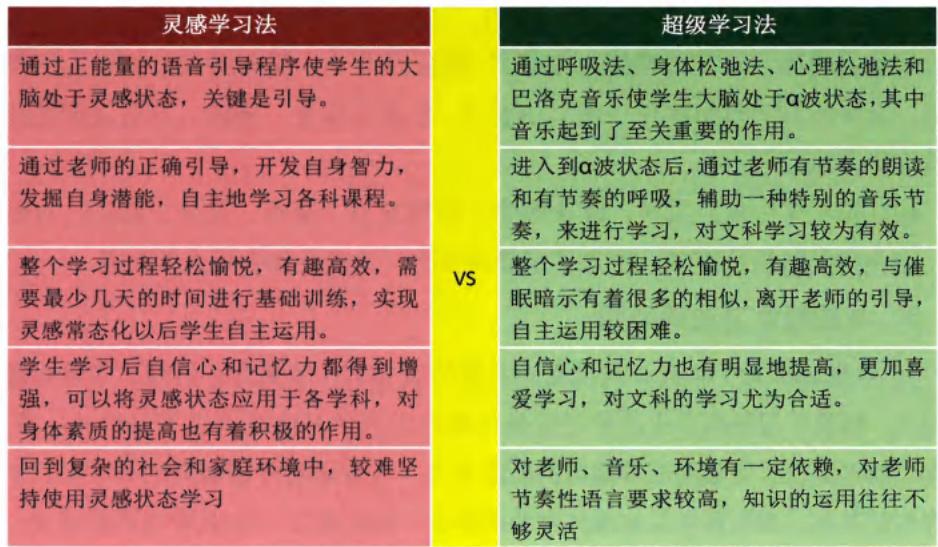
In the 1980s and 1990s, there were many applied research results based on Super Learning in China. The most prominent among them were the research results of Liu Shanxun, a researcher and graduate supervisor at the Institute of Psychology of the Chinese Academy of Sciences: “6S Super Learning Strategies” and “Strategies for Optimizing Learning Segments.” These results became promotion projects for the “Ninth Five-Year” and “Tenth Five-Year” plans of the National Education Science Planning of the Ministry of Education. For the application of the Inspiration Learning Method, one can combine some methods and techniques of Super Learning to perfect it and allow students to achieve better results.
- The Reputation of Tao’s Inspiration Learning Method
Before 2013, information about the Inspiration Learning Method was almost impossible to find in various media. After the operations team began adopting a franchise policy in 2014, Tao’s students flocked in, and franchisees sprang up everywhere across the country. By October of that year, Baidu search results for the keyword “Inspiration Learning Method” exceeded 130,000. Among these results, there was promotional information from Tao’s headquarters operations team and franchisees, as well as discussions on Tiebas and forums. In the initial information, negative comments were prevalent, with words like “fake,” “scam,” “hype,” and “ineffective” appearing frequently. The reason for this, as mentioned earlier, is that some students indeed failed to improve their grades. At that time, the price of Tao’s Inspiration Learning Method was 19,800 yuan (the price increased to 29,800 yuan after 2018), with free retraining unlimited times within a year. This price was basically the highest one-time fee in the training industry in 2014. There is a saying in business that “those who lose money scream the loudest.” When parents’ gaze remains stuck on the low-dimensional mindset of using money as the sole standard for measuring things, the result of their judgment can only be that they “lost big.” Those who benefit, on the other hand, tend to be more low-key; feeling that they have gained something, they pay no heed to what others say. Therefore, the more money people make, the more low-key they generally are; this is a typical way of thinking. In fact, based on my personal observations, students who felt they benefited or felt relatively positive about it still constituted an overwhelming majority at the time.
Starting from 2015, as the number of Tao’s veteran students continued to increase, aiming at the online doubts and denunciations, these students began to come forward to share their personal experiences and feelings to set the record straight. Franchisees also began to gradually break away from Tao, establishing their own independent ventures and creating various brands. Although it was difficult to achieve the teaching effectiveness of Tao’s highest level, it was not difficult to use the Inspiration Learning Method alone to improve students’ writing levels. The publicity of franchisees in various places was no longer as mysteriously exaggerated and far-fetched as it was at the beginning, thereby avoiding the verbal attacks and criticism from various media.
Tao’s reputation still needs to be accumulated gradually through strength. The saying “True gold fears no fire in the red furnace; good wine needs no bush” remains applicable for educators.
Chapter 11: How to Implement Potential Development Education
Potential development education is an important aspect of the application of potential development. After 2010, the potential development training market developed extremely rapidly, but the overall development did not appear orderly. It is estimated that by the end of 2019, there were already over 10,000 institutions nationwide engaged in potential development work, with a total of over 100,000 practitioners having participated in the field. Of course, potential development education includes various names; here, it encompasses all potential function-type projects such as blindfolded reading, photographic memory, wave speed reading, special functions, and intelligence activation devices (a type of headset). Institutions of various brands emerged one after another, each harboring different motives and a wide variety of doubts, presenting potential development in a myriad of forms. More institutions went from establishment to closure in less than two years. Although all claimed to be doing “education,” neither the practitioners nor the parents knew where the direction lay or what the ultimate harvest would be.
11.1 What is Education
Around 2007, the earliest potential development training market in mainland China was ignited by Taiwanese people using commercial methods. They told parents they could turn their children into “supermen,” told franchisees they could make big money, and told friends they were conducting an education revolution. Because the technical barrier was extremely low, with almost no requirements for counselors in terms of knowledge, academic degree, or physical condition, as long as one had affinity and could achieve “belief,” one could basically complete onboarding training within two days and become a counselor capable of developing children’s potential. The earliest people engaged in this industry came from all walks of life: high-level executives from group companies, owners of private enterprises, barefoot doctors, barbers, chefs, salespeople, and employees of various enterprises and public institutions. There were even some migrant workers who hadn’t graduated from junior high school but had traveled extensively across the country. They all possessed a certain passion for education or a dream of being a teacher. This kind of magical and fantastical technique, once linked with education, easily makes people’s thoughts run wild. Such reverie made these people with educational feelings feel a sense of mission arise spontaneously, and they advanced wave upon wave to begin the great cause of potential development education. I think we should first consider whether potential development is education or training? What is the difference between education and training?
What is education? In the concept of most people, learning cultural knowledge, learning skills and techniques, and learning is being educated. In fact, the connotation of the word “education” is very rich, and education is certainly not only at the level of technology, skills, and knowledge. The “Education Law of the People’s Republic of China” stipulates: Education shall adhere to fostering virtue through education, strengthen the education of socialist core values for the educated, enhance the educated’s sense of social responsibility, innovative spirit, and practical ability; and cultivate socialist builders and successors who are fully developed in morality, intelligence, physical fitness, and aesthetics. Xi Jinping stated regarding education that “the most fundamental thing is to fully implement the Party’s educational policy and solve the fundamental issue of who to cultivate, how to cultivate, and for whom to cultivate.”① However, the Soviet educator Sukhomlinsky has a saying that wakes up obsessed and persistent teachers and parents and constantly alerts us: “Far from all your students will become engineers, doctors, scientists, and artists, but everyone will become a father and mother, husband and wife. If the school proposes an educational task according to importance, then the first priority is to cultivate people, to cultivate husbands, wives, mothers, fathers, and the second priority is to cultivate future engineers or doctors.”
Adults often talk about some realistic issues, such as “2018 internet buzzword—Giant Infants”②, “the 2019 Hong Kong turmoil”, etc., and finally many people attribute it to “education has problems.” It can be seen that education indeed has more connotations.
In May 2019, at the “Talk of People of the New Era—Growing Together with the Motherland” speech contest, Zhao Xu, a high school Chinese teacher from Taiyuan No. 12 Middle School, was willing to be a waker of cultural genes. Her speech, which guided students to love excellent traditional culture and strengthen cultural confidence, spread across various media at once, causing countless teachers and parents to sigh with emotion, and even rethinking their cognition of education. Her sentence “That thing that can influence a person’s life is never the exam focus, but education with culture” further enhanced the cultural and ideological attributes of education.
In 2016, at the battle for the national top four of the third season of “I Am A Speaker” on Beijing TV, Dong Zhongwei, an English teacher from New Oriental, gave a live speech on “The Meaning of Education,” which shocked countless people. He interpreted the true purpose of education from two levels: The first level is that by acquiring knowledge, one can improve personal cultivation, increase our sensitivity to life, thereby know ourselves, and constantly improve ourselves. The second level is “to establish a heart for heaven and earth, to establish a life for the people, to inherit the lost teachings of past sages, and to bring peace to all generations.” What is education exactly? After reading the full text of Dong Zhongwei’s speech, perhaps you will understand more.
Teacher Zhao Xu’s speech at “Talk of People of the New Era”
[Note: The source text appears to have a missing section or misplaced text here regarding Gao Xiaosong. The translation follows the provided text structure.]
He spoke of understanding life, that life is not just about the immediate苟且 (drudgery/survival), but also poetry and the fields of the distance. Everyone comes to this world empty-handed, just to find that sea regardless of everything. He spoke very attentively and was very learned.
The young alumni in the audience were very dumbfounded! The lecture ended, and a girl asked: “Mr. Gao, do you think I should go to a state-owned enterprise or a foreign company?” Gao Xiaosong had a good temper, but at that moment he was very embarrassed and speechless.
From then on, he decided never to teach in a university again, nor was he willing to be a guest professor at a university. He concluded: “Current education has produced too many refined egoists!”
I started working in 1996 and have been a teacher for more than 20 years. I have taught in elementary school, junior high, high school, and vocational schools, and have also done training work for technical professionals; the span is quite large. When thinking about the topic of education, once the time is stretched to ten years or even decades, knowledge, skills, and grades seem to no longer be things that must be persistently pursued. These things are not constant and unchanging. There is not much knowledge that must be possessed for a lifetime. The knowledge a person needs must be updated at any time according to actual work and life, and one must have the ability to let go of unnecessary cognition.
I have several friends around me who devoutly believe in Buddhism. I once heard them say that the current society has entered the “Dharma Ending Age”①. More than 10 years ago, I was still a bit “mischievous.” I thought of a question, but at that time, no friend could give me a satisfactory answer. This question was: “You say it is the Dharma Ending Age now, but why is our country becoming more and more prosperous and strong, the society is stable, and the population is constantly growing (the two-child policy hadn’t been opened yet)?” It wasn’t until once during a break in a class on “Conscience” (Zhi Liang Zhi), while chatting with Teacher Ru Ping about the “Six Realms of Reincarnation”②, that I suddenly realized it and became enlightened. At the same time, I had a new and deeper understanding of education.
Why is the population decreasing in the “Dharma Ending Age”? Because there are fewer and fewer people who can be called “human.” During the Warring States period, Mencius set standards for “human.” Mencius said: “A man without compassion is not a human; a man without a sense of shame is not a human; a man without a sense of yielding is not a human; a man without a sense of right and wrong is not a human. Compassion is the beginning of benevolence; a sense of shame is the beginning of righteousness; a sense of yielding is the beginning of propriety; a sense of right and wrong is the beginning of wisdom.” (“Mencius · Gongsun Chou I”) People without these “four beginnings” are not “human.” Based on this standard and Confucian thought, combined with the Buddhist “Six Realms,” Teacher Ru Ping designed six levels of human life quality (see “Life Quality Comparison Table”). The names of these six life qualities include Devas (Tianren), Asuras, as well as Animals, Hungry Ghosts, and Hell. It looks very superstitious, but these are actually all humans, just with different living states of life quality. This is caused by different beliefs and positions determining their different outlooks on life and values.
Life Quality Comparison Table
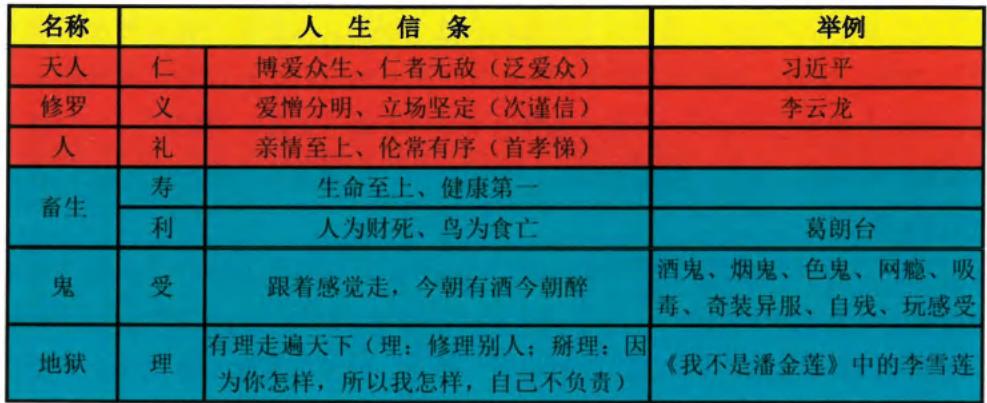
The core value of “Devas” (Tianren) is “Benevolence.” Such people are open-minded, care about the world, love everyone broadly, and are close to the benevolent. If classified according to Hawkins’ energy level, the energy of “Devas” is above 600. People like the Supreme Sage Confucius and the Second Sage Mencius, who are called sages, are people with great love; Mao Zedong’s belief position is to liberate all mankind; Sun Yat-sen’s code of conduct throughout his life was “The world belongs to everyone”; Xi Jinping’s “I will have no self, and I will not fail the people.” These people never calculate personal gains and losses, are wholeheartedly for the public, and are “Devas.”
People like Li Yunlong in “Drawing Sword,” who put “Righteousness” first in their dealings, have clear love and hate, extremely firm positions, and distinct personalities. Like Liu Hulan, Huang Jiguang, Dong Cunrui, Qian Xuesen, Deng Jiaxian, etc., who had incomparably firm beliefs and positions for the people and the motherland, and were wholeheartedly for their ideals and beliefs, such people can be called “Asuras.”
Confucius first proposed “Benevolence, Righteousness, Propriety.” Mencius expanded and proposed “Benevolence, Righteousness, Propriety, Wisdom” (Mencius’s “Four Beginnings”). Later, Dong Zhongshu expanded it again to “Benevolence, Righteousness, Propriety, Wisdom, Trustworthiness,” later called the “Five Constants.” These “Five Constants” run through the development of Chinese ethics and have become the most core factors in the Chinese traditional value system. The most basic thought and behavior of a person is expressed as “First filial piety and fraternity,” that is, family first and ethical order, which is the most basic belief position for being a human.
The energy levels of “Devas,” “Asuras,” and “Humans” are all above 200. They can see their own mistakes, thereby behaving in ways that are good for others and society. However, those who always look at or only look at others’ faults first, and whose fundamental purpose of all actions is for their own interests and gains, and whose belief positions do not conform to the Chinese traditional value system, such people are not in these three levels and cannot be called “human.”
There are two types of “Beasts,” “High-level Beasts” and “Low-level Beasts.” The core values of “High-level Beasts” are that everything is for their own lifespan; nothing is as important as life. “Life is supreme, health is first” is their life motto. “High-level Beasts” live for the continuation of life; there is nothing more important than being alive and healthy. The life motto of “Low-level Beasts” is “Men die for wealth, birds die for food,” meaning money is more important than anything, even more important than life and health. The kind of people often described as “earning money at the expense of one’s life” are these people. These two types of people are becoming more and more common in today’s society. When people push the most basic bottom line to this degree, people will say that this kind of person has “no humanity.” Health, life, and wealth are certainly important, but is there anything more important in a person’s heart? For example, when loved ones are in danger, what choice will be made? Therefore, it is not that “Devas,” “Asuras,” and “Humans” cannot have the right to pursue health, life, and wealth, but a person’s most basic principles and stance determine their quality of life.
The most important thing in the life of a “Ghost” is to pursue “feelings.” Their common saying is “Follow your feelings, drink today while there is wine today.” “Ghosts” live within their feelings, so people label those who are greedy or obsessed with external things as “Ghosts,” such as gambling ghosts, alcoholics, chain smokers, lechers, drug addicts, etc. Nowadays, there are people with internet addiction, people who wear weird costumes, and people who self-harm. These people have a common characteristic: they are addicted to “playing with feelings” and cannot extricate themselves. To outsiders, their living state is a mess, even terrifying. Occasionally, you can see people who have been on the internet for several days in a row; when they come out, they are pale and listless, making people feel like they have seen a “Ghost.” Do you dare to get close to people who wear weird costumes, wear exaggerated and weird makeup, self-harm, and look like “Ghosts”? Some stars in the entertainment industry went to prison for drug use. Why? Were they looking for feelings? The fundamental problem is still that they do not have firm and correct life mottos in their hearts!
People in “Hell” have narrow minds, recognize “dead logic,” and often live in pain and complaint. Their motto is “Reason walks everywhere under heaven.” The “reason” here refers to fixing others and arguing. They don’t look for their own faults but specialize in finding others’ faults. If others are wrong, they are right. They often say “Because you were like this, that’s why I was like that,” “If it weren’t for you doing that, I wouldn’t have done this,” etc. They make others responsible for everything, taking no responsibility themselves. Some people also call this phenomenon “shirking culture.” In the movie I Am Not Pan Jinlian, the heroine Li Xuelian was slandered by her husband as “Pan Jinlian.” This not only made Li Xuelian’s life miserable but also made everyone restless. For this one sentence, she dealt with people from top to bottom, in every aspect, for ten years, from the town to the county, from the city to the province, and then to the capital. Her entire life was petitioning. The feeling of those watching this work is entanglement. In over ten years, Li Xuelian never truly took responsibility for herself, had no pursuit of a beautiful life, and no optimism or confidence in the future. She showed the appearance of a “victim” and could not give any positive energy to the people around her; she can be called a person in “Hell.” In the 2018 Chongqing Wanzhou bus crash, a passenger missed a stop and quarreled with the driver. The two lost control of their emotions, and a fight caused the vehicle to lose control, causing the bus to fall into the river. All 15 people on the bus died. The youngest among the victims were two children aged 1 and 3, and the oldest was 82. We have to ask: For a meaningless dispute, why should the other 13 people on the bus pay with their lives for their mistake?
Are they people in “Hell”? In 2014, Shen Teng and others performed the skit To Help or Not to Help at the CCTV Spring Festival Gala. The ending line was: “If a person falls and we don’t help them up, won’t the human heart fall too? If the human heart falls, we won’t be able to help it up even if we want to.” This shows that the question of whether to help an elderly person who has fallen has become a hot topic in society. The 2006 “Peng Yu Case” was probably the fuse that introduced this problem into a major social issue. Various media acted as accelerants, instantly making people across the country learn that they need to think twice before helping the elderly. People’s pure and kind hearts have since become complex and entangled. Who opened this “Pandora’s Box” and led people to fall into “Hell”?
According to Hawkins’ energy theory, the energy values of these three types of people—“Beasts,” “Ghosts,” and “Hell”—are all below 200. From the perspective of the traditional Chinese value system, teaching activities for these three types of people can only be called training. Teaching activities that elevate people to the life quality levels of “Devas,” “Asuras,” and “Humans” are education. Education cannot just be a linear one-dimensional structure of teaching a person “from not knowing how to doing.” Simply imparting knowledge and skills, which makes people develop horizontally, can only be called training. To give a possibly inappropriate example, dogs can be trained to do arithmetic and drive cars; this is just training, called animal training. Education should also have at least a vertical axis like a coordinate, that is, vertically elevating a person’s quality of life. Education and teaching activities must be two-dimensional or multi-dimensional, and must be related to body, mind, soul, spirit, and other aspects. Habits determine the quality of life. The ancients believed that “By nature, men are similar; by habit, they become distant.” Therefore, ancient Chinese education emphasized removing human habits, that is, “preserve heavenly principles and extinguish human desires.” From the perspective of potential development, reducing human desires and greed is the foundation for successfully unlocking human potential functions.
Li Xigui, a famous educator and the Principal of the Beijing National Day School Alliance, said: “The essence of education is one person lighting up another person, and the essence of curriculum is to stimulate endowments.” “The essence of curriculum is not a syringe of knowledge, injecting knowledge that children don’t understand into them. Instead, it is to package and concentrate those challenges in society and those problems children will encounter in the future, and let children experience and feel them in school in advance, turning them into curriculum.” The best curriculum is experiential curriculum, where students gain cognition through experience.
In my work, I found that the proportion of students in high school sports specialty classes who return to school to visit their coaches (professional subject teachers) after graduation is at least 80 times that of ordinary academic class students (more than 80% of sports students visit their teachers after graduation, while ordinary academic students may not even reach 1%). Sports teachers rarely explain knowledge and reasoning to students because all knowledge and reasoning are verified through training and experience, so sports teachers do not need to preach earnestly. In training, the students’ hearts are activated and lit up by the teacher, so they have the motivation to learn. The students’ internal various energies can flow normally, and emotions can be expressed vividly. However, for students who are exhausted from thinking and learning knowledge, their energy channels seem to be mostly blocked; how can they cope with complex problems like emotions? Therefore, curricula that can stimulate endowments must be experiential. We can realize that potential development courses are like swimming and playing table tennis; they completely require experience. No matter how much, how detailed, or how beautifully you talk about it, it is useless no matter how the listener uses their imagination and creativity. Only if you lead the students to do it and practice it will the results be different.
“The essence of education is one person lighting up another person, and the essence of curriculum is to stimulate endowments.” How do we light up people, and how do we stimulate endowments? Let me tell you a story:
One day, a little monk came to the temple, and the masters in the temple took him in.
That winter solstice, the weather was very cold, and snowflakes floated in the sky. The little monk’s old friend found him and whispered, “The winter solstice is here. We stewed a dog. Let’s go eat dog meat together tonight.”
The little monk hurriedly said, “No, no, how can I eat meat?”
At night, the little monk tossed and turned and couldn’t sleep. Finally, unable to bear the desire to eat dog meat, he secretly got up and walked towards the door. Just as he was about to open the door, he stopped, walked back into the temple, and moved a stool to the base of the wall beside the main gate. It turned out that the little monk was afraid that the sound of opening the door would alert the masters, so he came back to move a stool. The little monk stepped on the stool, climbed over the wall, and went out.
After the little monk went out, the masters in the temple began to discuss how to educate him.
“When he comes back, we must give him a good beating!”
“Make him recite scriptures ten thousand times!”
“Let’s move the stool away so he can’t get down when he comes back. Then he will know what it means to be suspended in mid-air, and in the future, he will know what it means to be down-to-earth!”
“That’s not appropriate. Without the stool, he is likely to fall from the wall. Then he will resent us. Will he make progress?”
“Why don’t we find the skin of that dog and let him look at that bloody dog skin? Seeing this cruel scene, I believe he will reflect.”
The story stops here. I want everyone to pause for a moment and think: if it were you, how would you educate this little monk?
Finally, the head master said, “Good, good. Let nature take its course.”
After a long time, the snow outside was falling heavily, and the snow became thicker and thicker, but the little monk still hadn’t come back. The head master was worried, fearing that snow had accumulated on the stool and the little monk wouldn’t find the stool when he came back and would fall and get hurt. So, the head master walked to the base of the wall, wiped the snow off the stool, and sat quietly on the stool, waiting for the little monk to come back. After a while, the head master was also covered in snow, looking like a snowman.
Finally, the little monk returned. He still remembered where he had placed the stool, so he vaulted over the wall and stepped down with one foot. However, what he stepped on was not the stool, but the Abbot’s shoulder. He didn’t pay it much mind and stepped down with another foot, landing on the Abbot’s leg. The little monk climbed down to take a look and was startled. Upon closer inspection, he saw that the Abbot was covered in snow; he didn’t know how long he had been waiting there. The little monk felt terrible in his heart and felt that he had truly let the Abbot down. He hurriedly helped the Abbot into the room and heated water for him to drink. The Abbot merely said to him: “You go to sleep quickly. You haven’t slept all night; you must be exhausted. Move gently so you don’t wake the other masters.”
Through teaching by example and by word, this Abbot used kindness, warmth, and wisdom to guide his disciple to step up and discern his own behavior step by step, stimulating the little monk’s potential for self-awareness. I believe that the quality of the little monk’s life will be elevated because of this lesson.
When I was studying at the teachers’ college, the words “There are no trivial matters in a school; everywhere is education” were inlaid on the wall of the teaching building. The intention was to plant a seed in the hearts of the students, reminding them to be mindful of their responsibilities and words and deeds everywhere in the school. Nowadays, parents in probably no other place in the world value their children’s education as much as Chinese parents do, so one often hears people say: “There are no trivial matters in life; everywhere is education.” However, too many parents are prone to lecturing, so it is truly hard to say whether this constitutes educational behavior. Before the winter break, I saw a short essay written by a child sent by a friend, titled “My Wish”:
The holidays are here, please be likable uncles and aunties! Don’t grab a child and ask how many points they scored? What was their ranking in the class?
Did that child offend you? Did they ask you about your monthly salary? How many houses you have? Changed your car yet?
Are you embarrassed to answer?
This seemingly joking anecdote actually triggers quite a bit of reflection.
11.2 Industry Positioning of Potential Development Institutions
Overall, education in China is divided into academic education and non-academic education. Non-academic education mostly exists in society in the market-oriented form of education and training institutions. There is currently no unified official classification method for the education and training industry. Whether viewed from demand or scale, potential development training accounts for a relatively small proportion of the entire industry. What position should potential development occupy in the industry, and what are its future development prospects? We must first briefly understand the main status of the education and training industry.
Having undergone more than 30 years of development, the education and training industry has made important contributions to society. Overall research, management, and data regarding the industry are constantly maturing. According to the target audience and teaching content, the education and training industry generally includes the following categories that are well-known to everyone:
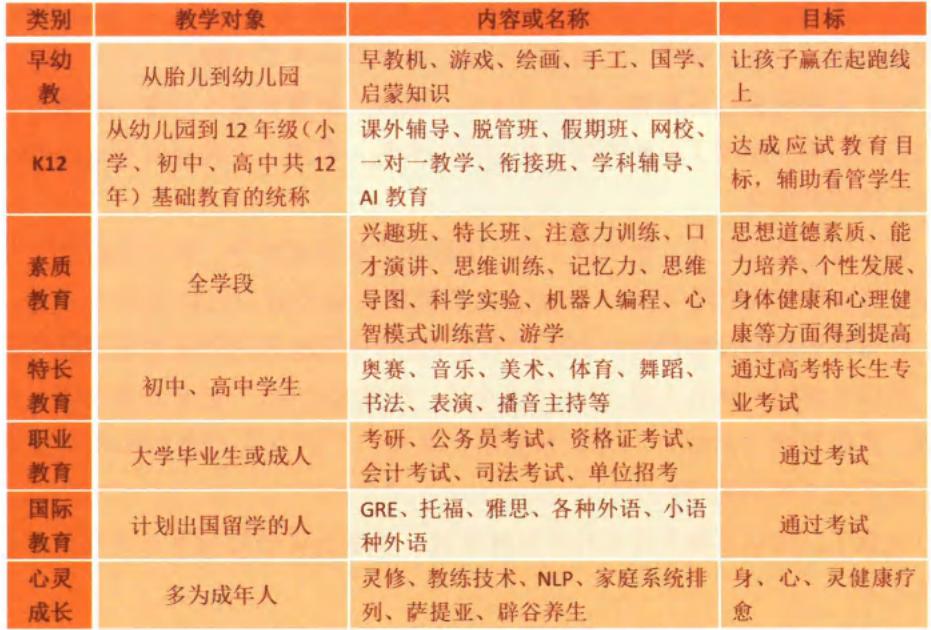
It is estimated that in 2019, the national education and training market generated operating net revenue of over 370 billion yuan. The following is relevant data for the top 7 national education enterprises, compiled based on the latest financial reports and public data (Source: Jiemodui.com “Reference for Training School Principals”). Through this data, we can see that these enterprises are primarily focused on K12 education. New Oriental, TAL (Xueersi), Jingrui Education, Xueda Education, Only Education, Pu Xin Education, and Zhuoyue Education are known as the “Seven Heroes” of the K12 training industry. Vocational education, represented by Offcn Education, Oriental Education (parent company of New Oriental Cooking School), Tarena Technology, and Sunlands Education, is continuously expanding its proportion within the education and training industry.
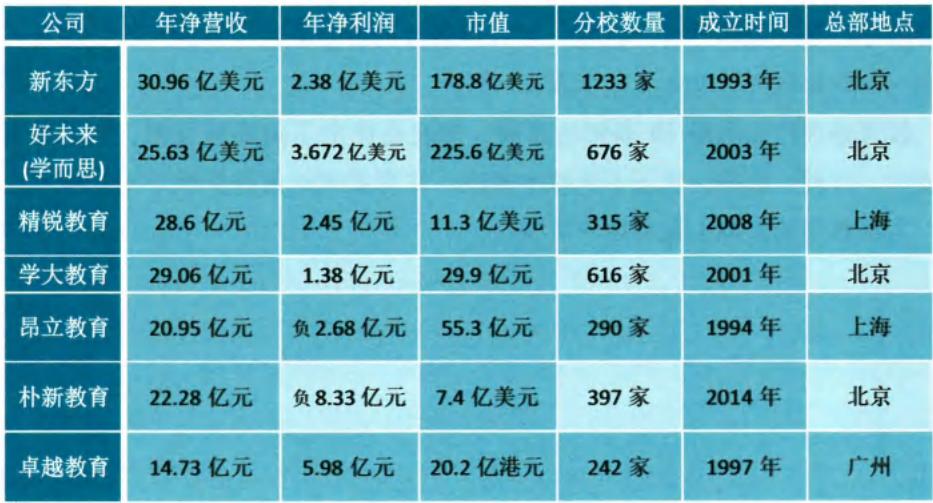
More and more students are no longer choosing the face-to-face learning mode with teachers; instead, they are choosing to study from home through online education enterprises represented by VIPKID, Xueersi Online School, GSX Techedu (Genshuixue), Yuanfudao, Zuoyebang, and Zhangmen 1-on-1, as well as new forms of franchise schools like Squirrel AI. These data indicate that, overall, for students in the basic education stage, society places a very high degree of attention on academic grades, while the proportion of attention paid to the moral, physical, aesthetic, ability, psychological, and spiritual development of students in this stage remains very small. Throughout the entire industry, the proportion of education and training for potential development is still insignificant. Due to the lack of a relatively successful model, potential development education and training is currently in an immature and unstable state within the industry.
Most practitioners of potential development education hope to classify themselves under K12 education, hoping that students will use “superpowers” to achieve effortless learning and grade improvement. We have already discussed in Chapter 8 whether this hope is realistic. In the view of industry researchers, this “strange egg” of potential development seems to be placed in quality-oriented (suzhi) education, because it improves students’ abilities, which belongs to the issue of basic human qualities. From the perspective of social demand, quality-oriented education ultimately serves students’ academic grades. Therefore, for potential development education, the fundamental issue remains how the activated functions and learning can promote each other over the long term. If this problem is not solved well, most potential development institutions will find it difficult to survive in the long run.
A prominent phenomenon is that many well-known potential development institutions are not doing education and training in a down-to-earth manner, but are engaging in commercial franchising to achieve brand effects and reach the goal of making money. The most typical examples are “Tao’s Voyage Education” (Taoshi Yuanhang) and “Brain Cube” (Naolifang). “Tao’s Voyage Education” operated commercial franchising for approximately one year and possessed over 200 franchisees. Revenue from franchise fees alone exceeded 100 million yuan. They hoped to achieve a listing on the ChiNext board through rapid expansion. According to their executives, the company invested at least 80% of its energy and 90% of its funds in the market operations department. Consequently, Tao Yongdi, who was actually conducting Taoist research, soon parted ways with the market operations team, and the “Tao’s Voyage Education” brand collapsed dramatically.
The owner of the “Brain Cube” brand is Shanghai Brain Cube Culture Communication Co., Ltd., established in April 2014. Its founder, Jin Jun, can be considered a business prodigy. “Brain Cube” rose to fame around 2016. By the end of 2017, there were 187 branches in Inner Mongolia alone, and by 2018, branches nationwide exceeded 1,900. At its peak, the number of tutors at its headquarters exceeded 1,000 (including several tutors with special functions). Its main courses include “Super-Sensory Creativity Training” (the writing part of “Inspiration Learning Method”), “Super-Sensory Imagery Training” (i.e., blindfolded reading and other training), “Haoji Miaoyi Training” (i.e., memory method), “Mind Mapping Thinking Breakthrough Training” (i.e., mind mapping), “Brain Screen Imaging Learning Method” (same as wave speed reading, photographic memory), “Massive Vocabulary Achievement Training” (i.e., English word memory method), “Youth LF Life Dynamics,” and “Future Leader Training Camp” (mindset training).
“Brain Cube” introduces itself in its propaganda as follows: “Brain Cube Group is a personalized training institution that uses the new concept ‘Whole Brain Balanced Learning Method’ to enlighten the brain wisdom potential of children and adolescents. Through scientific whole brain application training and happy learning methods, it is committed to improving the efficient application of comprehensive abilities such as concentration, memory, imagination, creativity, and self-confidence in children and adolescents. It perfectly combines the virtue (Moral Quotient) of quality-oriented education, the intelligence (IQ) of subject education, and the wisdom (EQ) of whole brain application, and builds a characteristic innovative industry platform with systematic overall training and informatized home-school interaction. Let more children be liberated from heavy study pressure, allowing children to learn easily and grow up happily!” It can be seen that “Brain Cube” also positions itself as education combining quality-oriented education with K12. Judging by the short-term training effects, it is very good. Through a few days of training, the abilities possessed by the children and the huge changes in certain aspects moved parents to tears, with some parents even kneeling at the graduation ceremony of the “Brain Cube” training camp to thank the tutors. However, education is a “slow effect.” Some children, after returning home, slowly returned to their state before training, which made some parents furious, accusing and seeking revenge against “Brain Cube” through various means. Many tutors believe this is because parents cannot continue to train students at home according to requirements. Now we know that the reason for this is complex, and sometimes it is not something parents can train just because they want to. Tutors only master a few techniques, and with the collective effect, it is not difficult to have gratifying short-term effects, but achieving satisfaction after the “slow effect” is not easy. Like “Tao’s Voyage Education,” “Brain Cube” placed more energy on commercial operations, with far insufficient investment in teaching research, leading an executive proficient in education research to resign in anger. What likely ignited the fuse that blew up “Brain Cube” was probably the price issue. From the cheapest 15,800 yuan to 68,000 yuan for a multi-course package, neither price is a small figure in the eyes of outsiders. This was what first attracted media interest, and subsequent investigations revealed many “miraculous” things. At the end of 2018, first Zhejiang “Brain Cube” was investigated for false propaganda, and then it gradually spread nationwide, setting off a wave of scrutiny of socially-run schools. The giant of the potential development education and training industry, “Brain Cube,” was in jeopardy.
According to a report by Jiemodui.com’s “Reference for Training School Principals,” 12,000 after-school training institutions closed down nationwide in 2019, and the closure of potential development institutions is even more of a norm. Due to various reasons, countless potential development institutions open every year, and countless institutions close down. At least 80% of potential development education and training institutions will close down within as little as two or three months or as long as three to five years. The reasons for this are quite numerous. Overall, it is currently not mature enough and is still in a period of practical exploration and adjustment.
Training is also education, and even more so, business; this is an industry that requires both profit and a conscience. However, as an industry with a not-so-high rate of return, for practitioners, it truly requires immense love—loving the students and loving the career one is engaged in. But for this era, this is extremely difficult. The reputation of an educational undertaking needs to be accumulated over years: for a product, the shorter the time it takes to gain a good reputation, the more qualified it is to become a “hit product”①. However, the reputation of an educational institution needs to be calculated in years. Why do educational institutions charge prepayments instead of paying per visit? Because education is a long-term experiment, and the chemical reaction of education takes at least one semester or even longer.
In the future, regarding educational training aimed at improving test scores, the traditional teaching model will certainly be outperformed by the dual-teacher model; offline will certainly be outperformed by online; and humans will certainly be outperformed by AI. The dual-teacher model involves two teachers: one responsible for teaching and one responsible for students. Or rather, one is responsible for the process of instruction, explanation, and learning, while the other is responsible for homework, practice, exercises, and evaluation. The teachers on both sides will continuously divide their labor, truly enabling a teaching process to begin with precision and personalization in a specialized manner. When it comes to understanding humans, humans cannot possibly compete with AI. Which questions a student answered incorrectly, how they got them wrong, what deficiencies the errors reflect in the student, to what extent these deficiencies exist, and how to enable the student to make up for these deficiencies and become a top student—AI’s teaching strategies can figure this out in seconds, making students love learning so much they cannot stop. This process is essentially a process of training the machine, where human thinking proceeds entirely under the guidance and instruction of AI, until the human brain’s neural circuits are reshaped according to the goals preset by the AI. Potential development education currently can only be conducted through face-to-face interaction between people, which makes implementing education easier and makes it easier to achieve “one person lighting up another” and stimulating innate gifts, although this places higher demands on the instructors.
The biggest challenge in the development of the potential development training industry lies in the lack of unified standards. The reason for the lack of standards is the absence of authoritative, leading organizations, societies, or associations; and the reason for the lack of societies or associations is the lack of support from scientific theories related to potential. Precisely because there is no scientific theoretical support, organizations of pedagogy and psychology, which might otherwise be included, adopt a basic attitude towards potential development of wishing to avoid it at all costs. The closest related fields, such as parapsychology and psychical research, are disciplines that mainstream science abroad does not look upon favorably, and these disciplines have not yet been recognized domestically either. Without relevant societies or associations, there can be no talk of relevant standards. There is neither a unified industry curriculum standard nor a qualification standard for instructors. The certificates issued by various training institutions on the market are diverse and confusing; as for which certificate is truly valid, everyone feels very lost. The state is tolerant towards potential development, which is why it allows numerous practitioners to engage in practice, exploration, and research; it simply requires time to wait for growth and maturity.
Founded in 2008, Qixin Education has held fast in the whole-brain education training field for 12 years, explored a unique operational model, formed a good reputation, and is a nationally renowned brand for 1-on-1 personalized tutoring that combines right-brain development, learning ability, learning methods, and subject knowledge. Although Qixin Education started earliest with right-brain development, it has always focused on cultivating student abilities, with rich teaching subjects, flexible and diverse teaching forms, and comprehensive curriculum design. Memory, attention, and mind mapping are Qixin Education’s core courses. In terms of potential development, it does not promote or emphasize functional aspects, but instead completely highlights the research and teaching of learning abilities and learning methods regarding student quality. Courses are conducted in the form of summer camps, winter camps, intensive training camps, and specialized subject training. Qixin Education attaches great importance to investment in educational research and has carried out long-term, comprehensive cooperation with the Institute of Psychology of the Chinese Academy of Sciences, the School of Psychology at Peking University, and the School of Educational Psychology at Beijing Normal University. Combining the character traits and thinking modes of Chinese people, it has found brain potential development technologies and learning methods suitable for Chinese students to ensure rapid improvement in students’ brainpower.
Dividing whole-brain education into functional and technical categories is more suitable for teaching practice and research. Qixin Education’s distribution ratio of the two in its educational activities meets social needs, and both types will inevitably be important components of quality education. Qixin Education engages in educational training in a down-to-earth manner and has arduously carved out a successful path; its model is worthy of consideration and reference.
An old saying goes: “A farm boy in the morning, a student in the Hall of Heavenly Sons by dusk.” This speaks to the wishes of many scholars during the imperial examination era. In today’s increasingly competitive world, education has become the life-saving straw for many families. Countless families view education as a good prescription for maintaining their current social class and helping their children move up the class ladder. “No matter how poor, do not let education suffer.” It is precisely because of this that the training industry seems to contain huge business opportunities, and quite a few people have hoped to enter the education training industry in recent years. Although in the last two years, education administrative departments have frequently conducted special inspections of the social training industry, and permits for running schools by social forces are even more difficult to obtain. But overall, early childhood education, custody, quality education, and arts education institutions can be said to be in a policy dividend phase, with low barriers to entry, and education administrative departments have not strictly inspected such training institutions. All policy directions can be simply condensed into two sentences: Strictly manage preschool education and off-campus training; benefit quality education and vocational education. Judging by current trends, even in the training fields enjoying a dividend period, the requirements for relevant qualifications are temporarily not strict, but training institutions should also make relevant preparations, standardize their school operations as much as possible, and plan for the long term.
There are mainly 6 national-level policies that have a profound impact on training enterprises: the “Notice on Effectively Reducing the Extracurricular Burden of Primary and Middle School Students and Carrying Out Special Rectification Activities for Extracurricular Training Institutions,” the “Implementation Regulations of the Private Education Promotion Law (Draft for Review),” the “Opinions on Regulating the Development of Off-campus Training Institutions,” the “Several Opinions of the CPC Central Committee and the State Council on Deepening Reform and Standardized Development of Preschool Education,” the “National Vocational Education Reform Implementation Plan,” and the “Implementation Opinions on Regulating Off-campus Online Training.” Among them, new solutions have been proposed regarding fire filing and permitting issues for off-campus training institution sites, in order to break through bottleneck constraints such as historical issues with fire acceptance. At the same time, setting requirements were clarified, such as “minimum site area of 200 square meters, with teaching housing accounting for no less than 2/3,” “if boarding is provided, the average dormitory usage area per student is no less than 3 square meters,” and “residential housing, or leased or borrowed primary and secondary school buildings and sites, shall not be used as school operation sites.”
Currently, K12 tutoring and language training remain the core market, with group classes still accounting for the bulk, while 1-on-1 generates high revenue and value-added supplements. Positioning potential development as quality education is more appropriate. In recent years, potential development education is still in a stage of shuffling and growth, with unstable development and many challenges to face, awaiting maturity.
11.3 Planning the Way, Not the Meal
11.3.1 A Business Like Flowing Water
Potential development poses a challenge to people’s cognition, and its integration into the education and training industry is equally a challenge. We must see that whole-brain development and potential development are not the entirety of education; they are merely tools of education. The first to enter this industry were few educators and mostly business people. In the early days, despite the high franchise fees for potential development education, people flocked to it one after another. Behind this lay not only the attraction of high income after franchising but also the “empowerment” of magical functions. “When an industry is profitable, everyone rushes in frantically”—this undoubtedly holds immense appeal for those wanting to make quick money. However, among potential development education institutions, “many start well, but few finish well.”
When education becomes a business, the competency of practitioners drops significantly. I know a businessman who has done telemarketing, direct sales, and sold insurance; when I knew him, he was selling wisdom machines. His wisdom machines cost 19,800 yuan each, with a one-month free trial, and it is said that he sold five or six units in half a year. Because the success rate of activating the blindfolded reading function in children was not very high, this person then franchised a brand of whole-brain education (including potential development). The result was not as he had imagined; student recruitment, teaching, and profits could not satisfy him. Later, he added a Lego toy project, then added a myopia treatment project, until finally he closed down for good. This person focused on only one thing—profitability. As for what these projects actually brought to people, he never cared, nor did he ever think about it. Such people who treat education as a business are not uncommon in the potential development education and training industry, and such institutions, not based on serving others, cannot last long.
11.3.2 Techniques That Can Be Copied in Minutes
Teacher Shen Runsheng, who has been engaged in research on children’s potential development and application for over 30 years, said:
Nowadays is different from more than ten years ago; more and more children’s training institutions have taken the stage one after another, but they have also gone bankrupt one after another. What is the difference between them and us?
First, the purpose is different. Our purpose in doing children’s potential education is to develop children’s potential and improve learning ability, and to further do a good job in researching its principles and applications on this basis. Many of those who have made the scene, certain institutions flying the banner of ”×× Education,” are in fact just trying to seize business opportunities and fish in troubled waters to make money.
Second, the path is different. We apply the results and experience explored over many years to the improvement of students’ learning abilities. Many training institutions often use various marketing means, exaggerating the promotion of the institution, faculty, and results, engaging in fraud to create a sense of “mystification,” and obtaining various “equipment and technologies” through “franchising” to follow the book mechanically, ultimately unable to sustain themselves. There are also those who establish their own headquarters and resell technology by accepting “franchises” to quickly obtain high profits, which accelerates the endless vicious cycle of “hanging a shingle then going bankrupt,” ultimately harming others and themselves.
Third, the guiding ideology is different. Is the effect a long-term effect that achieves fundamental change, or does it only pursue the short-term effect of having an on-the-spot demonstration? These are two completely different guiding ideologies.
Fourth, the philosophy is different. Good education must be conscience education; it must have love and a sense of responsibility. It must absolutely not be “industrialized” at all costs! ①
The evaluation criterion of business is only profit: if there is profit, do it; if there is a loss, abandon it. Therefore, business is like flowing water, constantly changing. The goal of education is to elevate the quality of human life. If you find that the joy brought by seeing progress in the students you teach can make up for the losses caused by operation, and you begin to prioritize people over “money,” then your quality of life is at the level of “humanity.” You are doing education, and you have fired the first shot in establishing your own education brand.
11.3.3 Distressing Media Reports
What distresses potential development workers the most is the reporting from various media outlets. For potential development education institutions, these reports have greatly impacted the credibility of human potential.
On the official websites of China Central Television and other satellite TV stations, searching for keywords such as “reading with eyes covered,” “reading with blindfold,” “seeing objects with eyes covered,” “visual perception with eyes covered,” “right brain development,” “retrieving objects from the air,” “superpowers,” “clairvoyance,” and “child prodigies” yields hundreds of videos. The vast majority criticize this training as a scam, a violation of educational laws, a violation of physiological common sense, and having absurd prices, etc. To attract attention, many journalists act as “detectives” to prove the falsity of various potentials. In the reports, words that are very alluring to people, such as “scam,” “secret,” “exposure,” and “truth,” are frequently used. This situation is still a far cry from the scientific literacy displayed by the media in Taiwan through “The Secret of the Midbrain.” Not only on television media, but on print media and online media, there is also an overwhelming amount of questioning about potential development. Facing the reports from various media outlets, potential development education institutions find it hard to explain themselves and are powerless to resist.
The emergence of this situation is not accidental. Potential development education institutions must correct their attitude and be clear that “do not blame the media for their faults; it is the trouble you brought upon yourself.”
In Chapter 9, we mentioned that because of the abilities presented by potential, neither Newton’s nor Einstein’s or Hawking’s theories can explain it. This kind of questioning and criticism did not just appear in recent years; it existed forty years ago.
CCTV News Report on the “Child Prodigy” Scam
After the report of Tang Yu’s “ear reading” in 1979, dozens or even hundreds of research institutions across the country conducted research in this area, and research papers and reports on various discoveries emerged one after another. However, the voices of opponents were also like thunderclaps, unceasing. In 1981, Li Liangming from the Institute of Aviation Physiology found the Wang Bin and Wang Qiang sisters mentioned earlier and conducted a series of experiments, writing an article titled “‘Special Functions’ of ‘Ear Reading’ Cannot Exist.” Its conclusion was:
-
The Wang Qiang sisters simply have no “special functions”; this is an “absolutely true” fact!
-
The so-called “special functions” of the Wang Qiang sisters are actually “disguised” visual perceptual functions; it is just peeking!
-
The so-called special functions are not strange; they are “low-level magic” that ordinary people can master and perform, but they are easily exposed.
-
The aforementioned related publicity and reports simply cannot withstand the test of objective practice. In our test results, we have negated most of the reports on “ear reading.” ①
Applying potential development to education should not involve over-interpretation and wild imagination; doing education requires understanding what education is. If education institutions value various functions but science cannot explain them, how do you expect people to comment? Researching potential development, especially adult potential development, cannot avoid the training of Qigong. Qigong masters easily form people’s worship of them, thereby naturally leading people to associate them with “cults.” Twenty years ago, many Qigong organizations had more or less a shadow of cults. At that time, the first to be impacted were the news media, which were very sensitive to this. Therefore, various functions can only serve as a tool for education, by no means the goal. True education is not utilitarian and must not be aggressively promoted in terms of functions.
In potential development training, some techniques indeed look suspicious and are difficult for people to understand. Dr. Jiang Wan from Shenzhen University, under the pseudonym Qinxin Wuyan, published an online article titled “Chinese Scientists Successfully Crack the Evolutionary Code of Human Extraordinary Abilities” on the “Super V Card” website. The article states:
Due to the intervention of human body scientists, the laws of blindfold training methods have been relatively thoroughly revealed, and their training value has been discovered and excavated.
Because of the strange laws exhibited by the blindfold training method, it may cause significant social misunderstanding. Scientists have discovered from a large amount of practice in training children to unlock their extrasensory perception (ESP) that in the early stage of training, this ability of children actually needs to be stimulated by visible light. That is, the brightness of the environment helps children recognize characters quickly. The blindfold training method uses ordinary eye masks, that is, the kind that cannot be completely sealed, which makes it easier to stimulate children’s abilities. The eye mask has very slight light leakage, which is not enough to allow children to peek and read smoothly, but it is easier to stimulate the child’s initial function; conversely, if a very sealed eye mask is used, such as the specially customized, completely water-tight and light-tight swimming goggles used in training children’s deep abilities, the child’s ability is almost impossible to train out.
If a strict investigation is conducted, it will be found that in the early stage of training, those children who have already shown the ability to read with a blindfold, when the light leakage of their eye mask is completely blocked, or when they are asked to wear a stricter eye mask, or simply when a thin piece of paper is placed in front of their eye mask, they immediately lose the ability to recognize characters and read.
Another law of blindfold training is that the directions to the lower left and lower right are the most sensitive directions for children’s abilities to manifest, so children in the initial training always read from these two directions. This inevitably creates the suspicion that they are peeking through the gap at the lower diagonal, which is another law that easily causes misunderstanding. However, this problem is relatively easy to solve, which is to forcibly require the child to face the book directly during training. Generally speaking, after the child slightly adjusts their state, they can adapt quickly, and then they can read with a blindfold from the front.
Another law in blindfold training that easily causes social misunderstanding is that, according to common sense inference, since one has the ability to recognize characters with eyes covered, that is, the useless direct visual function of the naked eye is not used, then whether the character card faces the child or has its back to the child, the effect should be the same. A child identifying a character card from the back is a much more difficult task than identifying it from the front.
Instructors and potential development institutions should not think they are doing Copernicus’s challenge to the geocentric theory, nor are they revealing new science; you are just doing education and training. Based on this, let every student’s academic performance improve, do not take whether the student’s functions are shocking as the standard, put the effort into the student’s learning and growth, this is a “slow effect,” but it is the right path, and the heart will be at peace.
11.3.4 The Law of Attraction
People interested in potential development often have a passion for education. Education and training is education, but it is also a business; without profits, most people cannot persist. According to the Law of Attraction, connections are attracted, resources are attracted, wealth is attracted, health is attracted, the type of students enrolled is attracted, and even the students’ academic grades are attracted.
The essence of the Law of Attraction is the focused projection of inner energy. Our inner energy is finite; scattered energy versus focused projection have different effects on surrounding things. For example, take a strong flashlight: with the same 5W power, if the light is scattered, the brightness is not high, but when focused, the brightness increases significantly. If it were a 5W laser, it could melt metal. Therefore, with the same energy, different methods of projection lead to vastly different results. The essence of the Law of Attraction is the focused projection of inner energy. The key is: where is it projected? The target of the projection is the goal. You must amplify the goal; enlarge the goal’s position in your heart to crowd out other things, and the desired result will be attracted. When applying the Law of Attraction, there are two major techniques: one is to amplify the goal. In the process of amplifying the goal, two points must be noted: first, remove distracting thoughts and negative information; second, firm up positive beliefs.
Why amplify the goal? When the goal is amplified, the difficulties before it appear small. So, when we feel that a task at hand is too difficult, when we want to give up, or when it’s so hard we could cry, it is because we only have what in our eyes? Yes, only the difficulties. What should we do then? Amplify the goal! Long-term goals can become beliefs. Here is a story:
One year, heavy rains fell in Hunan. A mother was taking a ferry boat across the river to return home. Suddenly, a flood came and capsized the ferry, throwing everyone into the water. The current was swift, and everyone on the boat was desperately trying to find something to save them. Not long after, in their panic, the mother and another person grabbed hold of a wooden post that had rushed down from upstream. The two of them hugged the wooden post, drifting with the current towards the lower reaches. The water was swift and cold, the rain was pouring down, there were no boats on the river, and not a single figure could be seen on the bank. At first, the two could still chat, but the wooden post rolled constantly, making it difficult to hold onto; they were buried in the water one moment and surfaced the next. Several hours passed; they were tired, hungry, sleepy, and scared. It was completely dark. The other person kept saying, “I’m too tired, too sleepy.” The mother felt the same way; she had almost no strength left to speak. She could only silently say to herself, “Hold on, hold on, I will definitely be saved.” After a long while, she heard a faint voice, “I’m too tired, I give up, I want to sleep.” She felt the force on the wooden post lessen by a fraction, and she vaguely realized her companion had fallen into the water… Before long, she also felt extremely exhausted; she wanted to sleep for a while, she wanted to give up. She slowly loosened her grip and slowly sank into the water. She didn’t know how much time passed before she suddenly saw her two children anxiously running towards her, shouting loudly, “Mom, Mom!” She started awake with a jolt, splashed and broke the surface of the water again. Fortunately, she could still reach that log. She hugged it tightly, thinking that her two children still needed her to raise them; she must survive. So, she hugged the wood tightly and never let go again. The next evening, she was finally discovered and rescued by PLA soldiers engaged in the search.
This story illustrates that firm beliefs can overcome difficulties, and amplifying the goal makes it easier to attract results. However, in learning and life, unclear or wavering goals are the main reasons for failure or the ineffectiveness of the Law of Attraction. Teachers are familiar with “The Story of the Groundhog,” which serves as a warning for their teaching work and is sometimes told to students to remind them to clarify their goals:
Three hounds were chasing a groundhog, and the groundhog drilled into a tree hole. This tree hole had only one exit, but a moment later, a rabbit actually drilled out of the hole. The rabbit ran forward quickly and climbed up another big tree. The rabbit, high in the tree, didn’t stand firm in its panic and fell, knocking out the three hounds that were looking up. Finally, the rabbit escaped.
Is there a problem with this story? You might think, what kind of story is this? Rabbits can’t climb trees; one rabbit couldn’t knock out three hounds at the same time. This story is called “The Story of the Groundhog”—where did the groundhog go? Because the rabbit suddenly appeared, our train of thought was unknowingly diverted, and the groundhog naturally disappeared from our minds. In the process of pursuing life goals, we are often distracted by trivial details and meaningless trivialities along the way, disturbing our line of sight, causing us to pause midway or take a detour, and abandoning our original goal. Potential development training institutions possess more and more magical potential development teaching techniques than other institutions, but conversely, their goals become confused and blurred: they need to recruit students, develop potential, teach, and produce results. What can such a chaotic state of mind attract? Similarly, firm and clear goals are very important for parents educating their children and for children’s learning and growth.
Let’s tell another story:
Last semester, I conducted a class meeting with the theme “Dream Launch” for a class. The atmosphere was intense and enthusiastic, and the students were surging with emotion. A boy with poor grades raised his hand to share: “Teacher, I want to be a straight-A student (Xueba)!” I said happily, “That’s great! You can do it. Achieving this goal requires a period of effort to reach. You have the determination, now you must act immediately!” After class, the student wanted to write a note and stick it on his pencil case to remind himself constantly, and some classmates gathered around to watch. After he wrote “I want to be a Xue,” he couldn’t remember how to write the character “Ba.” He mumbled for a while, and a classmate used hand gestures to show him how to write it. He felt he had lost face. He crumpled the paper, threw it, and said, “I just won’t be one then!”
I think this story reflects a common problem among children today: they give up as soon as they encounter a little difficulty. There is no such thing as a once-and-for-all solution; everything requires effort. Potential development institutions can only attract the desired results by persisting steadily and truly working for the growth of the students.
These three stories all aim to say that only firm goals can overcome all immediate difficulties. Students often lack long-term, clear goals because their parents’ goals are unclear, especially long-term goals. Today parents make the child do this, tomorrow that, leaving the child dizzy and confused, unwilling to persist in anything, because even if they persist, they don’t know what the parents will say in a few days. Therefore, the education of worldview, values, and outlook on life must be integrated into life, allowing children to have grand dreams so they can achieve the results they want on the path of growth.
Goals must be set by oneself, and they must be things one can achieve. How can something you cannot do be called a goal? That is merely a slogan. How do many parents set goals? The parent’s goal: The child’s academic grades are good. This cannot be the parent’s goal, because this is the parent hoping someone else achieves a certain result. Because psychology has a rule: “One person can never change another person, unless that person has the willingness to change themselves.” The child is an independent individual; he is only temporarily under your custody. He is not you, nor is he your accessory. The parent’s goal can be set as: Guide the child to study well. What will I do for the child’s learning (financial support? homework companionship? checking homework? making the child relaxed? giving encouragement? being as friendly as if treating a neighbor’s child?). Therefore, the goal must be something you can do yourself. How much result you get depends on how much you do. So this is how the Law of Attraction is used; it is not empty thinking or fantasy.
The goal set must be related to people, not just doing things. Accomplishing things is called a result; people are the goal. For example, in doing potential development, the goal set should be how many children obtain improvement through potential development within a certain amount of time. Seeing a child improve through your cultivation brings you gratification, happiness, and joy—this is your goal. Suppose you position your goal on how much money you can earn from enrolling a child. You will attract parents who care more about money than you do, and they will be pickier about the child’s progress. If anything about the child fails to satisfy them, they will come looking for trouble. Why do you attract such people? It is because your goal is set on things, on money, and has little to do with people; you are not sincerely seeking the good of others. When all your focus is on the students’ progress, and you feel you have achieved a result with every step of progress the student makes, you will attract greater progress from the students, and more parents will be willing to entrust their children to you for learning. This has nothing to do with price.
The second technique when using the Law of Attraction acts as a catalyst and can produce significant results. It involves first presenting an image in the mind, and then projecting it into reality. The key lies in the fact that you must live in the state of the result you expect, placing your attention on the event as if it were already completed, and living out your dream as a current reality. Using imagery ability is the most effective way to generate this image. In other words, people who have developed their right brain can utilize this Law of Attraction better to accomplish tasks and achieve results. For example, if a child sets a goal to become a top student, they need to visualize the image of being a top student: how a top student listens attentively in class, what their attitude towards learning is like, how they handle relationships with classmates, and what they look like when thinking through difficult problems. By allowing these images to frequently appear in the brain and then projecting them into reality, even though they are not yet a top student, their state resembles that of one. Thus, they are not far from becoming a true top student.
It is the same for adults applying the Law of Attraction. If you hope to possess wealth, then you must live within the speech, behavior, and mindset of the identity you desire, and the Law of Attraction will prove effective. “Birds of a feather flock together, and people are divided by groups.” If a person wants to become a multi-millionaire, and if they handle affairs and interpersonal relationships with the true perspective, beliefs, and qualities (the excellent qualities of successful people) of a multi-millionaire, then they will not be far from becoming one. Because doing so will inevitably attract wealth and success.
When we do things by considering others first, universal energy is infused into your heart, and blessings will flow continuously.
11.4 Successful Operation Models for Potential Development Education
After more than a decade of development, although potential development education is not yet widespread in society, time has still screened out some successful teaching sites. Most are small in scale, where counselors work in a warm and happy environment, students and parents are satisfied, and they shine and radiate heat within a small scope. These excellent potential development institutions share some common characteristics, which hold certain reference value for practitioners in potential development education.
Basic Principles: Light Assets, Heavy Focus on Cultivating People
Compared to the past development model of crazy financing and blind expansion, a steady approach—being small yet exquisite and capable of sustainable development—is more suitable for most potential development institutions. Potential development teaching itself does not require high specifications for hardware facilities; teaching aids are flexible and not expensive. Such institutions are not suitable for high-profile development, nor are they suitable for taking the “high-end” route. When establishing an institution, one should try to maintain light asset investment and go all out to focus energy on education and teaching. The more capital invested, the more attention is diverted to student recruitment and operations, making it harder to keep the target focus on cultivating people. The number of students taught by each counselor should not be too high; try to keep it below 15 per semester, with around 5 students per class. In this way, counselors can focus entirely on the students’ learning and growth, providing targeted educational guidance in all aspects.
Positioning: Personalized Education, A Supplement to School Education
As we analyzed earlier, from the broad classification of the education and training industry, potential development falls under quality education, aiming to improve students’ abilities. Just like other abilities, students exhibit large individual differences in brain potential development. Like interest classes, it is personalized education and can only serve as a supplement to school teaching. It is temporarily impossible to be like subject teaching, nor can it enter primary and secondary schools as a specific course.
Forms: Coexistence of Multiple Forms
- Studios, Learning Workshops, Family Workshops
Currently, the turnover rate among counselors is high; relying on recruitment makes it difficult to build a long-term career together, which has had a major impact on some education and training institutions. If 1–2 counselors conduct potential development education based on personal aspirations, strengths, and interests, they can provide tutoring in flexible residential settings in the form of studios, learning workshops, or family workshops for a small number of students. This form requires little capital investment, offers a warm and quiet environment, and is flexible in teaching, making it a form highly suitable for potential development education. For institutions existing in this form, potential development must be well integrated with academic tutoring to achieve good results, and often students can renew their enrollment for the long term.
- Tutoring+, Interest Class+, Sinology Class+…
Operating an education and training institution with potential development as a single project is often difficult to sustain. If academic tutoring institutions, interest specialty classes, Sinology education institutions, etc., add it as a course, it can better divert a portion of students, forming complementary advantages.
- Summer Camps, Winter Camps, Intensive Training Camps
The development of potential brings the most shock to students and parents in the initial stage. During intensive training, students find it easier to let go of the academic burden from school and devote themselves wholeheartedly, achieving better results than daily training. Summer camps, winter camps, and intensive training camps can easily realize improvements in students’ self-confidence, concentration, imagination, and other abilities. Integrating potential development with other course content, summer camps, winter camps, and intensive training camps will surely achieve satisfactory results.
Effect Guarantee: Student Screening, Parental Cooperation
There is a common law for building a reputation in the education industry: selective enrollment. The more famous, reputable, and academically successful a school is, the stricter the screening of student sources. To achieve good results, high-quality student sources are a foundation. Sending a group of students with the worst grades and study habits to any of the best schools, it is still difficult to educate them all successfully. Although making excellent people even more excellent is not easy, it is easier than turning poor students into what society considers excellent. Putting some poor students in a famous school will only drag down the famous school’s reputation.
Whether a child can smoothly develop their potential has a lot to do with their attention. If a child’s attention is poor, they often cannot start blindfolded training. Do not rush for quick success with such children; start by training their attention. For tutoring institutions, brainwave instruments or attention checklists can be used to test children’s attention. Children with high attention scores can generally proceed smoothly with potential development to a good level in ESP games; for children with lower attention scores, starting blindfolded training will be slower, learning will be more laborious, and grades will often not be too excellent. This situation should be communicated to parents so they can improve attention in time, avoiding the failure of potential development which would deal a blow to the student.
Although the family is the primary front for education, and off-campus training institutions can provide more skills education and knowledge education rather than moral education and habit education, potential education faces the student’s subconscious, and counselors can observe many inner things about the child. Therefore, parents who can cooperate well with the teaching will enable the child to achieve better results. The quality of the parents determines the height of the child.
Environment: Creating an Excellent Ecology for Whole Brain Potential Education
Humanity is a de facto community. Education is also the shared responsibility of the community. Nowadays, people in society often criticize school education; these people should not belittle themselves. Some people in the off-campus training industry, in order to show how much they understand education, either criticize school education or belittle other training institutions and potential development institutions. Do not criticize school education; social development has been so rapid, and school education has contributed significantly. Social schooling and tutoring institutions are supplements to school education. China’s basic education is recognized as the best in the world, and developed countries like the US and the UK have invested a lot of money and manpower in researching China’s basic education in recent years. Also, do not think training institutions are no good; in the eyes of outsiders, all principals and training institutions are the same. The reason potential development is not recognized by more people is largely because a good whole brain education ecology has not been created.
Responsibility: Doing a Good Job in Accumulating Research Materials for Potential Development Education
Human potential still contains too many things unknown to humanity, and human potential development education has profound meaning and heavy responsibility. Potential development counselors must do a good job in teaching research and material accumulation. For potential development counselors, the focus of teaching research should use simple methods such as observation and educational narratives, and recording them in educational archives is sufficient. This archive can serve as teaching experience for future use, become important physical evidence for parents to trust, and also accumulate data for potential development education research. This is a responsibility for potential development counselors, and it is also growth.
11.5 Making People Mature Is an Important Task of Education
After being a teacher for a long time, one will inevitably have a feeling: what kind of parents there are, that is what kind of child there is; what a child becomes depends on the parents, and all of the child’s problems stem from the parents. Using the words of parenting experts, this is called “The child is a photocopy of the parent; the blemishes on the copy come from the original, and the parent is the original.” These statements and theories are sufficient to illustrate the role of parents in a child’s education, and it seems one could say, “Everything is the parents’ fault.” So, what exactly is the problem with parents? I believe that parental immaturity is the biggest obstacle to the success of a child’s education, and making a person mature is also an important task of education. Potential development education generally uses forms such as parent classes and salons, trying every means to make parents more mature.
What is immaturity? In 2018, a term became popular on the internet—“Giant Infant” (Ju Ying). It refers to people who, although already adults, have minds that still remain in the infant stage and are extremely immature. The famous psychological writer Wu Zhihong believes: “Adults whose psychological development stays at the infant level can be called Giant Infants.” Giant Infants have many terrifying psychologies, among which the two main traits are:
First is “Omnipotent Narcissism,” believing that one is omnipotent. This is a very destructive pathology. It leads a person to treat the whole world as their possession, unable to treat others equally, or even not treating other people as living beings. This psychology is actually a psychology that exists in early infancy, and in pedagogy, it is called
“Egocentrism.”
Second is “Paranoid-Schizoid” (Pianzhi Fenlie); they are satisfied with their own imaginary world and detached from reality. People with Giant Infant psychology, on one hand, are very solid inside, but on the other hand, are very fragile. The inner solidity is to protect their fragility, so they cannot accept questioning; once questioned, they will strongly resist; they cannot accept treatment that is not as expected; once this happens, they will fall into depression; they cannot accept setbacks; once they encounter a setback, their inner self will shatter.
Adults possessing these two traits are said to have Giant Infant psychology. Baidu Baike states: “This kind of person is self-centered, lacks rule awareness, and has no moral constraints. Once a situation occurs that is beyond their expectations, they will lose emotional control, produce extreme irrational behavior, and use infant-like methods to protest. They attempt to make others or even the surrounding environment yield or retreat through crying, shouting, physical conflicts, and other extreme methods to achieve their own goals, bringing catastrophic consequences to society. The 2018 ‘High-speed rail seat squatter’ and ‘Chongqing Wanzhou bus falling into the river’ incidents further increased the popularity of the term ‘Giant Infant’.”
People mature only through growth; growth is the process of getting rid of the “Giant Infant” psychology and shedding childishness. For a person, growth is the experience of the body and mind developing toward maturity; the goal of growth is to become an adult and become a talent; knowledge and skills are merely tools to help growth and maturity. The cultivation of people is to make people mature, and the standard of maturity is whether one looks at oneself when solving problems. People learn to face one unknown problem and challenge after another to gain growth. Liu Feng said, “Every problem encountered in life is designed for you, intended to open up our wisdom.” With this wisdom, one can face more problems and challenges, and thus a person gains true growth.
I.M. Pei is a world-class Chinese-American architect and can be called the most successful architect of the 20th century. However, any of I.M. Pei’s works coming into the world were full of tribulations, harsh criticism, and nitpicking. For example, the “Pyramid” in front of the Louvre he designed was scolded by the French for over a decade, and some people even spat on him when they saw him. Facing the insults and nitpicking of others, I.M. Pei had no time to pay attention to these things; he said, “I have always been immersed in how to solve my own problems.” Many people, however, are always immersed in picking out others’ problems, avoiding solving their own problems. “It is not about solving imaginary problems, but responding to real-world challenges.” Only by looking at oneself and placing oneself in the event can one solve the problem. Only by doing it oneself is it possible to solve the problem. But too many parents are actually only willing to be bystanders, unwilling to personally get involved, so the problems that appear cannot be solved.
Behind an excellent child, there must be a mature parent. Parents must learn to let their children experience, face, and undergo setbacks; everything the child experiences should let them gain something and grow. A child cannot only enjoy praise; a child who is only appreciated and praised is like a flower in a greenhouse, unable to withstand wind and rain. “If Heaven had feelings, Heaven too would grow old; the right path in the human world is full of vicissitudes,” “Since ancient times, heroes have faced many tribulations; rarely have great men been raised in comfort.” At all times and in all countries, no successful person has achieved achievements in a calm and smooth process. Therefore, we must let children accumulate the gains brought by all experiences during the growth process. When a child encounters something and doesn’t know how to face it, but this thing will eventually pass; when the thing has passed, the child must have gained something. This gain is the most valuable, and the attitude and method of facing this matter is the process of the formation of the child’s values, and also the process of the child’s maturation.
There is such a story:
There was a high school girl who was very beautiful, had a sunny personality, was in good health, had good grades, and was a class monitor. In her sophomore year of high school, the class was collecting class fees, and as the monitor, she was naturally responsible for collecting them. But somehow, the class fees were lost, and everyone in the class thought she had embezzled the class fees. This time, not only did the teacher not protect or help her, but
That is how it is; everyone possesses innate wisdom and enlightenment, and only one can save oneself. To help someone, one must enable them to help themselves, rather than relying on someone else to help them. Relying on others will only make them more dependent and helpless in the future. Many people subconsciously harbor the word “rely”—relying on parents at home, relying on friends when out, relying on God, relying on Bodhisattvas, relying on the government—in short, relying on anything is fine, as long as they don’t rely on themselves. Some parents insist on selecting schools and teachers, completely entrusting their child’s academic performance to others; this is a sign of immaturity, and such parents find it difficult to raise outstanding children. One must undergo a process of self-awakening to grow and mature.
Educators in potential development education often experience moments where “five plus two equals zero”①. We discussed in the first chapter of this book “what causes human potential to remain hidden.” Parents are a child’s first teachers; their cognitive level and worldview determine the achievement and height their child can reach. The “credit” for hidden potential largely belongs to the parents; as the saying goes, “those who tied the bell must untie it.” Therefore, clarifying the goals, content, and significance of potential development education for parents—and more importantly, helping parents mature—makes the work of potential development educators more valuable. Only parents who value the principles of education can fully respect their child’s individuality, inspire their talents, help them establish correct outlooks on life, the world, and values, and find and become themselves, becoming people with inner strength. Parents are the true source of strength for a child’s growth.
From another perspective, potential development educators must also possess self-awareness, constantly observing whether their perspective on issues is mature and what growth they have gained in the face of problems and difficulties. Some counselors are keen on finding lesson plans, courseware, and resources, pursuing everything only at the level of “technique” (术). If they only use their brains without putting in the work, do not conduct systematic research, and do not view potential development from a holistic perspective, they will not truly grow or mature themselves.
Appendix: A Brief Analysis of Two Types of Myopia Healing in Adolescents and Children: Internal Vision and External Qi
(This paper was published in the Proceedings of the Symposium on the 40th Anniversary of Chinese Human Body Science Research, Zhengzhou, April 2019)
For two years, the clamor of investment and franchise promotions for myopia treatment has been rising one after another, unceasing. The effect of advertising makes those seeking business opportunities salivate with greed and unable to stop, while parents of myopic children are even more anxious about their children and deeply worried. This is because in recent years, the myopia rate among students in our country has remained high, climbing to the highest in the world at 88.5%. In August 2018, the Ministry of Education, together with the National Health Commission and seven other departments, formulated the “Implementation Plan for Comprehensive Prevention and Control of Myopia in Children and Adolescents,” highlighting the nation’s emphasis on the problem of myopia in children and adolescents. Some astute individuals saw a huge market here and quickly developed marketing plans to push to society. Technically speaking, in addition to traditional physical medical methods such as wearing glasses, laser surgery, massage, and eye patches, newly emerged methods such as whole-brain vision restoration, vision return to origin, natural healing, and subconscious hypnosis not only have very attractive names, but slogans like “improve by 4 lines in at least two days,” “easily take off glasses,” and “thoroughly solve the myopia problem” make people flock to them. The essence of these emerging myopia healing methods is the utilization of the basic principles of internal vision (内视) and external Qi (外气) in human body science.
1 Physiological Causes of Myopia and Hypotheses on Internal Mechanisms
1.1 Overview of Physiological Causes of Myopia
Myopia is a type of refractive error. It manifests as the ability to see near objects clearly, but not distant objects. When the myopic eye is at rest, parallel light coming from an infinite distance is refracted by the eye’s optical system and forms a focal point in front of the retina, resulting in an unclear image on the retina. (Schematic diagram comparing a myopic eye with a normal eye)
The vast majority of myopic eyes are caused by the elongation of the ocular axis, known as axial myopia. This is evident in high myopia exceeding 600 diopters, where there is a possibility of obvious exophthalmos (protruding eyes). This is also why some people mistakenly believe that wearing glasses causes eyeball protrusion and are unwilling to wear them. Generally, for every 1 millimeter the ocular axis grows, the myopia increases by 300 diopters. This change in the eyeball is regulated by the contraction and relaxation of related ligaments and muscles; when these ligaments and muscles spasm, the regulatory function fails, and the focal point cannot be focused on the retina.
Adolescents aged 6 to 18 are in a critical period of physical development and growth. If not for genetic reasons, they are very prone to myopia due to unhygienic use of eyes or lack of care, known as the susceptibility period for the onset of myopia.
1.2 Hypothesis on Internal Mechanisms of Myopia
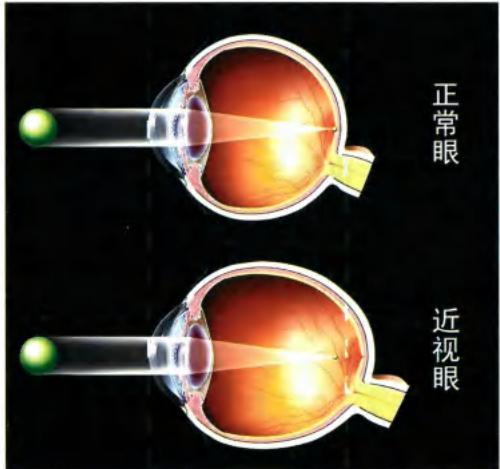
Schematic diagram comparing a normal eyeball and a myopic eyeball
Existing evidence indicates that myopia is a multifactorial disease, with both genetic and environmental factors participating in its onset and development. However, both genetic and environmental factors are external factors. If the formation of myopia proceeds this way, the individual cannot participate in its regulatory mechanism and can only passively accept the consequences brought by myopia. In treating myopia, one can only use physical means to change the spasms of ligaments and muscles, or correct and treat it by changing the environment. The counter-effect of consciousness on matter has not been considered an important factor, making it difficult to fundamentally cure myopia.
The essence of consciousness is information, so the following hypothesis can be made. The characteristic of life is the presence of compilable genetic information within the body. From primitive organisms 3 billion years ago to the present, the bodies of wise humans contain 3 billion years of life evolution information. Cells with similar information form various organs and tissues, performing their respective life missions. For the continued evolution of this unified individual, the massive number of “life forms”—cells—that make up an individual must be coordinated and unified. The way that allows these “life forms” to interconnect or directly receive instructions is “Wu” (Nothingness/Void). The thought and consciousness of our brain’s neocortex can transmit high-level instructions to the body through nerves, but these high-level instructions cannot take precedence over the low-level “Wu” instructions. Moreover, information regarding internal organs that maintain vital signs rarely allows one to become aware of relevant information, let alone allow them to directly receive ideas from the neocortex. Since they cannot receive instruction information at the conscious level, what gives them instructions can only be at the subconscious level. “Qi” (炁) is a kind of energy information that enables the interaction between consciousness and the subconscious; if one wishes to be aware of and control parts of the body that one cannot normally sense, one can only do so through “Qi”.
The ligament and muscle spasms that cause myopia must have external causes created by the environment; generally speaking, it is the greedy, excessive use of eyes in an unsuitable environment. The subconscious causes people to unknowingly develop habits of unhygienic eye usage. There may be two situations: first, because one always wants to see things more clearly but is never satisfied with or trusting of one’s own eyes, thus bringing visual objects closer and closer; second, because the subconscious has things it does not wish to see, thereby causing the eyes to escape reality. In both situations, the information perceived by the eyes is that either the owner does not love themselves, or the owner does not want the eyes to see. Both situations will cause some reactions in the eyes, such as tension in the muscles controlling the eyeball.
When the eyes do not receive care, and the ligaments and muscles that contract and tense up do not receive instructions to relax, over time these ligaments and muscles will spasm. Just like some children who fall asleep while doing homework, or are still thinking about mobile games during class, they have never paid attention to their eyes. If one learns to understand the body through “Qi” and understand the information conveyed by the eyes, one can discover problems. Even if one cannot use “Qi,” knowing to stop at the appropriate time, press and rub the eyes, do eye exercises, and let the eyes receive care at the subconscious level will prevent the formation of myopia.
2 Overview of Correction and Healing Methods for Myopia
2.1 Medical Myopia Treatment Methods and Precautions①
Wearing frame glasses: Suitable for all children with myopia; frames and lenses should be made of lightweight, non-toxic materials; glasses should be prescribed based on refraction results; the prescription should use the minimum power that achieves corrected vision of 1.0.
Wearing Orthokeratology lenses (i.e., OK lenses): Suitable for children over 8 years of age who do not wish to wear frame glasses, suitable for myopia within 6.00 diopters and astigmatism within 2.00 diopters. Orthokeratology lenses are actually a type of special rigid contact lens that is suitable for overnight wear due to very high oxygen permeability. Worn at night, the pressure from the eyelids causes the cornea to approximate a normal shape, thereby achieving the goal of correcting myopia. Main side effects include: astigmatism and corneal injury caused by improper wearing. Must be worn and maintained under a doctor’s guidance.
Wearing contact lenses (soft, rigid): Not suitable for use by children under 10 years of age. There are soft and rigid types.
Laser myopia correction surgery: Performing laser myopia correction surgery has the following requirements for patients: age over 18, with good cooperation ability; unilateral high myopia, or a difference of more than 5.0D between the two eyes, and the degree of myopia has been relatively stable in the last 2 years; lack of stereoscopic vision; exclusion of glaucoma or related suspicious factors, and ocular conditions permit (corneal thickness, fundus condition, etc.). The side effect is that there will be unpredictable sequelae 10~20 years after the operation.
2.2 Traditional Chinese Medicine (TCM) Myopia Treatment
Traditional Chinese Medicine treatment of myopia is not like the physical methods used in Western medicine mentioned above, where wearing glasses provides immediate results. TCM believes that the eyes are closely related to the body’s internal organs (zang-fu), so TCM treatment generally involves unified regulation of all associated body systems. In the view of TCM, if children under 14 suffer from myopia, amblyopia, or strabismus, as long as their growth and development period is grasped, and through correcting posture, nutrition, and taking Chinese medicine, the chance of improvement is very high.
TCM states that the liver opens into the eyes, and the kidney infuses essence into the eyes, so for many eye diseases, TCM treats from the liver and kidney; Chinese medicine preparations such as Sheep Liver Eyesight-Brightening Pills, Dendrobium Night-Glow Pills, and Eyesight-Brightening Rehmannia Pills all follow this treatment principle. However, these methods are not effective in treating myopia because the root cause lies in the fact that myopia is mostly caused by spasms of the eye ligaments and muscles; the problem is not in the deep internal organs, but at the meridian level.
Therefore, many TCM treatment methods and products targeting meridians, such as massage, herbal eye patches, and moxibustion, to improve myopia and eye fatigue are now widely promoted. For example, the “Walnut Moxibustion” (Walnut Shell Glasses Moxibustion), which is very active in WeChat business, not only has an effect on improving myopia but also has certain alleviating and improving effects on presbyopia, optic nerve atrophy, senile cataracts, styes, conjunctivitis, keratitis, etc. Its operation is simple, it feels very comfortable, and it makes people feel it is very magical.
According to the previously hypothesized internal cause of myopia formation, only when the meridians are unobstructed can “Qi” flow smoothly within the body, and the eyes thus receive healing and restore health; this is the physiological basis for the recent “Whole Brain Vision Recovery.” Emerging methods of subconscious eye healing all need to be combined with some TCM method to enhance the effect.
2.3 Internal Vision Healing of Myopia
The use of Qigong and special functions to treat myopia and other eye diseases was occasionally heard of during the Qigong fever in the late 20th century, but later, with the rapid cooling of Qigong fever, these methods seemed to have disappeared. Around 2013, brain potential development technologies with gimmicks such as blindfolded reading, photographic memory, and wave speed reading began to sweep across the country, attracting a large number of parents. Around 2015, brain potential development institutions excavated the methods of Qigong and special functions to treat myopia. Because this method has the same origin and subtlety as brain potential development, the two are easily combined. After commercial packaging and operation, myopia treatment methods named “Whole Brain Vision Recovery,” “Vision Return to Origin,” “Natural Healing,” and “Subconscious Hypnosis” began to appear in the market. Because brain potential development institutions have a large number of student resources, and counselors based on brain potential development technology can easily switch to learning myopia treatment (mainly verbal guidance), and brain potential development institutions are mostly named “Whole Brain Development Education,” the name “Whole Brain Vision Recovery” emerged. The word “treatment” can only be used by people with a physician’s qualification, but those who use this subconscious guidance method to treat myopia almost never have a physician’s qualification, so they can only use the word “healing.” There is no difference between this type of treatment method and the hypnotic suggestion guidance recognized by psychology; the goal is to stimulate the huge energy within oneself, which can also be said to utilize the energy of the subconscious.
A person’s beliefs and positions are only accepted by the subconscious, and then their body, thinking, and behavior will change. Subconscious healing of myopia adopts means such as belief implantation, energy enhancement, mind healing, and imagination improvement. The basis for performing these operations is that the patient must activate the internal vision function of the “Light Ball.” This is a continuation of the “Light Ball” function activated by ESP games in brain potential development. It is not too difficult for whole brain development institutions to master this method.
Mr. Liang Guangxiang, the inheritor of the Bright Mirror Skill, when developing potential in children in the late 20th century, would often activate the ability of internal vision. Children would diagnose their own diseases through internal vision and perform self-healing on the diseased parts through the light ball. When a child is sick, he can discover that the diseased part of the body is turbid and particularly black, while the non-diseased places are transparent. Transferring the light ball to the diseased part, illuminating it, and rotating it fixes it. Applying this method to the healing of myopia is the same.
2.4 External Qi Healing of Myopia
People who practice Qigong or cultivate themselves connect the body’s acquired Qi with the innate Qi, which runs through the body. “Qi” can also be called Qi, magnetic field, energy, or External Qi (emitting internal Qi outward in Qigong). The scientific community has tested the physical effects of Qigong External Qi, which are of the following six types: infrared radiation modulated by low-frequency fluctuations, electrostatic enrichment, magnetic signals, particle flow (a type of unknown pulse signal), infrasound with a frequency between 2~30Hz, and cold light. External Qi healing of myopia is to intervene in the patient’s eyes through others’ “Qi” to adjust the energy and information of the eyes, thereby enabling the patient’s eyes to recover.
In order to enable External Qi to quickly produce an effect, it is generally necessary to assist through acupoint massage techniques. This method is widely spread in society and is mostly taught by the famous hypnotist Mr. Pan Chenghai.
3 Brief Description of Internal Vision Healing Methods for Myopia
3.1 Healing Methods for People with Internal Vision Ability
For those who have already activated the internal vision function, using the light ball for self-healing of myopia is relatively simple and the effect is obvious. As mentioned earlier, the light ball and internal vision can be activated during brain potential development. If the light ball is to have a healing effect, children need to strengthen their practice, enhance their energy, and make the light ball appear large, bright, and golden. Not only must it be able to reach any part of the body at will, but the light ball must also obey commands to rotate, change shape, become hot, become cold, etc. Through internal vision, students can discover abnormalities in the eye area. At this time, let the light ball reach the diseased part and make it clear and bright.
3.2 Healing Methods Without Activating Inner Vision
Current mainstream brain potential development technologies aim solely to improve students’ self-confidence, concentration, and imagery sense. This minimizes the impact on the child’s body and often does not activate their inner vision function. Without using the inner vision function, it is still possible to heal myopia through subconscious guidance similar to meditation and hypnosis. However, this method takes a relatively long time and requires continuous reinforcement in the early stages; it is best to arrange for two days of intensive training. This method is used by ×× Guiyuan, and the general process is as follows:
I. Use “Hypnosis Relaxation Script (2)” on page 63 of the “Right Brain Development Training Manual” to conduct relaxation training.
II. During the guidance, pay attention to implanting beliefs in the students. Have the students repeat after the teacher: “My eyes are already healthy and bright, I can see everything clearly, I can take off my glasses forever, and I am very happy to see myself without glasses!”
III. Use the “White Light Imagery Method” for imagery training (refer to page 73 of the “Right Brain Development Training Manual”).
IV. Press your eyeballs with moderate force, using the standard that the eyeballs do not feel discomfort. Press for 510 seconds each time, repeating 35 times.
V. Perform the following meditation exercises:
Imagine white light entering from the left eye when inhaling…
On the first inhalation, imagine white light entering from the left eye, while both eyes rotate the eyeballs clockwise. When exhaling, the eyeballs are completely relaxed, and imagine negative energy being exhaled out of the right eye.
On the second inhalation, imagine white light entering from the left eye, while both eyes are completely relaxed. When exhaling, the eyeballs are completely relaxed, and imagine negative energy being exhaled out of the right eye.
On the third inhalation, imagine white light entering from the left eye, while both eyes rotate the eyeballs counter-clockwise. When exhaling, the eyeballs are completely relaxed, and imagine negative energy being exhaled out of the right eye.
On the fourth inhalation, imagine white light entering from the left eye, while both eyes are completely relaxed. When exhaling, the eyeballs are completely relaxed, and imagine negative energy being exhaled out of the right eye.
Then, take four breaths as a set, and repeat this process continuously.
Imagine white light entering from the right eye when inhaling…
On the first inhalation, imagine white light entering from the right eye, while both eyes rotate the eyeballs clockwise. When exhaling, the eyeballs are completely relaxed, and imagine negative energy being exhaled out of the left eye.
On the second inhalation, imagine white light entering from the right eye, while both eyes are completely relaxed. When exhaling, the eyeballs are completely relaxed, and imagine negative energy being exhaled out of the left eye.
On the third inhalation, imagine white light entering from the right eye, while both eyes rotate the eyeballs counter-clockwise. When exhaling, the eyeballs are completely relaxed, and imagine negative energy being exhaled out of the left eye.
On the fourth inhalation, imagine white light entering from the right eye, while both eyes are completely relaxed. When exhaling, the eyeballs are completely relaxed, and imagine negative energy being exhaled out of the left eye.
Then, take four breaths as a set, and repeat this process continuously.
Imagine white light entering from both eyes when inhaling…
On the first inhalation, imagine white light entering from both eyes, while both eyes rotate the eyeballs clockwise. When exhaling, the eyeballs are completely relaxed, and imagine negative energy being exhaled out of both eyes.
On the second inhalation, imagine white light entering from both eyes, while both eyes are completely relaxed. When exhaling, the eyeballs are completely relaxed, and imagine negative energy being exhaled out of both eyes.
On the third inhalation, imagine white light entering from both eyes, while both eyes rotate the eyeballs counter-clockwise. When exhaling, the eyeballs are completely relaxed, and imagine negative energy being exhaled out of both eyes.
On the fourth inhalation, imagine white light entering from both eyes, while both eyes are completely relaxed. When exhaling, the eyeballs are completely relaxed, and imagine negative energy being exhaled out of both eyes.
Then, take four breaths as a set, and repeat this process continuously.
VI. Repeat the sequence of the above five sets of exercises several times, and guide the students to finish the training session.
Your heart feels calm, relaxed, and confident at this moment. When you open your eyes, your eyes will emit light. The light gradually grows larger and projects onto the eye chart, allowing you to see clearly any line you wish to see. Repeat deep breathing 3 times. Use your hands rubbed warm to iron (cover) the eyes, and slowly open your eyes.
VII. Test the effect of this treatment session using an eye chart.
4 Brief Description of External Qi Healing Method for Myopia
People who have practiced Qigong or cultivation for a long time have sufficient internal Qi. When sensitive people approach them, they may feel pressure, warmth, comfort, safety, etc. Mr. Pan Chenghai calls this Qi sensation a magnetic field, and its essence is External Qi. For those who have never practiced Qigong or other cultivation methods, they need to first activate their own magnetic field before they can heal myopia for others. Although the effect is related to the strength of the healer’s magnetic field, the requirement for the magnetic field to heal the eyes of teenagers and children is not very high, which most people can easily reach, so technical replication is not difficult.
4.1 Magnetic Field Exercise
The magnetic field exercise spread by Mr. Pan Chenghai is the simplest and most effective training method to activate and improve one’s internal energy field. The key points are as follows:
-
Sit as far forward as possible on a stool or stand with feet shoulder-width apart. When sitting, the calves should be perpendicular to the ground, and the thighs should form a 90° angle with the calves. The waist stands naturally straight, and the chest and back are naturally stretched and straight. Relax the whole body, close the eyes gently, breathe naturally, raise both arms and place them about 30 cm in front of the chest, with the palms of both hands facing each other. When exhaling, bring the hands closer; when inhaling, move the hands apart (as shown in Figure 2, Schematic Diagram of Magnetic Field Exercise, see page 79 of this book).
-
Focus attention on the hands and the space between the hands. Maintain attention for as long as possible. When the attention wanders, be aware of it, and then bring the attention back to the hands and the space between the hands.
-
15 minutes per session is sufficient. After completion, place both hands on the waist and kidney area for 1~2 minutes as a closing movement.
-
Practice indoors as much as possible. Do not practice near hospitals or slaughterhouses. Do not practice under air conditioners, fans, or near water, or when it is raining, thundering, when you have a cold, nasal congestion, or are angry.
Now please put aside all thoughts, relax your body, and earnestly do this magnetic field exercise for 15 minutes. After 15 minutes, carefully experience the sensations of your body, thoughts, and emotions.
As long as you earnestly do this magnetic field exercise, you may have the following feelings: numbness, swelling, heat in the hands, as if there is wind, or as if being pricked by needles; when the hands are moved apart, the hands seem to have an attraction that does not allow them to separate easily, and when the hands are brought closer, it seems as if something is between the hands preventing them from easily approaching; chest tightness, shortness of breath, yawning, poor breathing, asthma; whole body heating, body feeling relaxed or body feeling cold; clear mind, bright eyes, agile thinking; mood feeling comfortable, happy, calm. These reactions are all possible. Of course, there may be other feelings. Only you can feel these sensations. You only need to know that this is all normal. It is just a dialogue from your body, thoughts, and emotions to you. It is good that you have this awareness.
4.2 External Qi Healing Method for Myopia
When the magnetic field is activated, you can press the pulp of the first joint of the middle finger of the same hand firmly with your thumb, and use the Qi Gate (also called Magnetic Gate, as shown in the figure on the right) to draw circles on the palm of the other hand. That palm will be able to feel Qi spraying out from the Qi Gate. During healing, the patient lies flat. You can heal the patient’s eyes according to the following 10 steps. The healer should harbor compassion, apply a certain intention, focus on the healing, and cannot be half-hearted.
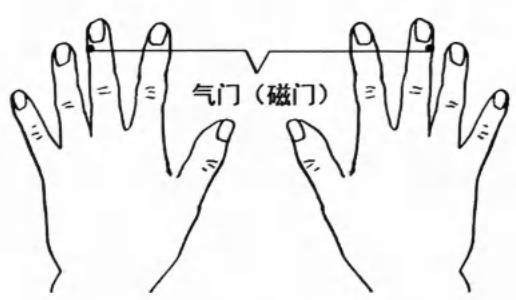
Location of the Qi Gate (Magnetic Gate)
(1) Preheat the eye area: With palms facing down, place both hands 3 cm above the patient’s eyes. The patient’s eyes begin to receive external Qi, allowing the healer’s hand magnetic field to merge with the patient’s eye magnetic field.
(2) The Qi Gate (Magnetic Gate) is suspended 3 cm above the patient’s eyes. The thumb presses the middle finger pulp to release external Qi around the outer edge of the patient’s eyeballs.
(3) The pads of both thumbs alternately press the Yintang point and push upward. (4) The pads of the thumbs scrape the lower orbital rim in a rotating motion. (5) The pads of the index fingers press and knead the Jingming point and Sibai point. (6) The index fingers press the Fengchi point and Fengfu point. (7) Press and knead the Baihui point. (8) Pinch and rub the ear tips. (9) The pads of the thumbs press on the temples, and the remaining fingers of both hands cross 35 cm above the patient’s eyes. Shake the fingers, feeling the external Qi sprinkling into the patient’s eyes like spring rain. (10) The index fingers press the Zanzhu point to end the patient’s reception of external Qi. Each of the above movements takes about 1 minute, or is performed for 8 sets of 8 beats per movement, totaling 1520 minutes.
4.3 Precautions for Magnetic Field Myopia Healing
(1) The healer should practice the magnetic field at least twice a day for 15 minutes each time to strengthen and activate their own magnetic field. (2) The healer should maintain feelings of confidence, joy, and compassion when performing myopia healing. Magnetic field manipulation healing can be performed every other day, but the interval should not exceed three days. Each healing session takes approximately 15–25 minutes (excluding the time for eye patch care). (3) During the healing period, the patient should gaze out of the window for 2~5 minutes during every recess or every hour, aiming to see the (clear) furthest target object. Flashcard training can also be used to consolidate vision. (4) The patient should avoid viewing electronic products (mobile phones, computers, televisions, etc.) for 14 hours after each eye adjustment session, and should also refrain from reading books as much as possible to allow the eyes to get fully rested. (5) According to the patient’s schedule, select the “Brighten Your Eyes” subconscious guidance audio of different durations and listen to it once a day. When listening to the long-duration guidance, the volume can be slightly higher; it does not affect the efficacy if the patient falls asleep while listening to the guidance audio. (6) During the healing period, the patient should, to the greatest extent possible and without affecting studies or daily life, avoid wearing glasses. (7) During the healing period, the patient should eat as little as possible or avoid eating chicken, duck, fish, pork, and other farmed meats containing relatively high hormones, as well as beef, lamb, dog meat, and other “heating” (warming) meats. (8) The healing period consists of 21 days as one course of treatment. Generally, patients will experience significant improvement in vision after one course and gradually develop good eye usage habits. If further consolidation and improvement are desired, the next course of treatment can begin 7 days after the end of the previous course. (9) This method has no obvious effect for patients who have undergone eye surgery or already have organic pathological changes.
5 Effectiveness Analysis
According to incomplete statistics from various myopia healing institutions, both healing methods have shown good results in improving myopia and enhancing vision in the short term. The analysis is summarized in the following table:
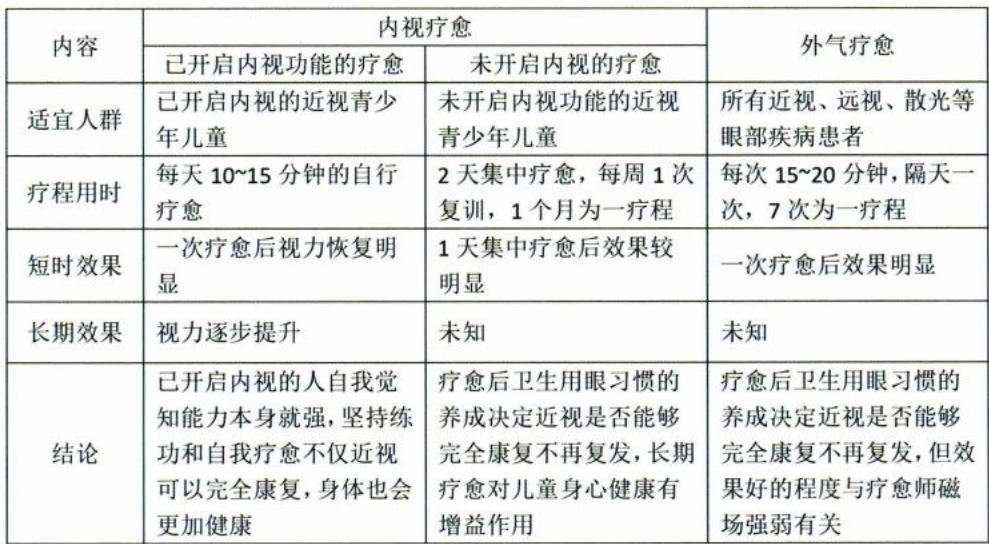
Although the test results are impressive shortly after completing the healing, in the long run, fewer than 20% of patients truly recover to normal vision. Since the predisposing factors for the formation of myopia do not change, relying solely on healing or treatment makes it difficult to thoroughly achieve complete eye recovery.